Weather vanes

vanes01.jpg

New illustration work has had me searching again through the Internet Archive’s scanned books so there may be a surfeit of these postings for a while. One of the more fascinating areas of that site for my purposes is the Winterthur Museum Library which has a large quantity of manufacturers’ and retailers’ catalogues. This is the kind of ephemera that Walter Benjamin enjoyed, the documents that you give you a more initimate and direct sense of the past than the broader examinations of social historians. (The same applies to magazine and newspaper adverts.)

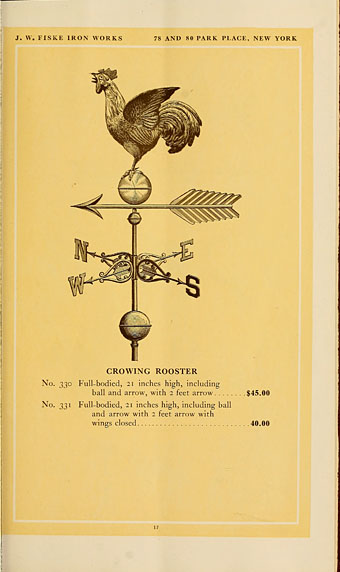
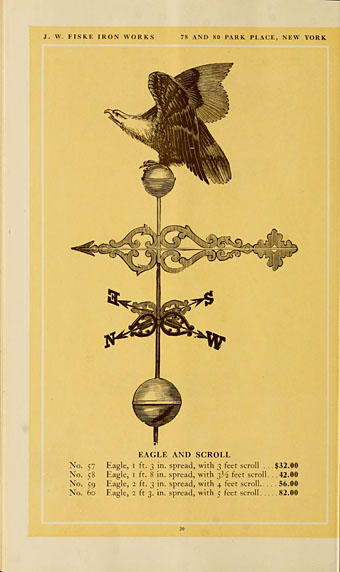
This weather vane catalogue for the Fiske Iron Works, New York, dates from 1921. Have weather vanes in recent times been more popular in America than in Britain? It often feels that way, possibly as a result of the preponderance in the US of new (or newish) houses in remote locations. The variety of designs in the Fiske catalogue implies a demand, in any case, with some surprising offerings such as a fish and an automobile. The rest of the designs can be seen here.

vanes02.jpg

vanes03.jpg

Continue reading “Weather vanes”

Rentz’s Todentanz

rentz01.jpg

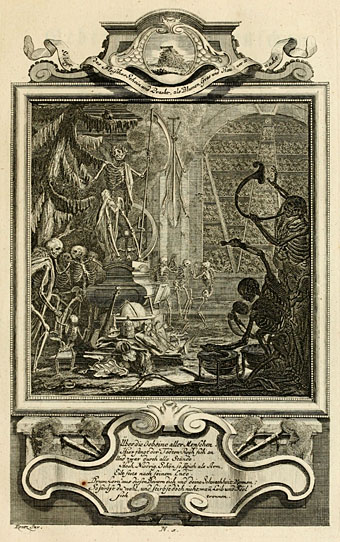
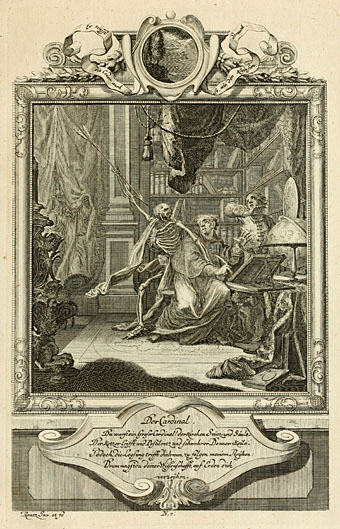
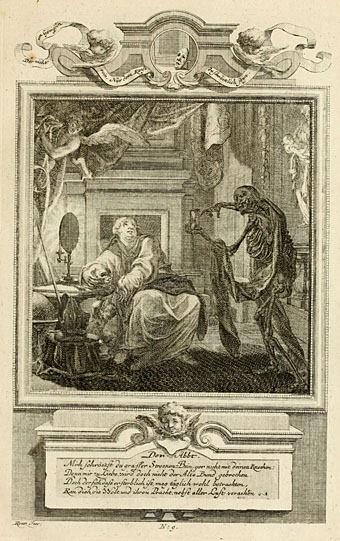
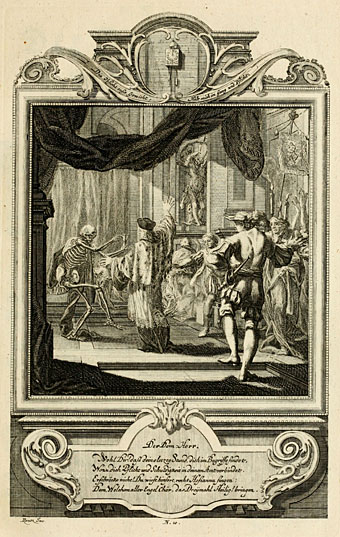
A post for Día de los Muertos. The 16th-century Dance of Death by Hans Holbein the Younger has been copied and adapted many times, often with results that add little to the original. These engravings by Michael Heinrich Rentz (1701–1758) from Der Sogenannte Todentanz (1767) feature some impressive compositions, the subject being the traditional one of Death in skeletal form bearing all and sundry to the grave. They may lack the vigour of Holbein’s series but they compensate with a wealth of fine detail. Browse the rest of the book here or download it here.

rentz02.jpg

rentz03.jpg

rentz04.jpg

Continue reading “Rentz’s Todentanz”

A mix for Halloween: Ectoplasm Forming

Ectoplasm Forming by Feuilleton on Mixcloud

Presenting the eighth Halloween playlist, and this year I decided it was time to finally make a proper mix of my own. Reluctance in years past has been mainly a result of the time it takes me to put things like this together, hours spent pondering the order of the tracks, and fine-tuning transitions.

This year’s mix is rather heavy on the drones and eldritch atmospherics with little in the way of songs. There are some rhythms, however. I’ve also taken the opportunity to highlight the ongoing excellence of Emptyset, some of whose recordings I’ve been helping design recently. Their Medium album involved installing a quantity of electronic equipment in an allegedly haunted building, a process similar to that undertaken by the unfortunate doctor in The Legend of Hell House, albeit with better results.

The tracklist is on the Mixcloud page but I’m repeating it here with dates added for each recording. One likes to be thorough.

The Legend of Hell House – Dialogue (1973)
Emptyset – Demiurge: Of Blackest Grain To Missive Ruin (Paul Jebanasam Variation) (2012)
Arne Nordheim – Solitaire (1969)
David Lynch – The Air Is On Fire Pt. 7 (2007)
Ben Frost – The Carpathians (2009)
The Wyrding Module – Subtemple Session II (edit) (2013)
:Zoviet*France: – On The Edge Of A Grain Of Sand (1996)
John Zorn – Lucifer Rising (2002)
Jarboe – A Sea Of Blood And Hollow Screaming… (2009)
The Haxan Cloak – Excavation (Part 1) (2013)
Emptyset – Medium (2012)
Jon Brooks – Experiments With A Medium (2011)
Wendy Carlos – Visitors (2005)
The Advisory Circle – Eyes Which Are Swelling (2007)
Bernard Szajner – Chant Funèbre (1981)
Emptyset – Function: Vulgar Display Of Power (Roly Porter Variation) (2012)

Previously on { feuilleton }
A playlist for Halloween: Hauntology
A playlist for Halloween: Orchestral and electro-acoustic
A playlist for Halloween: Drones and atmospheres
A playlist for Halloween: Voodoo!
Dead on the Dancefloor
Another playlist for Halloween
A playlist for Halloween

Witches

witches02.jpg

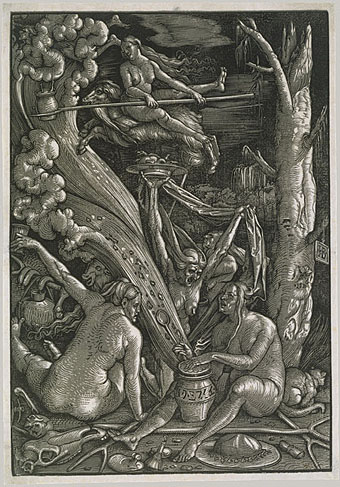
Scene of Witchcraft (1510) by Hans Baldung Grien.

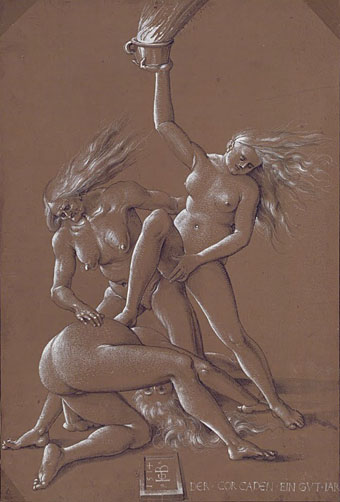
Earlier this year Pam Grossman declared 2013 to be the Year of the Witch, so in honour of that (and the season) here’s a handful of sorceresses through the ages. Most can be found in higher quality at the Google Art Project but a couple are from other sources. I’ve taken the liberty of attributing the drawing below to Hans Baldung Grien, not Albrecht Dürer as Google has it. Not only is this the attribution I’ve always seen for this picture but Baldung’s “HBG” monogram is clearly visible beneath the sprawling woman.

witches01.jpg

New Year’s Greeting with Three Witches (1514) by Hans Baldung Grien.

witches03.jpg

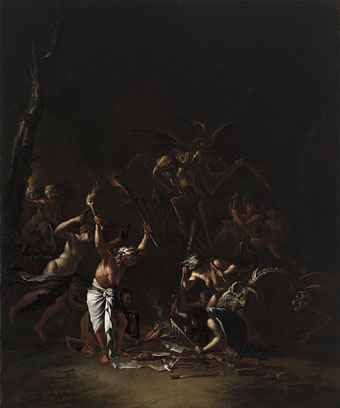
The Witches’ Sabbath (c.1640–1649) by Salvator Rosa.

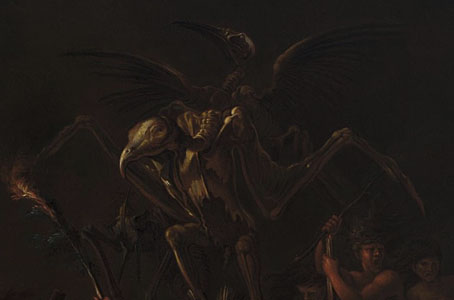
Salvator Rosa specialised in lurid depictions of bandits, executions and—as here—witches. The excessive imagery appealed to later generations, especially the Romantics. This painting is even more grotesque than usual with its flayed-bird abominations (below) looming out of the shadows.

witches04.jpg

Continue reading “Witches”

The Pendulum, the Pit and Hope

pendulum1.jpg

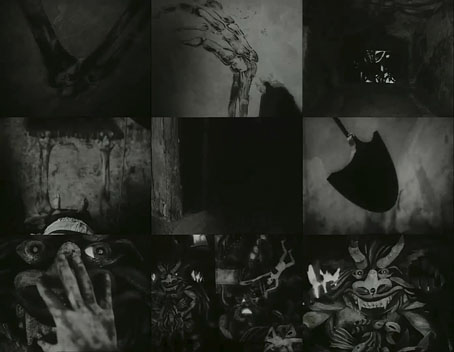
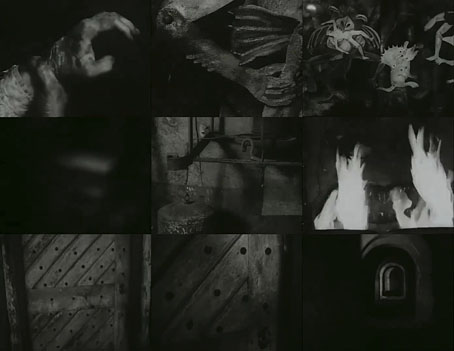
The Pendulum, the Pit and Hope (1983) is the third and best of three Gothic shorts made by Jan Švankmajer, the two earlier works being Castle of Otranto (1973–79) and The Fall of the House of Usher (1980). Švankmajer combines Poe’s famous tale of Inquistion torment with A Torture by Hope by Auguste Villiers de L’Isle-Adam, and  unlike Corman and co. reduces the story to a stark and wordless first-person ordeal in the face of clanking, fire-breathing engines of destruction. Poe’s story lets the narrator off the hook with a deus ex machina intervention, something Švankmajer evidently felt unable to swallow, hence the Villiers coda.

All the above works, and much more besides, can be found on the BFI’s collection of Švankmajer’s short films. Another short adaptation of the Poe story, The Pit (1962) by Edward Abraham, will appear next month as an extra on the eagerly-awaited DVD/BR debut of Schalcken the Painter.

pendulum2.jpg

Previously on { feuilleton }
Two sides of Liška
The Torchbearer by Václav Švankmajer