Two covers

patel1.jpg

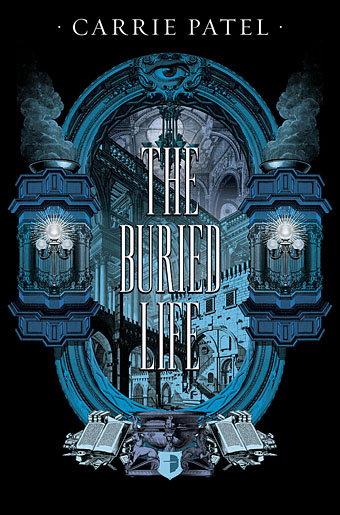
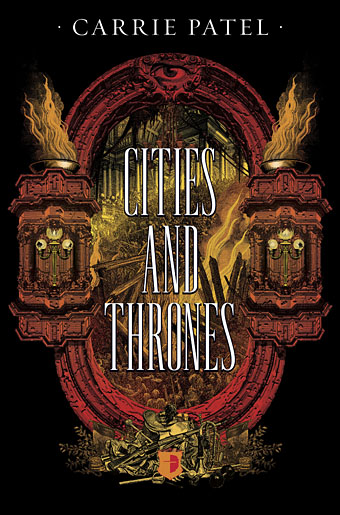
More new work of mine has been unveiled in the past few days so I can show these here. The Buried Life and Cities and Thrones are a pair of fantasy novels by new author Carrie Patel being published by Angry Robot. I was asked to provide something in an engraved style set against a black background, with imagery that reflected themes of vast, underground architecture and armed conflict.
patel2.jpg

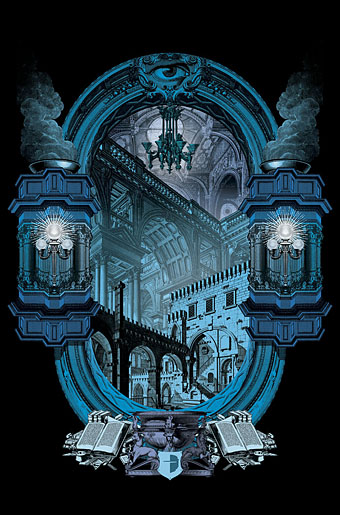
Vast architecture of any description is something I’ve always enjoyed, the main challenge with each book came in trying to imply the architecture and events without the pictorial content becoming incoherent. Marc at Angry Robot asked for something Piranesian where the architecture was concerned. Looking over Piranesi’s non-Carceri designs didn’t turn up anything with a suitably dramatic perspective, however, so most of what you see in the first cover comes from Giuseppe Galli Bibiena’s Architetture e Prospettive (1740). The Bibienas were a family of architects and theatrical engineers who specialised in dizzying perspective views for their stage designs; Bibiena’s book was produced to preserve some of his more celebrated designs, the originals of which are now lost. I’ve had a book of these drawings for years but this is the first opportunity I’ve had to make use of them in any kind of collage.
patel3.jpg

This style of Baroque architecture doesn’t suit steampunk imagery which tends towards 19th-century urban/industrial; the plates are also rather staid scenes without the graphic flare that Piranesi gave to everything he rendered, real or imagined. But I do like those plunging perspectives, and pieces from two of the plates turned out to share both the same perspective and the same lighting direction. It’s easy to collage things into a flat view but creating a realistic sense of depth from bits and pieces can be tricky.
patel4.jpg

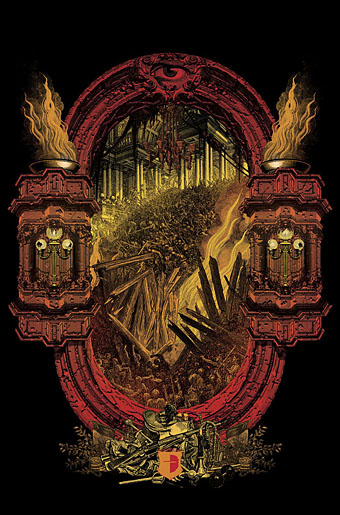
The frame for the second cover has more of a Piranesian quality being chipped and eroded. The typography for the titles went through several changes, the versions here show a late suggestion of mine with lettering that’s probably too thin to read well at a distance (or a small size on a web page). SF Signal has a post showing the Angry Robot versions which will probably be the final ones, together with a preview of the first book.

Previously on { feuilleton }
Aldous Huxley on Piranesi’s Prisons
The art of Fritz Hegenbart, 1864–1943

hegenbart4.jpg

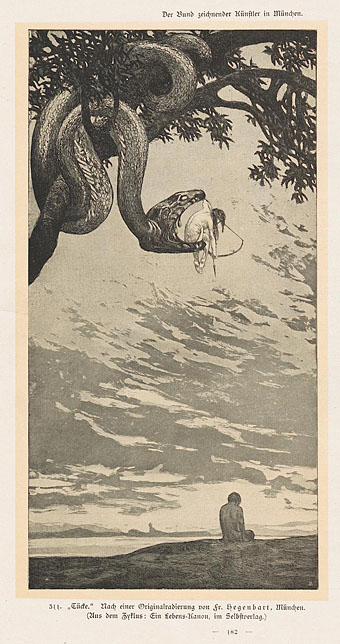
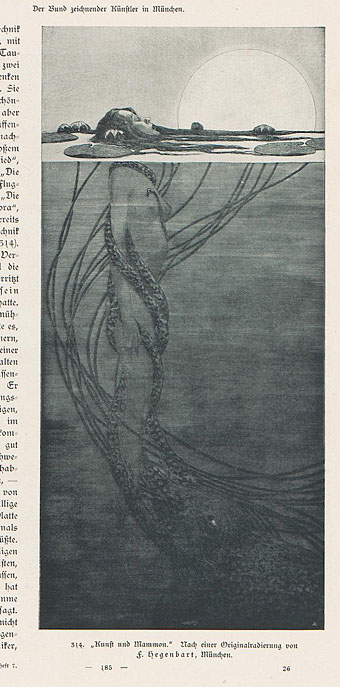
Fritz Hegenbart was an Austrian artist some of whose work has appeared here before in posts about Jugend magazine. Hegenbart provided many illustrations and embellishments for Jugend and other journals circa 1900, the examples here being mostly from a feature in the collected Kunst und Handwerk for 1902/03, a magazine I was rifling through last week. Once you’ve been through Deutsche Kunst und Dekoration and others you find the same contents repeating themselves with slight variations; that’s no surprise when there was only a certain amount of news that any arts magazine could report for a given year.

Hegenbart’s work stands out for conjuring the slightly grotesque allegories I often like to see: The woman aiming an arrow from inside a serpent’s jaws represents Malice, while the woman being dragged under the water by a tentacled monstrosity is Art falling prey to Mammon. An updated version of that picture would have to show Mammon as a bloated and triumphant abomination. Hegenbart seemed to enjoy attaching wings to whatever women he was drawing; further down the page you’ll find a wingless woman being menaced by a particularly dopey-looking dragon.

hegenbart7.jpg

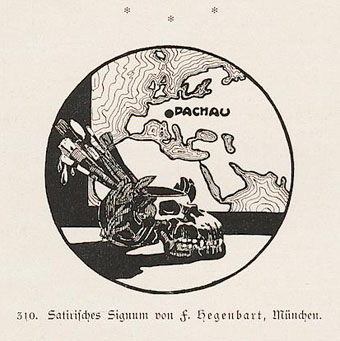
There’s also the curious ink piece below showing the location of the artist’s home in Dachau, Bavaria, and what to our eyes is a supremely inappropriate skull-shaped container for his brushes. The shadow of two world wars always hangs heavily over these magazines (especially in the nationalistic Jugend) but the imagery is seldom as prescient as this.

hegenbart3.jpg

Continue reading “The art of Fritz Hegenbart, 1864–1943”

Tom of Finland postage stamps

stamp1.jpg

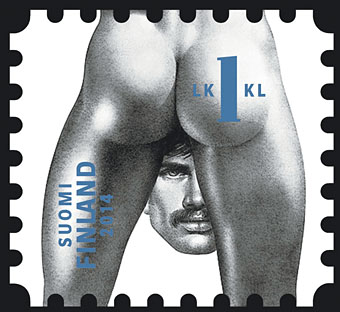
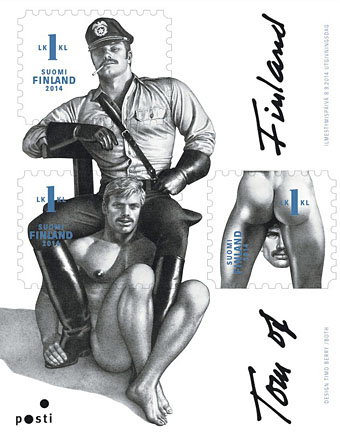
Finland’s most famous writer and female artist was a lesbian so it’s perhaps fitting that Tom of Finland is now firmly established as its most famous male artist. At one time you could have argued that Akseli Gallen-Kallela had more of an international profile but the rising visibility of gay art, and the pioneering erotica of Touko Laaksonen aka Tom of Finland, has changed all that. Tove Jansson’s Moomin characters have already appeared on a commemorative coin but later this year Tom of Finland’s beefy clones expose themselves to a wider public when they appear on postage stamps for the first time. The stamps have been designed by Timo Berry and Susanna Luoto. Even with all the recent social changes in the UK I can’t imagine anyone getting away with a stamp design featuring such a prominent pair of buttocks, however lovingly rendered. It’s also a sign of changing attitudes that many people today would be less likely to object to sight of a bare bum than they would to a picture of somebody smoking. There’s more about the stamp designs, including links to larger images, here.

stamp2.jpg

stamp3.jpg

stamp4.jpg

Elsewhere on { feuilleton }
The gay artists archive

The Dreamlands: A Lovecraftian film

dreamlands.jpg

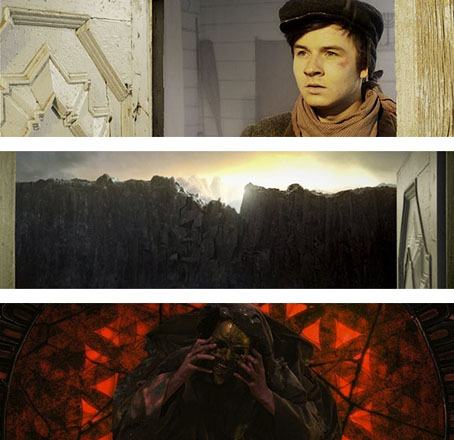
A crowd-funding goal has been announced for The Dreamlands, a feature film set in the worlds of HP Lovecraft’s Dream Cycle which, if it goes ahead, will be director Huan Vu’s second Lovecraftian feature. His first, Die Farbe (2010), is an excellent adaptation of The Colour Out of Space which impressed me with its atmosphere and its serious attitude towards the material, qualities that you can’t always rely on where horror cinema is concerned.

The Dreamlands will of necessity be more fantastical and so warrants a larger budget, hence the funding bid. I was asked to contribute to the production side of this late last year but prior commitments intervened, not least all the work I was doing on Lovecraft’s Monsters. I did find time to design the star symbol that’s being used to promote the film, however, and there’s talk at the moment of my working on some of the gifts for the funders in the higher brackets. More about that later. Watch the teasers, they’re very good.

Elsewhere on { feuilleton }
The Lovecraft archive

Weekend links 207

barker.jpg

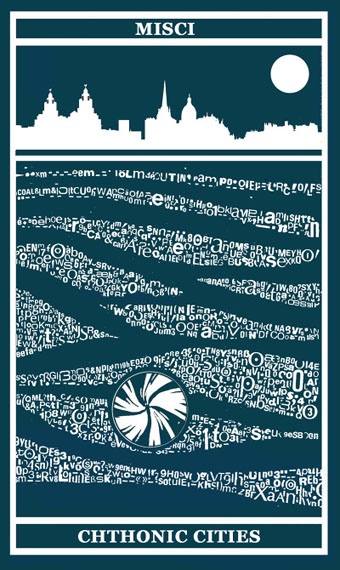
Chthonic Cities by David Chatton Barker. One of a series of Folklore Tapes screenprints available from Bleep.

• The original version of Kenneth Anger’s Lucifer Rising, the one with the Jimmy Page soundtrack that was completed in 1973, has always been described as lost/stolen/buried or otherwise gone forever. So you’d think the news that a print had been discovered recently by Brian Butler would have received greater attention. There’s a screening in Los Angeles this Thursday. When do the rest of us get to see it?

Chris Marker: A Grin Without a Cat, an exhibition and series of Marker-related events at the Whitechapel Gallery, London. Related: The Encounter of M. Chat & Chris Marker as Told By Louise Traon.

• The trailer for The Gospel According to St Derek, a forthcoming documentary about Derek Jarman. Related: Carl Swanson on why Tilda Swinton is not quite of this world.

Maybe there’s just something conservative at the bedrock of American fiction. […] Or maybe it’s just another symptom of the creeping conservatism that’s infected so many aspects of the culture.

Eric Obenauf talks to author Jeff Jackson whose comments about cultural conservatism could equally be applied to the UK.

• Primitive graphics, inventive graphics, budget Surrealism, and some great theme tunes; it’s Trunk TV, Episode 1: Title Sequences.

• Mixes of the week: Secret Thirteen Mix 110 by Black To Comm, and Intro To Drone For Debcon 1, almost 7 hours of music!

Joseph Burnett reviews Ett, an album of electronic music by Klara Lewis.

The Delian Mode (2009), a film about Delia Derbyshire by Kara Blake.

• Extracts from Tokyo Reverse by Simon Bouisson and Ludovic Zuili.

Dan Piepenbring on The Haunting Illustrations of Alfred Kubin.

• At Strange Flowers: Photos of arcades by Germaine Krull.

• Fish, Fiends, and Fantasy: The Gothic Art of Ian Miller.

• At 50 Watts: Richard Teschner and His Puppets.

• Sonic Foam: Ian Penman on Kate Bush and Coil.

Bits and Pieces

Lucifer (1968) by The Salt | Experiment IV (1986) by Kate Bush | Methoxy-N, N-Dimethyl (5-MeO-DMT) (1998) by Coil