Young Knight in a Landscape

carpaccio01.jpg

Young Knight in a Landscape (1510).

A painting by Venetian artist Vittore Carpaccio (c. 1460–1525/26) replete with natural detail. Many of these details, the animal ones in particular, are no doubt symbolic, although what they symbolise can change over time, and may also refer to the personal mythology of the family for whom the painting was created. Dogs often represent fidelity but the dog crouching on the path behind the knight wears an expression that may be taken for a snarl. The hawk knocking another bird from the sky is more obviously a symbol of belligerence which suits the action of drawing a sword.

The note for this painting says it was attributed to Albrecht Dürer until 1919, something I find surprising. The vegetation is certainly painted with a Dürer-like precision but Dürer was equally precise with his figures, and would have paid more attention to the modelling of the hands. One detail I don’t recall seeing before is the codpiece pocket. The Scottish sporran often has a pocket in the back, there being no pockets in kilts or, for that matter, in suits of armour.

carpaccio12.jpg

carpaccio02.jpg

Continue reading “Young Knight in a Landscape”

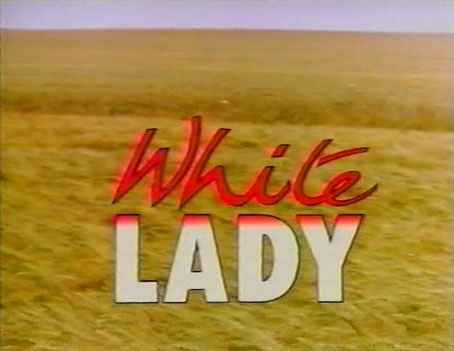
White Lady by David Rudkin

whitelady1.jpg

Amy: Dad? What’s a parable.

Gil: Parable? A sort of story, with something in it…strange. To help you remember it. And think. About something important.

I first heard about David Rudkin’s White Lady (1987) from Grant Morrison during a conversation about Penda’s Fen, Morrison having been a Rudkin-head as far back as the original screening of that TV film in 1974. This was at a time when you couldn’t call up details of somebody’s entire career in a couple of seconds, so all I knew of Rudkin’s television work aside from Penda’s Fen was Artemis 81 (1981) and his adaptation of The Ash Tree (1975) by MR James, one of the BBC’s Christmas ghost stories.

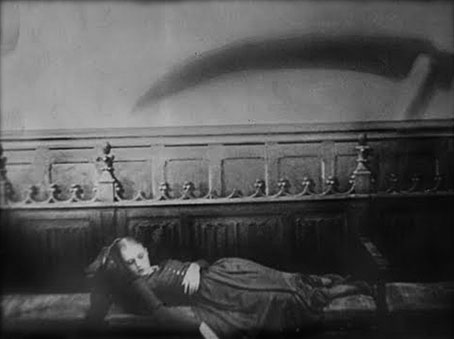
vampyr.jpg

Vampyr (1932).

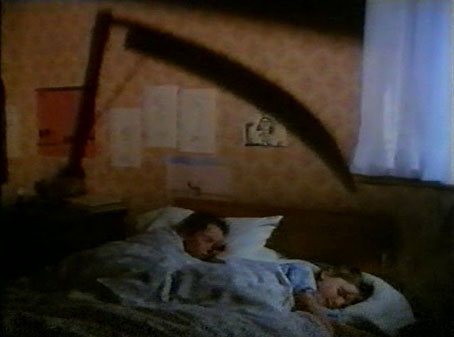
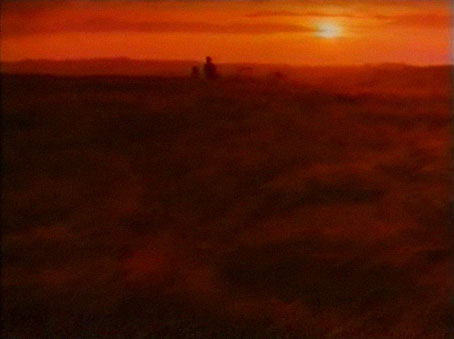
All of those films feature sinister, possibly supernatural events taking place in the English countryside, and this theme is continued in White Lady, a 45-minute drama which Rudkin wrote and also directed. In dramatic terms the film is a minimal piece concerning a divorced father trying to set himself up as a farmer while also taking care of two young daughters. In the fields surrounding the farm pesticides are being used, although we see little direct evidence of this. More overt are the disturbing interjections and animated graphics which show photographs and X-rays of laboratory animals suffering from pesticide exposure. Rudkin’s dialogue tells us at the outset that this is a parable, hence the deadly effects of the pesticide being embodied by the White Lady of the title, a spectral figure who carries a scythe.

whitelady2.jpg

The first time I saw this I thought the scythe was a heavy-handed device, despite its obvious farming connections; watched again I realise that Rudkin would have been alluding (if only for himself) to the scythe-bearing ferryman in Carl Dreyer’s Vampyr (1932), a film Rudkin subjected to very close scrutiny in 2005 for the BFI’s Film Classics series. In his book Rudkin notes a shot in which a sleeping figure is menaced by the shadow of a scythe on a wall; that shot is recapitulated in White Lady.

whitelady3.jpg

It’s unfair to compare this to the eerie, intellectual masterpiece that is Penda’s Fen, but White Lady is still worth a look for anyone interested in Rudkin’s dramas, especially with it being his sole directing credit. If the dire warnings of genetic mutation haven’t come to pass there’s relevance in our present concern about the effects of nicotinoids on bee and bird populations. The White Lady still has plenty of work to do.

White Lady: part one | part two

Previously on { feuilleton }
The Horror Fields
Robin Redbreast by John Bowen
Red Shift by Alan Garner
Children of the Stones
Penda’s Fen by David Rudkin
David Rudkin on Carl Dreyer’s Vampyr

Blaine L. Reininger: An American Friend

blaine1.jpg

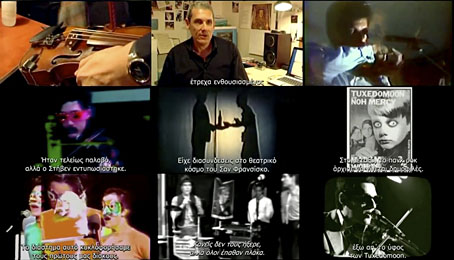
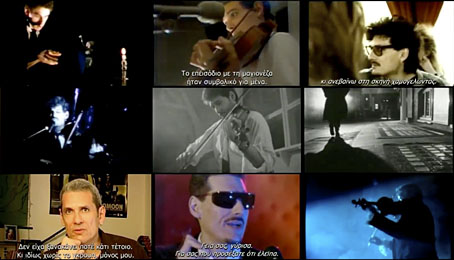
Blaine L. Reininger, Tuxedomoon co-founder, singer, violinist and composer, is profiled in this 50-minute documentary made by George Skevas for Paraskinio, a Greek television series. Tuxedomoon have long been popular in Europe, and seem to have struck a particular chord in Greece. These days Reininger is something of a star over there, a fact which surprises him still but which has no doubt helped with Tuxedomoon’s fortunes in recent years.

blaine2.jpg

Skevas’s film comprises a long biographical interview with Reininger, relating his progress from childhood in Colorado, and the formation of Tuxedomoon in San Francisco, to the group’s inadvertent exile in Europe. There a wealth of historical film footage throughout, some of which is familiar from the official Tuxedomoon DVDs but other clips are exclusive to this programme. Among the notable pieces for me were a glimpse of Winston Tong’s pre-Tuxedomoon puppet performances, a performance by the band on Andy Warhol’s Interview TV show, and shots of the recording of the Desire album in London. Few bands from the 1970s have been this diligent in documenting their activities on film and video. In addition to discovering why Reininger’s first solo album is called Broken Fingers, you also get to see some scenes from the Ghost Sonata film/performance, an ambitious project that I’d known about for years but didn’t get to see until it was released on the 30th anniversary box set in 2007.

Previously on { feuilleton }
Tuxedomoon: some queer connections
Made To Measure
Subterranean Modern: The Residents, Chrome, MX-80 Sound and Tuxedomoon
Tuxedomoon on La Edad de Oro, 1983
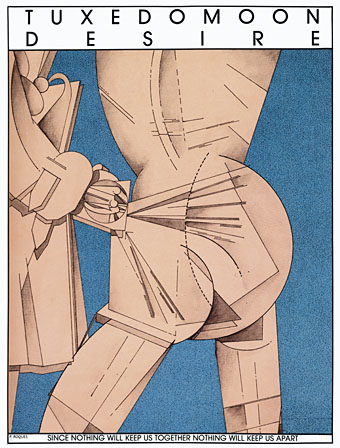
Tuxedomoon designs by Patrick Roques
Pink Narcissus: James Bidgood and Tuxedomoon

Tuxedomoon: some queer connections

roques18.jpg

UK poster insert by Patrick Roques for Desire (1981).

Yes, more Tuxedomoon: there’s a lot to explore. It’s always a pleasure when something that you enjoy one medium connects to things that interest you elsewhere. From the outset Tuxedomoon have had more than their share of connections to gay culture—to writers especially—but it’s more of an ongoing conversation than any kind of proselytising concern. This post teases out those connections some of which I hadn’t spotted myself until I started delving deeper.

The Angels of Light: Not the Michael Gira group but an earlier band of musicians and performers in San Francisco in the early 1970s. The Angels of Light formed out of performance troupe The Cockettes following a split between those who wanted to charge admission for their shows, and those who wanted to keep things free to all. Among the troupe there was Steven Brown, soon to be a founding member of Tuxedomoon:

The group began as an offshoot of The Angels of Light, ‘a “family” of dedicated artists who sang, danced, painted and sewed for the Free Theater’, says Steve Brown. ‘I was lucky to be part of the Angels—I fell for a bearded transvestite in the show and moved in with him at the Angels’ commune. Gay or bi men and women who were themselves works of art, extravagant in dress and behaviour, disciples of Artaud and Wilde and Julian Beck [of the Living Theater] … we lived together in a big Victorian house … pooled all our disability cheques each month, ate communally … and used the rest of the funds to produce lavish theatrical productions—never charging a dime to the public. This is what theatre was meant to be: a Dionysian rite of lights and music and chaos and Eros.’

Rip it Up and Start Again: Postpunk 1978-1984 by Simon Reynolds

(Special Treatment For The) Family Man (1979): A sombre commentary from the Scream With A View EP on the trial of Dan White, the assassin of Harvey Milk and George Moscone. White’s “special treatment” in court led to a conviction for manslaughter which in turn resulted in San Francisco’s White Night riots in May, 1979.

James Whale (1980): An instrumental on the first Tuxedomoon album, Half-Mute, all sinister electronics and tolling bells as befits a piece named after a director of horror films. Whale’s Bride of Frankenstein (1935) is not only the best of the Universal horror series, it’s also commonly regarded as a subversive examination of marriage and the creation of life from a gay perspective. (Whale’s friends and partner disagreed, however.)
joeboysf.jpg

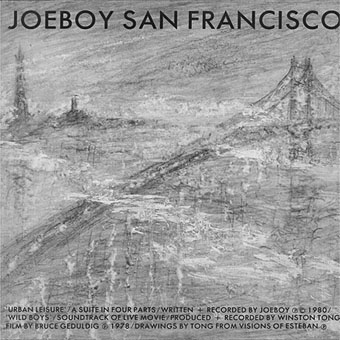
Cover art by Winston Tong.

Joeboy San Francisco (1981): The Joeboy name was lifted from a piece of San Francisco graffiti to become a name for Tuxedomoon’s DIY philosophy. It’s also a record label name, the name of an early single, and a side project of the group which in 1981 produced Joeboy In Rotterdam / Joeboy San Francisco. The SF side features a collage piece by Winston Tong based on The Wild Boys by William Burroughs, a key inspiration for the band which first surfaces here.

In one piece, the band cites its influences as: “burroughs, bowie, camus, cage, eno, moroder”. Can you say what you admired or drew on vis-à-vis these artists?

William S. Burroughs — ideas concerning use of media — tapes, projections, his radical anti-control politic in general as well as his outspoken gayness. Early on we duplicated on stage one of his early experiments projecting films of faces onto faces.

Simon Reynolds interview with Steven Brown

Continue reading “Tuxedomoon: some queer connections”
Fast Friends

lazarov1.jpg

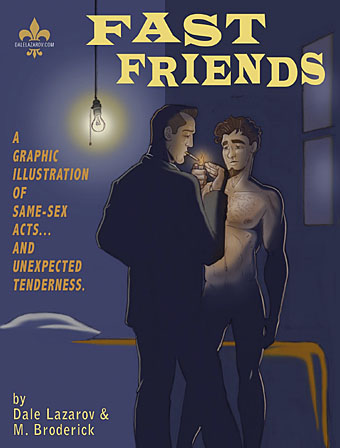
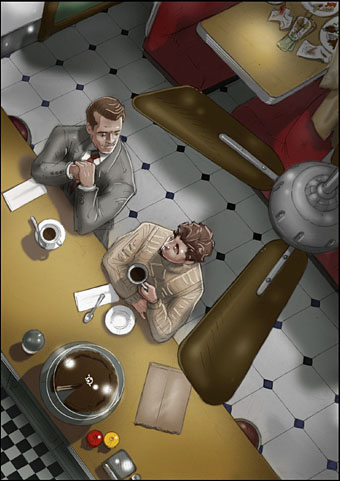
My thanks to writer Dale Lazarov for letting me see an advance copy of his new comic, Fast Friends. Despite writing about gay art often enough I don’t see many gay comics but this one had the immediate attraction of being a 62-page wordless story, wordless comics being a minor tradition that I’ve always enjoyed. When description and dialogue are removed, the artist needs to take greater care over the storytelling, even in an uncomplicated story such as this chance meeting between two spurned lovers. That’s not to say wordless comics aren’t still written at the outset: someone has to imagine the characters, create the story, describe the action, and so on. Michael Broderick is responsible for the artwork, and he proves himself adept at dealing with the technical challenges; he’s equally adept at making the erotic encounter into a stimulating, sexy read. Fast Friends is a touching story, and, in the recurring comic books that act as a commentary on the action, not unaware of the romance comic tradition.

lazarov2.jpg

Elsewhere on { feuilleton }
The gay artists archive