Weekend links 229

drongelen.jpg

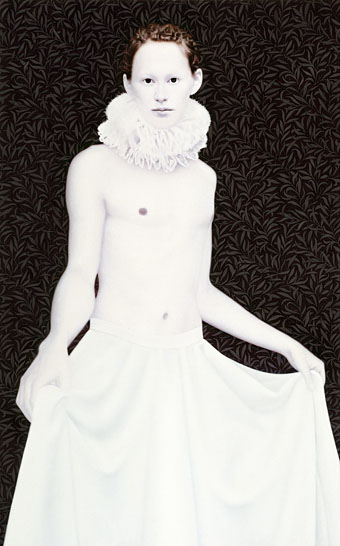
Untitled (2007) by Remko van Drongelen.

• Another week, another Kickstarter project: Frank Woodward’s 2008 documentary, Lovecraft: Fear of the Unknown, was an excellent study of HP Lovecraft’s life and work featuring interviews with John Carpenter, Neil Gaiman, Caitlín R. Kiernan, Peter Straub, Guillermo Del Toro and leading Lovecraft scholar ST Joshi; the film also included a few examples of my Cthulhoid artwork. Disc copies of the film have been out-of-print for a while so Frank’s fund is hoping to raise money for a new Blu-ray edition featuring extended interviews and other extras.

• David Cronenberg’s debut novel, Consumed, “reads somewhat like a mashup of William Gibson, the king of near-future SF cool, and 1970s horror maestro James Herbert,” says Steven Poole. I’d have thought a more obvious analogy would be with JG Ballard; descriptions of Cronenberg’s narrative make it sound like Ballard’s concerns repurposed for our current era of electronically-mediated everything. Related: Crash by Sanyú, “adaptación de un fragmento de la novela de J. Ballard”.

• “To commune with the music of Cyclobe is to enter not just a strange world, but strange constellations – interdimensional, atemporal zones of carefully cultivated auras bordering wild, unstable forces.” Russell Cuzner talks to Ossian Brown and Stephen Thrower about Derek Jarman, hurdy-gurdies and the deceptive nature of time.

…there are no rules in fiction even if creative writing programs everywhere have tried to make people believe there are. When I read fiction that has passed through the filter of too many workshops, I often get the feeling that I’m reading the same novel over and over again: the same way of being humorous, the same way of being candid, the same way of creating empathy.

Valeria Luiselli talking to Jennifer Kabat about fiction, cities and maps.

• The rationale behind Silent Partners: Artist & Mannequin from Function to Fetish is “to explore the way that the artificial human figure has routinely provided artists with the most direct and reliable route to visual realism. And then to work out why that makes us so upset.” Kathryn Hughes on a new exhibition.

• “It immediately throws up some interesting thoughts: Bowie as the young dandy and the obvious comparisons with Oscar Wilde and The Picture Of Dorian Gray, with the portrait that ages.” Designer Jonathan Barnbrook on the cover photos for David Bowie’s forthcoming album Nothing Has Changed.

• October brings all the music mixes. This week there’s a choice of FACT mix 463 by Dntel, Autumn’s Whirr by Café Kaput (aka Jon Brooks), and Suspected Rural Telephone Box Poltergeist by The Geography Trip.

• “…when you first go into the room it’s like entering a furnace… a furnace of sound.” Scott Walker talks to John Doran about recording with Sunn O))). The new album, Soused, is out on 20th October.

We are the Martians: the Legacy of Nigel Kneale, a new collection of Kneale-related essays and appreciations, edited by Neil Snowdon.

• Kim Newman is one of the contributors to the Kneale collection. Here he is on the main types of ghost story, and how to recognize them.

Issue 7 of Glitterwolf magazine is out on the 15th, and it’s a Halloween special.

Etai Rahmil makes mask-pipes from glass for weed smokers.

Accidental Cool Art

Hurdy Gurdy Man (1968) by Donovan | Hurdy Gurdy Man (1970) by Eartha Kitt | Hurdy Gurdy Man (2009) by Patrick Cowley & Jorge Socarras
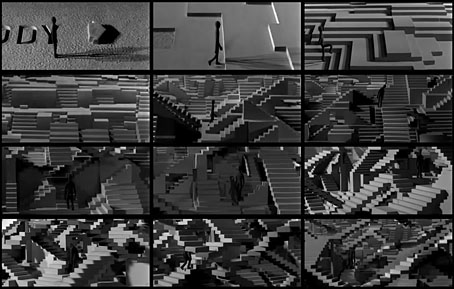
Stairs, a film by Stefan Schabenbeck

stairs.jpg

YouTube in recent years has become an increasingly worthwhile repository for short animations or experimental films, many of which you might otherwise never get to see. Stairs (1969) is another great piece of Polish animation, a brief scenario concerning a Plasticine figure who wanders into a terrain of random steps which soon turns mountainous. The obvious precursor is MC Escher’s stairways, but Escher’s worlds are always very formal despite their paradoxes. Schabenbeck’s film, like many Eastern European animations, can be read as allegory although this only becomes apparent at the very end. Watch it here.

Previously on { feuilleton }
Walls, a film by Piotr Dumala

The art of Adolf Hirémy-Hirschl, 1860–1933

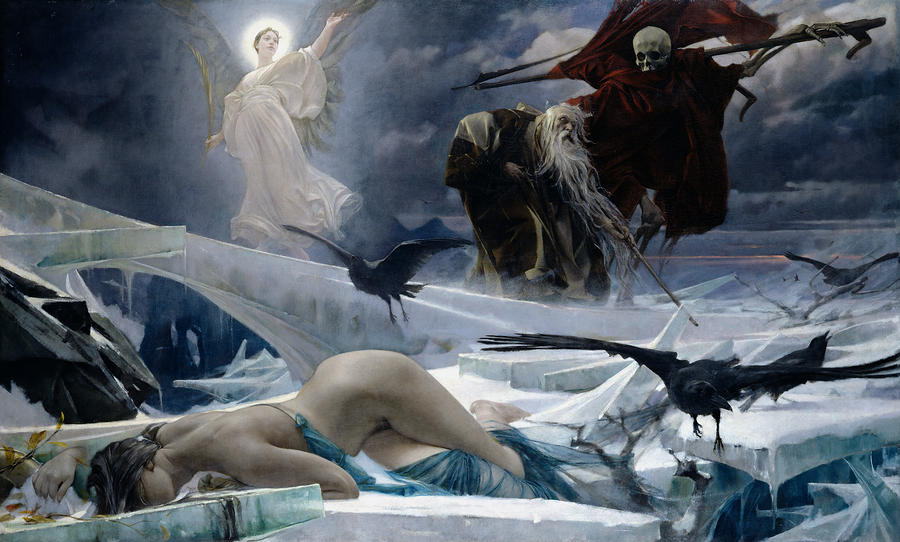
hirschl1.jpg

Ahasuerus at the End of the World (1888).

Regular readers will know that I have a fondness for the academic or historical painters of the 19th century if their work is sufficiently grotesque, macabre or fantastical. These paintings by Adolf Hirémy-Hirschl push a number of the relevant buttons, especially Ahasuerus at the End of the World which is so immediately startling I can’t imagine why I’ve not seen it before. Hirémy-Hirschl was a Hungarian who pursued his career in Vienna until he fell out of favour with the arrival of the Secession artists.

The Ahasuerus painting is the stand-out piece here, Ahasuerus being the name of the Wandering Jew who was condemned to walk the earth until Jesus returned. What struck me about this was how uncharacteristic it seems for 1888, with everything rendered in a very hard-edged manner; and that’s before you get to the gratuitous dead woman and the skeletal reaper. This is closer to some of the Russian painters of the period than the academic artists in Paris.

hirschl2.jpg

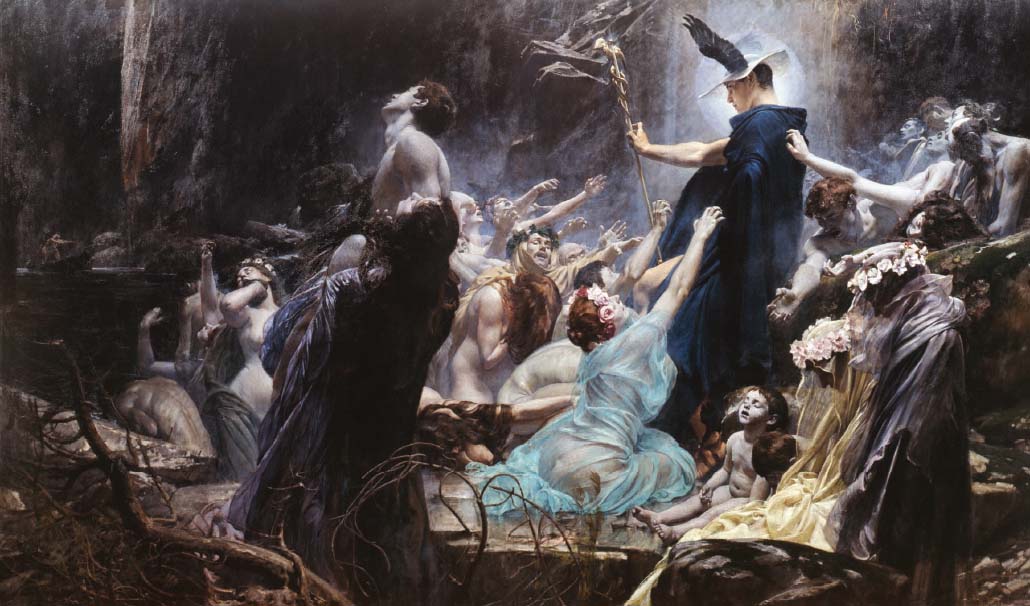
The Souls of Acheron (1898).

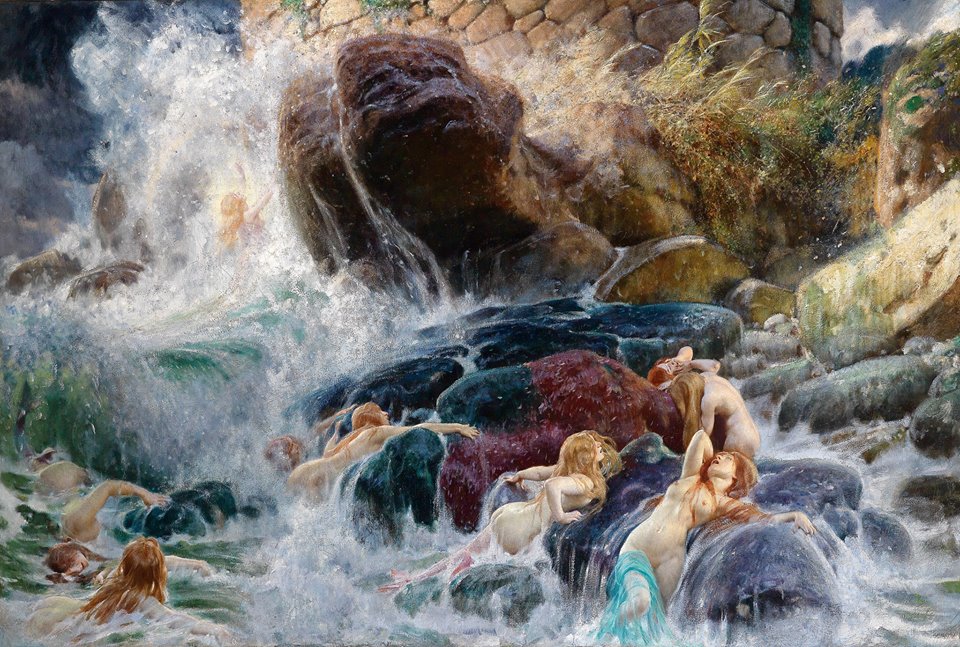
The Souls of Acheron shows a crowd of the newly dead waiting to be ferried across the river Styx. The Tomb of Achilles seems to be about sea-nymphs mourning the dead hero whose mother was also a nymph; mythology aside, it looks like one of the many 19th-century pictures that use a legend as an excuse to paint more naked flesh. Translucent blue material wrapping a body is a recurrent detail in all three paintings.

hirschl3.jpg

The Tomb of Achilles (no date).

Continue reading “The art of Adolf Hirémy-Hirschl, 1860–1933”

More vapour trails

jeter.jpg

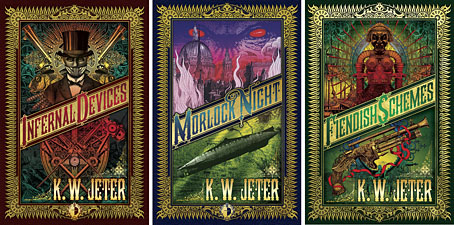
Those covers everyone likes. My designs for KW Jeter’s steampunk novels from Angry Robot and Tor Books.

When I wrote a brief history of steampunk for Eye magazine last year I ended by somewhat provocatively declaring that until something better appeared this was the defining aesthetic of the moment. A year later, the movement (if we can use that term) continues to evolve despite the steady drip of complaints that it’s all reactionary, historically illiterate, and so on. Much of the ire remains nonsensical, and often seems to boil down to a common disdain for people enjoying themselves in some unorthodox manner.

manual.jpg

Design by Galen Smith after the Hetzel editions of Jules Verne’s novels.

If I hadn’t got involved on the art side I would have found it difficult to avoid being attracted by steampunk in one form or another since so much of it originates in areas I was already interested in, not least HG Wells and Victorian science fiction. The rapid evolution of the past few years means we’re currently seeing an aesthetic leaving behind its origins to become an international subculture. What’s striking about this activity—and this is something that doesn’t seem to have been discussed very much—is the way the whole thing has been birthed by genre fiction rather than by pop music, as was the case for the second half of the 20th century. This piece is meant to be a news post, however, not another cultural critique, but if I happen to write any more on the subject there’s something there that’s worth exploring.

manual2.jpg

As to the news: this month finds my steampunk artwork manifesting in three very different locations in one of those odd coincidences of timing that occur now and then. First up there’s the Steampunk User’s Manual edited by Jeff VanderMeer & Desirina Boskovich, a follow-up to 2011’s Steampunk Bible. For the new volume I designed spreads for three entries by Jess Nevins from The Encyclopedia of Fantastic Victoriana: Alternative History Edition.

Continue reading “More vapour trails”

Crime and Punishment, a film by Piotr Dumala

dumala2.jpg

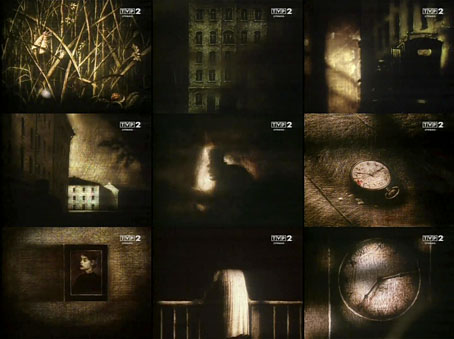
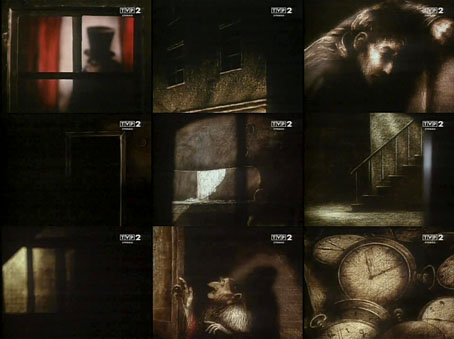
More from the Polish animator, and a stunning, wordless adaptation of Dostoevsky’s novel. Crime and Punishment dates from 2000, and utilises the same technique as Dumala’s earlier films—images scratched into a plaster ground—only this time there’s a muted colour palette and considerable depth achieved through cast shadows and blurred objects layered over the drawings. Yuri Norstein achieved a similar sense of depth in Hedgehog in the Fog (1975) and Tale of Tales (1979), and Dumala’s film also shares the latter’s umber tones and sombre lighting. The story is pared to its bones, as it would be with a running time of 30 minutes, but it’s still a marvellous adaptation. There’s even a nod to Walls when an omnipresent fly disappears for a moment into a hole in the wallpaper.

dumala3.jpg

Previously on { feuilleton }
Walls, a film by Piotr Dumala
Academy Leader Variations
Yuri Norstein animations
Screening Kafka