Etidorhpa by John Uri Lloyd

etidorhpa01.jpg

I wouldn’t usually post so many illustrations but these depictions by J. Augustus Knapp for Etidorhpa by John Uri Lloyd add a great deal to the attractions of this early work of science fiction. Lloyd’s book is subtitled The End of Earth; The Strange History of a Mysterious Being; The account of a remarkable journey as communicated in manuscript to Llewellyn Drury who promised to print the same, but finally evaded the responsibility. The novel was published in 1895, and shares features with similar works that concern travellers exploring the interior of the Earth. What sets it apart is a degree of imagination that generated enough interest for it to be reprinted many times.

etidorhpa02.jpg

Science fiction and fantasy evolved so rapidly in the early 20th century that the products of previous centuries often seem uninventive in comparison. Whatever hidden cities, lost continents or subterranean kingdoms are promised, too many of them reveal a race of pompous individuals, usually clad in Greek, Roman or Egyptian attire with little variety to their civilisations unless their world is also populated by the odd monster or two. The manuscript in Lloyd’s novel relates a journey to the Earth’s interior by a bearded, white-haired character variously named I-Am-The-Man and The-Man-Who-Did-It who reads his adventures in a series of visits to the irresponsible Llewellyn Drury. I-Am-The-Man is kidnapped by a secret society who take him to a cave in Kentucky where he’s eventually delivered into the care of a mysterious, unnamed guide from the subterranean world:

The speaker stood in a stooping position, with his face towards the earth as if to shelter it from the sunshine. He was less than five feet in height. His arms and legs were bare, and his skin, the color of light blue putty, glistened in the sunlight like the slimy hide of a water dog. He raised his head, and I shuddered in affright as I beheld that his face was not that of a human. His forehead extended in an unbroken plane from crown to cheek bone, and the chubby tip of an abortive nose without nostrils formed a short projection near the center of the level ridge which represented a countenance. There was no semblance of an eye, for there were no sockets. Yet his voice was singularly perfect. His face, if face it could be called, was wet, and water dripped from all parts of his slippery person.

The illustrations by J. Augustus Knapp show the guide as naked but conveniently sexless. The pair descend into the Earth’s interior where they encounter a succession of wonders, from giant fungi (possibly derived from A Journey to the Centre of the Earth) and a sea of “crystal liquid” which the pair traverse in a metal boat, to a variety of strange fauna and flora. Knapp’s illustrations make the journey seem much more interesting than it is on the page where Lloyd spends far too much time lecturing the reader—there’s a chapter about the evils of drunkenness—or having I-Am-The-Man relate his continual bewilderment. “Etidorhpa”, it turns out, is “Aphrodite” reversed, and Etidorhpa herself appears as the embodiment of love at the culmination of what has become a spiritual journey rather like a weak precursor of David Lindsay’s extraordinary A Voyage to Arcturus (1920). Lindsay had the good sense to write a continuous narrative whereas Lloyd frequently interrupts his story with scientific speculations that seek to qualify some of the less outlandish features of his interior world. There’s also a curious note from the author on page 276 about the various properties of intoxicating drugs, and the possibility that they might be combined by a chemist to create strange visions for a writer. Lloyd was a chemist as well as a writer so the speculation that he might have experimented on himself—and thus produced this book—is understandable. Speculation aside, L. Sprague de Camp dismissed the novel as “unreadable” (despite its multiple reprintings) whereas HP Lovecraft apparently enjoyed it. You can judge for yourself here.

etidorhpa03.jpg

etidorhpa04.jpg

Continue reading “Etidorhpa by John Uri Lloyd”

The recurrent pose 55

flandrin1.jpg

And still they come… These latest examples of the Flandrin pose are in the Flandrinesque category since they don’t quite match the figure in Flandrin’s painting. The one above is Spanish model Emilio Flores, photographed by Matteo Felici, one of a series featured at Homotography. The one below is another of those mystery pictures whose origin is difficult to determine. The source site is here but, as with many Tumblr sites, it’s so slow to load its hoard of endlessly scrolling high-res photos that I’m afraid I didn’t search very far. Lastly, there’s this photo by Santy Mito, a recommendation from a Twitter user.

flandrin2.jpg

Elsewhere on { feuilleton }
The recurrent pose archive

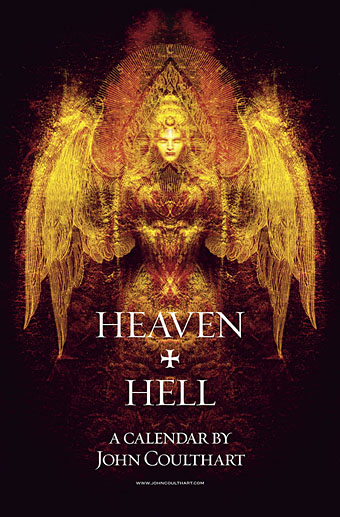
Heaven and Hell calendar

heavenhell00.jpg

Painting from the poster art for The Highbury Working (2000) by Alan Moore & Tim Perkins.

Unlike last year, this year’s CafePress calendar arrives on time, its creation being eased by the fact that it’s a reworking on an earlier version. The idea with the previous Heaven & Hell calendar had been to alternate various pieces of infernal Cradle of Filth artwork with contrasting imagery; as things turned out I had more offerings for Hell than for Heaven—no surprise there—so the reality wasn’t very satisfying.

This year I’ve managed to fill out the Heaven sequence with more recent works, all of which have been slightly adjusted to fit the square page ratio required by CafePress. So even though these are old pieces many of them are unique to this printing. Larger copies of the pages may be seen here while the CafePress purchase page is here. As always, my thanks to everyone who buys these things.

And as before, the calendars for previous years are now available all year round; see the full range here. Note that this means you need to select January as the starting month if you want the months to run for a single year only.

heavenhell01.jpg

JANUARY: Variation of the poster art for Angel Passage (2001) by Alan Moore & Tim Perkins.

Angel Passage was Alan and Tim’s album about the life and work of William Blake. I designed the CD, a poster, and also produced a video for the multi-media performance of the piece at the Purcell Room, London, in February 2001.

heavenhell02.jpg

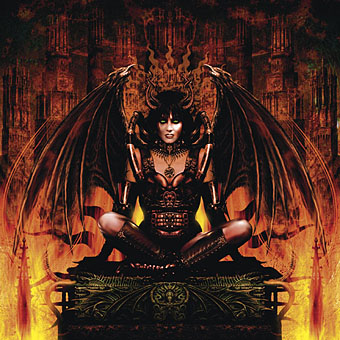
FEBRUARY: Cover for Bitter Suites To Succubi by Cradle of Filth (2001).

My first piece of Cradle of Filth art. I was a little surprised when working on this that they really did want the wings and horns; Dani loved that kind of imagery. I was even more surprised when this cover was subsequently showcased in an entire window in Tower Records’ main London shop in Piccadilly.

Continue reading “Heaven and Hell calendar”

Weekend links 230

bebergal.jpg

Cover art by Arik Roper.

Peter Bebergal’s Season of the Witch: How the Occult Saved Rock and Roll was published this week. Articles about rock music’s occult preoccupations have been a recurrent feature of music magazines, especially around Halloween, but Bebergal’s book is the first attempt at a wide-ranging, full-length study. Despite the subtitle, the scope goes beyond the familiar—David Bowie’s Golden Dawn references, Jimmy Page’s Aleister Crowley obsession—to take in the pagan nature of the blues, pre-Beatles rock’n’roll, and the byways of electronic music. My old employers, Hawkwind, provide a title (Space Ritual) for one section, and I was pleased to see the Krautrock scene receiving some attention: years ago you couldn’t have counted on this from an American music study. As Bebergal notes, Can’s Aumgn on Tago Mago (1971) isn’t the hippy Aum/Om but originates in a mantra defined in Crowley’s Magick in Theory and Practice.

• “We don’t just have skeletons in our cupboard, we have an ossuary.” Another week, another Alan Moore interview, but Tim Martin‘s piece is as much a portrait of the man as a conversation about the usual subjects: art, science, magic, etc.

• “Europe’s history of penis worship was cast aside when the Catholic Church realized Jesus’s foreskin was too potent to control.” Stassa Edwards on venerated members.

Gays and horror actually have  somewhat of a lost history. FW Murnau, the director of Nosferatu, was openly gay. Frankenstein’s real creator, James Whale, was also out. Given the talent involved, and the illicit nature of the genre, amateur and professional critics have been divining queer themes from horror films for decades.

Patrick Rosenquist on Gory, Gay & Loving It: Why Homosexuals Heart Horror

• “I thought that fine art was fairly dishonest as an industry. It pretends to be about culture but it’s really about money.” Andy Butler interviews designer Neville Brody.

• Snapping, Humming, Buzzing, Banging: Richard B. Woodward on the creative partnership between David Lynch and sound-design genius Alan Splet.

• Also published this week: Discovering Scarfolk, Richard Littler’s guide to the occult-obsessed, rabies-infested English town.

• More rock music: When Art Rocked: San Francisco Music Posters, 1966–1971 by Ben Marks.

• The trailer for 808, a documentary about Roland’s celebrated drum machine.

• At The Millions: Devin Kelly on the collaborative art of words and images.

• More Crowley: Strange Flowers goes looking for Aleister Crowley’s Berlin.

• Mix of the week: Secret Thirteen Mix 130 by Gábor Lázár.

• Yello’s Boris Blank on his 10 favourite electronic records.

Richard Hirst‘s Top 5 Robert Aickman Stories.

I Put A Spell On You (1968) by Arthur Brown | I Put A Spell On You (1992) by Diamanda Galás | I Put A Spell On You (2004) by Queen Latifah

Newlyborn, a film by Dave Colohan

newlyborn1.jpg

Dave Colohan was in touch recently to tell me he enjoyed the posts here (thanks, Dave) and also to point the way to Newlyborn, a short film he’s made. This is a moody piece that suits the season, black-and-white shots of South Longford, Ireland, accompanying Niamh Beirne’s narration. The music is minimal but Dave Colohan has a growing discography of music production by himself and in collaboration with others. I’d come across Taskerlands before—immediately notable because their name is a reference to The Stone Tape—and have had Raising Holy Sparks recommended to me, but there’s more there to explore. The No Longer Reel Vimeo channel has three videos for Raising Holy Sparks.

newlyborn2.jpg

newlyborn3.jpg