The Return: a ghost story

thereturn.jpg

Another obscure film, The Return (1973) isn’t a television drama, more a miniature for the cinema, and as such may have been produced as a double-feature short. Director and co-writer Sture Rydman only has one other film to his credit but the music for The Return is by film composer Marc Wilkinson while the photography is the work of the very distinguished Douglas Slocombe.

The story is a blend by Rydman and fellow writer Brian Scobie of two ghost stories: Nobody’s House by AM Burrage, and The Middle Toe of the Right Foot by Ambrose Bierce. Nobody’s House is surprisingly one of the few Burrage stories I have on the shelves, and it provides the bulk of the script, the Bierce story being a very different piece concerning a duel in an abandoned building. Rydman’s film is a two-handed affair for two very good actors: Rosalie Crutchley, here playing a less sinister housekeeper than she did in The Haunting, and Peter Vaughan who the year before had been the lead in one of the best of the BBC’s MR James adaptations, A Warning to the Curious. The Return runs for 30 minutes, and to say much more would be to spoil it. The copy at YouTube does Slocombe’s photography no favours but you can at least watch it here.

Previously on { feuilleton }
Nigel Kneale’s Woman in Black
“Who is this who is coming?”

To Kill a King by Alan Garner

tokillaking.jpg

This is a very curious short film I’d not come across before, the final entry in Leap in the Dark, a series of half-hour supernatural dramas and documentaries broadcast by the BBC from 1973 to 1980. To Kill A King could be viewed as a supernatural piece although it’s more of a psychodrama with writer Harry (Anthony Bate) struggling to maintain contact with his spectrally visible muse after a long period of inactivity. Bate is a familiar face from TV drama of this period, often playing government officials, memorably so in his role as Oliver Lacon for the BBC’s two George Smiley serials. Jonathan Elsom and Pauline Yates play Harry’s secretary and sister, neither of whom are very sympathetic to Harry’s predicament or to each other.

What’s odd about the film is that it seems to be a partial self-portrait of its author: the house where Harry lives is either Garner’s own or one very like it, close to the Jodrell Bank radio telescope on the Cheshire Plain; Garner has spoken about the years of deep depression that prevented him from writing. If these details are circumstantial there’s a brief shot of the Carnegie Medal that Garner was awarded for The Owl Service in 1967. The whole film is so hermetic and inaccessible it seems to have been written more as an act of personal exorcism (or perhaps of evocation) rather than anything intended as mere entertainment. Watch it here.

Previously on { feuilleton }
Red Shift by Alan Garner

Weekend links 239

crystal.jpg

The Crystal Gazer (or The Magic Crystal, 1904) by Gertrude Käsebier.

• “I had to resort to extreme violence”: how Hipgnosis revolutionised the album sleeve. Aubrey Powell, last surviving member of the design team, talks to Joe Muggs.

• Mixes of the week: Radio Belbury: Programme 14; The Conjurer’s Hexmas by SeraphicManta; Secret Mix 139 by A Closer Listen.

• Social progress, high-speed transport and electricity everywhere: Iwan Rhys Morus on how the Victorians invented the future.

• At Cinephilia & Beyond: “The most complete investigation into the origins and making of Citizen Kane.”

Poor Souls’ Light: seven curious tales for the end of the year, and a dedication to Robert Aickman.

• Music and the Occult: Stuart Maconie and Rob Young spend an hour in the magick circle.

Alejandro Jodorowsky and Iain Sinclair in conversation at the British Library, July 2014.

• From 1972: An unpublished Victor Moscoso interview by Patrick Rosenkranz.

The Spooky Story Behind Hollywood’s Favourite Mansion.

The Lost World of British Tape Recording Clubs.

• 2014 was a year of outrage.

Wyrd Daze issue 11

Inspirograph

• Pepper-Tree (1984) by Cocteau Twins | Otterley (1984) by Cocteau Twins | Aikea-Guinea (1985) by Cocteau Twins

Carabosse, a film by Lawrence Jordan

carabosse.jpg

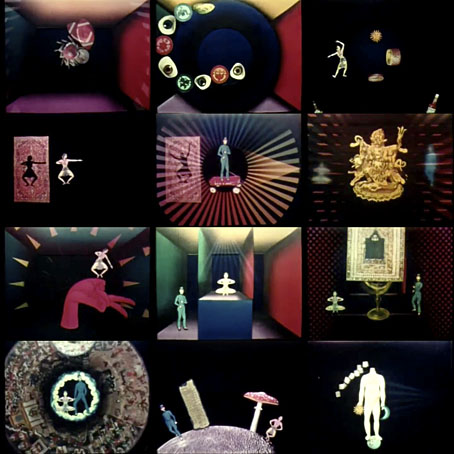
Collage animators may not be as plentiful as collage artists but this branch of filmmaking has attracted a number of heavyweight talents including Harry Smith, Jan Lenica, Walerian Borowczyk and Terry Gilliam. Lawrence Jordan worked for a time as an assistant to Joseph Cornell but he’s been making short films since the 1950s, many of which involve animated collage. Carabosse (1980) is a brief and distinctly Surreal piece set to Erik Satie’s Gnossienne No. 4. (An earlier film is titled Gymnopédies.) Watch it here. (Thanks to Erik Davis for the tip!)

Previously on { feuilleton }
Labirynt by Jan Lenica
Science Friction by Stan VanDerBeek
Heaven and Earth Magic by Harry Smith
Short films by Walerian Borowczyk

MMM in IT

mmm.jpg

“Are you your own master? Or are there forces beyond reason that shape your actions?”

This full-page ad appeared in issue 72 of International Times, Jan 28, 1970. The part-work encyclopedia, Man, Myth & Magic, was launched at the best possible moment, capitalising on the late-60s’ resurgence of interest in the occult and unorthodox spirituality. That bold declaration—”The most unusual magazine ever published”—might have seemed unconvincing to readers of the undergrounds, many of which made “unusual” their starting point, but there certainly hadn’t been a magazine/encyclopedia like MMM before, and none of the titles that followed could match its scope and authority. The ad also promises “From Adam and Eve to LSD, from lucky numbers to human sacrifice…” which its 112 issues went on to deliver.

This is the first press ad I’ve seen for MMM. A TV ad for the later American reprinting turned up recently, 30 seconds of film that sent Austin Osman Spare’s sinister goat-faced elemental into millions of Christian households in 1974. I keep hoping we might get to see the UK equivalent one day.

MMM.jpg

Previously on { feuilleton }
Wilfried Sätty: Artist of the occult
Owen Wood’s Zodiac
Austin Osman Spare