Weekend links 648

klee.jpg

The Twittering Machine (1922) by Paul Klee.

• “Thinking of ‘writer Twitter’ as more important than writers themselves is an insult to the profession. People have been trading words for money for thousands of years. They will continue to do so after the death of a platform built on manufactured outrage, social hierarchy, unfunny jokes, stale memes, pornography, and spam. I mention this Atlantic essay only because it echoes what so many people are saying in the ether right now, not to pick on its author. The piece reads like a parody of how writers overestimate the importance of Twitter to their work and careers. It’s frankly a little embarrassing. Your work is the product you sell! Not the shitty jokes you tell with people you want to impress.” Freddie deBoer on the kerfuffle du jour. For “writer” see also “artist” or anyone else working at the intersection between commerce and creativity. From what I’ve read this week about potential technical problems at the pestilential birdcage I’d be less sanguine about its immediate survival. Since I retreated from the place as an active user two-and-a-half years ago all I get from it is the inflated subscriber number you see on the right-hand side of this page, a combination of Twitter followers plus email subscribers. The latter currently stand at some 270 individuals so if you’re among that number you can consider yourself part of a more exclusive group. And thanks for subscribing!

• “…the books of the past, besides adding to our understanding, offer something we also need: repose, refreshment and renewal. They help us keep going through dark times, they lift our spirits, they comfort us. Which means that I also strongly agree with the poet John Ashbery, who once wrote, ‘I am aware of the pejorative associations of the word “escapist,” but I insist that we need all the escapism we can get and even that isn’t going to be enough.'” Michael Dirda makes a case for reading classic, unusual and neglected books. Kudos for the mention of Anthony Skene‘s Monsieur Zenith, a character few of Dirda’s readers will have heard of.

• “While Haeckel’s paintings turn the floating phantoms into baroque spectacles of colour and flowing form, Mayer’s medusae are more sober, their tentacles subdued, their umbellate bells transparent.” Kevin Dann on the jellyfish and other “floating phantoms” described in AG Mayer’s Medusae of the World (1910).

• “The passing of time has added potency to the images, giving this interpretation of the Dracula story the feel of a distant fairy tale, a myth emerging from the mists of time, erupting across the world of cinema, its shadow reaching everywhere.” Martyn Bamber on 100 years of Murnau’s Nosferatu.

• At AnOther: Camille Vivier talks about shooting nude models in the treasure-filled home of HR Giger.

• New music: In Concert & In Residence by Sarah Davachi, and Anglo-Saxon Androids by Moon Wiring Club.

• At Spoon & Tamago: Kimono portraits were popular souvenirs for sailors visiting Japan in the 1800s.

• Mix of the week: Saturnalia: Deep Jazz for Long Nights, 1969–1980 at Aquarium Drunkard.

• At Dennis Cooper’s: Clouds.

Dark Clouds With Silver Linings (1961) by Sun Ra | Obscured By Clouds (1972) by Pink Floyd | Firmament (Cloudscape) (1995) by Main
Weekend links 645

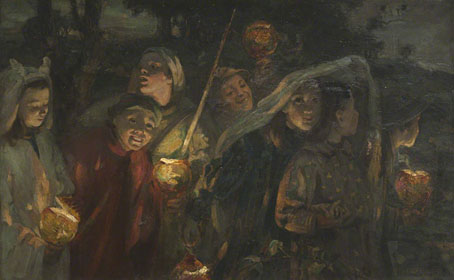
macgeorge.jpg

Halloween (no date) by William Stewart MacGeorge.

• Couldn’t Care Less: Cormac McCarthy in a 75-minute conversation (!) with David Krakauer at the Santa Fe Institute, filmed in 2017 and recently posted to YouTube. Not a literary discussion, this one is all about science, philosophy, mathematics, architecture and the operations of the unconscious mind. McCarthy’s essay about the origins of language, The Kekulé Problem, may be read here.

• At Wormwoodiana: Douglas A. Anderson finds a 1932 reprint of an HP Lovecraft story, The Music of Erich Zann, in London newspaper The Evening Standard. The story had appeared a few months prior to this in a Gollancz book, Modern Tales of Horror which reprinted a US collection edited by Dashiell Hammett. The newspaper printing includes an illustration by Philip Mendoza.

• New Hollywood Vs Mutant Cinema: The flipside of US cinema, 1960s–80s. Joe Banks talks to Kelly Roberts, Michael Grasso and Richard McKenna about their new book, We Are the Mutants: The Battle for Hollywood from Rosemary’s Baby to Lethal Weapon.

• At Bandcamp: Rich Aucoin explains the army of synths on his new quadruple album. The battalion includes the bespoke modular setup known as T.O.N.T.O., a rig that few people get to play with.

• New/old music: Malebox, an EP of Patrick Cowley rarities coming soon from Dark Entries.

• Mix of the week: Samhain Séance 11: endleofon by The Ephemeral Man.

• The surreal photographs of Ralph Eugene Meatyard.

• “NASA team begins study of UFOs”.

Ghost Rider (1969) by Musical Doctors | Ghost Rider (1970) by The Crystalites | Ghost Rider (1977) by Suicide

Weekend links 644

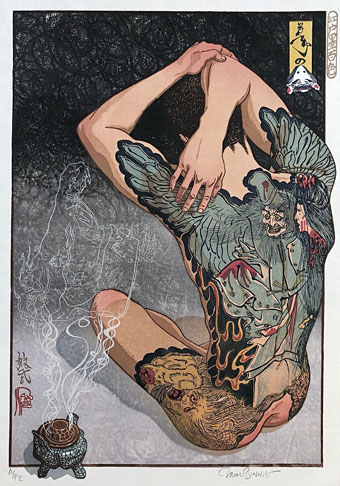
binnie.jpg

Yoshitoshi’s Ghosts (2004) by Paul Binnie.

• “The later Grand Etteilla series, printed well into the nineteenth century, and the present-day proliferation of Tarot decks, following ephemeral fads and fashions, all trace their origins to this beautiful and beguiling creation from the enigmatic Egyptophile at 48 Rue de L’Oseille.” Kevin Dann on the Livre de Thot Tarot (ca. 1789) by Jean-Baptiste Alliette, better known as “Etteilla”.

• “Death is not a subject he has ever shied away from, in his fiction or conversation. Indeed, he has measured other writers by how seriously they address it.” Richard B. Woodward on his friend, Cormac McCarthy, and McCarthy’s new novels. There’s an exclusive extract from The Passenger here.

• “…addicts, psychopaths, lovelorn outsiders, cult leaders, lesbian and gay icons…you name it, the vampire has become it.” Christopher Frayling on the perennial popularity of the vampire, and a new book collection of vampire film posters.

Robert Wilson‘s new production of Ubu Roi by Alfred Jarry is “a sinister, multilingual pantomime bathed in red light and looped in noise…fittingly violent, absurd, ominous and infantile”.

• “What kind of music goes with a show that originates in deep space?” Aquarium Drunkard on Sonny Sharrock’s final recordings, the soundtrack music for Space Ghost Coast To Coast.

• At Wormwoodiana: Mark Valentine takes a fresh look at the health of secondhand bookshops in Britain.

• Tokyo nightlife photographed by Hosokawa Ryohei.

• New music: Approach by Lawrence English.

The Passenger (1977) by Iggy Pop | The Passenger (1987) by Siouxsie And The Banshees | The Passenger (1997) by Lunachicks

Weekend links 641

coin.jpg

For mysterious and eldritch reasons the Republic of Palau has minted a Cthulhu-themed 20 dollar coin. Via.

• “Pre-gap tracks are a CD-specific phenomenon, paralleled only by DVD Easter Eggs, or hidden levels in a computer game. On the one hand, they’re only possible digitally, on the other, they seem to be an attempt to add some mystique to a circle of plastic.” Daryl Worthington on the 40th anniversary of the Digital Audio Compact Disc. Regular readers will know that CD has been, and remains, my favourite musical format for reasons I won’t bother arguing here. Related: Wikipedia’s list of albums with tracks hidden in the pregap. Also: “There’s endless choice, but you’re not listening”: fans quitting Spotify to save their love of music.

• “Meek’s use of sound effects and swathes of ghostly reverb, woven into seemingly innocuous pop songs and rock and roll instrumentals—as if the BBC Radiophonic Workshop was directed by Phil Spector—created a sense of the sublime and hinted at strange realities beyond our own.” Mark Pilkington explores the strange world of Joe Meek.

• “Structured as a ‘dream within a dream’, the narrative weaves together mythological, biblical, and occult references to construct a universe filled with ruinous landscapes and orgiastic celebrations.” Demetra Vogiatzaki on the enigmas, architectural and otherwise, presented by Hypnerotomachia Poliphili (1499).

The man who made this absurd noir was answerable neither to studio nor Shakespeare, but only his own monumental whims. Thus, Mr. Arkadin sends Citizen Kane (1941) through the looking glass—the action transposed to post–World War II Spain and given a spin somewhere between metaphysics and megalomania…

If Jean Cocteau’s Orpheus recast myth as pulp, Mr. Arkadin elevates pulp to myth. It is the most Borgesian of Welles’s movies. Writing in Cahiers du cinéma, the young Eric Rohmer compared Mr. Arkadin to Jules Verne and Fantômas: It creates something that is ­nearly impossible today: a romantic fiction that involves neither the future nor any removal from one’s usual surroundings…

J. Hoberman writing in 2006 about Orson Welles’ Mr. Arkadin (1955). I was rewatching the film earlier this week in its guise as Confidential Report, the version re-edited by its producer to try and create something with greater commercial appeal. I’ve yet to see the recent restoration but even in its butchered form it’s a fascinating piece of work

Early Cormac McCarthy interviews rediscovered: “Between 1968 and 1980, he gave at least 10 interviews to small local papers in Lexington, Kentucky and east Tennessee, a region where he lived and had friends.”

• New music: Perceptions by Model Alpha (Jonathan Fitoussi & Julie Freyri), and Epektasis by Nicklas Barker.

Dreams of Space: Books and Ephemera; “Non-fiction children’s space flight stuff 1945–1975”.

• At Dennis Cooper’s: Roget Malot presents…Spirit Photography Day.

• Mix of the week: A mix for The Wire by FOQL.

Spirit (1978) by Frédéric Mercier | Spirit (1990) by Jah Wobble’s Invaders Of The Heart | Spirit Level (Lost In Space) (1992) by Horizon 222

Weekend links 640

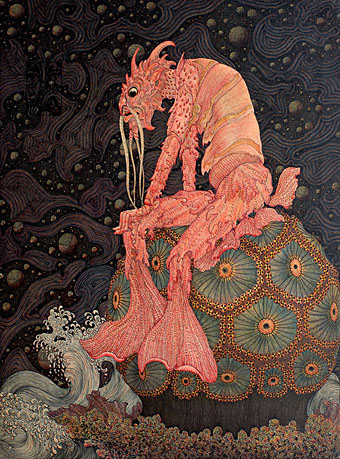
ewers-wunderwald.jpg

Aquarius (1910–1914) by Ilna Ewers-Wunderwald.

• “…they created a unique Afro-Caribbean soundscape—Battiste’s exceptional skills saw him use the studio as an instrument, voices flutter in and out, instruments shiver and shriek, over which Rebennack mutters and chants, a shaman of sorts.” Garth Cartwright on the life and works of Mac Rebennack, better known to the world as Dr John.

• Issue 3 of Man Is The Animal: A Coil Zine is now available for pre-order. I contributed to this one with a piece entitled “Singularities of Art and Nature”, an examination of the Coil discography via the Wunderkammer concept and the Musaeum Clausum of Thomas Browne.

• Among the recent arrivals at Standard Ebooks, the home of free, high-quality, public-domain texts, is Arthur Machen’s episodic and influential horror novel The Three Imposters (1895).

Media History Digital Library: “A free online resource, featuring millions of pages of books and magazines from the histories of film, broadcasting, and recorded sound.”

• At Dennis Cooper’s: Shall I, Jean Eugène Robert-Houdin, conjurer, introduce myself to you, viewer? And why not?

• At Public Domain Review: The Blood Collages of John Bingley Garland (ca. 1850–60).

• Mix of the week: Endymion, an autumnal ambient mix by The Ephemeral Man.

• “New Webb image captures clearest view of Neptune’s rings in decades.”

• New music: Of Endless Light by Cleared.

• RIP jazz giant Pharoah Sanders.

Conjuration (1977) by Tangerine Dream | Necronomicon—Conjurations (2004) by John Zorn | A Boy Called Conjuror (2020) by Teleplasmiste