Sanctuarium Artis Elisarion

elisarion1.jpg

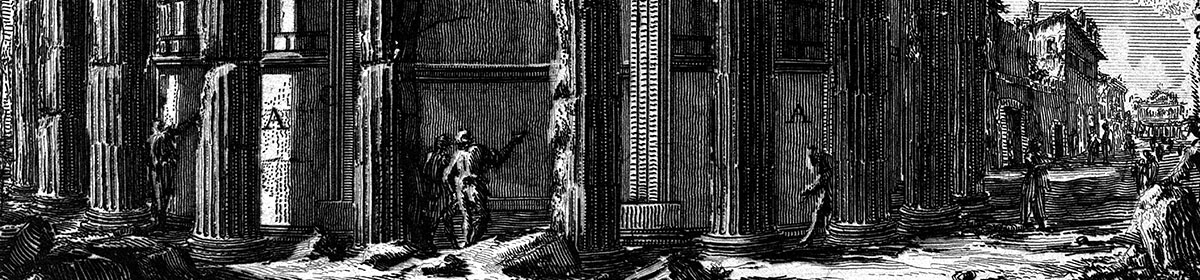
The Clear World of the Blessed Souls (detail).

Once again the web proves beneficial in showing you something you didn’t expect to find. The Sanctuarium Artis Elisarion was the grandiose name given by Elisar von Kupffer (1872–1942) aka Elisarion to his art-filled villa at Lake Maggiore which he shared with his partner Eduard von Mayer. Kupffer was an artist, writer, historian and another of those rare pioneering gay men who used their position and their work to proselytise for social tolerance of same-sex attraction.

elisarion2.jpg

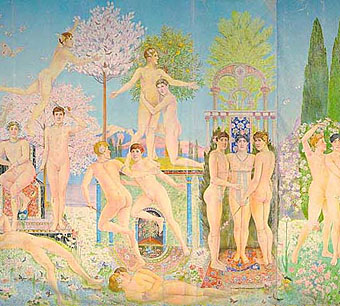
The Clear World of the Blessed Souls (detail).

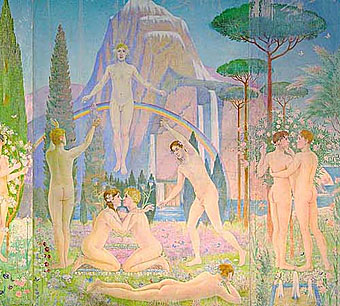
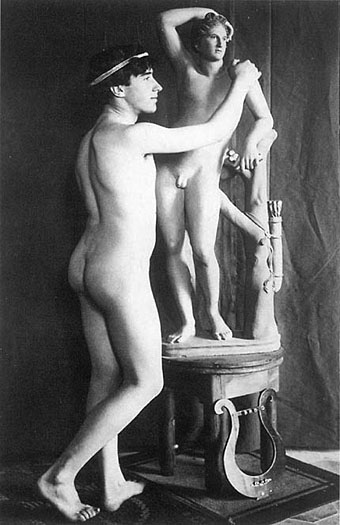
Kupffer and Mayer’s Sanctuarium is documented at this site (Italian and German language only) with details of the artist’s paintings and the villa’s extraordinary mural, The Clear World of the Blessed Souls, which depicts a luscious homoerotic paradise. Also present are a few of the photos Kupffer used as a basis for his paintings (below). The mural title refers to Klarismus (Clarity), apparently the name of Kupffer and Mayer’s spiritual philosophy and a creed which evidently involves lots of naked boys. Where do I sign up?

elisarion3.jpg

Elsewhere on { feuilleton }
The gay artists archive

Previously on { feuilleton }
The art of Sascha Schneider, 1870–1927
The art of Andrey Avinoff, 1884–1949

Frank Frazetta, 1928–2010

frazetta1.jpg

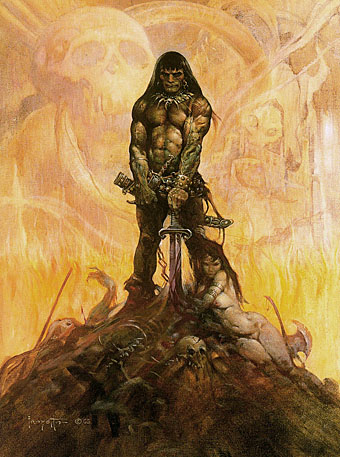
Conan the Adventurer aka The Barbarian (1965).

How to appraise Frank Frazetta? In November last year I wrote about this Conan portrait for an SF Signal Mind Meld feature on favourite book covers:

The covers that launched a thousand imitators. Lancer’s series of Conan books in the 1960s were the first appearance of Howard’s barbarian in paperback and came sporting cover art by Frank Frazetta. A great example of artist and subject being perfectly matched, these are the standard by which all subsequent barbarian art must be judged. Frazetta’s painting of a brooding warrior lord (which he reworked slightly for its poster edition) is for me the definitive portrait of Howard’s hero, battle scarred and proudly malevolent, with a chauvinistic blur of trophy female clinging at his feet. Other artists can do the muscles and monsters but none capture the physical presence and brute animality of Howard’s characters the way Frazetta does.

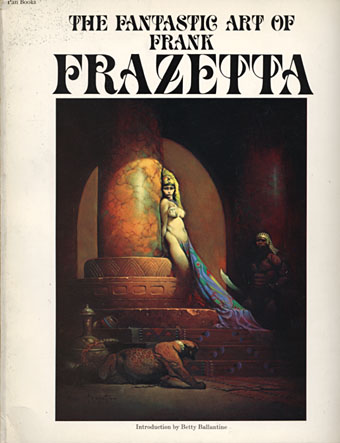
I found Frazetta’s work through the great series of fantasy art books which Pan/Ballantine published in the 1970s. I hadn’t read any Robert E Howard at the time, I only knew the diluted version of the Conan character in the Marvel comics series but Frazetta’s work was so powerful it was a spur to search out Howard, especially when I read that the writer had been a pen-pal of HP Lovecraft. I was never as interested in Frazetta’s other staple inspiration, Edgar Rice Burroughs, probably because Tarzan was too familiar from films and TV.
larkin_frazetta1.jpg

The Fantastic Art of Frank Frazetta (1975).

Both Howard and Frazetta defined a milieu which combined an intensity of vision with a projection of their own personalities into the worlds they created. (Many of Frazetta’s protagonists resemble their creator.) Both suffered from having that intensity of vision watered-down by ham-fisted imitators or the vulgarisations of films and comics. At their best, Howard’s Conan stories are a blend of heavyweight adventure story with supernatural horror; many of them were first published in Weird Tales magazine alongside other masters of the weird like Lovecraft and Clark Ashton Smith. What impressed me about Frazetta’s paintings was the way he managed to capture a sense of eldritch weirdness as well as the more obvious barbaric adventure in a manner which eluded so many of the sword and sorcery illustrators who followed. What’s even more remarkable when you read interviews is that he seemed to do all this instinctively. He’d learned from looking at earlier artists such as J Allen St John, Howard Pyle, Frank Schoonover and Roy Krenkel, and found the means to apply their painting style to his own internal aesthetics and sense of drama.
frazetta3.jpg

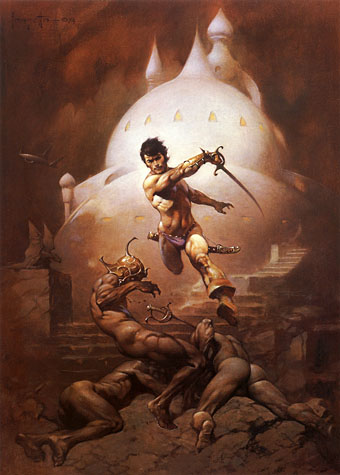
Swords of Mars (1974).

Aesthetics is one of the things I always come back to with Frazetta. I used to pore over these paintings wondering how it was that all the details of weapons and decor seemed absolutely right. Nothing was ever over-worked or too elaborate. Where did this invention come from? The other obvious feature is a raw sexiness which pervades everything. I’ve had people tell me that Frazetta must have been bisexual because of the equal care he lavished on his male and female figures. I’ve always disagreed with this. The point about Frazetta’s world is that everything is sexy: the people, the decor, the architecture, the animals, even the monsters; naturally the men are going to be as sexy as the women. In addition, he wasn’t afraid of giving his men real balls (so to speak) unlike the endless parade of costumed eunuchs filling the comic books. These figures may be dealing death but they’re filled with vigour and life when they’re doing it.
frazetta2.jpg

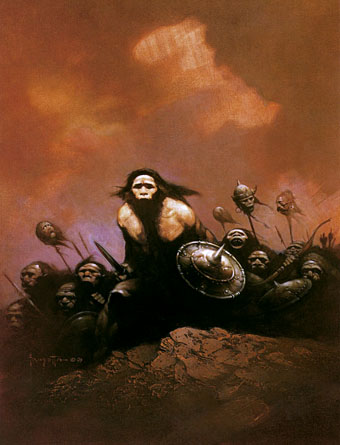
Bran Mak Morn (1969).

I said everything is sexy; I’ll make an exception for the extraordinary painting of Bran Mak Morn and his tribal horde, a picture of feral nightmarishness that goes beyond mere illustration and makes you feel the artist has shown you an atavistic glimpse of ages past. Robert E Howard would have been thrilled to see his characters brought to life with this kind of visceral intensity. For years Howard’s fiction was dismissed as pulp, now he’s a Penguin Modern Classic. And it’s as a modern classic that I’ll continue to think of Frank Frazetta.

Unofficial gallery site

Elsewhere on { feuilleton }
The illustrators archive

Previously on { feuilleton }
Frazetta: Painting with Fire
The monstrous tome
Men with snakes
My pastiches
Fantastic art from Pan Books
Boy, O Boy by Julie Heffernan

heffernan.jpg

Self Portrait as Great Scout Leader III (2010).

In which the artist changes sex on canvas for a new series of self-portraits and an exhibition aptly titled Boy, O Boy at P·P·O·W, New York. Three new paintings are on display all of which continue Heffernan’s fascination with self-portraits, miniature landscapes and accumulated objects, each presented in her customary super-detailed style. The gallery also has examples of her astonishing earlier work. Boy, O Boy runs from April 29 to June 5, 2010. Via Phantasmaphile.

Elsewhere on { feuilleton }
The fantastic art archive

Previously on { feuilleton }
The art of Julie Heffernan

Nirvana and The Conquerors

nirvana.jpg

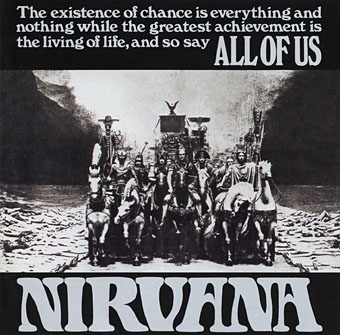
All Of Us by Nirvana (1968).

Every now and then the web’s great proliferation of images serves a useful purpose by solving some minor artistic conundrum. All Of Us is the second album by UK psychedelic band Nirvana (no relation to Kurt and co.) and the striking cover painting—a long line of emperors and warriors from different ages parading down an avenue of corpses—is annoyingly uncredited. The notes for the 2003 CD reissue inform us that “Patrick had found, in an exhibition of Nazi art (in Bremen, Germany), a still shot from a propaganda film directed by Adolf Hitler’s favourite film-maker, Leni Riefenstahl.” Setting aside the bizarre use of such a picture by one of London’s more effete psychedelic groups, I wasn’t convinced that this was a Nazi-era painting. The style is more like a piece of Neoclassical academic art from the late 19th century, and that’s what it turns out to be.

fritel1.jpg

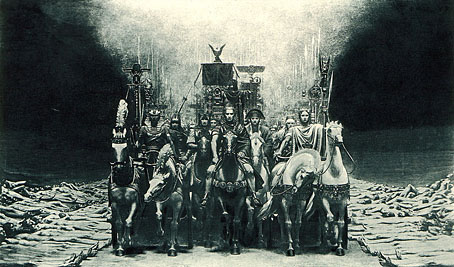
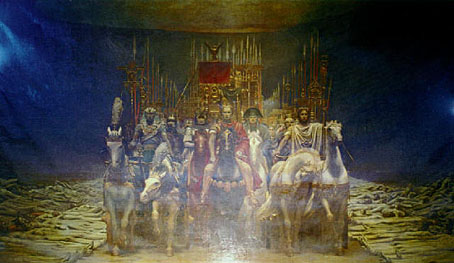
Les Conquérants (1892) by Pierre Fritel. From this Flickr page.

It was a search for works by French academician George Antoine Rochegrosse that turned up a copy of the painting in Google Images. “Aha, it’s Rochegrosse, then!” thought I, only it wasn’t. The picture is entitled Les Conquérants and the artist responsible is one Pierre Fritel (1853–1942) about whom there’s very little information on the web. There is, however, a discussion here which details the painting’s symbolism:

Through the Valley of the Shadow of Death, whose limits are obscured in darkness, advance, hollow-eyed and remorseful, the conquerors of all ages, marching in close ranks between a double row of corpses, stripped and rigid, lying packed close together with their feet toward the procession. In the center of the van rides Julius Caesar, whom Shakespeare has pronounced “the foremost man of all this world.” On his right are the Egyptian called by the Greeks Sesostris, now known to be Rameses II., Attila, “the Scourge of God,” Hannibal the Carthaginian, and Tamerlane the Tartar. On his left march Napoleon, the last world-conqueror, Alexander of Macedon, Nebuchadnezzar of Babylon, that “head of gold” in the great image seen in his vision as interpreted by the prophet Daniel, and Charlemagne, who restored the fallen Roman Empire.

There’s a follow-up discussion on MetaFilter where a commenter makes the Nirvana connection, and the Internet Archive even has the catalogue for the Salon of 1892 which lists the painting’s first public appearance. See a larger monochrome version here. The only mystery now is the whereabouts of the painting itself. Artnet tells us it was sold in 1988, and they have a poor quality colour photo of the picture (below) which looks a lot less dramatic than the moody monochrome reproductions. If anyone knows the current location of Fritel’s canvas, please leave a comment.

fritel2.jpg

Elsewhere on { feuilleton }
The album covers archive

Previously on { feuilleton }
The art of Vasili Vereshchagin, 1842–1904

Weekend links 12

archigram.jpg

Simulation No. 136 (1973); From the Archigram Revival Project.

Scientific American looks at DMT: “the only psychedelic known to occur naturally in the human body”. Related: Hofmann’s Elixir: LSD and the New Eleusis, a book from the Beckley Foundation Press.

• “People weren’t quite sure what this guy was doing.” Colin Marshall talks to Eno biographer David Sheppard.

• LA FAN presents its debut group show, Eve in the Garden of Lost Angels, curated by Milla Zeltzer, at Optical Allusion Gallery, downtown Los Angeles, from May 15 to June 12, 2010.

Masturbation: literature’s last taboo. The words “last” and “taboo” should never be used together; taboos don’t vanish, they migrate.

Announcing the Text: Development of the Title Page, 1470–1900.

The Anachronism is an award-wining Steampunk short about two children who discover the wreck of a giant squid submarine on a beach near their home.

Out There is a brand new, bi-annual, international magazine for gay men and their friends.

The Big Picture looks at the eruption of Eyjafjallajokull.

Expo 2010 opens in Shanghai on May 1st.

• (Walter) Benjamin in Extremis.

Nathalie returns to Bomarzo.

• Acronymic songs of the week: Lucy In The Sky With Diamonds (1967) by The Beatles; The Stars That Play With Laughing Sam’s Dice (1967) by The Jimi Hendrix Experience; London Social Degree (1968) by Billy Nicholls; Love’s Secret Domain (1991) by Coil.