The Shadow Over Atlantis by The Wounded Kings

deprofundis.jpg

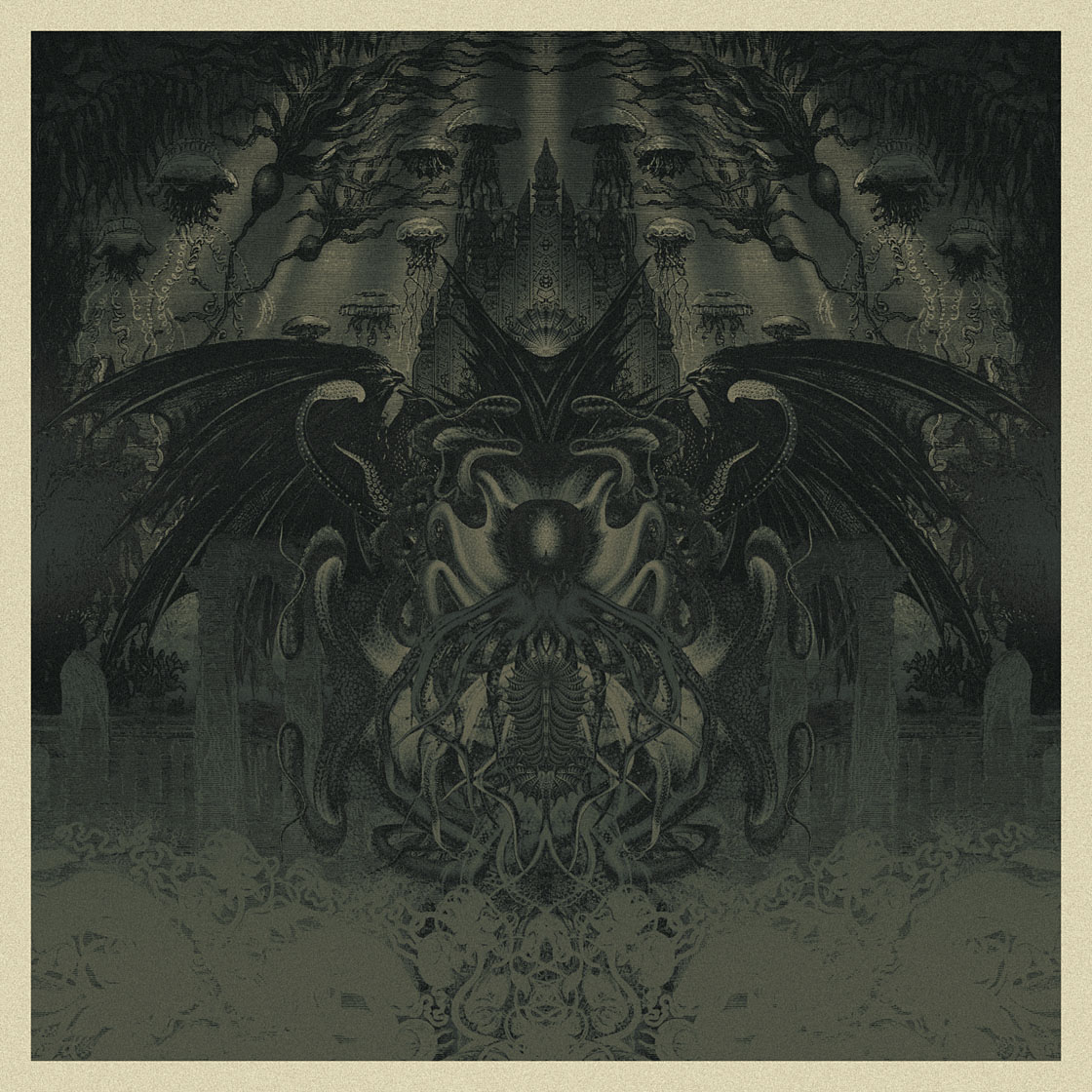
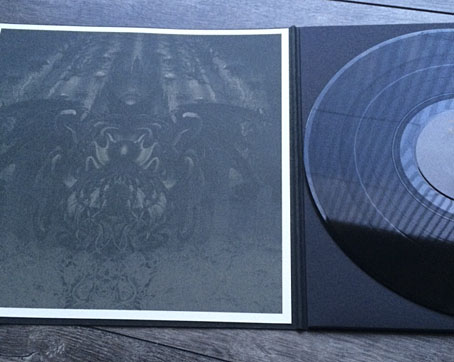
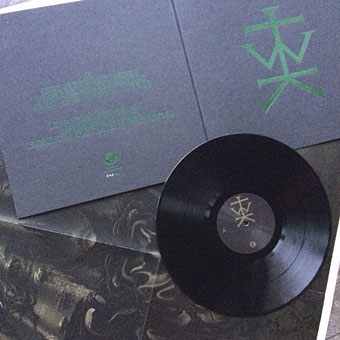
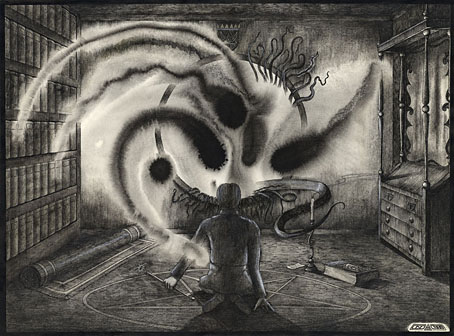
Van Records and British Doom-metal band The Wounded Kings couldn’t have chosen a better week to announce the reissue of The Shadow Over Atlantis. This is a limited repressing of an album first released in 2010, and for the new edition the vinyl is packaged in a foil-embossed gatefold sleeve whose interior features my Cthulhoid De Profundis piece. The album will also come with a poster insert of the same artwork. I am, of course, looking forward to seeing and hearing all of this. It’s available for pre-order now.

shadow1.jpg

shadow2.jpg

Previously on { feuilleton }
Rock shirts
De Profundis

HPL in France

hpl-fr1.jpg

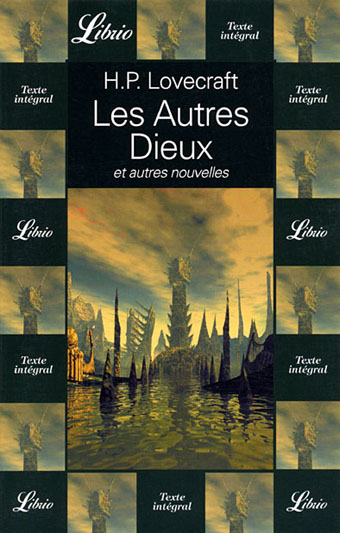
Les Autres Dieux et autres nouvelles (2002).

In 2002, French publisher J’ai Lu used my perennially popular view of R’lyeh on the cover of a small collection of HP Lovecraft’s fiction. This replaced a Michael Whelan painting on an earlier edition which looks fine but which happens to be a detail from one of his old Elric covers.

hpl-fr7.jpg

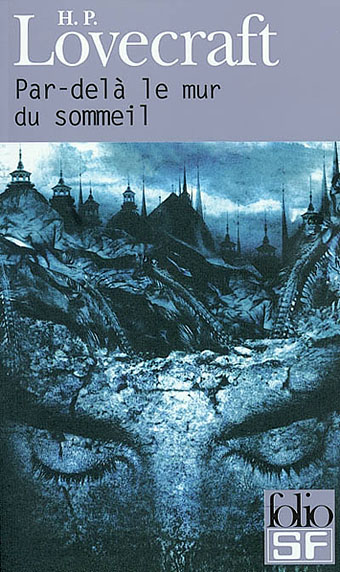
Par-delà le mur du sommeil (2002). Cover art by Eikasia.

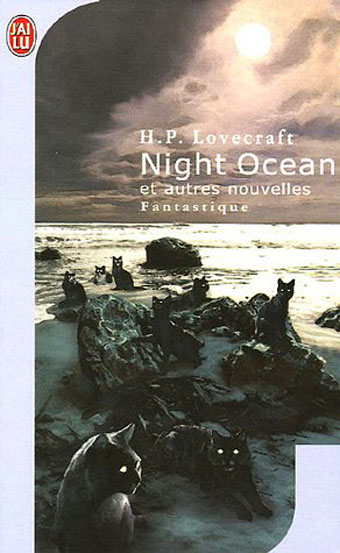
Looking through the Lovecraft pages at Noosfere this week turned up some recent French covers I’d not seen before. One of the striking things about cover art for French genre titles is the amount of artists who also work in comics. This isn’t so surprising given the scale of the French comics world but in the UK the tendency is for people to work in one area alone. Artists such as myself who move freely from comics to cover art to graphic design are a very small minority.

hpl-fr8.jpg

Night ocean et autres nouvelles (2005). Cover art by Richard Guérineau.

Continue reading “HPL in France”

The King in Green

hastur.jpg

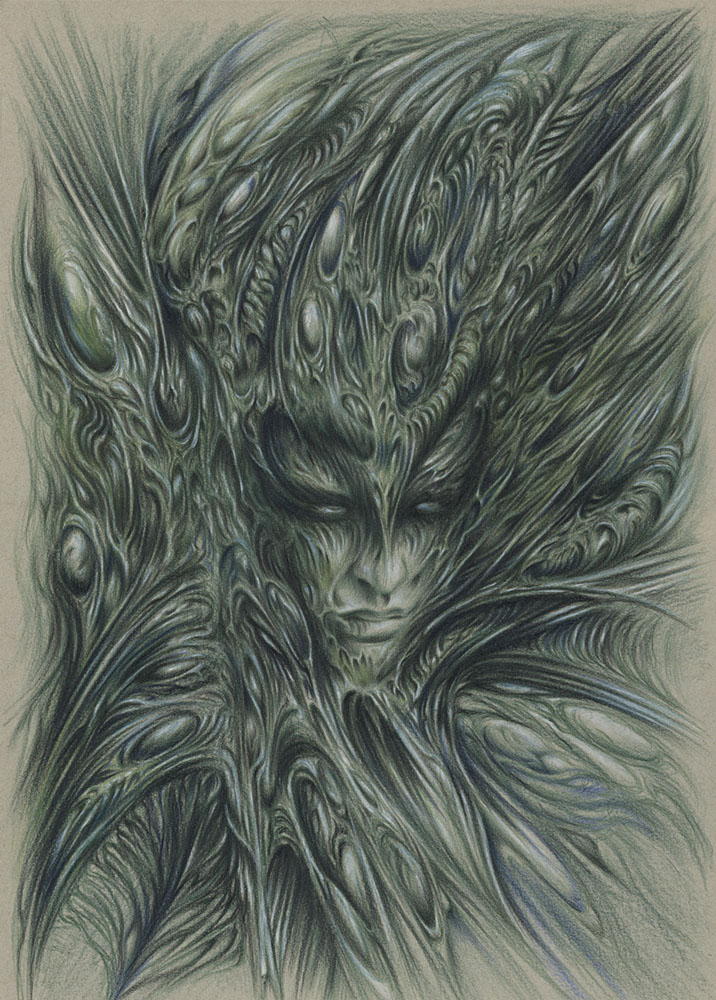
Hastur (1999) by John Coulthart.

Going through some of my old Lovecraft art this week it occurred to me that this drawing hadn’t been made public in its original colour form. Hastur appears as a murkier black-and-white illustration in the Great Old Ones series I produced in collaboration with Alan Moore for The Haunter of the Dark. The drawing was one of several improvised pieces made using coloured pencils on tinted paper. Some people may regard this and similar works as “Gigeresque” but I only apply that label to close imitations of HR Giger’s biomechanical style. This type of improvised drawing or painting predates Giger—Max Ernst’s decalcomania paintings being familiar examples—and you see similar fields of organic or mineral forms in the work of other Surrealist or Fantastic artists. If you have some ability with a pencil or paintbrush it’s relatively easy to produce a lot of this kind of work; the challenge is to do something more than create a mass of writhing abstraction.

Elsewhere on { feuilleton }
The Lovecraft archive

The Gable Window

gable.jpg

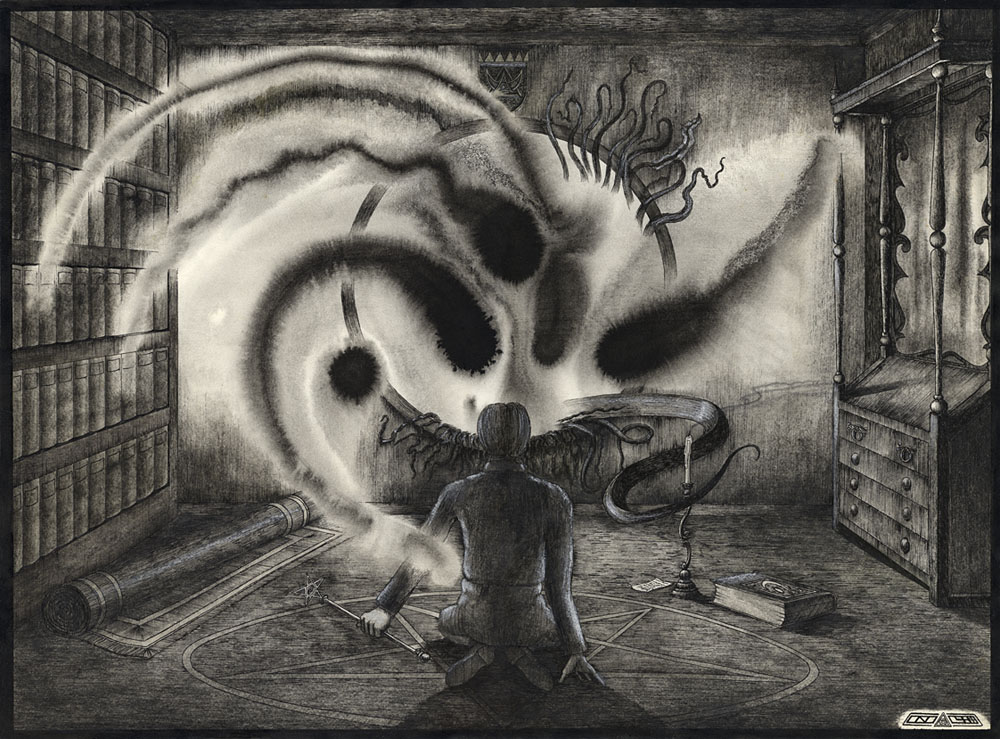
The Gable Window (1984) by John Coulthart.

Presenting some of my first Lovecraftian illustrations, neither of which have been made public before. This drawing, and the one below, are as much Derlethian as they are Lovecraftian, depicting scenes from a short story and a short novel written by August Derleth from fragments and notes found in Lovecraft’s papers. The Gable Window was collected in The Survivor and Others (1957) which happens to be the only Lovecraft-related title I own in its original Arkham House printing. Derleth’s posthumous collaborations are often more Derleth than Lovecraft but I liked the central idea of The Gable Window which, like The Music of Erich Zann, concerns a window that also serves as a portal to other dimensions.
lurker.jpg

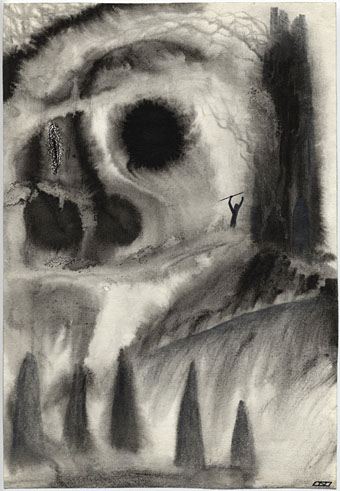
The Lurker at the Threshold (1982) by John Coulthart.

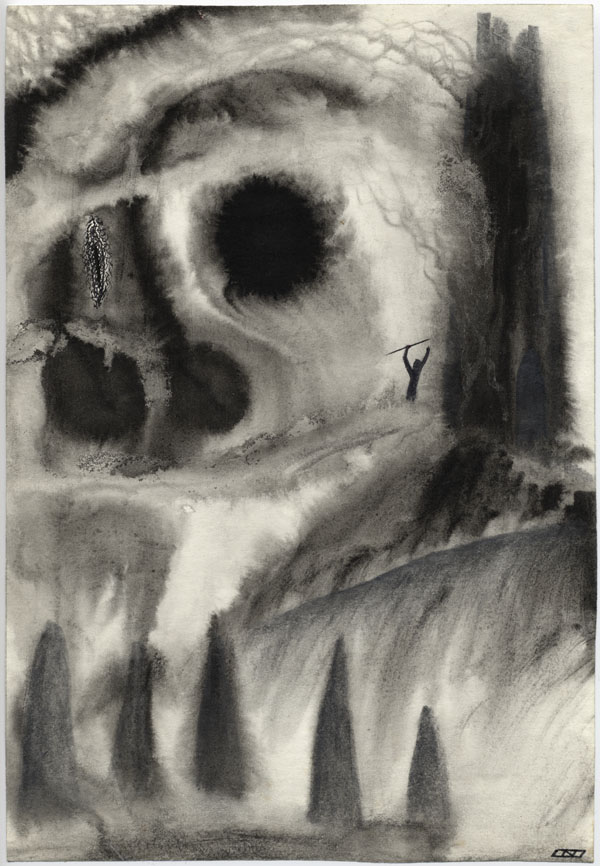
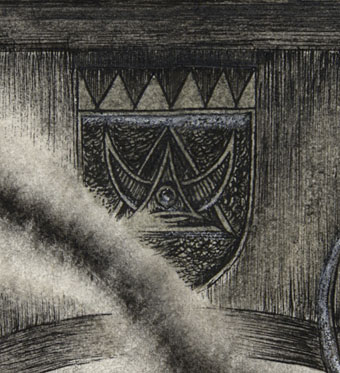
Before I began adapting The Haunter of the Dark in 1986 I hadn’t made much of an attempt to illustrate Lovecraft seriously. These drawings and a handful of other pieces were more like experimental sketches, although The Gable Window is obviously a very polished piece of work. Rather than depict anything overtly monstrous, each piece began as an arrangement of ink splotches and washes applied to cartridge paper soaked with water. The Lurker at the Threshold is one of several small pictures made with this technique in 1982, none of which are very successful. This one doesn’t look too bad but the best one, depicting the climax of The Dunwich Horror, I sent to the late Roger Dobson for possible use in an issue of Aklo, and haven’t seen it since. The Gable Window refined the technique by using fewer splotches and a more detailed drawing applied afterwards. I’ve never been happy with the figure, and the books on the left are lazily done, but it’s one of the better things I was doing in 1984. The biggest surprise looking at the drawing again was noticing the crest over the window which features a triangle/crescent motif that’s very similar to the one I designed a year later for Hawkwind’s Chronicle of the Black Sword album. This wasnt intentional.
gable-detail.jpg

Today The Gable Window seems like an indicator of where my head was at during this time. I was tired of doing Hawkwind-related things, and eager to immerse myself in something different; a series of Ballard illustrations was one potential way forward, Lovecraft was another. A year later I’d made a decision and, as it were, stepped through the window.

Elsewhere on { feuilleton }
The Lovecraft archive

NecronomiCon Providence 2015

necro.jpg

Next month I’ll be in Providence, Rhode Island, where I’m the Artist Guest of Honour for NecronomiCon Providence 2015. This is an honour for me in more ways than one: the city of Providence, or its representation in the spectral prose of HP Lovecraft, has occupied a fair amount of my creative life, especially in the comic-strip adaptations I was drawing in the 1980s. I just hope the citizens of Providence can forgive the liberties I took with the city’s architecture in The Haunter of the Dark where the buildings owe far more to the architecture of Scotland than they do to New England.

lm19.jpg

A nameless entity from Lovecraft’s Monsters (2014).

The main event where I’m concerned will be the Ars Necronomica art show at the Providence Art Club on Thomas Street. This is a few doors away from the beautiful Fleur-De-Lys Studios, a building that Lovecraft mentions in The Call of Cthulhu, and which (having done some research this time) filled a panel in my adaptation. In the story the building is the home of eccentric artist Henry Wilcox so it’s a dizzying prospect to find my own art being exhibited a few doors away. Among my works there will be print enlargements of some of the illustrations from last year’s Lovecraft’s Monsters, Ellen Datlow’s expertly edited collection of recent Lovecraftiana; and the piece I created in 2007 for the Exhibition of Unspeakable Things at Maison d’Ailleurs, Switzerland, has been refashioned especially for this show. My work isn’t the only art on display, there’ll be contributions from 50 other artists which I think must make the event one of the largest Lovecraftian art shows staged anywhere. The show opens on August 11th but the official opening will be on the 20th which happens to be Lovecraft’s 125th birthday. Big thanks to Joe Shea, Niels Hobbs et al for arranging everything.

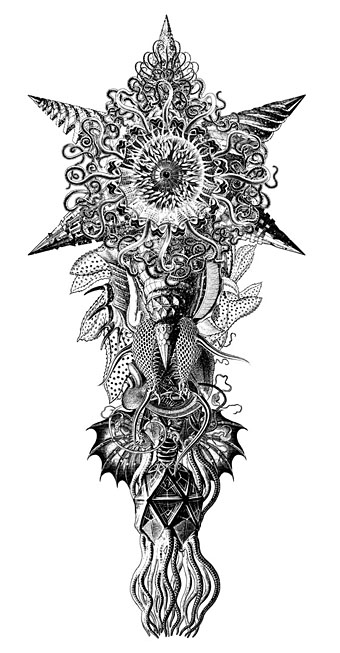
The convention begins on the 21st, and rather than attempt to summarise the astonishing range of events it’s easier to provide links to the main schedule and the additional programming. For anyone interested in attending, there are still day passes available, while many of the additional events are open to the public. Oh, and I’ve also designed the cover for the convention booklet so attendees will be able to get their copy defaced by my signature. (I’m probably making work for myself here, aren’t I?) And I’ve just noticed that there’s a preview of the booklet cover on the convention Facebook page.

Elsewhere on { feuilleton }
The Lovecraft archive