Single sleeves

singles01.jpg

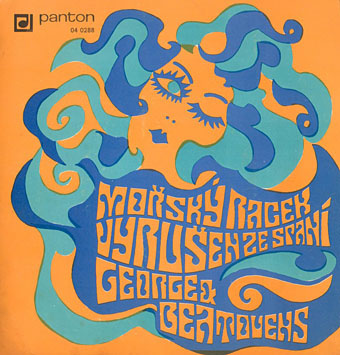
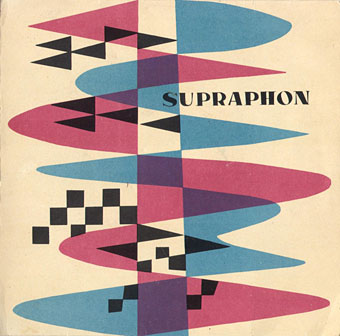
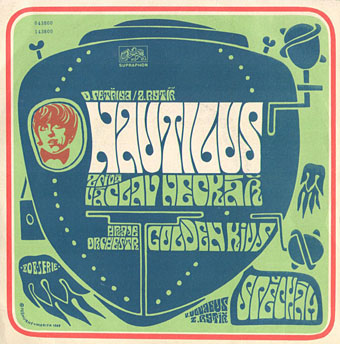
A septet of 7-inch single sleeves from Eastern Bloc Songs, a small but well-selected repository of sleeve art from the record labels of the Eastern Bloc. I’d looked at the album art before but had missed the singles, some of which feature more impressive designs than their 12-inch counterparts. Of special interest are designs that show how the psychedelic styles of the decadent West were transmuted for a Communist audience. The Nautilus sleeve above dates from 1969, and uses the lettering adapted by Wes Wilson from a much earlier design by Alfred Roller. Elsewhere the generic sleeves from venerable Czech label Supraphon stand out for their modish graphics. (Via Record Envelope and Things Magazine.)

singles02.jpg

singles03.jpg

Continue reading “Single sleeves”

London: Signs and Signifiers

nico01.jpg

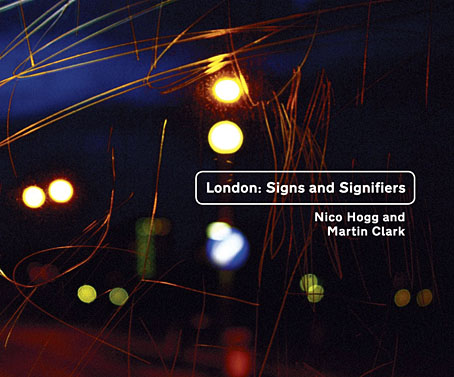
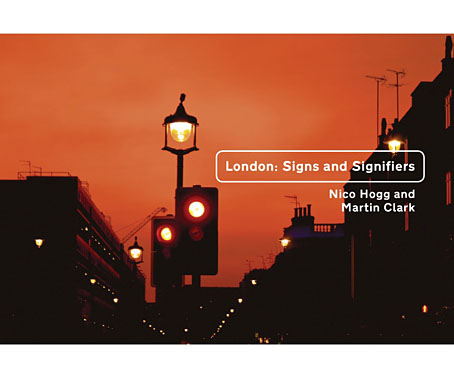
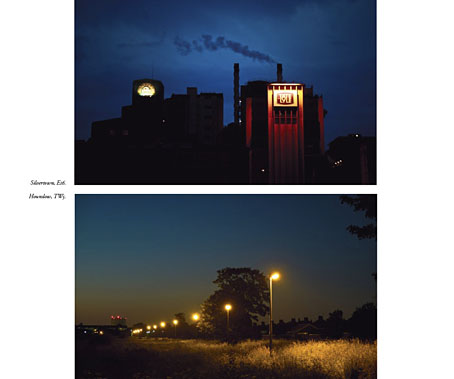
By coincidence, two of the projects I was working on in the summer are released this week. First up is London: Signs and Signifiers, a collection of Nico Hogg’s photographs of the streets and architecture of London’s East End. I’ve mentioned Nico’s photography before as his pictures have been used on several of the albums and singles I’ve designed for Keysound Recordings, some of which are featured in the book. This is being published as part of the Keysound catalogue, with a launch event taking place today (the 8th) at the Doomed Gallery, London. See this post for details, and a link to download a free chapter.

nico02.jpg

Nico’s work is notable for the way it avoids the stereotype of the style of urban photography that presents deprived or run-down areas in grim monochrome. Nico doesn’t avoid the decay—there are shots of burned-out flat-blocks, and a chapter devoted to the recent Tottenham riots—but the colour in his pictures shows a different side to these areas of the city.

nico03.jpg

My design for the book follows the minimal approach I’ve used on the Keysound albums, organising the information clearly and giving the photos as much room as possible. The font used for the titles and chapter headings is Transport, the typeface designed by Jock Kinneir and Margaret Calvert used on roads signs throughout the UK.

nico04.jpg

Continue reading “London: Signs and Signifiers”

Weekend links 267

morgan.jpg

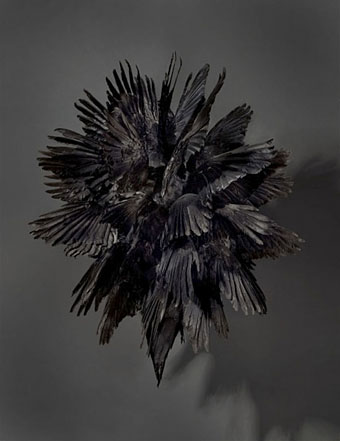
Black Fever (2010) by Polly Morgan.

• “She was something of an Auntie Mame figure for me. We spent years haunting secondhand bookstores in Berkeley, Los Angeles, and New York, talking for hours over ever more bizarre dishes of Chinese Hakka cuisine in a hole-in-the-wall eatery at Stockton and Broadway in San Francisco, watching Kenneth Anger flicks and the surrealistic stop-motion puppet masterpieces of Ladislas Starevich, which Tom Luddy would screen for us at the Pacific Film Archive, over and over again until our eyeballs nearly fell out.” Steve Wasserman remembers Susan Sontag.

California Dreams is “the first career-spanning compendium of Mouse’s work; it includes his recent landscapes and figurative paintings. Taken as a whole, the work is a weird, gilded, space-age, flame-licked way to chart the rise of late-twentieth-century youth culture”. Jeffery Gleaves on the psychedelic art of Stanley Mouse.

• “Not only does moral preoccupation corrupt the artfulness of fiction, but fiction is an inefficient and insincere vehicle for moralizing,” says Alice Gregory, joining Pankaj Mishra to address the question: “Do Moralists Make Bad Novelists?”

Nabokov’s posthumously published Lectures on Literature reprints a corny magazine ad that Nabokov liked to show to his students at Cornell, as an example of a certain kind of sunny American materialism and kitsch (or poshlost, in Russian): it’s an ad for flatware featuring a young housewife, hands clasped, eyes brimming as she contemplates a place setting. Nabokov titled it “Adoration of Spoons,” and it undoubtedly played a significant role in his creation of the suburban widow Charlotte Haze. From such strangely endearing trash was a masterpiece born.

John Colapinto reviewing Nabokov in America by Robert Roper

• “How many typefaces is too many typefaces?” asks Adrian Shaughnessy. “What happens to our ability to discriminate and exercise good judgment when we have a near-infinite number of possibilities?”

• At BUTT: a clip from one of the more dreamlike scenes in Wakefield Poole’s gay porn film, Bijou (1972). Poole’s “sensual memoir”, Dirty Poole, is published by Lethe Press.

John Banville reviews The Prince of Minor Writers, selected essays of Max Beerbohm edited by Phillip Lopate.

• My thanks once again to Dennis Cooper for featuring this blog on his list of cultural favourites.

• More Moogery: Sarah Angliss, Gazelle Twin and Free School in the Moog Sound Lab.

• Mix of the week: XLR8R Podcast 394 by Francesca Lombardo.

Atlas Obscura gets to grips with the enormous Devil’s Bible.

Feel You, a new song by Julia Holter.

Spoonful (1960) by Howlin’ Wolf | Spoon (1972) by Can | Spoon (2013) by Mazzy Star

Weekend links 265

rainbowhouse.jpg

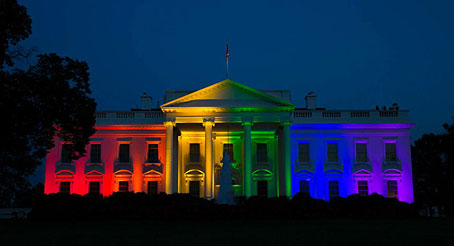
The White House, Washington DC, on the evening of June 26, 2015.

I can remember that after the cops cleared us out of the bar we clustered in Christopher Street around the entrance to the Stonewall. The customers were not being arrested, but a paddy wagon had already hauled off several of the bartenders. Two or three policemen stayed behind, locked inside with the remaining members of staff, waiting for the return of the paddy wagon. During that interval someone in the defiant crowd outside called out “Gay Power”, which caused us all to laugh. The notion that gays might become militant after the manner of blacks seemed amusing for two reasons—first because we gay men were used to thinking of ourselves as too effeminate to protest anything, and second because most of us did not consider ourselves to be a legitimate minority.

At that time we perceived ourselves as separate individuals at odds with society because we were “sick” (the medical model), “sinful” (the religious model), “deviant” (the sociological model) or “criminal” (the legal model). Some of these words we might have said lightly, satirically, but no amount of wit could convince us that our grievances should be remedied or our status defended. We might ask for compassion but we could not demand justice. Many gays either were in therapy or felt they should be, and the words gay liberation would have seemed as preposterous to us as neurotic liberation (now, of course, Thomas S. Szasz in the United States, RD Laing in Britain and Felix Guattari on the Continent have, in their different ways, made even that phrase plausible enough).

What I want to stress is that before 1969 only a small (though courageous and articulate) number of gays had much pride in their homosexuality or a conviction that their predilections were legitimate. The rest of us defined our homosexuality in negative terms, and those terms isolated us from one another. We might claim Plato and Michelangelo as homosexuals and revere them for their supposed affinities with us, but we could just as readily dismiss, even despise, a living thinker or artist for being gay. Rich gays may have derived pleasure from their wealth, educated gays from their knowledge, talented gays from their gifts, but few felt anything but regret about their homosexuality as such. To be sure, particular sexual encounters, and especially particular love relationships, were gratifying then as now, but they were explained as happy accidents rather than as expected results.

Edmund White writing on The Political Vocabulary of Homosexuality (1980). Reprinted in The Burning Library: Writings on Art, Politics and Sexuality (1994).

• “…after seeing Don’t Look Now, The Wicker Man looked just so dull and flat. What Don’t Look Now has that The Wicker Man doesn’t is a complete mastery of cinema. Don’t Look Now is almost a silent movie, a brilliant, coherent, original and fantastic film that has an enormous emotional impact.” Bernard Rose emoting at length about Nicolas Roeg. Related: Wild Hearts Run Out Of Time, the Roy Orbison video that Rose mentions directing.

• “The male sex organ is depicted not so much as a body part, but more as a fetish object in its own right—a thing independent of the male body, worthy of intense, delirious veneration.” Jason Farago reviewing Tom of Finland: the Pleasure of Play. Related: Same-sex desire through the ages at the British Museum.

• “Sphinx is a typical love story only in the way that it’s the tale of two people who have fallen in love, and things don’t go smoothly. Beyond that…as reader, you have no idea of the gender of either half of this romantic equation.” Chris Clarke reviewing Sphinx, a novel by Anne Garréta.

• “To give space to the musical elements was really a thrill—how far can you get without using too much stuff?” Moritz von Oswald on “the sounds of emptiness”.

• “The problem is not always Helvetica but that Helvetica is all too often the default, the fall-back, the I-really-can’t-be-arsed choice,” says John Boardley.

• Mix of the week: Shaft’s Old Man: An Imaginary Soul Jazz Soundtrack by Aquarium Drunkard.

• “What is the Cut-Up Method?” Ken Hollings explains in a BBC magazine piece and radio feature.

• Nigel Kneale’s Quatermass, the final TV serial, will be released on Blu-ray next month.

• Relevant to the week’s reading: an archived Italo Calvino site.

Drÿad: a Tumblr.

Sphinx (1989) by Syd Straw | The Sodom And Gomorrah Show (2006) by Pet Shop Boys | Pattern 1 (2009) by Moritz Von Oswald Trio

English printers’ ornaments

ornaments01.jpg

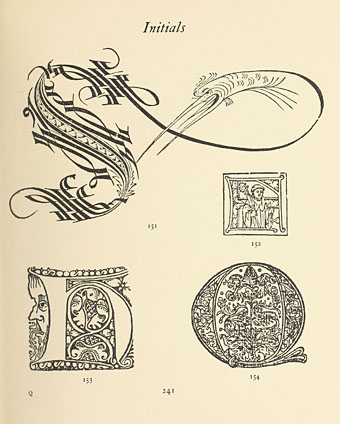
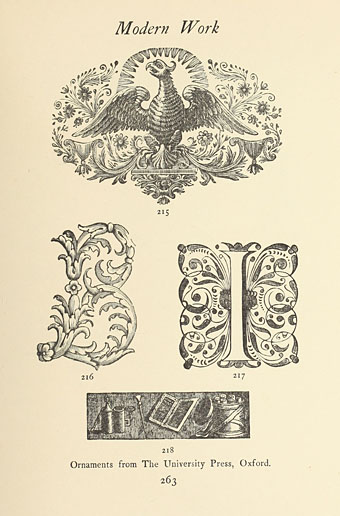
As a book designer you can never have too many printers’ ornaments, especially if you’re required to mimic period designs. These are from a historical overview, English Printers’ Ornaments (1924) by Henry Robert Plomer. Ideally I’d prefer several volumes gathering hundreds of these things from different periods but such a hoard seems a distant dream. Collections like this, and contemporary ones by Dover et al, usually have to suffice instead.

ornaments06.jpg

Continue reading “English printers’ ornaments”