Tuxedomoon on La Edad de Oro, 1983

tuxedomoon1.jpg

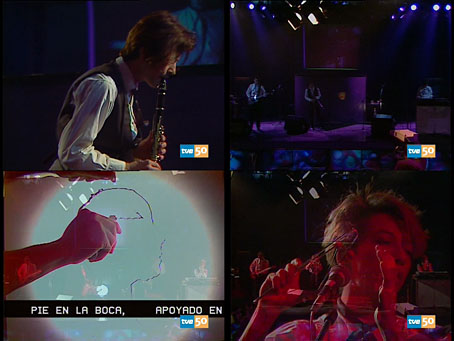
La Edad de Oro (The Golden Age) was a Spanish television show which only ran from 1983 to 1985 but during that time it managed to cause a considerable stir, first by showcasing in lengthy programs many musical groups that would have been unknown to the Spanish public (or the public of their native countries, for that matter), and secondly by scandalising that public with irreligious performances from some of those bands. La Edad de Oro was part of a general attempt to bring Spain up to speed with the rest of European culture following the end of the Franco regime, as a result of which a number of leftfield groups were given far more attention than they would have received in the UK. Psychic TV were one of the groups offered a carte blanche two-hour slot, and I remember Genesis P Orridge mentioning this with some surprise in interviews.
tuxedomoon2.jpg

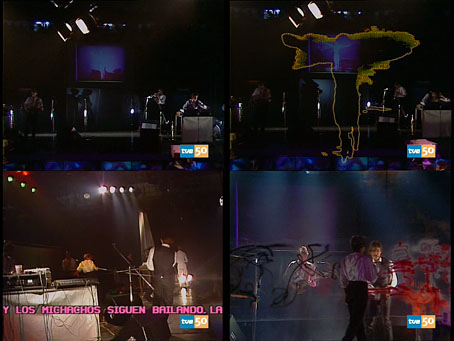
Tuxedomoon’s own edition of La Edad de Oro was broadcast on May 24, 1983. I’ve been fortunate to acquire a pristine copy of a later screening from one of the tape trading sites, and it’s a remarkable thing, cutting between couch interviews with the band members and a complete studio performance of their songs. The latter can been seen on YouTube, of course, so there’s no need to go hunting down rare files. This is the first Tuxedomoon concert I’ve seen, I don’t recall them ever being on British TV although some of their videos must have been screened somewhere. What’s fascinating is seeing how theatrical their performance is. In addition to screening some of Bruce Geduldig’s films on a backdrop, there are shadow vignettes and bits of stage play such as the ropes that bind each of the band members together during The Cage. Later on, Blaine Reininger and Winston Tong graffitise a sheet of film stretched over the stage. (Tuxedomoon’s “Joeboy” designation originated in some San Francisco street art.) I’m wondering if the rope business was borrowed from David Bowie: in the Cracked Actor film he does a similar thing during the Young Americans tour.

Wikipedia has a list of La Edad de Oro‘s artistas invitados not all of which are essential—China Crisis…please—but I’d love to see some of the other editions, the Cabaret Voltaire one especially. Time to go hunting.

Previously on { feuilleton }
Tuxedomoon designs by Patrick Roques
Pink Narcissus: James Bidgood and Tuxedomoon
Weekend links 213

munro.jpg

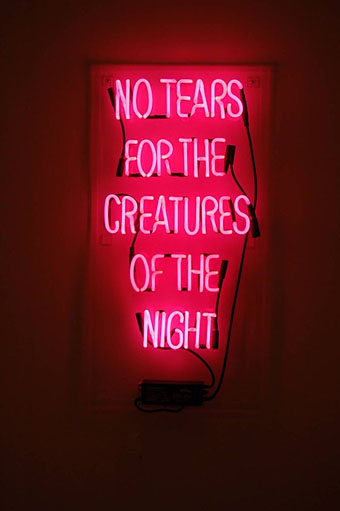
No Tears for the Creatures of the Night (2005) by Will Munro.

• Steve Barker’s On The Wire show on BBC Radio Lancashire is one of the longest-running music shows on British radio but it’s not broadcast in London so you seldom hear it mentioned at all. (It’s also the only radio show I’ve appeared on, oddly enough.) Some of Barker’s shows, which predominantly feature dub and reggae artists, can now be heard at Mixcloud.

• “As protagonist after protagonist is undone by temptation and lust, one can’t help but divine a sinister double entendre in the book’s title – something nocturnal and obscene.” James Lovegrove on the reissue of Robert Aickman’s 1964 collection of “strange stories”, Dark Entries.

Coil vs. Kenny Loggins sounds like no contest, and so it proved in 1988 at the Mike Tyson/Michael Spinks fight. There’s another surprising connection between Tyson and Industrial culture with the poster that Neville Brody designed for the boxer’s Tokyo bout.

Ventriloquism: Unheimlich manoeuvres: Sarah Angliss (who performs as Spacedog) on the history of ventriloquist dummies. With a bonus appearance from the great Ray Alan and Lord Charles. Related: the Vent Haven Museum.

• I’ve been wanting to read Proust’s À la recherche du temps perdu for years but always hesitate over which translation to choose. As Leland de la Durantaye shows, the arguments about translating Proust into English are still unresolved.

Music For A Good Home 3: a collection of 31 rare or unique tracks by a variety of artists including Belbury Poly, Pye Corner Audio, and Grumbling Fur. All proceeds go to Shelter.

David Cronenberg – The Exhibition is running throughout the summer at the EYE Film Institute in Amsterdam showing props and other materials from the director’s films.

• “’I’m in pictures,’ John Wayne explained when Nabokov cordially inquired about his line of work.” Blake Bailey on Vladimir Nabokov’s unpublished Lolita screenplay notes.

• Original artwork for the Linweave Tarot (1967) at Sweet Jane’s Pop Boutique. As noted before, the full set of cards is probably the grooviest ever created.

• Mixes of the week: Secret Thirteen Mix 118 by Ensemble Economique, and a Wyrd Daze Solstice mix from The Ephemeral Man.

• At One With Chaos & Abandonment: The Irrepressibles’ Jamie McDermott talks to Joseph Burnett about his music.

From the Zodiacal Light, a new track from Earth with vocals by Rabia Shaheen Qazi.

• The Ultimate Chinatown Filming Location Map of Los Angeles.

Tuxedomoon at Pinterest.

Dark Companion (1980) by Tuxedomoon | Dark River (1990) by Coil | Dark Turn Of Mind (2011) by Gillian Welch

Weekend links 211

shau.jpg

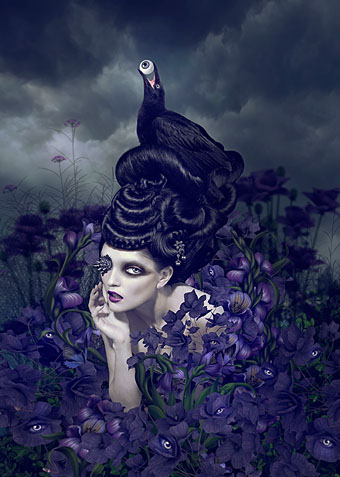
Secret Bloom (2014) by Natalie Shau.

Bloomsday approachs. “Reading Ulysses changed everything I thought about language, and everything I understood about what a book could do,” says Eimear McBride whose debut novel, A Girl Is a Half-formed Thing, recently won the first Bailey’s women’s prize for fiction. McBride was interviewed by Susanna Rustin last month, shortly before the award was announced, and her novel has now become one of those minor causes célèbres for being rejected so often it was eventually published by a new imprint set up by a bookseller. “If the publishing industry doesn’t take a risk then who will?” asks Henry Layte, the bookseller in question.

Speaking of risk, David Hebblethwaite coincidentally wrote a post earlier this week asking where the formal challenge has gone in science-fiction writing. (He mentions McBride in passing.) Nina Allen followed up with a post of her own. I suspect the books are still being written but they’re no longer being accepted by editors and publishers who want even more adventure stories, “sympathetic” characters, and easy reads. Novels that only aspire to be written equivalents of action films or computer games are doomed to be less exciting than their more kinetic competitors. The struggle between the values of art and the values of entertainment is an old one but it shouldn’t be an either/or proposition. “Difficulty is subjective,” says Eimear McBride, “the demands a writer makes on a reader can be perceived as a compliment.”

Related: the following from Geoffrey Hill on “difficulty”:

We are difficult. Human beings are difficult. We’re difficult to ourselves, we’re difficult to each other. And we are mysteries to ourselves, we are mysteries to each other. One encounters in any ordinary day far more real difficulty than one confronts in the most “intellectual” piece of work.

• The Quietus pulled out all the stops this week, interviewing Annette Peacock, Iain Sinclair (again), Alan Moore (again), and asking Peter Strickland, the director of Berberian Sound Studio, for a list of his favourite albums. Given the above, it’s worth noting that all those people have produced challenging work of their own in different media.

• “The Satyrs Motorcycle Club was founded in 1954 with seven members, but little did anyone know it would become the oldest running LGBT organization (and oldest gay motorcycle club) in the world.”

Trunk TV posted another great selection of television title sequences. The previous selection has been taken down for the usual tiresome copyright reasons so watch this one while you can.

• “Detroit techno and black metal have so much in common,” say Wolves In The Throne Room whose new album, Celestite, is predominantly a product of synthesizer technology.

• “Houghton Library’s copy of Arsène Houssaye’s Des destinées de l’ame (FC8.H8177.879dc) is without a doubt bound in human skin.”

• The secret of Nabokov’s sexual style: David Lodge reviews Nabokov’s Eros and the Poetics of Desire by Maurice Couturier.

• How long can you hold your breath? 2 models, 7 divers in an underwater shipwreck by photographer Von Wong.

• At Dangerous Minds: Paul Gallagher on The fantastic world of Sharmanka Kinetic Theatre.

• Wizards of the Coast: Benjamin Breen on John Dee and the occult in California.

• More photography: Peter Guenzel captures strange lights in forests.

• Mix of the week: Bleep podcast 121 presented by Margot Didsbury.

I’m The One (1972) by Annette Peacock | Eros Arriving (1982) by Bill Nelson | The Dire And Ever Circling Wolves (2005) by Earth

RS Sherriffs’ Tamburlaine the Great

sherriffs01.jpg

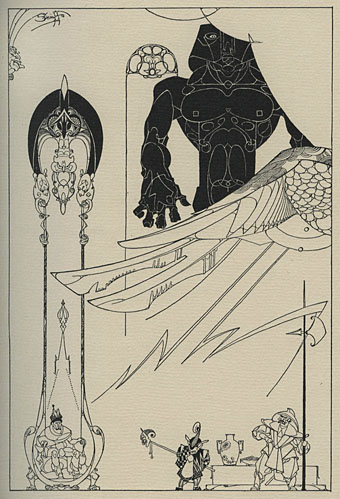
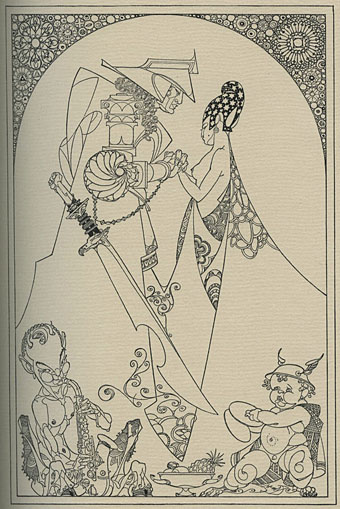
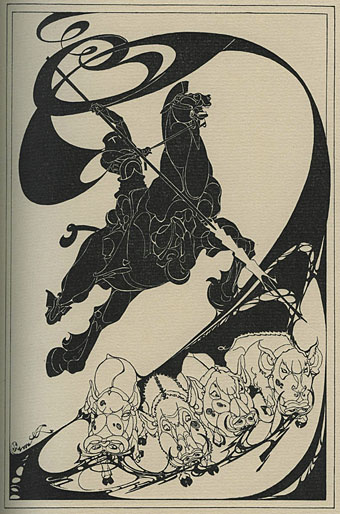
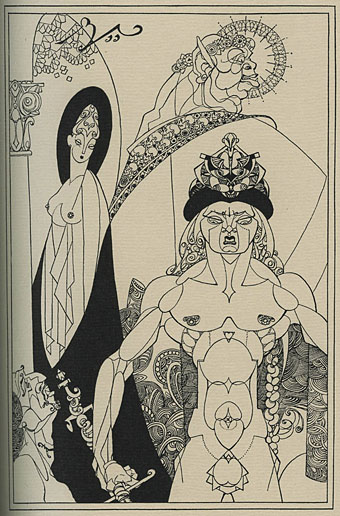
I would have posted this by now if it hadn’t been for the recent unpleasantness. Robert Stewart Sherriffs (1906-60) was a Scottish artist who I confess I hadn’t come across before until Nick H (thanks, Nick!) drew my attention to this book at silver-gryph’s eBay pages. Sherriffs’ illustrated edtion of The Life and Death of Tamburlaine the Great by Christopher Marlowe was published in a limited edition in 1930.

The drawings are black-and-white throughout, and of such a quality you have to wonder why Dover or someone hasn’t done a reprint. The general approach owes much to the usual suspects, notably Aubrey Beardsley and Harry Clarke, but there’s a development of these earlier styles that you also find in the work of Ray Frederick Coyle and Beresford Egan. In addition to the full-page plates Sherriffs also provided a number of insect vignettes, the last of which is a Death’s-head Hawkmoth.

sherriffs02.jpg

sherriffs03.jpg

sherriffs04.jpg

Continue reading “RS Sherriffs’ Tamburlaine the Great”

Paul Konewka’s Faust

faust01.jpg

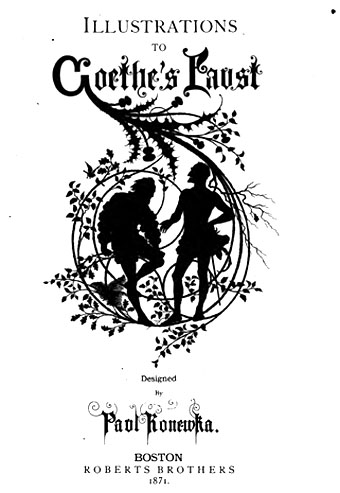
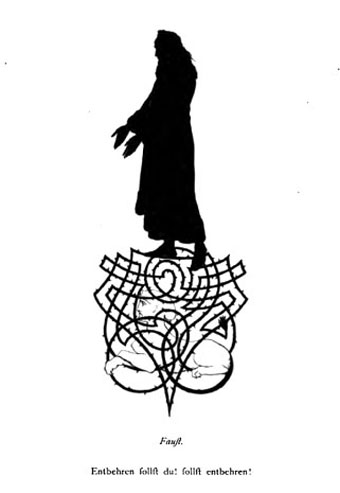
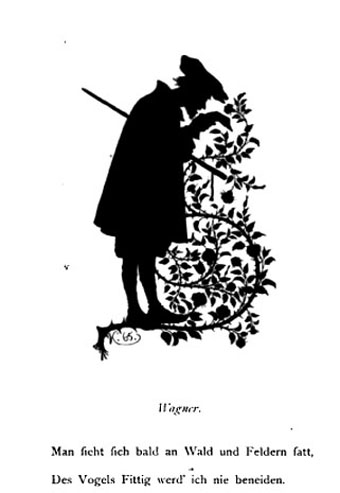
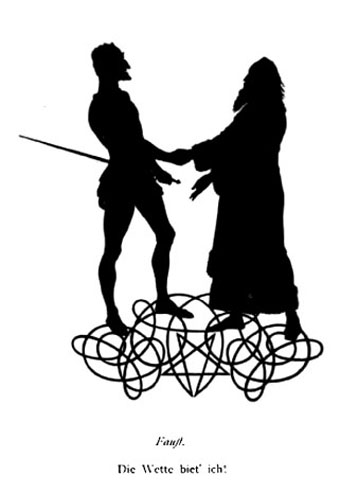
Discovered via the GoetheZeitPortal, these illustrations for Faust by German artist Paul Konewka (1841–1871) date from 1865, although the copies here are from a later edition. Konewka was a silhouette cutter so while these may look like ink illustrations they’re actually paper silhouettes displaying a formidable level of detail and complexity. Whatever the technique, the story itself is immediately recognisable from the characters even if none of the more dramatic scenes are represented. There aren’t many books you could treat in this fashion since the story has to be almost universally familiar; Shakespeare would be an obvious candidate—Konewka subsequently produced illustrations for A Midsummer Night’s Dream—fairy tales (like Arthur Rackham’s Sleeping Beauty), and also Lewis Carroll’s Alice books come to mind.

The copies shown here are from another shoddy Google scan at the Internet Archive but you do get to see all the pages. The Goethe site has better copies of the illustrations.

faust02.jpg

faust03.jpg

faust04.jpg

Continue reading “Paul Konewka’s Faust”