
Weekend links 57

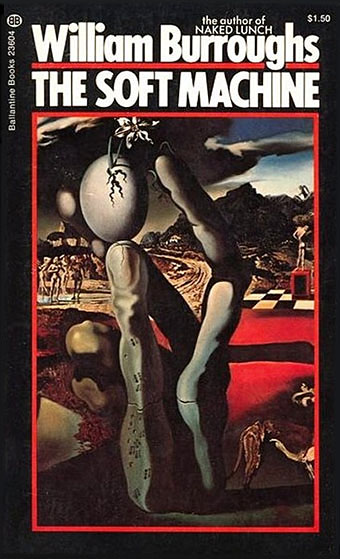
softmachine.jpg

A 1973 Ballantine edition of William Burroughs’ novel with a cover illustration from Metamorphosis of Narcissus (1937) by Salvador Dalí. Via the Burroughs Book Covers archive.

The Sel Publishing House, Turkey, published a new translation of The Soft Machine by William Burroughs in January, an edition which is now under investigation by the Istanbul Prosecutor’s Office following a report by the (deep breath) Prime Ministry’s Council for Protecting Minors from Explicit Publications. The Council lodged a number of complaints, among them assertions of “lacking unity in its subject matter,” “incompliance with narrative unity,” “using slang and colloquial terms” and “the application of a fragmented narrative style.” Details here. Does Turkey still want to join the EU? Because this kind of persistently illiberal bullshit (see the earlier treatment of Orhan Pamuk) isn’t helping their case at all.

• Related to the above: Evan J Peterson reads Allen Ginsberg’s Howl in the toilet of a Seattle gay bar; Ginsberg himself reads Kaddish and other works here.

• More illiberal bullshit: LGBT activists arrested during royal wedding; Queer Resistance released a statement about the arrests. MPs, activists and trade unionists condemn new attacks on the right to protest.

The Dorian Gray That Wilde Would Want Us To Read. Harvard University Press publishes an uncensored and annotated edition of Wilde’s novel. Kudos for using Caravaggio’s Narcissus on the cover.

One weekend in late 1967, they all decamped to a hotel suite in California’s Ojai Valley for a brainstorming session. Amid clouds of pot smoke, they talked all weekend with the tape recorder running. [Jack] Nicholson then took the tapes and turned the conversations into a screenplay; according to Rafelson, he structured it while on LSD.

Revisiting The Monkees’ psychedelic movie, Head.

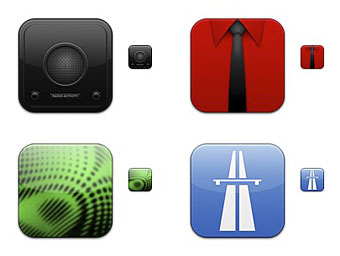
kraftwerkicons.jpg

Kraftwerk icons for Windows and Mac OS X by Dave Brasgalla.

Robert Louis Stevenson gets his revenge on sneaky literary agent – 120 years later. And Michael Moorcock imagines tales of unseen Mervyn Peake pictures.

Painting doesn’t look so good on the web. It looks better in life. Sculpture looks better in life. What you end up with is just a reproduction. Whereas with film or with sound or with poetry, you get the deep primary experience not the secondary experience. The web delivers those primary experiences very well.

Ubuweb’s Kenneth Goldsmith interviewed.

• Arkhonia’s Another Dispatch in a World of Multiple Veils is now a free download.

• The story of This Is The Sea: An interview with Mike Scott of The Waterboys.

Fairlight: The Rolls Royce of synthesizers.

Haeckel Clock, a free app for the iPad.

What is totalitarian art?

Porpoise Song (1968) by The Monkees | Hope For Happiness (1969) by The Soft Machine | I’m A Believer (1974) by Robert Wyatt.

Weekend links 49

ceranic1.jpg

Star City by Tomislav Ceranic.

• Noted in the blogosphere this week: A Journey Round My Skull underwent a transmutation into 50 Watts; a blog devoted to artist, designer & illustrator Jessie M King; “The arts and musicks of the supranatural” at Secret Lexicon; From the Farm, Railroads, Sewing Machines & Beyond, lengthy reminiscences from a long life in America.

Barney Bubbles in Wonderland, in which the designer and his chums indulge in some Carrollian shenanigans somewhere in the 1960s. The resulting footage is now a promo video for Balloon Race by Bear Driver.

HP Lovecraft’s favourite words, the desert island books of Jorge Luis Borges, a profile of Christopher Isherwood, and Edward Gorey again.

[Arthur] Machen explicitly talks about the strength of London, as opposed to Paris, in that London is more chaotic. Although he doesn’t put it in these words, I think what partly draws him to London is this notion that, in the absence of a kind of unifying vision, like Haussmann’s Boulevards, and in a city that’s become much more syncretic and messy over time, you have more room to insert your own aestheticizing vision.

China Miéville in a great interview at BLDGBLOG.

Matryomin is “the unique, original erectronic [sic] musical instrument invented by Masami Takeuchi in 2000”. Yes, a theremin inside a Russian doll. The Mable ensemble playing Duke Ellington’s Caravan is, well…I’m still speechless. And there’s also this.

Conductor turns the New York subway system into an interactive string instrument.

ceranic2.jpg

Discordia by Tomislav Ceranic.

Amazingly enough, prostitution was legal during the Victorian period. There were tons of brothels all over the major cities of England, and of all different kinds. There were lots of flagellation brothels; these were places where primarily men would go to be whipped by women or by men. There were also gay male brothels. You could go to a park in London at night, pick up what were called the “park whores” and give them a very small amount of money to have sex openly in the park. I also write about gay “cruising,” which was quite common. If you knew the right place to go and knew the right signals, you could pick up a man on the street and have sex in an alley.

Deborah Lutz is interviewed about her book Pleasure Bound: Victorian Sex Rebels and the New Eroticism.

Cult-ure: Ideas can be dangerous, a book by Rian Hughes.

Chernobyl: Europe’s strangest wildlife refuge.

The Eadweard Muybridge Online Archive.

Aubrey Beardsley at Tumblr.

Caravan (1959) by Martin Denny | Caravan (1961) by 80 Drums Around The World | Caravan (1962) by Sir Julian | Caravan (1965) by The Ventures | Caravan (1973) by Enoch Light & The Light Brigade | Caravan (1997) by Jimi Tenor (I could go on and on, yes I could…)

The Peacock Clock

peacockclock1.jpg

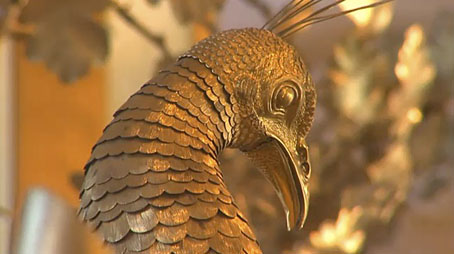
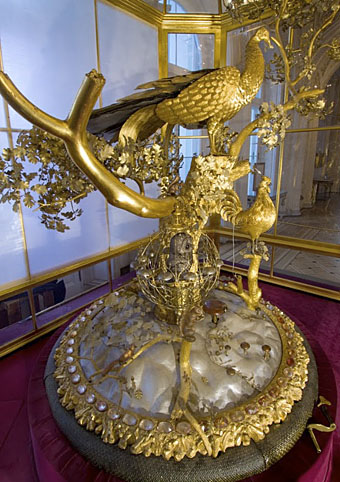
Something discovered courtesy of the Google Art Project is James Cox’s splendid Peacock Clock automaton, an exhibit at the Hermitage Museum, St Petersburg:

The history of the Hermitage’s Peacock Clock begins in 1777, when the Duchess of Kingston visited St Petersburg. Balls were given in the Russian capital in honour of this wealthy and distinguished guest. Grigory Potiomkin, who met the Duchess in society, learned of James Cox’s magnificent mechanisms. Pandering to Catherine II’s passion for collecting, the Prince commissioned the celebrated craftsman to make a monumental automaton with a clock for the Empress’s Hermitage. In order to meet this expensive order as quickly as possible, Cox, whose financial affairs were currently not in the best of health, decided to use an existing mechanical peacock that featured in the Dublin lottery. He expanded the composition with a cockerel, owl and a clock mechanism with a dial incorporated into the head of a mushroom, and removed the snakes. To create his new automaton, Cox recruited the assistance of Friedrich Jury, a German craftsman who had settled in London. (More.)

The snakes referred to were from an earlier work which Cox used to create this one, and the Google view shows a snake-like base to the construction. Google shows us all the detail but to see the clock in action we need YouTube. Astonishing work even if the crowing rooster spoils things a little. Cox was the first owner of the equally remarkable (and arguably more beautiful) Bowes Swan automaton which was featured here some time ago.

peacockclock2.jpg

Previously on { feuilleton }
Ghost clocks
Mystery clocks
Skeleton clocks
The Midsummer Chronophage
Andrew Chase’s steel cheetah
The Corpus Clock
The Bowes Swan

The Ambassadors in detail

holbein1.jpg

Some revelations courtesy of a new venture, the Google Art Project, in which we’re given the opportunity to wander some of the world’s great art galleries and examine a selection of paintings in detail. Holbein’s 1533 masterpiece, The Ambassadors, is the default work for the collection from the National Gallery, London, and it’s a great place to start, being painted in a quite astonishing hyper-realist style. I’ve seen this work in situ and despite its being a large picture it’s difficult to offer it any kind of careful scrutiny. This is partly because the more famous works in that gallery always draw an impatient crowd eager for you to get out of their way, but also because the staff there don’t like people getting too close to the paintings; I was once reprimanded by a staff member for gesticulating too closely to one of the pictures whilst discussing it with a friend.

holbein2.jpg

The Ambassadors is celebrated for its anamorphic vanitas skull (gallery visitors usually take turns viewing this from the side of the picture) and its collection of very carefully painted objects and instruments. Thanks to Google we’re now able to examine these to a degree we wouldn’t have been able to do before unless we worked for the gallery. Holbein astonishes even more when you can see how carefully he rendered so many different materials and textures. And this is only one of the works available from one of the galleries…

holbein3.jpg

Of the paintings I’ve looked at so far not all allow such ultra-magnified views but then not all paintings require this. Artists such as Titian and Turner don’t benefit from scrutiny with a magnifying glass. An initial gripe would be the lack of any thumbnail view of the paintings on offer but it seems unfair to complain, this is a great development for art lovers. I’m hoping now that the project will evolve the way Google Earth has, with the addition of other galleries and paintings. A few more details follow.

Continue reading “The Ambassadors in detail”

Passage 14

passage14.jpg

It’s that time of year again when my good friend Ed Jansen unveils the latest edition of Passage, his Dutch-language webzine:

The 14th issue of Passage contains articles about language, the dreamachine of Brion Gysin, the collaboration of Gysin with William Burroughs and Ian Sommerville (The Third Mind), a recently discovered photograph of Arthur Rimbaud’s presence in Aden, lots of photos of exhibitions and performances of artists in and around The Hague, about the experiences of Louis-Ferdinand Céline in the First World War and the latest novel of Michel Houellebecq. The purpose behind everything we write and make is to give the reader a sense of direction towards the unknown, towards the North-West Passage that leads to a new world.

The cover picture is a photo of the audience at a Dreamachine-inspired presentation by Matthijs Munnik about which we’re told:

In my performance I also make use of the flicker effect, but I have more control over it. In my performance, the audience wears white plastic masks, this way they look into a ganzfeld, a totally white field during the performance. In my set up, I use beamers, projecting light on the audience’s masks, completely immersing them in the light and colors of the projection.

I play an 8 minute live composition, based on the varying effects of different frequencies of flicker, colour, binaural beats and sound. During the performance every spectator will see something different, varying patterns and colours, created within their own brains.

And speaking of the Dreamachine, Nick Hydra left a comment in an earlier post with the news that visitors to the Wellcome Collection’s High Society exhibition in London have the opportunity to trip out with one of Brion Gysin’s flicker machines until the end of February.

Previously on { feuilleton }
Brion Gysin let the mice in
Passage 13
Passage 12
Passage 11
Passage 10