Weekend links 49

ceranic1.jpg

Star City by Tomislav Ceranic.

• Noted in the blogosphere this week: A Journey Round My Skull underwent a transmutation into 50 Watts; a blog devoted to artist, designer & illustrator Jessie M King; “The arts and musicks of the supranatural” at Secret Lexicon; From the Farm, Railroads, Sewing Machines & Beyond, lengthy reminiscences from a long life in America.

Barney Bubbles in Wonderland, in which the designer and his chums indulge in some Carrollian shenanigans somewhere in the 1960s. The resulting footage is now a promo video for Balloon Race by Bear Driver.

HP Lovecraft’s favourite words, the desert island books of Jorge Luis Borges, a profile of Christopher Isherwood, and Edward Gorey again.

[Arthur] Machen explicitly talks about the strength of London, as opposed to Paris, in that London is more chaotic. Although he doesn’t put it in these words, I think what partly draws him to London is this notion that, in the absence of a kind of unifying vision, like Haussmann’s Boulevards, and in a city that’s become much more syncretic and messy over time, you have more room to insert your own aestheticizing vision.

China Miéville in a great interview at BLDGBLOG.

Matryomin is “the unique, original erectronic [sic] musical instrument invented by Masami Takeuchi in 2000”. Yes, a theremin inside a Russian doll. The Mable ensemble playing Duke Ellington’s Caravan is, well…I’m still speechless. And there’s also this.

Conductor turns the New York subway system into an interactive string instrument.

ceranic2.jpg

Discordia by Tomislav Ceranic.

Amazingly enough, prostitution was legal during the Victorian period. There were tons of brothels all over the major cities of England, and of all different kinds. There were lots of flagellation brothels; these were places where primarily men would go to be whipped by women or by men. There were also gay male brothels. You could go to a park in London at night, pick up what were called the “park whores” and give them a very small amount of money to have sex openly in the park. I also write about gay “cruising,” which was quite common. If you knew the right place to go and knew the right signals, you could pick up a man on the street and have sex in an alley.

Deborah Lutz is interviewed about her book Pleasure Bound: Victorian Sex Rebels and the New Eroticism.

Cult-ure: Ideas can be dangerous, a book by Rian Hughes.

Chernobyl: Europe’s strangest wildlife refuge.

The Eadweard Muybridge Online Archive.

Aubrey Beardsley at Tumblr.

Caravan (1959) by Martin Denny | Caravan (1961) by 80 Drums Around The World | Caravan (1962) by Sir Julian | Caravan (1965) by The Ventures | Caravan (1973) by Enoch Light & The Light Brigade | Caravan (1997) by Jimi Tenor (I could go on and on, yes I could…)

The Peacock Clock

peacockclock1.jpg

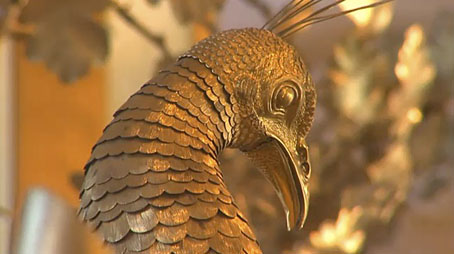
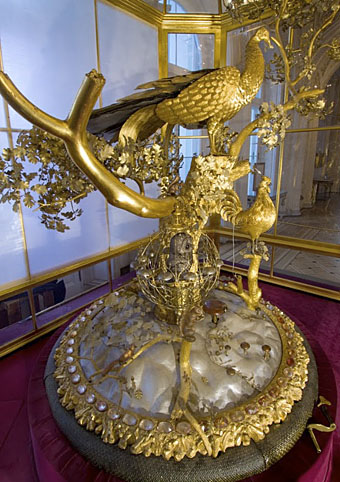
Something discovered courtesy of the Google Art Project is James Cox’s splendid Peacock Clock automaton, an exhibit at the Hermitage Museum, St Petersburg:

The history of the Hermitage’s Peacock Clock begins in 1777, when the Duchess of Kingston visited St Petersburg. Balls were given in the Russian capital in honour of this wealthy and distinguished guest. Grigory Potiomkin, who met the Duchess in society, learned of James Cox’s magnificent mechanisms. Pandering to Catherine II’s passion for collecting, the Prince commissioned the celebrated craftsman to make a monumental automaton with a clock for the Empress’s Hermitage. In order to meet this expensive order as quickly as possible, Cox, whose financial affairs were currently not in the best of health, decided to use an existing mechanical peacock that featured in the Dublin lottery. He expanded the composition with a cockerel, owl and a clock mechanism with a dial incorporated into the head of a mushroom, and removed the snakes. To create his new automaton, Cox recruited the assistance of Friedrich Jury, a German craftsman who had settled in London. (More.)

The snakes referred to were from an earlier work which Cox used to create this one, and the Google view shows a snake-like base to the construction. Google shows us all the detail but to see the clock in action we need YouTube. Astonishing work even if the crowing rooster spoils things a little. Cox was the first owner of the equally remarkable (and arguably more beautiful) Bowes Swan automaton which was featured here some time ago.

peacockclock2.jpg

Previously on { feuilleton }
Ghost clocks
Mystery clocks
Skeleton clocks
The Midsummer Chronophage
Andrew Chase’s steel cheetah
The Corpus Clock
The Bowes Swan

The Ambassadors in detail

holbein1.jpg

Some revelations courtesy of a new venture, the Google Art Project, in which we’re given the opportunity to wander some of the world’s great art galleries and examine a selection of paintings in detail. Holbein’s 1533 masterpiece, The Ambassadors, is the default work for the collection from the National Gallery, London, and it’s a great place to start, being painted in a quite astonishing hyper-realist style. I’ve seen this work in situ and despite its being a large picture it’s difficult to offer it any kind of careful scrutiny. This is partly because the more famous works in that gallery always draw an impatient crowd eager for you to get out of their way, but also because the staff there don’t like people getting too close to the paintings; I was once reprimanded by a staff member for gesticulating too closely to one of the pictures whilst discussing it with a friend.

holbein2.jpg

The Ambassadors is celebrated for its anamorphic vanitas skull (gallery visitors usually take turns viewing this from the side of the picture) and its collection of very carefully painted objects and instruments. Thanks to Google we’re now able to examine these to a degree we wouldn’t have been able to do before unless we worked for the gallery. Holbein astonishes even more when you can see how carefully he rendered so many different materials and textures. And this is only one of the works available from one of the galleries…

holbein3.jpg

Of the paintings I’ve looked at so far not all allow such ultra-magnified views but then not all paintings require this. Artists such as Titian and Turner don’t benefit from scrutiny with a magnifying glass. An initial gripe would be the lack of any thumbnail view of the paintings on offer but it seems unfair to complain, this is a great development for art lovers. I’m hoping now that the project will evolve the way Google Earth has, with the addition of other galleries and paintings. A few more details follow.

Continue reading “The Ambassadors in detail”

Passage 14

passage14.jpg

It’s that time of year again when my good friend Ed Jansen unveils the latest edition of Passage, his Dutch-language webzine:

The 14th issue of Passage contains articles about language, the dreamachine of Brion Gysin, the collaboration of Gysin with William Burroughs and Ian Sommerville (The Third Mind), a recently discovered photograph of Arthur Rimbaud’s presence in Aden, lots of photos of exhibitions and performances of artists in and around The Hague, about the experiences of Louis-Ferdinand Céline in the First World War and the latest novel of Michel Houellebecq. The purpose behind everything we write and make is to give the reader a sense of direction towards the unknown, towards the North-West Passage that leads to a new world.

The cover picture is a photo of the audience at a Dreamachine-inspired presentation by Matthijs Munnik about which we’re told:

In my performance I also make use of the flicker effect, but I have more control over it. In my performance, the audience wears white plastic masks, this way they look into a ganzfeld, a totally white field during the performance. In my set up, I use beamers, projecting light on the audience’s masks, completely immersing them in the light and colors of the projection.

I play an 8 minute live composition, based on the varying effects of different frequencies of flicker, colour, binaural beats and sound. During the performance every spectator will see something different, varying patterns and colours, created within their own brains.

And speaking of the Dreamachine, Nick Hydra left a comment in an earlier post with the news that visitors to the Wellcome Collection’s High Society exhibition in London have the opportunity to trip out with one of Brion Gysin’s flicker machines until the end of February.

Previously on { feuilleton }
Brion Gysin let the mice in
Passage 13
Passage 12
Passage 11
Passage 10

Weekend links: New Year edition

olofsdotter1.jpg

Flower Me Gently (2010) by Linn Olofsdotter.

• “Many of Moorcock’s editorials are published here, and they still make exhilarating reading. Then, as now, Moorcock set his face against a besetting English sin: a snobbish parochial weariness, an ironic superiority to the frightful oiks who have started filling up the streets. You can almost hear, behind the languorous flutter of the pages, Sir Whatsits sniggering to Lady Doo-Dah. It still goes on, and it’s usually the same flummery in different clothes. Moorcock not only would not go to the party: he threw the literary equivalent of explosive devices into the Hampstead living rooms.” Michael Moorcock’s Into the Media Web reviewed. And also here.

• “Beefheart channeled a secret history of America, the underbelly of a continent and a culture that has now all but vanished along with one of its greatest poets.” Jon Savage on the life and work of the late Captain.

Miniatures Blog, in which musician Morgan Fisher works his way through each of the fifty one-minute tracks on his extraordinary Miniatures compilation album, with details and anecdotes about the artists and the recording of each piece.

Look at Life: IN gear (1967). A Rank Organisation newsreel about Swinging London. Sardonic commentary and some great colour photography showing how the often shabby reality differs from the caricature. Many of the shots are familiar from documentaries about the era but this is the first time I’ve seen them all in one place.

olofsdotter2.jpg

Predator (Self-portrait) by Linn Olofsdotter.

Lewis Carroll’s new story: The Guardian‘s review of Through the Looking-Glass from December, 1871. Related: My Through the Psychedelic Looking-Glass 2011 calendar is now reduced in price.

The United Kingdom and Ireland as seen from the International Space Station, December, 2010. Related: Spacelog, the stories of early space exploration from the original NASA transcripts.

The “Big Basket” Fraud, 1958: “…there seems to be a limited segment with a one-track mind interested in seeing an exaggerated masculine appendage.”

• “Ancient arena of discord”: a billboard for King’s Cross by Jonathan Barnbrook. Related: Vale Royal by Aidan Andrew Dun.

• The inevitable Ghost Box link, Jim Jupp is interviewed at Cardboard Cutout Sundown.

• Amazon is still playing the random moral guardian at the Kindle store.

Antwerpian Expressionists at A Journey Round My Skull.

Salami CD and vacuum packaging by Mother Eleganza.

Paris 1900: L’Architecture Art Nouveau à Paris.

Bill Sienkiewicz speaks about Big Numbers #3.

Philippe Druillet illustrates Dracula, 1968.

Aesthetic Peacocks at the V&A.

Well Did You Evah! (1990), Deborah Harry & Iggy Pop directed by Alex Cox.