Weekend links 73

sun2.jpg

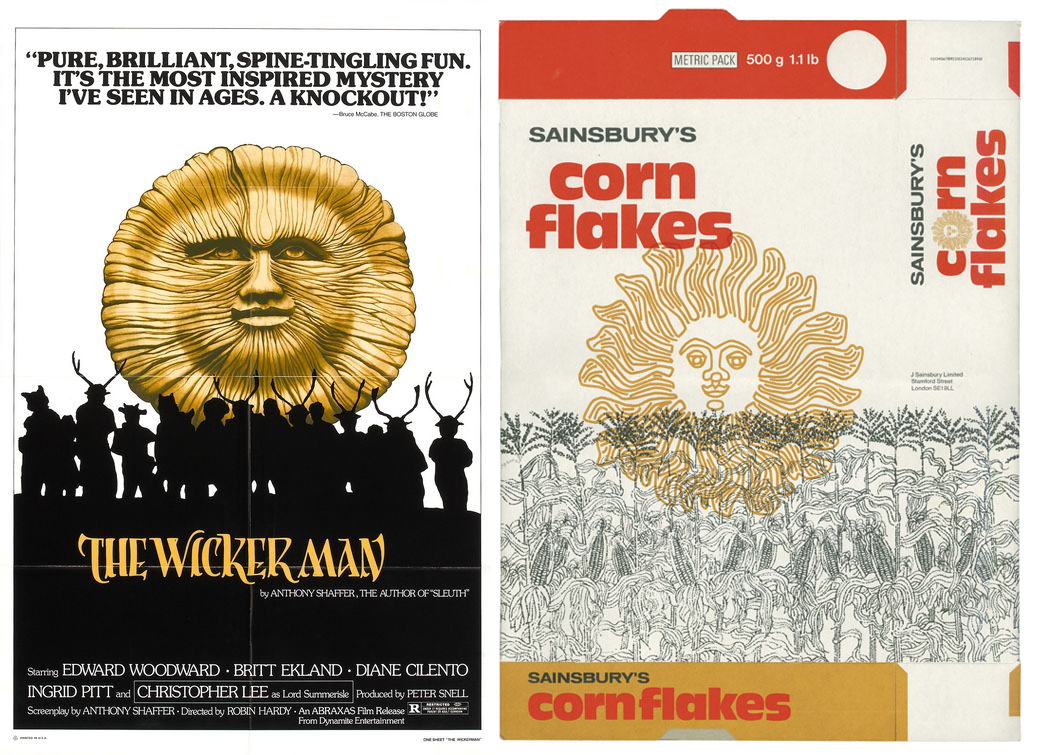
Johnny Trunk of Trunk Records reissued the soundtrack to The Wicker Man in 1997. Mr Trunk’s latest delve into the cultural past is Own Label: Sainsbury’s Design Studio, a book from Fuel examining the supermarket chain’s packaging design of the 1960s and 1970s. Creative Review shows some examples while I have to note the uncanny similarity between one of the posters for The Wicker Man and an old Sainsbury’s corn flakes box. Now we see that the Old Weird Britain wasn’t only hiding in the fields and the folk songs but was also lurking on the supermarket shelves.

Related: a new DVD set from the BFI, Here’s a Health to the Barley Mow: A Century of Folk Customs and Ancient Rural Games. And let’s not forget the ley lines of Milton Keynes, and a new edition of Ritual by David Pinner, said to be the novel which inspired The Wicker Man.

• “He wrote me…” Sans Soleil (1983), Chris Marker’s beguiling accumulation of memories, dreams and reflections, is recalled in a Quietus piece entitled Things that Quicken the Heart. Not the first time on DVD as it says there (Nouveaux Pictures released it with La Jetée in 2003) but it’s good to know it’s being reissued.

• Marker’s film references Tarkovsky’s Stalker a couple of times, most notably in the comment, “On that day there will be emus in the Zone.” Geoff Dyer has what he describes as “a very detailed study” of Stalker out next year.

I don’t like those commentators who keep on saying that London will never be the same again. London is always the same again. I remember those comments were made very loudly after the [July 2005] terrorist attacks – “London will never be the same again, London has lost its innocence” – it was all nonsense. London was exactly the same again the following day. Rioting has always been a London tradition. It has been since the early Middle Ages. There’s hardly a spate of years that goes by without violent rioting of one kind or another. They happen so frequently that they are almost part of London’s texture. The difference is that in the past the violence was more ferocious, and the penalties were more ferocious – in most cases, death.

Peter Ackroyd, reminding us that the Four Horsemen of the Apocalypse don’t wear hoodies and ride bikes.

Wolf Fifth: “rare vinyl records from the golden era of avant garde and experimental music”. And in FLAC as well, not crappy mp3; I want to hear all those scratches uncompressed, dammit!

Another great mix at FACT, this time compiled by snd who throw together Morton Feldman, Siberian shamen, Einstürzende Neubauten, Dome, Oval and many others.

• Colin Marshall asks “how weird is Australia?” in an appraisal of Nicolas Roeg’s Walkabout.

A Comprehensive Solution to the Tokyo Umbrella Problem.

• More poster art from Hapshash and the Coloured Coat.

Morbid Excess, a series of drawings by May Lim.

Conrad Schnitzler (1937–2011) by Geeta Dayal.

Neopolitan cephalopods.

Willow’s Song (1973) by Paul Giovanni & Magnet | The Willow Song (1989) by The Mock Turtles | Wicker Man Song (1994) by Nature and Organisation.

Ceramic Buddha Machines

fm3.jpg

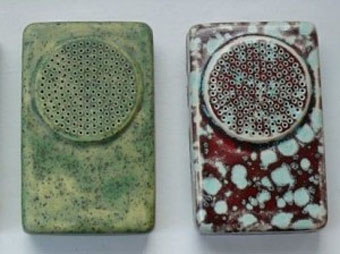
The experimentalists at Fm3 continue to impress with their commitment to unorthodox music delivery when the trend remains digital and ephemeral. Back in April they announced a new line of ceramic-bodied players for their series of Buddha Machines, that essential collection of ambient loops in a case the size of a box of matches. The new players will be available at the end of the year. Being ceramic they’re probably a little less portable than the plastic versions, and might also be more fragile. For durability and retro cachet I would have opted for Bakelite if that material is still being manufactured anywhere. (It seems it is, thanks Wikipedia.)

Back in the digital and ephemeral world, Fm3 also have a Buddha Machine app for iPhones and iPads. If that seems to defeat the object of the loops being encased in a box of their own you do at least have the option of mixing six of the machines at once. For an idea of how far the mixing and extrapolation of these sounds can be taken, Robert Henke’s two ambient mixes of Buddha Machine samples from 2007 and 2008 are still available as free downloads on his website.

Previously on { feuilleton }
Gristleism
Uncopyable
Buddha Machine Wall
God in the machines
Layering Buddha by Robert Henke

Network 21 TV

network21.jpg

What was Network 21? It’s easiest to grab an explanation from the people responsible:

NeTWork 21 was a pirate television station which broadcast a 30mns program on Fridays from midnight throughout April to September 1986 in London. It had never been done before, and has not been done since anywhere in the UK. The broadcasts took place on channel 21 of the UHF band, slightly below ITV, using a low powered transmitter covering 8-10 miles across London. Program content was literally hand made, shot with a Sony Video 8 camera, edited on Low Band U-Matic, and broadcast on VHS. They showed slices of London’s artistic buzzing underground life as well as casual glimpses of everyday life, something which the normal television stations never showed. We would also offer slots to whoever was willing to appear on pirate TV, saying, showing or doing whatever they wanted, with no pre/post-production censorship of any kind. Because of our low tech approach, we could easily film people, situations and events with minimum disruption and maximum interaction. We were also free to choose program content and style according to our own mood, without having to worry about ratings, advertisers or good taste standards. (more)

In 1986 the UK only had four TV channels, and none of them ran through the night so theoretically there was plenty of space available for other broadcasters. In practice any unauthorised activity was always swiftly curtailed. Those of us outside London could only read about these illicit broadcasts but now it’s possible to jump back in time to the gloomy heart of Thatcherite Britain via the Network 21 YouTube channel. All the clips are fairly short and lean heavily towards the (for want of a better term) Industrial culture familiar from the early RE/Search publications, Simon Dwyer’s sorely-missed Rapid Eye, and Cabaret Voltaire’s “television magazine” TV Wipeout: William Burroughs (reading at the London Final Academy event in 1982), Brion Gysin, Psychic TV, Diamanda Galás, Derek Jarman et al. There’s also Roz Kaveney on passion, and Simon Watney with a news item related to the AIDS crisis in the US. The network website has complete listings for each broadcast.

Previously on { feuilleton }
ICA talks archived
The Final Academy

Everything old is new again

negovan.jpg

Thomas Negovan.

Music journalist Simon Reynolds has been garnering attention over the past couple of weeks with his new book Retromania, an exploration of the thriving revivals and resurrections in the musical world and an examination of what this may mean for the future. There’s an astute discussion along these lines between Reynolds and Colin McKean over at The Quietus (and it is a discussion for once, rather than the more usual Q&A). The debate is a pertinent one but seems a little insular in its focus on music alone, and pop music in particular. Other creative disciplines have been dealing with questions of influence and originality for some time, they only seem pressing concerns in the musical world because so much music from all nations and eras is now available, and pop as a form is still relatively young.

In addition to the rear-view mirror approach to musical creation, there’s another side to retromania in the present fascination with antique musical instruments and recording equipment. The Cramps once declared that they preferred valve amplifiers because valves “turned the music to fire”; amps containing silicon chips, on the other hand, deadened the music by routing it through pieces of stone. There’s a lot of this attitude around at the moment (organic analogue versus inorganic digital), not least the persistent fetish for analogue synthesizers which dates back as far as 1995 and the Node project. That said, you’ll have to work hard to find anyone pursuing a retro aesthetic with greater determination than Thomas Negovan, a Chicago musician intent on releasing a 4-track EP which has been recorded directly onto wax cylinder using an 1894 Edison recording machine. Negovan and co. plan to release the recording on vinyl (with no digital technology used in the transfer), and also release a single on wax cylinder, a medium which they say hasn’t been used in this way since 1924. They still need some funding so there’s a Kickstarter page for the project here, and more details about Mr Negovan’s music over at his MySpace page.

Lastly, and quite by coincidence, The Wire‘s website has been running Antique Phonograph Portal links this week, including mention of a wax cylinder preservation project at the University of Santa Barbara. Go here, here and here for further details.

Update: Jay reminds me that he wrote a piece for the LA Weekly back in 2003 about the ongoing interest in music of the past.

Previously on { feuilleton }
Obsolete formats continued
Old music and old technology

Weekend links 57

softmachine.jpg

A 1973 Ballantine edition of William Burroughs’ novel with a cover illustration from Metamorphosis of Narcissus (1937) by Salvador Dalí. Via the Burroughs Book Covers archive.

The Sel Publishing House, Turkey, published a new translation of The Soft Machine by William Burroughs in January, an edition which is now under investigation by the Istanbul Prosecutor’s Office following a report by the (deep breath) Prime Ministry’s Council for Protecting Minors from Explicit Publications. The Council lodged a number of complaints, among them assertions of “lacking unity in its subject matter,” “incompliance with narrative unity,” “using slang and colloquial terms” and “the application of a fragmented narrative style.” Details here. Does Turkey still want to join the EU? Because this kind of persistently illiberal bullshit (see the earlier treatment of Orhan Pamuk) isn’t helping their case at all.

• Related to the above: Evan J Peterson reads Allen Ginsberg’s Howl in the toilet of a Seattle gay bar; Ginsberg himself reads Kaddish and other works here.

• More illiberal bullshit: LGBT activists arrested during royal wedding; Queer Resistance released a statement about the arrests. MPs, activists and trade unionists condemn new attacks on the right to protest.

The Dorian Gray That Wilde Would Want Us To Read. Harvard University Press publishes an uncensored and annotated edition of Wilde’s novel. Kudos for using Caravaggio’s Narcissus on the cover.

One weekend in late 1967, they all decamped to a hotel suite in California’s Ojai Valley for a brainstorming session. Amid clouds of pot smoke, they talked all weekend with the tape recorder running. [Jack] Nicholson then took the tapes and turned the conversations into a screenplay; according to Rafelson, he structured it while on LSD.

Revisiting The Monkees’ psychedelic movie, Head.

kraftwerkicons.jpg

Kraftwerk icons for Windows and Mac OS X by Dave Brasgalla.

Robert Louis Stevenson gets his revenge on sneaky literary agent – 120 years later. And Michael Moorcock imagines tales of unseen Mervyn Peake pictures.

Painting doesn’t look so good on the web. It looks better in life. Sculpture looks better in life. What you end up with is just a reproduction. Whereas with film or with sound or with poetry, you get the deep primary experience not the secondary experience. The web delivers those primary experiences very well.

Ubuweb’s Kenneth Goldsmith interviewed.

• Arkhonia’s Another Dispatch in a World of Multiple Veils is now a free download.

• The story of This Is The Sea: An interview with Mike Scott of The Waterboys.

Fairlight: The Rolls Royce of synthesizers.

Haeckel Clock, a free app for the iPad.

What is totalitarian art?

Porpoise Song (1968) by The Monkees | Hope For Happiness (1969) by The Soft Machine | I’m A Believer (1974) by Robert Wyatt.