Weekend links 110

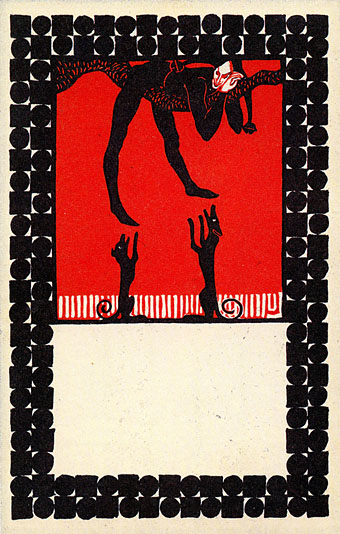
janke.jpg

Til Eulenspiegel by Urban Janke. From Twenty Postcards of the Wiener Werkstätte at 50 Watts.

Rorschach Audio by Joe Banks is “essential reading for everyone interested in air-traffic control, anechoic chambers, artificial oxygen carriers, audio art, bell-ringing, cocktail parties, cognitive science, communications interference, compost, the death penalty, Electronic Voice Phenomena, evangelism, evolutionary biology, experimental music, ghosts, the historiography of art, illusions of sound and illusions of language, lip-reading jokes, nuclear blast craters, predictive texting, singing hair, sonic archives, sound design, steam trains, tinnitus, the Turing Test, Victorian blood painting, visual depth and space perception, ultrasonic visual music, ventriloquism, voices and warehouse fires and robberies.”

• “Freud did not understand female sexuality. Klimt did. Klimt’s women please themselves. The realization that women have an independent sexual life was an insight in art.” Eric Kandel discusses his new study The Age of Insight: The Quest to Understand the Unconscious in Art, Mind, and Brain, from Vienna 1900 to the Present.

• Three new books already mentioned here receive further attention: Stan Persky on Christopher Bram’s Eminent Outlaws : The Gay Writers Who Changed America. | Matthew Aquilone on Paul Russell’s The Unreal Life of Sergey Nabokov. | Karin L. Kross on the new translation of the Strugatsky’s Roadside Picnic.

The creative writing moment/movement baffles me and it intrigues me. What does it signify, all this creative longing? And why through language? Specifically fiction, poetry, memoir? […] The crazy part of it is that we are breeding professional, competent, homogenised writers who will go on to teach writing that is professional, competent and homogenised. The intriguing part of it is whether this movement towards creativity and self-expression is really the start of a kind of Occupy – that it could be dangerous and confrontational, not homogenised at all.

Dangerous? But then they won’t get published and win awards and get film deals and… Jeanette Winterson prepares to teach creative writing at Manchester University.

The Underground New York Public Library is a visual library featuring the Reading-Riders of the NYC subways.

Hob by No Man: “Constructed from soundtrack noises from both version of Quatermass and the Pit.”

Stephen Thrower talks about his soundtrack music for The Erotic Films of Peter De Rome.

John Waters surprises everyone by hitchhiking across the US.

• Sounds & the City: An interview with Julia Holter.

The Dead Dream of the Dirigible.

Meditation (1979) by Edward Artemyev.

Weekend links 107

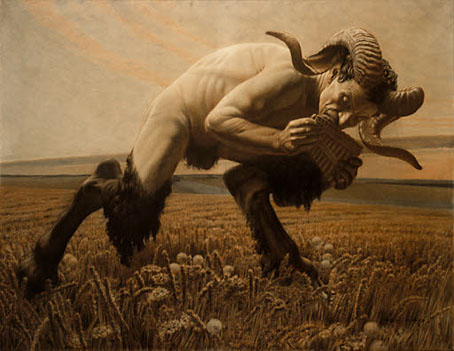
schwabe.jpg

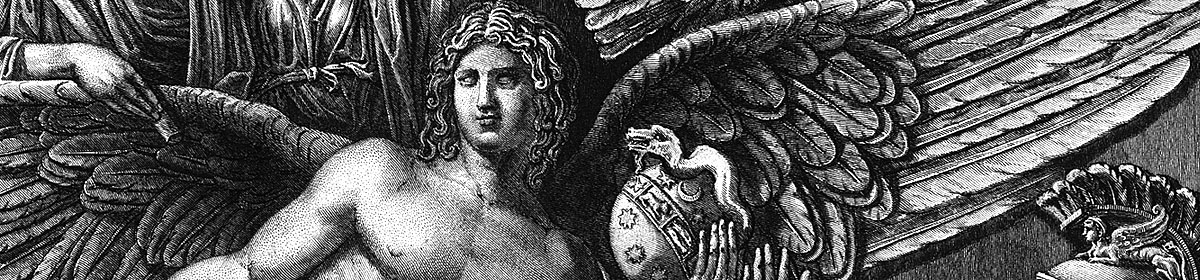
Le Faune (1923) by Carlos Schwabe.

• “When I recently attended a conference in China, many of the presenters left their papers on the cloud—Google Docs, to be specific. You know how this story ends: they got to China and there was no Google. Shit out of luck. Their cloud-based Gmail was also unavailable, as were the cloud lockers on which they had stored their rich media presentations.” Ubuweb’s Kenneth Goldsmith on why he doesn’t trust the Cloud.

• “I’m a poet and Britain is not a land for poets anymore.” A marvellous interview with the great Lindsay Kemp at Dangerous Minds. Subjects include all that you’d hope for: Genet, Salomé, David Bowie, Ken Russell, Derek Jarman, The Wicker Man and “papier maché giant cocks”.

• “As early as the 1950s, Maurice Richardson wrote a Freudian analysis which concluded that Dracula was ‘a kind of incestuous-necrophilious, oral-anal-sadistic all-in wrestling match’.” Christopher Frayling on the Bram Stoker centenary.

Björk gets enthused by (among other things) Leonora Carrington, The Hourglass Sanatorium and Alejandro Jodorowsky’s YouTube lectures.

• Before Fritz Lang’s Metropolis there was Algol – Tragödie der Macht (1920). Strange Flowers investigates.

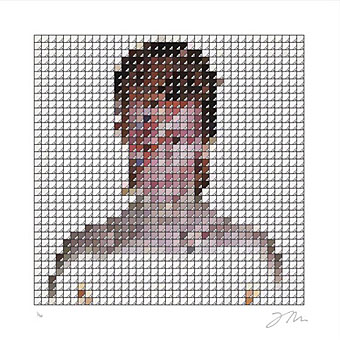
marsh.jpg

David Marsh recreates famous album covers using Adobe Illustrator’s Pantone swatches.

• New titles forthcoming from Strange Attractor Press. Related: an interview with SAP allies Cyclobe.

• 960 individual slabs of vinyl make an animated waveform for Benga’s I Will Never Change.

• An exhibition of works by Stanislav Szukalksi at Varnish Fine Art, San Francisco,

Keith Haring‘s erotic mural for the NYC LGBT Community Center is restored.

The Situationist Times (1962–1967) is resurrected at Boo-Hooray.

• Doors Closing Slowly: Derek Raymond‘s Factory Novels.

Will Wilkinson insists that fiction isn’t good for you.

• More bookplates at BibliOdyssey and 50 Watts.

The Top 25 Psychedelic Videos of All Time.

Flannery O’Connor: cartoonist.

• RIP Adam Yauch.

• Their finest moment: Sabotage (1994) by Beastie Boys.

Viddy well: Back in the Chelsea Drug Store

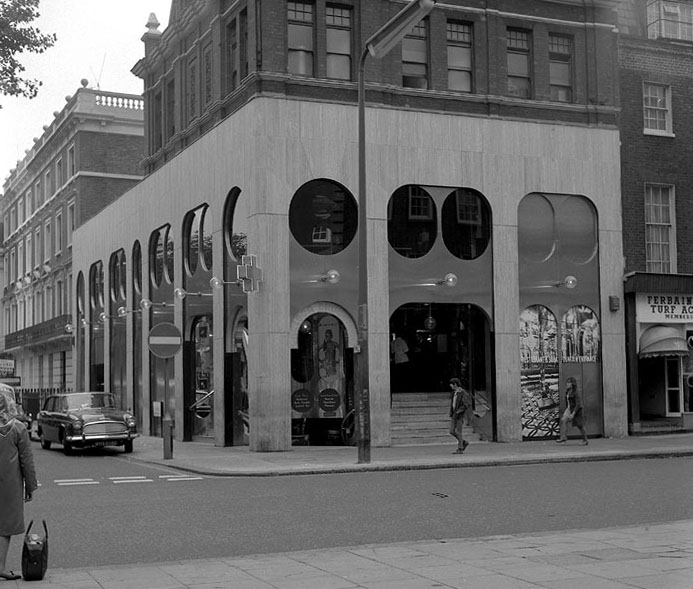
drugstore.jpg

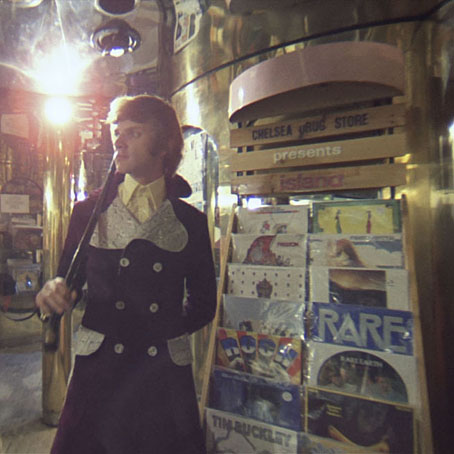
The Chelsea Drug Store, 49 King’s Road, London, circa 1970.

How quickly things change. It was almost six years to the day that I posted an unapologetically sedulous analysis of the record shop scene in Stanley Kubrick’s A Clockwork Orange, something that’s still one of the most regularly visited of all the entries here. That post concerned the excitement of being able to at last scrutinise on DVD a single shot whose details had earlier been obscured by no end of noise and interference, the embargoed film having previously been available in the UK on various bootleg videos. Fuzzy warbles indeed. The DVD wasn’t ideal, however, and many of the frame enlargements looked pretty shoddy. Last month I acquired a box of Blu-ray Kubrick films so all the images on that post have now been upgraded. There isn’t a great deal more to see in a shot that lasts all of sixty-six seconds, but John Alcott’s wide-angle photography is now crystal clear.

As for the location of the record shop, I noted in the original post that the famous Chelsea Drug Store building is now a McDonald’s. A place that once sold music and magazines becomes another outlet for an international burger chain; that’s the real future horror, not rampaging youth. See it up close on Google’s Street View.

alex.jpg

Alex and the sounds of 1970.

Previously on { feuilleton }
Kubrick shirts
A Clockwork Orange: The Complete Original Score
Juice from A Clockwork Orange
Clockwork Orange bubblegum cards
Alex in the Chelsea Drug Store

Weekend links 94

walpoth.jpg

Mateo (2011), carved wood sculpture by Bruno Walpoth.

“Dennis Potter’s [The Singing Detective] is 25 years old but still feels avant garde,” says Stephen Armstrong. No fucking kidding, I watched the DVDs again last weekend. Potter’s drama featured non-linear flashbacks, song-and-dance hallucination sequences, an intertextual sub-plot, and a central character who was vitriolic, misanthropic, misogynist and covered from head-to-toe in flaking skin. This wasn’t exiled to an arts channel ghetto but was primetime viewing, Sunday evenings on BBC 1. • Related: “Is Dennis Potter’s singalong noir miniseries the all-time pinnacle of television drama? Graham Fuller thinks it is.”

• American band Earth are using Kickstarter to fund their next project, Wonders from the House of Albion, an LP/CD/DVD/book combining their music with “field recordings from various megalithic and other sites of human/fairy encounters across the UK, also the use of ritual and folkloric magical practices”. Dylan Carlson & Adrienne Davies discuss their work here.

…sort of like Nabokov’s objection to Our Lady of the Flowers, which he saw as a masterpiece but thought, “Why isn’t this book about women?” Nabokov hated homosexuality and was very edgy around it, partly because his own brother was homosexual and his uncle. And he believed that it was hereditary, so he was always nervous about it.

Edmund White chooses five favourite gay novels. Related: a dance adaptation by Earthfall of Jamie O’Neill’s At Swim, Two Boys.

• “The Belbury Tales is the kind of record you feel should have come out on Vertigo around ’73, but never actually did.” Belbury Poly‘s Jim Jupp on ploughman’s lunches, prog rock and avoiding “Clarkson/Wakeman territory”.

Morbid Curiosity: The Richard Harris Collection, an exhibition at the Chicago Cultural Center exploring “the iconography of death across cultures and traditions spanning nearly six thousand years”.

Geoff Dyer’s Zona, an exegesis of Andrei Tarkovsky’s Stalker, is officially out at the end of this month. The book is reviewed here and here.

• “Through a blurry electronic prism“: MetaFilter traces a history of analogue video synthesis.

Dylan Ricci‘s wonderful photography of the male body has moved to a new location.

Infinite Forest by Studio a+i, a design for an AIDS memorial in New York City.

Susan Cain discussing “the power of introverts” at Scientific American.

• Strange Flowers on that icon of Middle Eastern music, Umm Kulthum.

Ewan Morrison on “The self-epublishing bubble”.

Winter Sleep (2007) by Valgeir Sigurdsson feat. Dawn McCarthy | Black (2008) by Ben Frost with Valgeir Sigurdsson, Sam Amidon & Sigrídur Sunna Reynisdóttir | Unbreakable Silence (2011) by Ben Frost & Daníel Bjarnason