The art of Sascha Schneider, 1870–1927

schneider1.jpg

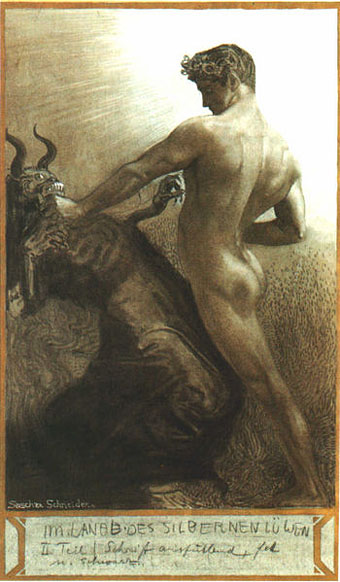
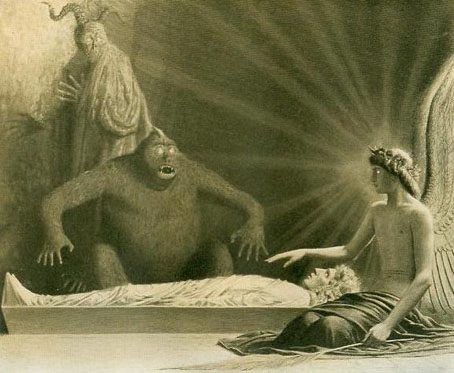
I first came across Sascha Schneider’s art some years ago when reading about German writer Karl May (1842–1912), and it was as May’s illustrator that Schneider initially gained recognition. May was one of Germany’s most popular novelists, his Western adventures about Old Shatterhand and Winnetou the Warrior sold millions of copies and numbered Albert Einstein and Adolf Hitler among their enthusiasts. Schneider’s work struck me as unusual compared to other illustrators of the period; there was a curious quality which seemed to owe more to Symbolist painting than book illustration and the few examples I saw were distinctly homoerotic at a time when homosexuality was regarded with suspicion or downright hostility. Sure enough it turns out that Schneider was openly gay and that May had no problem with this. It also transpires that the Symbolist tone which seemed so unsuited to a writer of Western pulp fiction complemented the content of some of May’s later works which weren’t Westerns at all but were Orientalist fantasies with a metaphysical inclination. The publisher wasn’t too happy with the ambivalent nature of these pictures, however, and they were replaced in later editions.
schneider14.jpg

For once I don’t have to complain about a lack of website examples, Schneider’s connections with May have at least ensured his work is still being written about even if it seems overlooked by gay art histories. This latter circumstance is unusual since he was a contributor to Der Eigene, the world’s first gay periodical, founded by Adolf Brand in 1896.

I’ve taken the liberty of posting more samples than usual here and you’ll have to forgive the lack of information about titles and dates. Many of the pictures are quite bizarre for the way they’re continually juxtaposing naked figures with angels, demons or monsters. Even the Winnetou illustrations, which should be depicting Native Americans, look more suited to the wall of a salon in fin de siècle Paris than stories of the Wild West. Links to various galleries follow.

Schneider’s Karl May frontispieces
An extensive Russian gallery
A smaller Schneider gallery

Continue reading “The art of Sascha Schneider, 1870–1927”

Bruges-la-Morte

rodenbach.jpg

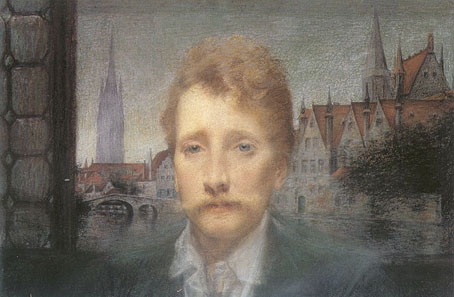
Portrait of Georges Rodenbach by Lucien Lévy-Dhurmer (1895).

Georges Rodenbach’s short, atmospheric novel is one of the key texts of Symbolism, not only for its themes but also for the art it either inspired or complemented. Bruges-la-Morte was first published in 1892 and the recent Dedalus Books edition, edited by Alan Hollinghurst and with a new translation by Mike Mitchell and Will Stone, was reprinted late last year.

Bruges-la-Morte…concerns the fate of Hugues Viane, a widower who has turned to the melancholy, decaying city of Bruges as the ideal location in which to mourn his wife and as a suitable haven for the narcissistic perambulations of his inexorably disturbed spirit. Bruges, the ‘dead city’, becomes the image of his dead wife and thus allows him to endure, to manage the unbearable loss by systematically following its mournful labyrinth of streets and canals in a cyclical promenade of reflection and allusion. The story itself centres around Hugue’s obsession with a young dancer whom he believes is the double of his beloved wife. The consequent drama leads Hugues onto a plank walk of psychological torment and humiliation, culminating in a deranged murder. This is a poet’s novel and is therefore metaphorically dense and visionary in style. It is the ultimate evocation of Rodenbach’s lifelong love affair with the enduring mystery and haunting mortuary atmosphere of Bruges.

Continue reading “Bruges-la-Morte”

Strange cargo: things found in books

books1.jpg

The Secret Oral Teachings in Tibetan Buddhist Sects by Alexandra David-Neel & Lama Yongden, City Lights Books (1972).

One of the additional pleasures of buying old books besides finding something out-of-print (or, it has to be said, something cheap) occurs when those books still possess traces of their previous owners. A recent posting on The Other Andrew’s page concerned book inscriptions, something any book collector will be used to seeing. Less common are the objects which slip from the pages when you’ve returned home. There are several categories of these.

1: Bookmarks

I have a substantial collection of bookmarks proper, from embossed strips of leather to the more mundane pieces of card of the type that bookshops frequently give away. But I also make a habit of using odd inserts to mark a place as did the previous owners of these volumes. The City Lights book (above) came with a very fragile leaf inside it which may well be as old as the book. Another City Lights book I own, the Artaud Anthology from 1965, included a newspaper article about Artaud. Newspaper clipping inserts are discussed below.

Continue reading “Strange cargo: things found in books”

Kafka and Kupka

kafka_kupka.jpg

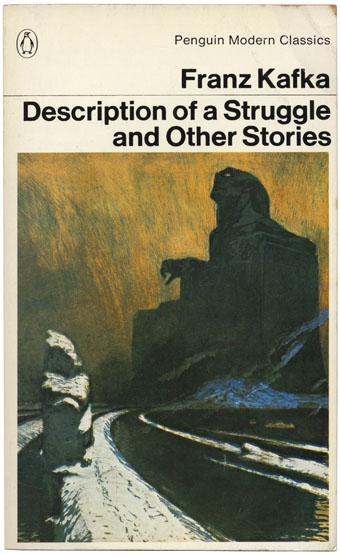
And speaking of Kafka, today’s book purchase was this 1979 story collection. The picture on the cover is a coloured aquatint and my favourite work by Czech artist František Kupka (1871–1957).

kupka2.jpg

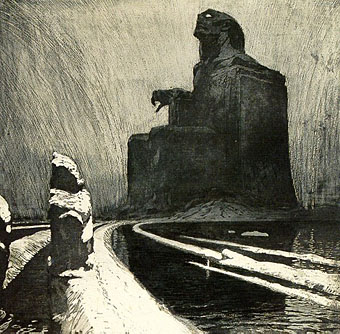
Resistance, or The Black Idol (1903).

Kupka is one of the more unique artists of the period, having begun his career in the Symbolist mode then abruptly changed course, post-Cubism, to become one of the earliest abstract painters. Kandinsky and Mondrian followed a similar evolution but little of their early work is valued, whereas Kupka’s Symbolist pastels and etchings are still regarded as significant. This page has several of his pictures on mystical themes.

As well as being a good match for Kafka, The Black Idol was also the model for the ruined castle in Francis Coppola’s Dracula. There aren’t any decent pictures around, unfortunately, but if you must you can go and squint at the screen grabs here.

Elsewhere on { feuilleton }
The book covers archive

Men with snakes

laocoon.jpg

Laocoön and His Sons attributed to Agesander, Athenodoros
and Polydorus of Rhodes (c. 160–20 BCE).

No jokes about snakes in a frame, please. Bram Dijkstra’s Idols of Perversity: Fantasies of Feminine Evil in Fin de Siècle Culture (1986) is a wide-ranging study of the “iconography of misogyny” in 19th century painting. Dijkstra examines the numerous ways that women were depicted in late Victorian and Symbolist art, with one chapter, “Connoisseurs and Bestiality and Serpentine Delights”, being devoted to representations of women with animals, especially snakes. The story of Eve and the Serpent prompts many of these latter images, of course, while scenes with other creatures seem intended to demonstrate the Victorian attitude that woman was closer to the brute beasts than man and could often be found conspiring with them to bring down her masculine masters. Continue reading “Men with snakes”