Dalí’s Elephant

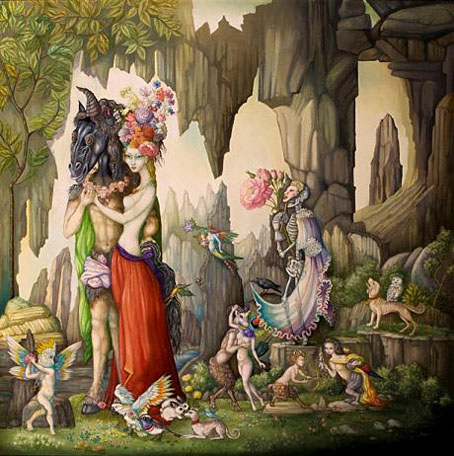
burman.jpg

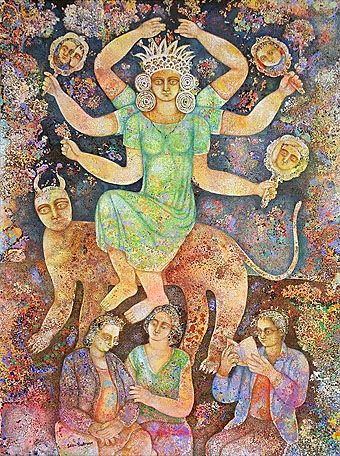
Madhav Reading Stories of Devi (2007) by Sakti Burman.

Dalí’s Elephant is a group exhibition at London’s Aicon Gallery that “traces the echoes of Surrealism in modern and contemporary art from the Indian Subcontinent.” The exhibition title refers to the gift ashtray which Salvador Dalí designed for Air India in 1967:

In 1967 Air India commissioned Salvador Dali to produce a limited edition ashtray which was to be given to a select group of lucky first-class passengers. Dali produced a small unglazed porcelain ashtray composed of a shell-shaped centre with a serpent around its perimeter. This was supported by three stands, two of which point in the same direction and resemble an elephant’s head. The third stand was inverted so that it resembled swan’s head. Dali was initially paid no more than a few hundred dollars for his design but when they received the design the airline bosses were so delighted that they made Dali the surprise gift of an elephant. Dali lived with the elephant for a few days at his Portligat home before donating the beast to the local zoo. (More.)

The Surrealist element is very much a trace in some of the works which seems surprising given the distinctive heritage of India’s religious imagery, as was demonstrated recently at A Journey Round My Skull. But I like the Sakti Burman paintings, especially the example shown here. Dalí’s Elephant runs to September 4th, 2010.

Previously on { feuilleton }
Marsi Paribatra: the Royal Surrealist
Dalí in Wonderland
Bollywood posters
Impressions de la Haute Mongolie revisited
Dalí and Film
The persistence of DNA
Salvador Dalí’s apocalyptic happening
Dalí Atomicus
Impressions de la Haute Mongolie

The art of Jessica Harrison

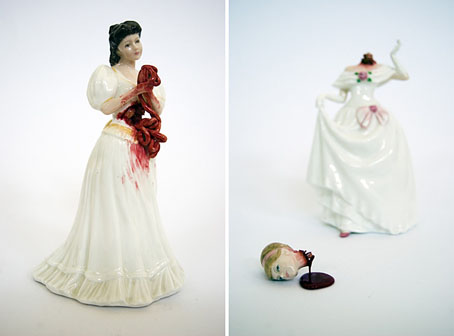
harrison.jpg

left: Maria (2010); right: Dawn (2010).

British artist Jessica Harrison undermines the saccharine innocence of porcelain figurines in a manner which would no doubt appeal to a Surrealist and black humorist like Jan Svankmajer. As well as these recent pieces, her website features further contemporary takes on Surrealism including a number of pencil drawings, one of which is a self-portrait alluding to that Švankmajer favourite, Giuseppe Arcimboldo.

Previously on { feuilleton }
Surrealism, graphic design and Barney Bubbles
Jan Švankmajer: The Complete Short Films

The art of Ran Akiyoshi, 1922–1982

akiyoshi1.jpg

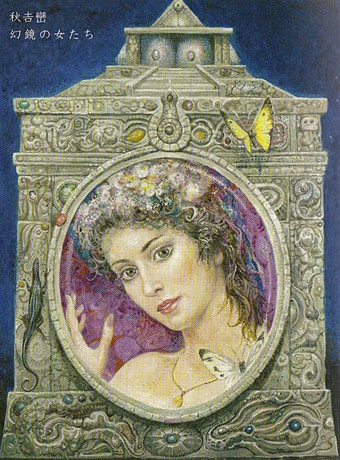
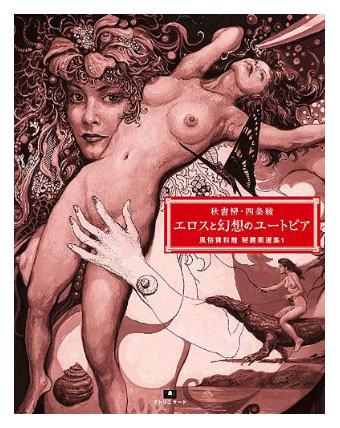
In a similar vein to the work of Gilles Rimbault and other erotic fantasists is Ran Akiyoshi, a Japanese artist and illustrator. Akiyoshi’s work manages to be even more obscure than the Europeans, being virtually undocumented outside Japanese websites, hence the absence of titles and dates for these examples. This is surprising given the quasi-Surrealist nature of his paintings which place buxom goddess types in phantasmagoric settings with subtle or not-so-subtle erotic qualities. Akiyoshi follows the pattern of much of this kind of personal fantasy whereby most of the women share similar features. The book cover immediately below is from a recent Japan-only collection of his work. The Illusion cover at the end is another book collection some of whose fascinating pages can be seen here. As always, if anyone turns up a gallery of further pictures, please leave a comment.

akiyoshi2.jpg

Continue reading “The art of Ran Akiyoshi, 1922–1982”

Marsi Paribatra: the Royal Surrealist

marsi1.jpg

La Menace (1994).

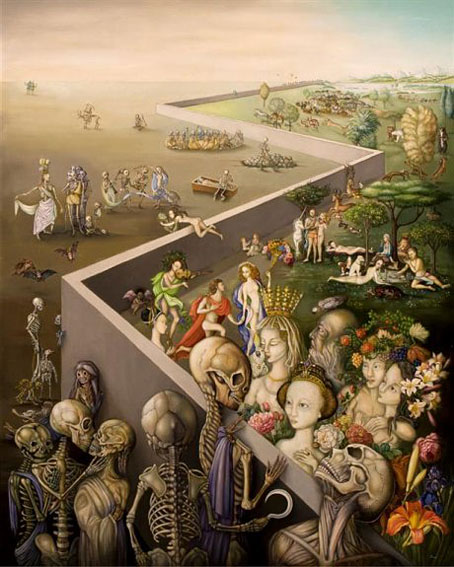
Two paintings by Princess Marsi Paribatra, a member of the royal family of Thailand who lists Dalí, Arcimboldo and Titian among her artistic influences. If it seems surprising that a princess should not only be an accomplished painter but also be possessed of a distinctly vivid imagination we might ask why this is the case. There’s no reason why a member of a royal family shouldn’t be as good a painter as anyone else although it’s the case that here in Britain our views of royalty are inevitably tainted by the uninspiring members of the current House of Windsor. Prince Charles in particular is a singularly dreary and frequently philistine figure, and also a painter whose daubs would never have received any attention at all were it not for his being born into the right family.

This hasn’t always been the case. It used to be that being an aristocrat gave you the free time and the wealth to indulge no end of manias and eccentricities. The British Isles are littered with architectural follies of various kinds built to appease the whims of rich landowners; William Beckford (1760–1844) is renowned for having written the Gothic melodrama Vathek and also for having built the lavish (and unfortunately short-lived) pile of Fonthill Abbey. In the 20th century we had Edward James (1907–1984), a lifelong champion of Surrealism who spent much of his later life building Las Pozas in the Mexican jungle at Xilitla, a concrete fantasia which looks like something dreamed up by Antonio Gaudí and JG Ballard. James collected the work of Leonora Carrington and Dorothea Tanning and I’d imagine him being equally entranced by some of Marsi Paribatra’s paintings. The recurrence of skeletal figures in her work invokes the Mexican Day of the Dead traditions which always excited the Surrealists.

marsi2.jpg

No title or date available.

Dali House has more about Marsi Paribatra’s life and art while further examples of her paintings can be found here and here. Thanks again to Monsieur Thombeau for pointing the way!

Elsewhere on { feuilleton }
The fantastic art archive

Previously on { feuilleton }
Angels of Anarchy: Women Artists and Surrealism
Return to Las Pozas
The art of Leonor Fini, 1907–1996
Surrealist women
Las Pozas and Edward James

Surrealism, graphic design and Barney Bubbles

starowieyski.jpg

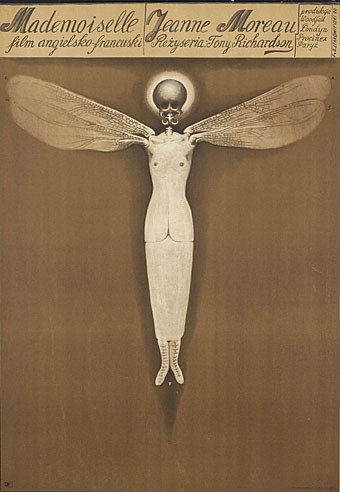
Poster for Mademoiselle (1970) by Franciszek Starowieyski.

Work has cranked into overdrive this week so posting will no doubt be minimal until some semblance of normality is restored. I can however mention two essential exhibitions which will be running through the forthcoming months.

Uncanny: Surrealism and Graphic Design at the Moravian Gallery in Brno, Czech Republic, is curated by design writer Rick Poynor and runs to 24 October, 2010. On display is an intriguing mix of work from familiar names such as Jan Švankmajer and Eva Švankmajerová, poster artist Franciszek Starowieyski, graphic designers Vaughan Oliver and Stefan Sagmeister, and many others.

Uncanny: Surrealism and Graphic Design uncovers the presence of an alternative tradition in graphic design. The Surrealist movement of the 1920s and 1930s focused on literature, painting, photography and the object, and the Surrealists’ publishing activities provided only hints of what a fully conceived Surrealist graphic design or typography might look like. Many of the most suggestive early examples came from Czechoslovakia, where Surrealism would become a lasting influence. Subsequently, Surrealist ideas and images had a profound impact on image-makers in every sphere of art and design, and by the 1960s the effects of Surrealism were widely felt in international graphic communication. Uncanny traces this intermittent line of development up to the present.

There’s further information at the gallery site including a page of related works.

process.jpg

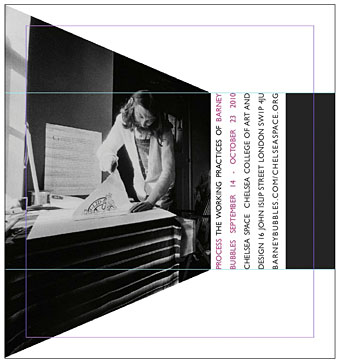
And launching later in the year is Process: The Working Practices of Barney Bubbles, a very timely exhibition of the designer’s work at Chelsea Space, London. Bubbles biographer Paul Gorman is the curator and the event will also see the launch of a second edition of his study of Barney’s life and work, Reasons To Be Cheerful.

The show will contain many never-before-seen items drawn from private collections, including student notebooks, working sketches, original artwork, paintings, books and photography. These were the raw material for videos, record sleeves, t-shirts and posters created by Bubbles for such performers as Ian Dury, Hawkwind, Elvis Costello, The Damned and Billy Bragg (who is contributing a one-off rug with a rendition of the designer’s Masereel-quoting cover for his album Brewing Up With).

Process opens on September 14 and will run to October 23, 2010.

Previously on { feuilleton }
Franciszek Starowieyski, 1930–2009
Jan Švankmajer: The Complete Short Films
Barney Bubbles: artist and designer