Weekend links 742

hughes-stanton.jpg

Thunderstorm (1959) by Blair Rowlands Hughes-Stanton.

• “To create a novel or a painting, an artist makes choices that are fundamentally alien to artificial intelligence,” says SF writer Ted Chiang. A New Yorker essay which has received a fair amount of attention over the past week, with good reason. As someone who found his name on the list of artists whose work was allegedly being fed into Midjourney, I suppose I have a vested interest in the arguments. (Good luck to any machine trying to imitate my “style”. I don’t have one.) Too much of the discussion, however, has been very poor which is why this is the first time I’ve linked to such a piece here.

• “After going their own way for much of the 20th century, mathematicians are increasingly turning to the laws and patterns of the natural world for inspiration. Fields stuck for decades are being unstuck. And even philosophers have started to delve into the mystery of why physics is proving ‘unreasonably effective’ in mathematics, as one has boldly declared.” Ananyo Bhattacharya on why physics is good at creating new mathematics. Having recently finished reading Cormac McCarthy’s final novel, Stella Maris, this was all very timely.

• “…our films obey musical laws. Of course, you can never tell people how they should watch a film. But the musical element provides a narrative of its own.” Thus the Quay Brothers, in the news again with their forthcoming feature film, Sanatorium Under the Sign of the Hourglass. The quote is from a recent interview with Xan Brooks. Meanwhile, Alex Dudok de Wit posted another interview from 2019, originally published in French, now made available in English for the first time.

• At Wormwoodiana: Mark Valentine announces a new book of his essays, The Thunderstorm Collectors.

• At Dennis Cooper’s: 28 books that either faked ingesting LSD or did.

• At Public Domain Review: Antiquities of Mexico (1831–48).

• At Print mag: Kelly Thorn’s Tarot of Oxalia.

USC Optical Sound Effects Library

Strange Thunder (1987) by Harold Budd | Sweet Thunder (1991) by Yello |  Studies For Thunder (2004) by Robert Henke

Weekend links 736

jupiter.jpg

South Polar Map of Jupiter by the Cassini spacecraft, 2000.

• “A ghostly train journey on a forgotten branch line transports a son, Jozef, visiting his dying Father in a remote Galician Sanatorium. Upon arrival Jozef finds the Sanatorium entirely moribund and run by a dubious Doctor Gotard who tells him that his father’s death, the death that has struck him in his country has not yet occurred, and that here they are always late by a certain interval of time of which the length cannot be defined. Jozef will come to realise that the Sanatorium is a floating world halfway between sleep and wakefulness and that time and events cannot be measured in any tangible form.” The Quay Brothers have finished their third feature film, Sanatorium Under the Sign of the Hourglass, a combination of live action and animation which is being premiered next month at the Venice film festival. No sign of a trailer as yet but the curious can prime themselves by watching (or rewatching) the Quays’ Street of Crocodiles—their first adaptation of Bruno Schulz—or Hourglass Sanatorium, the first screen adaptation of Schulz’s stories by Wojciech Has.

• “No one is sure when the tremendous whirl—the largest and longest-lived storm in our current solar system, with a diameter wider than planet Earth and wind speeds of more than 260 miles per hour—began. Or why it’s red. Or even who first observed it…” Katherine Harmon Courage on Jupiter’s Great Red Spot.

• New music: Bórdice by Nestor, and Nightfall by Trentemøller, the latter with a video swiping shots from Maya Deren’s Meshes of the Afternoon. Nice song but musicians really need to stop plundering independent film-makers when they want some visual embellishment.

• At The Daily Heller: Steven Heller talks to Drew Friedman about Friedman’s new book of caricatures, Schtick Figures.

• Mixes of the week: A mix for The Wire by Miaux, and Isolatedmix 127 by David Douglas & Applescal.

• DJ Food’s latest psychedelic trawl is a collection of book covers, puzzles, etc, designed by Peter Max.

• At Unquiet Things: Vic Prezio’s Gothic book covers.

• At Dennis Cooper’s: Morgan Fisher Day.

Jupiter (1990) by NASA Voyager Space Sounds | Jupiter! (Feed Your Head Mix) (1994) by System 7 | Jupiter Collision (2002) by Redshift

Weekend links 731

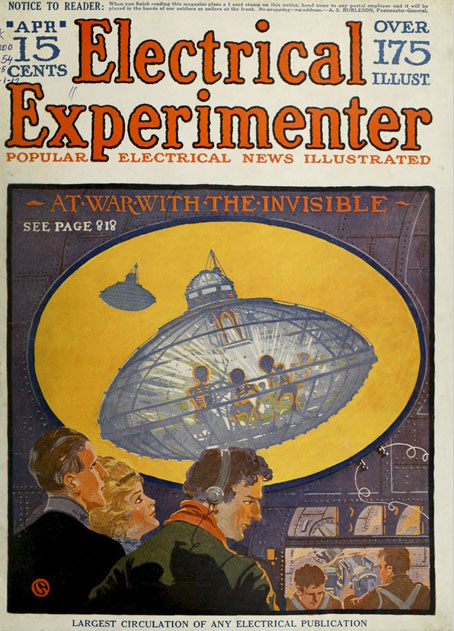
electrical.jpg

The Electrical Experimenter, Vol. 5, no. 1. April, 1918. Electrical cover art by Vincent Lynch.

• Coming soon from Rocket 88 Books: Electricity and Ghosts, a collection of art and graphic design by John Foxx/Dennis Leigh. The book itself has been designed with a regular Foxx collaborator, Jonathan Barnbrook. Last year I put together a post collecting Dennis Leigh’s book covers.

• At Strange Flowers: Lavinia Schulz and Walter Holdt, their Expressionist dance costumes, and their short, tempestuous lives. There’s more about the couple’s costumes and dances here.

• New music: Road to Mandalay by Laurie Anderson; Panorama (French Soundtracks & Rarities) by Various Artists; The Passage Of Time by Cosmos In Collision.

• At Public Domain Review: Raffaele Mainella’s illustrations for Nos Invisibles (1907), a Spiritualist text by Clotilde Briatte (writing as Charles d’Orinio).

Dennis Cooper’s favourite fiction, poetry, non-fiction, film, art, and internet of 2024 so far. Thanks again for the link here!

John Cale’s favourite music. Also The Records That Made Me by Carsten Nicolai/Alva Noto.

The mysterious mirrored monolith returns.

• RIP Donald Sutherland.

BBC Sound Effects.

Electricity (1967) by Captain Beefheart & His Magic Band | Electricity (1980) by Orchestral Manoeuvres In The Dark | Electricity (1995) by Pet Shop Boys

Weekend links 729

demorgan.jpg

Phosphorus and Hesperus (1881) by Evelyn De Morgan.

• Mix of the week, or possibly the entire year: The Deep Ark, 167 tracks (over 8 hours of music), most of which are from the electronic deluge of the early 1990s. The download link may not work for all browsers—it didn’t for one of mine—but it is active. Via Simon Reynolds who has more about the Deep Ark project.

• At Nautilus: Betsy Mason on the use of stage magic to investigate animal behaviour. “By performing tricks for birds, monkeys, and other creatures, researchers hope to learn how they perceive and think about their world.”

• At The Daily Heller: Mad and the Usual Gang of Idiots. Meanwhile, Mr Heller’s font of the month may prove useful for this election season, a Jonathan Barnbrook design named Moron.

Looking back, you can see a pattern in those eras in which interest in telepathy boomed. Coined by Myers and his fellow psychical researchers in the 1880s, telepathy gained traction because it was formulated inside a moment of scientific and technological revolution, where uncanny transmissions proliferated across the visible and invisible spectrum, seeming to collapse the natural and the supernatural together. In the 1970s, telepathy returned, if under different names, as part of another moment of crisis. The Cold War arms race was an essential part of this, feeding a strange supplemental world of fantasy technologies, from mind control to brainwashing, and playing on an all-too-widespread psychological paranoia around being seen, infiltrated and manipulated by invisible agents.

Roger Luckhurst looks back at a century of psychic research

• New music: Portable Reality Generator by Field Lines Cartographer, and Sublime Eternal Love by Chrystabell and David Lynch.

• Coffee and Chocolates for Two Guitars: Robert Fripp interviewing John McLaughlin in July, 1982.

• Paintings by Ithell Colquhoun currently showing at the Ben Hunter gallery, London.

• At Public Domain Review: Eye Miniatures (ca. 1790–1810).

ESP (1965) by Miles Davis | ESP (1990) by Deee-lite | ESP (2002) by Comets On Fire

Phaeton: The Son of the Sun

phaeton1.jpg

The animation collection at the Internet Archive has been improving of late, with a wider variety of uploads being added to the already copious quantities of American cartoons and Japanese anime. Last week I drew attention to Jan Lenica’s Adam 2. This week it’s the turn of Phaeton: The Son of the Sun (1972), a short Russian film written and directed by Vasiliy Livanov which is a curious combination of ancient myth and science fiction. Phaeton in Greek mythology was the son of Helios the sun god, a minor deity whose demise is related in the first part of Livanov’s film. The son takes his father’s fiery chariot for a ride across the sky after being warned about the damage the chariot’s flames may cause if it strays to close to the world below or too far from it. Phaeton’s poor horsemanship provokes a spate of natural disasters until Zeus ends the ride with a fatal thunderbolt.

phaeton2.jpg

This tale of cosmological destruction informs the “Phaeton hypothesis”, a 17th-century theory which sought to explain the existence of the Solar System’s asteroid belt as the remains of a destroyed planet, a body which a German linguist, Johann Gottlieb Radlof, named after the doomed god. The second part of Livanov’s film concerns a group of cosmonauts being launched into the asteroids in order to investigate the theory. The film is too short to properly explore the subject but the discussion detours briefly into ancient astronaut territory; Livanov had evidently been reading one or more of Erich von Däniken’s specious books which were topping the bestseller lists in 1972. One of the “astronaut” figures seen during the explication is the same Japanese figurine that von Däniken reproduces in Chariots of the Gods?, a book whose title echoes the theme of Livanov’s film. Short as it is, Phaeton: The Son of the Sun is nicely styled, and features the voice of Nikolay Burlyaev, an actor familiar to Tarkovsky aficionados as the boy in Ivan’s Childhood.

(Note: The Internet Archive has English subtitles for this one as a separate text file. You can get these to work by saving them in a folder along with the film file then changing the subtitle extension from txt to srt. Video applications such as VLC autoload subtitles if they’re stored in the film folder with the correct extension and a name that matches that of the film file.)

Previously on { feuilleton }
Crank book covers
The Heat of a Thousand Suns by Pierre Kast