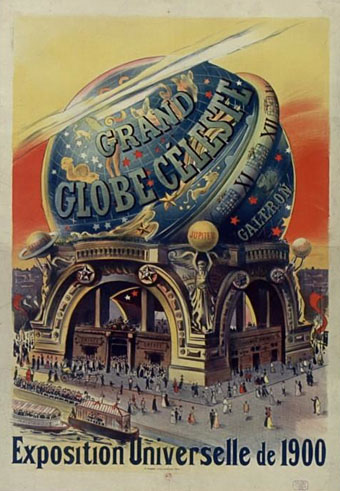
Le Grand Globe Céleste, 1900

globe.jpg

I’m sure I’ll run out of things to say on this subject eventually but it’s showing no sign of happening yet. In an exposition with its fair share of unusual buildings, the Grand Globe Céleste in the Paris Exposition Universelle of 1900 was one of the more notable constructions. An enormous globe built on the banks of the Seine close to the Champs de Mars, the Grand Globe Céleste was some 50 meters in diameter with its attractions including a restaurant and an exhibition space in the interior showing planetary orbits and maps of the stars. Enormous globes became a common feature of later world’s fairs which makes me wonder whether this example was the first of its kind. A far larger structure was proposed for the 1893 exposition in Chicago but never built.

The poster here is from the archives at Gallica. Searching around for other images turned up a wiki I hadn’t come across before devoted to the Exposition Universelle. The page there for the Grand Globe has a picture of one of the exposition’s tragedies caused when a footbridge leading to the attraction collapsed, killing five people. (The intact footbridge can be seen on this view facing towards the river.)

Previously on { feuilleton }
• Tony Grubhofer’s Exposition Universelle sketches
• The Cambodian Pavilion, Paris, 1900
• Le Manoir a l’Envers
• Suchard at the Exposition Universelle
• Esquisses Décoratives by René Binet
• Le Palais de l’Optique, 1900
• Exposition Universelle films
• Exposition jewellery
• Exposition Universelle catalogue
• Exposition Universelle publications
• Exposition cornucopia
• Return to the Exposition Universelle
• The Palais Lumineux
• Louis Bonnier’s exposition dreams
• Exposition Universelle, 1900
Weekend links 71

orazi.jpg

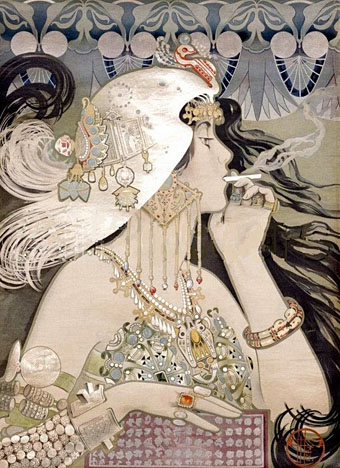
Manuel Orazi (1860–1934) was one of the best of the many Mucha imitators. An untitled & undated posting at Indigo Asmodel.

The mob now appeared to consider themselves as superior to all authority; they declared their resolution to burn all the remaining public prisons, and demolish the Bank, the Temple, Gray’s Inn, Lincoln’s Inn, the Mansion House, the Royal palaces, and the arsenal at Woolwich. The attempt upon the Bank of England was actually made twice in the course of one day; but both attacks were but feebly conducted and the rioters easily repulsed, several of them falling by the fire of the military, and many others being severely wounded.

To form an adequate idea of the distress of the inhabitants in every part of the City would be impossible. Six-and-thirty fires were to be seen blazing in the metropolis during the night.

An Account of the Riots in London in 1780, from The Newgate Calendar.

In a week of apparently limitless bloviation, a few comments stood out. Hari Kunzru: “Once, a powerful woman told us there was no such thing as society and set about engineering our country to fit her theory. Well, she got her way. This is where we live now, and if we don’t like it, we ought to make a change.” Howard Jacobson: “One medium-sized banker’s bonus would probably pay for all the trash that’s been looted this past week.” Meanwhile Boff Whalley complained about the predictable misuse of the word “anarchy” by lazy journalists.

• For further historical perspective, a list of rioters and arsonists from The Newgate Calendar (1824), and an account of the looting in London during the Blitz.

svanberg.jpg

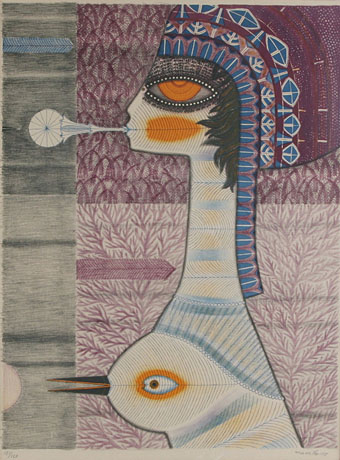
From a selection of works by Max Walter Svanberg (1912–1994) at But Does It Float. There’s more at Cardboard Cutout Sundown.

• NASA posted a gorgeous photo from the surface of the planet Mars. Related: Astronomers have discovered the darkest known exoplanet. Obliquely related: Julio Cortázar’s From the Observatory, a prose poem inspired by the astronomical observatories at Jaipur and New Delhi, India, receives its first English translation.

• The Advisory Circle is still in a Kosmische groove. Not Kosmische at all, Haxan Cloak’s mix for FACT has Wolf Eyes, Sunn O))) and Krzysztof Penderecki competing to shatter your nerves.

• The wonderful women (and friends) at Coilhouse magazine are having a Black, White and Red fundraising party in Brooklyn, NYC, on August 21st. Details here.

• Sodom’s ambassador to Paris: the flamboyant Jean Lorrain is profiled at Strange Flowers.

• Empire de la Mort: Photographs of charnel houses and ossuaries by Paul Koudounaris.

• The Craft of Verse by Jorge Luis Borges: The Norton Lectures, 1967–68.

• Jesse Bering examines The Contorted History of Autofellatio.

• Robert Crumb explains why he won’t be visiting Australia.

• The Crackdown (1983) by Cabaret Voltaire.

Detmold’s insects

detmold1.jpg

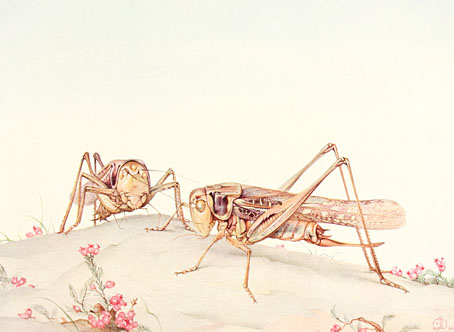
The White-Faced Decticus.

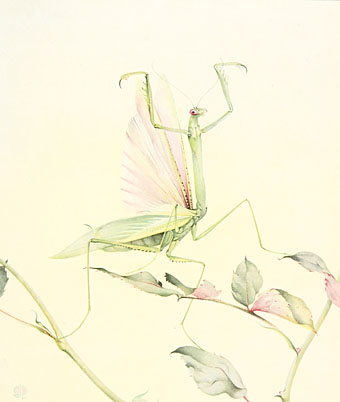
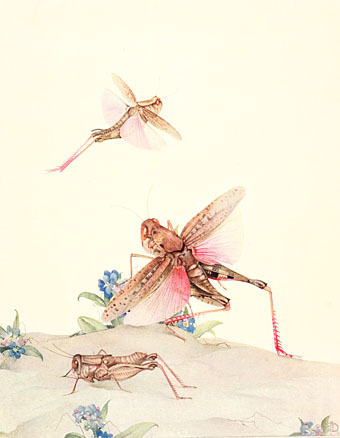
Edward Julius Detmold’s (1883–1957) skill at drawing animals gave him a great advantage when it came to illustrating Kipling’s The Jungle Book and Aesop’s Fables, still among the very best editions of those books. Less well-known are his illustrations for Fabre’s Book of Insects (1921), a guide by naturalist Jean-Henri Fabre. Bud Plant has details about the artist’s unhappy life, while the Internet Archive also has copies of the Aesop and the Kipling.

detmold2.jpg

The Praying Mantis.

detmold3.jpg

Italian Locusts.

Elsewhere on { feuilleton }
• The illustrators archive

Previously on { feuilleton }
• Entomologia
• Fantastic art from Pan Books

Wonders of the Invisible World

hartsoeker.jpg

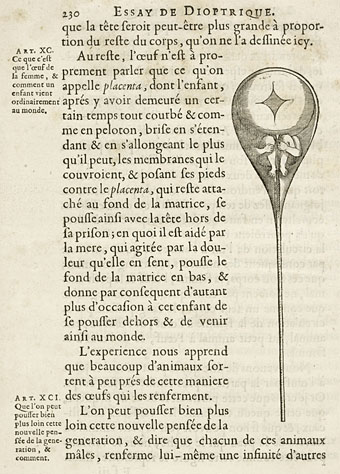
Nicolaas Hartsoeker’s drawing of a spermatozoon from 1695 is on display in Sunderland as part of the Wonders of the Invisible World exhibition at the Northern Gallery for Contemporary Art. The exhibition takes its title from a treatise on witchcraft by Cotton Mather, and the notes for the show must be one of the few places where quotes from Prince Charles and Dadaist Hugo Ball have been used together.

The artists here have coaxed objects to levitate, facilitated autosuggestion, photographed apparitions, or foretold the future. Though echoing pre-scientific ideas, their approaches are curiously timely, and might collectively be described as ones of ‘irrational exuberance’. For many of the artists, their works are allegories for the workings of an intangible and mysterious world propelled by illusions and suspension of disbelief: those of the economic marketplace. As here, much of the material world seems to defy the laws of gravity, as though objects were suspended ‘in a bubble’, or else held aloft by a so-called ‘invisible hand’.

Given the intriguing nature of the exhibition it’s a shame that more of the works on view aren’t shown on the gallery site. There’s a preview of the show this Wednesday after which it will run until October 9th, 2011. See gallery details and a list of the artists here.