Raising the roof

ramases1.jpg

Roger Dean’s album cover art extends further than his sleeve illustrations for Yes. His earlier designs for the Vertigo label showed his visual invention to good effect, and a couple of those designs have had their imitators. The cover art for Dedicated To You, But You Weren’t Listening by the Keith Tippett Group is one that I’ve seen copied although I forget where for the moment so you’ll have to take this on trust. (Ahem.)
ramases2.jpg

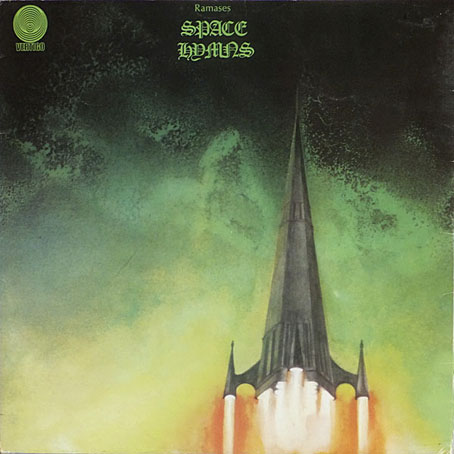
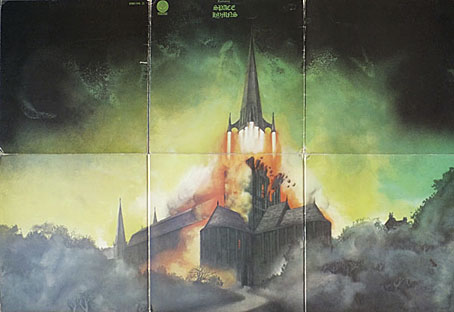
The church steeple blasting off from Space Hymns (1971) by Ramases is borrowed somewhat crudely in a 2011 ad for the Wien Museum which shows Vienna’s St Stephen’s cathedral undergoing a similar transformation. The Ramases idea is so eye-catching I’m surprised I’ve not seen it imitated before, although it wasn’t Dean’s invention; in his Views book he says that it was the group’s idea, and they gave him a thorough brief. I presume by this he means that they also wanted the spire as a cover detail, and looking sufficiently rocket-like to give a surprise when the sleeve is opened.
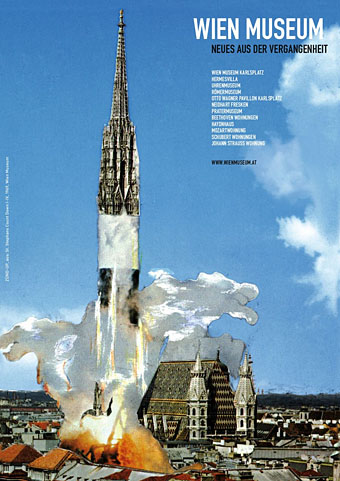
wien.jpg

“Ramases” was Martin Raphael Barrington Frost, an Egypt-obsessed British musician who recorded two albums and a single with wife, “Selket”. The single B-side, Mind’s Eye (1968), is a decent piece of psychedelia that turns up on compilations. The same can’t be said for Space Hymns, unfortunately; the presence of 10cc as backing band isn’t enough to rescue songs whose cosmic titles offer more than they deliver. But that’s still a great sleeve. Thanks to @weird_prophet for the Wien tip!

Elsewhere on { feuilleton }
The album covers archive

Previously on { feuilleton }
Roger Dean: artist and designer
Zone music

stalker1.jpg

Undulating terrain: Stalker (1979).

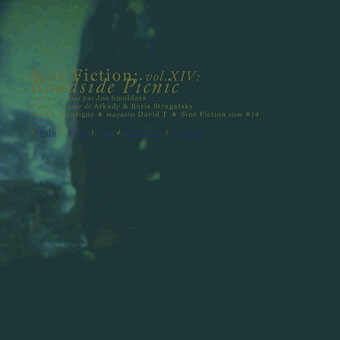
Marking the boundaries of an obsession, this post follows the discovery last week of the Sine Fiction soundtracks for science fiction novels, one of which was five tracks by Jos Smolders for Arkady and Boris Strugatsky’s Roadside Picnic. That album set me wondering what other recordings might have been inspired by that bounded region known as the Zone, whether derived from the Strugatskys’ novel, from Andrei Tarkovsky’s 1979 film Stalker (for whom the Strugatskys provided a screenplay) or even from the real-life Zone around the irradiated Chernobyl disaster site in Ukraine.

The cult status of the book and film can be measured by the following list which I’m sure will have many omissions, not least because searching music sites for “stalker”, “zone” and “roadside picnic” yields multiple results; all three of those terms happen to also be the names of musical artists or groups, as well as the names of labels, albums and individual recordings. (I’ll skip over the S.T.A.L.K.E.R. series of computer games. All have music but since I’ve not played any of them I can’t say much about them.)

stalker2.jpg

The stalker’s dream from Stalker.

The first release is of course the haunting film theme by Edward Artemyev, a mere five minutes of music which nonetheless adds a great deal to Tarkovsky’s unforgettable images. Artemyev also provided music for Tarkovsky’s Solaris (1972) and Mirror (1975) yet nothing else I’ve heard by the composer resembles this piece which wouldn’t be out-of-place on a compilation of German Kosmische music from the 1970s.

While that long camera shot over waterlogged objects is still in mind, there’s the following from Nova Swing (2006) by M. John Harrison, a science fiction novel which riffs on both Stalker and Roadside Picnic:

Upstairs, Emil Bonaventure was propped upright against the pillows like a corpse, his skin yellow in the streetlight from the window, his old ribs slatted with shadows. The energy had drained out of his smart tattoos and he was breathing ever so lightly. Edith watched the pulse in his neck. She could almost see the life through the skin, the thoughts in his head, and what were they but the dreams he couldn’t any longer have? Shallow water over cracked chequerboard tiles and cast-off domestic objects, books, plates, magazines, empty tunnels smelling of chemicals, a black dog trotting aimlessly round him in his sleep on some dirty waterlogged ground neither in nor out of anything you could think of as the world, while a woman’s voice mourned open-throat from a house not far enough in the distance.

Nova Swing will be available in a new edition later this year.

richlustmord.jpg

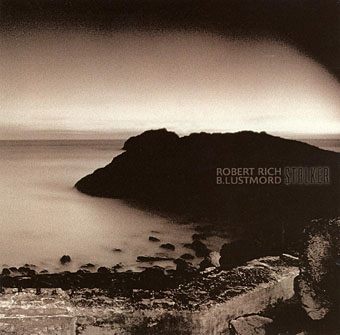
Stalker (1995) by Robert Rich & B. Lustmord.

The doomy atmospherics which have become the hallmark of Zone music begin with this album by Robert Rich and B. Lustmord. Seven tracks take Tarkovsky’s film as an inspiration with vaguely allusive titles—Undulating Terrain—and occasional snatches of dialogue buried in the mix. A superb piece of late-night listening even without the associations.

Continue reading “Zone music”

Weekend links 148

lanna.jpg

Quantum Entanglement by Duda Lanna.

An hour-long electronica mix (with the Düül rocking out at the end) by Chris Carter for Ninja Tune’s Solid Steel Radio Show.

• “…a clothes-optional Rosicrucian jamboree.”: Strange Flowers on the paintings of Elisàr von Kupffer.

• A Paste review of volume 2 of The Graphic Canon has some favourable words for my contribution.

It is an entertaining thought to remember that Orlando, all sex-change, cross-dressing and transgressive desire, appeared in the same year as Radclyffe Hall’s sapphic romance The Well of Loneliness. The two novels are different solar systems. The Well is gloomy, beaten, defensive, where women who love women have only suffering and misunderstanding in their lonely lives. The theme is as depressing as the writing, which is terrible. Orlando is a joyful and passionate declaration of love as life, regardless of gender. The Well was banned and declared obscene. Orlando became a bestseller.

Jeanette Winterson on Virginia Woolf’s androgynous fantasia.

Jim Jupp discovers the mystical novels of Charles Williams.

Michael Andre-Driussi on The Politics of Roadside Picnic.

Les Softs Machines: 25 August 1968, Ce Soir On Danse.

• At 50 Watts: Illustrations and comics by Pierre Ferrero.

Soviet posters: 1469 examples at Flickr.

Oliver Sacks on drugs (again).

• At Pinterest: Altered States.

• Farewell, Kevin Ayers.

Darkest London

Why Are We Sleeping? (1969) by The Soft Machine | Lady Rachel (1969) by Kevin Ayers | Decadence (1973) by Kevin Ayers

Sine Fiction

sine6.jpg

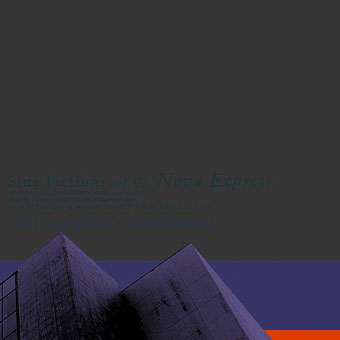
Sine Fiction VI: Nova Express (2003) by Eucci.

More Burroughsian music, and a selection that includes another interpretation of The Ticket That Exploded. Sine Fiction is a music project curated by Aimé Dontigny that commissions electronic artists to provide soundtracks to science fiction novels. The project has been running since 2000, and has so far managed twenty releases, the most recent of which—Dontigny’s own music for Ballard’s The Drowned World—appeared in 2011. In addition to three Burroughs titles there’s another work with considerable cult status, the Strugatsky Brothers’ Roadside Picnic, which Jos Smolders accompanies in a very minimal fashion. I’d still go for the gloriously doomy atmospheres of Stalker (1995) by Robert Rich & B. Lustmord but there’s room in the world for multiple interpretations.

All the Sine Fiction releases are available as free downloads at the No Type site or (if you prefer) at the Internet Archive.

sine7.jpg

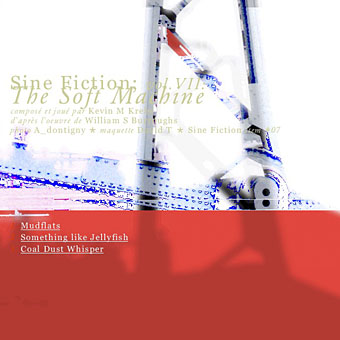
Sine Fiction VII: Soft Machine (2003) by Kevin M Krebs.

sine9.jpg

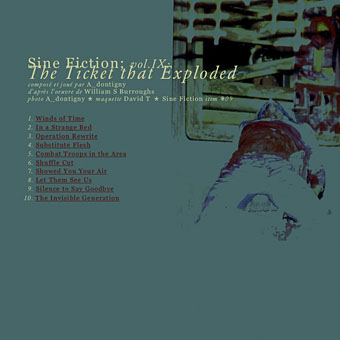
Sine Fiction IX: The Ticket That Exploded (2003) by A_Dontigny.

sine14.jpg

Sine Fiction XIV: Roadside Picnic (2004) by Jos Smolders.

Elsewhere on { feuilleton }
The William Burroughs archive

Previously on { feuilleton }
A playlist for Halloween: Drones and atmospheres

Le Voyage dans la Lune

melies.jpg

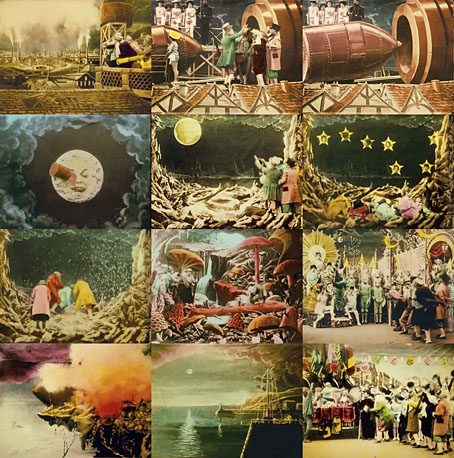
The title of Georges Méliès’Le Voyage dans la Lune (1902) is usually given the English translation of A Trip to the Moon, the word “trip” being an apt one when the lunar voyagers discover a landscape of giant mushrooms and crab-clawed inhabitants similar to the Selenites in HG Wells’ The First Men in the Moon (1901). I linked to a copy of this film years ago but these shots are from the recently reissued colour version, a print of which was discovered in 2002. The new version also includes a previously lost scene at the end. The soundtrack is by the French group Air. The more time elapses, the stranger these films seem. Queen Victoria had only been dead a year when this one was made; some of the young women here may have lived long enough to see the Apollo missions.

Previously on { feuilleton }
A Trip to Mars
Lunation: Art on the Moon
Somnium by Steve Moore
Blood on the Moon
Mushrooms on the Moon
Filippo Morghen’s Voyage to the Moon