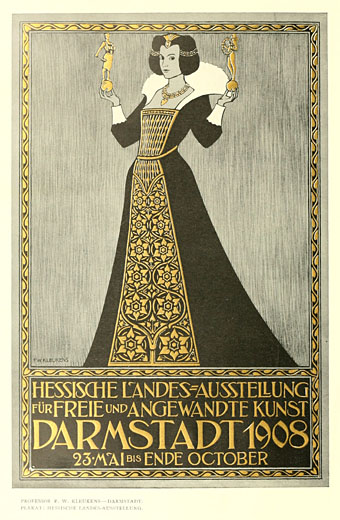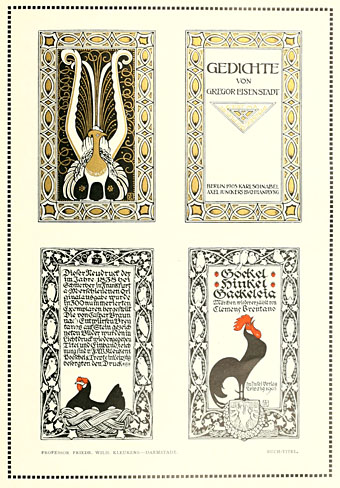
Deutsche Kunst und Dekoration #21

dkd21-01.jpg

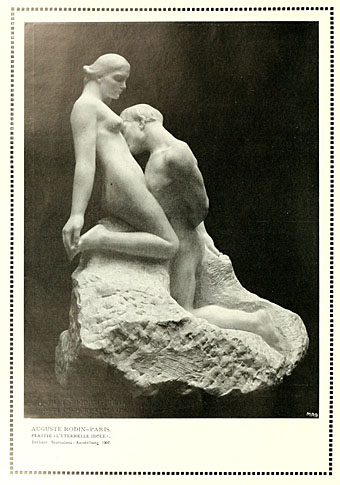
The Eternal Idol by Auguste Rodin.

Continuing the delve into back numbers of Deutsche Kunst und Dekoration, the German periodical of art and decoration. Volume 21 covers the period from October 1907 to March 1908, and the highlight of this issue is a feature on the black-and-white art of Julius Klinger, an artist whose drawings appeared regularly in Jugend.

If you’ve been following this series it’s worth noting that volume 3 which is missing from the collection at the Internet Archive can be found at the University of Heidelberg. I would have featured it here but it turns out to be surprisingly dull compared to the other early editions. As before, anyone wishing to see these samples in greater detail is advised to download the entire number at the Internet Archive. There’ll be more DK&D next week.

dkd21-02.jpg

dkd21-03.jpg

Continue reading “Deutsche Kunst und Dekoration #21”

Weekend links 56

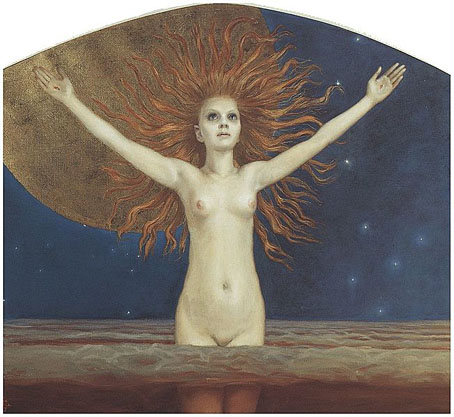
kallela.jpg

Ad Astra (1907) by Akseli Gallen-Kallela.

• Andres Serrano’s works are photo prints so you can’t damage an exhibition item the way you can with a painting. That didn’t stop Catholic protestors in France attacking a copy of Piss Christ on Monday. By coincidence, Dave Maier had posted an essay about Serrano’s work a few hours earlier, and with a reminder that the notorious photograph was part of a series, a detail which is often forgotten or conveniently ignored.

• The Avant Garde Project which made available deleted experimental audio works (see this earlier post) ceased activity a while ago so it’s good to see that its archives will now be hosted at Ubuweb.

…African Head Charge again was a studio name I had to start with, and it evolved into a band about eight years later. That started out again I read an interview in a newspaper where Brian Eno talked about he’d made an album called My Life in the Bush of Ghosts with another musician—that Talking Heads fellow [David Byrne]—and he said “I had a vision of a psychedelic Africa”. And I thought, “Oh, that’s pretentious”. But then I thought about it, and thought “No, what a good idea! Make really trippy African dub”.

Adrian Sherwood on thirty years of On-U Sound.

• Related: Brian Eno has a new album out in July, Drums Between The Bells, a collaboration with Rick Holland.

“Do you think Lord Leighton could by any chance have been a homosexual?” enquired Richard. “It says here,” I replied, consulting a laminated information card, “that there is no evidence one way or the other.”

“Rent boys leave no evidence,” said Richard.

A private view of Lord Leighton’s home in Holland Park, London, which opened to the public again last year.

Passengers, an exhibition of urban transit photos by Chris Marker at Peter Blum, NYC. For a different kind of rail transport there’s this exploration of London’s disused underground Post Office Railway.

• Reappraising the recent past: Jon Savage on Taxi zum Klo, Christiane F, David Bowie and the seedy attraction of Berlin in the 70s and 80s; Iain Sinclair on the Festival of Britain sixty years on.

Stella Steyn’s illustrations for Finnegans Wake as seen in transition magazine, 1929. And speaking of literary magazines, the return of New Worlds has been announced.

Clive Hicks-Jenkins is an art monograph published next month by Lund Humphries. Clive enthused about the book’s arrival.

• 50 Watts announces the Polish Book Cover Contest.

• 4th June, 2011 is Radiophonic Creation Day.

• Americans: has your state banned sodomy?

Stardust (1931) by Louis Armstrong | Stardust (1940) by Artie Shaw | Stardust (1957) by Nat King Cole.

Joachim Beuckelaer’s Four Elements

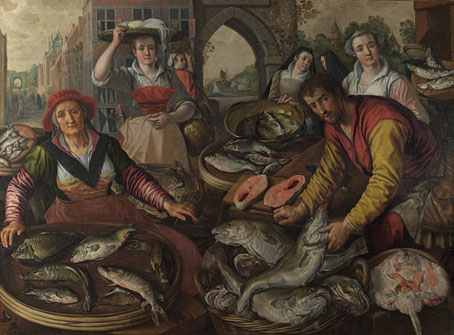
beuckelaer1.jpg

The Four Elements: Water. A Fish Market with the Miraculous Draught of Fishes in the Background (1560–1574).

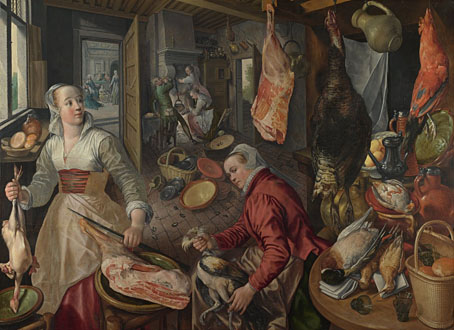
Flemish artist Joachim Beuckelaer (1533–1574) depicts the four elements using foodstuffs. All four paintings can be explored via Google’s Art Project.

beuckelaer2.jpg

The Four Elements: Fire. A Kitchen Scene with Christ in the House of Martha and Mary in the Background (1560–1574).

Continue reading “Joachim Beuckelaer’s Four Elements”

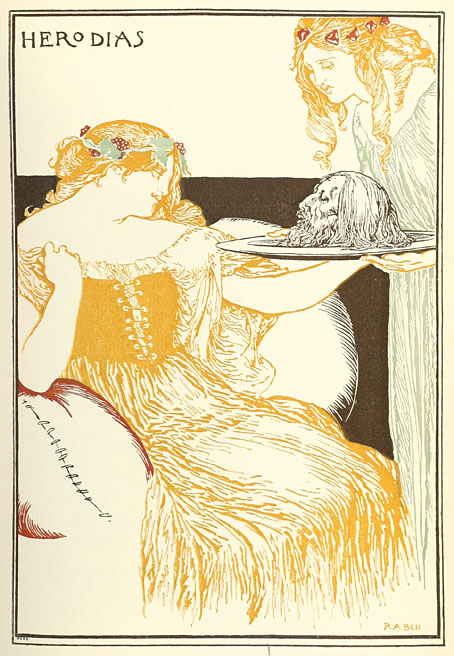
Robert Anning Bell’s Herodias

herodias.jpg

Artist Robert Anning Bell (1863–1933) chooses to depict Salomé’s mother rather than the more usual daughter in a slightly Pre-Raphaelite take on the familiar theme. This print appears in volumes 8–10 of Studio International, and seeems to have been a one-off although I’ll be happy to be hear of any other depictions of the story by Mr Bell.

Elsewhere on { feuilleton }
The illustrators archive

Previously on { feuilleton }
The Tempest illustrated
Book-plates of To-day
Robert Anning Bell’s Tempest

The Temples of Bagan

bagan1.jpg

Anyone who’s seen Werner Herzog’s The Enigma of Kaspar Hauser (1974) will recognise vistas of Bagan, Burma with their apparently endless plain of Buddhist temples and stupas. These appear near the end of the film in a startling moment when Herzog’s doomed protagonist is given a final vision on his deathbed, another instance of Herzog’s fantastic realism like the valley filled with thousands of windmills in Signs of Life. It’s dismaying to read that this region has been denied World Heritage status as a consequence of unsympathetic restoration work carried out by the wretches currently governing the place. It’s even more dismaying to read about that most useless of human creations, a golf course, being built in the area. May the storms of Burma be lightning-rich and eager for men waving metal poles.

There are plenty of photos of Bagan at Flickr, of course. This set showing departing balloons is particularly good.

bagan2.jpg

Previously on { feuilleton }
Aguirre by Popol Vuh
Temples for Future Religions by François Garas
The temples of Angkor