Carl Larsson’s Angel of Death

larsson01.jpg

I’ve known the work of Swedish artist Carl Larsson (1853–1919) for many years via a collection of drawings and paintings of the artist’s family and home life, light works created between bouts of more serious painting. The interiors in the At Home series are especially good, meticulously rendered watercolours which today resemble the kinds of delineations found in Continental comic books. Less familiar is the work Larsson created prior to these drawings.

larsson02.jpg

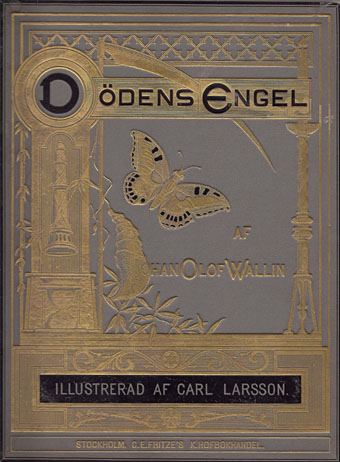
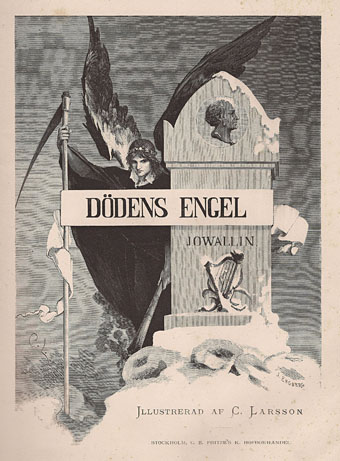
Dödens Engel (The Angel of the Death) is a book-length religious poem by Johan Olof Wallin inspired by the cholera epidemic of the 1830s, the same epidemic that Poe writes about in The Sphinx. Larsson illustrates every page of this edition from 1880, deploying the full range of traditional death symbolism: skulls, hourglasses, scythes, extinguished torches and so on.The sombre imagery makes a striking contrast with the pictures of Larsson’s home life yet the painting for which he hoped to be remembered, Midvinterblot (1915), is equally doom-laden, a huge canvas that depicts a king preparing to sacrifice himself to spare his people from famine.

larsson03.jpg

Continue reading “Carl Larsson’s Angel of Death”

John Aarts’ Lucifer

aarts01.jpg

The Lucifer in question being the principal character in a play of the same name by Dutch poet and playwright Joost van den Vondel (1587–1679). I confess that I hadn’t heard of this work before even though it’s well-known in the Netherlands, and may also have influenced Paradise Lost. The version linked here is an American reprint of an earlier edition from 1898 that was the first English translation of the play. The graphics by John Aarts appear to be wood engravings but I’m not certain of that, matters not being helped by the present invisibility of Mr Aarts. In addition to a suite of full-page illustrations there are many embellishments in the nascent Dutch Art Nouveau style. And unlike many books that repeat the same two or three vignettes there’s a lot of variation throughout so it’s worth seeing the book as a whole.

aarts02.jpg

aarts03.jpg

aarts04.jpg

Continue reading “John Aarts’ Lucifer”

Weekend links 372

mognetti.jpg

Battistero della Basilica di Santa Maria Maggiore, Bergamo (2017) by Mattia Mognetti.

• “Mumbo Jumbo: a dazzling classic finally gets the recognition it deserves.” Jonathan McAloon on Ishmael Reed’s unique novel being reissued as a Penguin Modern Classic.

• Amanda Gefter talks to Donald D. Hoffman, professor of cognitive science at the University of California, about “the evolutionary argument against reality”.

• Geeta Dayal on composer Raymond Scott. A new compilation, Three Willow Park, collects more of Scott’s electronic music from the 1960s.

Nagle critiques the follies of campus identity politics and social media liberalism not from the right, but as a left-leaning feminist. As she elucidates point after reasonable point, it feels as if a grown-up has finally entered the room. Like Mark Fisher, the Marxist critic who was savaged by his putative comrades for decrying “the stench of bad conscience and witch-hunting moralism” of the online left, Nagle has no sympathy for Twitter/Tumblr liberalism’s “cult of fragility and victimhood mixed with a vicious culture of group attacks, group shaming, and attempts to destroy the reputations and lives of others”. It is reassuring to find a self-described feminist disdaining the “hysterical” liberal call-out culture, and acknowledging that it has produced “a breeding ground for an online backlash of irreverent mockery and anti-PC”. Without joining the forces of reaction or losing sight of the vileness of the alt-right, she writes of “the deep intellectual rot of contemporary political progressivism”; “the moral self-flattery of … a tired liberal intellectual conformity”; and “the hysteria and faux-politics of liberal Internet culture”.

Rob Doyle reviewing Kill All Normies by Angela Nagle

• Mixes of the week: XLR8R Podcast 501 by Ryan Elliott, and ReMelodiya vol. 1 by Laurent Fairon.

Sumit Paul-Choudhury on the slime mould instruments that make sweet music.

The Wire Salon: an audience with photographer and writer Val Wilmer.

Simon McCallum‘s list of 10 great lesser-known British LGB films.

Zaria Gorvett on the ghostly radio station that no one claims to run.

S. Elizabeth reposted her Coilhouse interview with me from 2010.

• “Boys are selling sex in Japan. Who is buying?” Boys For Sale

• At Spoon & Tamago: Ando Tadao’s Hill of Buddha.

• At Dennis Cooper’s: Gisèle Vienne Day.

Sun Ra is now on Bandcamp.

Shaolin Buddha Finger (1994) by Depth Charge | Atomic Buddha (1998) by Techno Animal | Psycho Buddha (2001) by Acid Mothers Temple & The Melting Paraiso U.F.O.

Weekend links 366

kashiki.jpg

Dandelion (2009) by Tomoko Kashiki.

• “Standard Ebooks takes ebooks from sources like Project Gutenberg, formats and typesets them using a carefully designed and professional-grade style guide, lightly modernizes them, fully proofreads and corrects them, and then builds them to take advantage of state-of-the-art ereader and browser technology.”

Obscenity and the Arts, a previously unpublished essay by Anthony Burgess, will appear in book form later this year via Pariah Press.

• Mixes of the week: VF Mix 97: Talk Talk by The Last Dinosaur, and Secret Thirteen Mix 225 by Janek Schaefer.

Rub any two writers together and similarities will show. No two writers, however different, are completely different. Here’s a crucial instance: Lovecraft and Ballard both put architecture at the heart of their fiction, even though neither had the slightest formal training in the subject. And it is via this interest that the two intersect in an unexpected way. They are connected, through time and space, by that most humble of architectural events: the corner, the junction between two walls. What Lovecraft and Ballard did was to make the corner into a place of nightmares — and in doing so, they reveal its secret history.

Will Wiles in a long and rewarding essay, The Corner of Lovecraft and Ballard

• Dungeons Deep, Forests Dark – A beginner’s guide to Dungeon Synth by Daniel Pietersen.

Alex Ross on Joséphin Péladan, the Symbolists and the occult roots of Modernism.

• Cooling the Tube: engineering heat out of the [London] Underground by IanVisits.

Caroline on the mysteries of Pye Corner: Flames, poltergeists and bodysnatchers.

• The Saint of Sin City – Tony Kail Visits Las Vegas’ Santuario de la Santa Muerte.

• Photographs of Art Nouveau architecture by Keiichi Tahara.

• A stream of the new Porter Ricks album, Anguilla Electrica.

Jasper Sharp on 100 years of Japanese animation.

• At Dennis Cooper’s: 197 clocks.

On The Corner [Take 4] (1972) by Miles Davis | Corner Crew Dub (1976) by Augustus Pablo | Empty Avenues And Dark Corners (Pye Corner Audio Mix) (2013) by John Foxx and the Belbury Circle

Under the Pendulum Sun by Jeannette Ng

pendulum.jpg

Once again I’m a little behind with putting new pieces of work on these pages, a consequence of the reduced rate of posting and the delay between finishing various works and them being announced by publishers.

Under the Pendulum Sun is a fantasy novel by Jeannette Ng whose cover was revealed this week by Angry Robot. I was very pleased with the way this one turned out so it’s good to see it being given a positive reception. Jeannette’s novel is a dark hybrid of Gothic drama and fairy story, the main characters being a pair of Victorian missionaries attempting to bring the Gospel to Arcadia, a very real and very sinister fairyland. The model is that of the Victorian missionary heading into what were regarded as the benighted places of the world then finding themselves and their beliefs subverted by the alien culture they were hoping to enlighten. It’s a clever concept, and the novel is filled with strange invention, so much so that I had to scale down the amount of things I wanted to get into the cover. This often happens with inventive novels (the ones I’ve done for KW Jeter suffered from this), you find yourself with enough material for three or more covers but only the one cover to contain everything.

There’s no need for me to go into any detail about the art and design when I did that earlier for the cover reveal at Fantasy Faction. The book itself will be published at the beginning of October.