Philip José Farmer book covers

feast.jpg

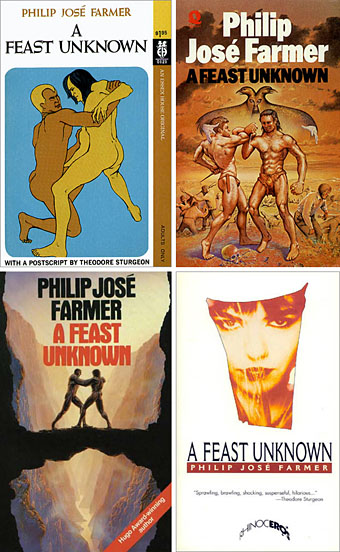
top left: artist unknown (1969); top right: Patrick Woodroffe (1975)
bottom left: Peter Elson (1988); bottom right: artist unknown (1995)

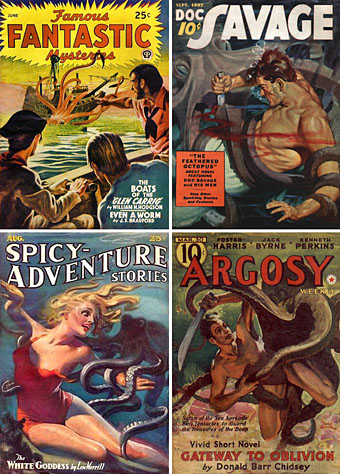
The Men with snakes post at the weekend finished on a note of Freudian melodrama with a picture of Doc Savage battling a giant python. Lester Dent’s brazen hero has appeared a number of times in the work of Philip José Farmer, a writer who’s spent much of his career laying bare the psychosexual forces which give us stories of pulp heroes struggling with (among other things) enormous snakes.

Farmer is famous—notorious, even—for being the first writer to place sex centre stage in science fiction with his story of a human/alien encounter, The Lovers, in 1952. While subsequent writers have broadened the field in their own way, Farmer is somewhat unique in being equally adept at writing solidly successful sf adventure such as the World of Tiers or Riverworld books, yet with a mischievous and intellectual facility that could be upsetting to what used to be a very conservative sf establishment. Farmer was writing about sex at a time when few genre writers wanted to deal with the subject. He also loves pulp fiction in all its manifestations yet isn’t afraid of examining its characters with the objectivity of an anthropologist. Both these impulses came together (so to speak) in the late Sixties with the outrageous pulp pornography of Image of the Beast and A Feast Unknown. More about these in a minute.

Farmer has a particular enthusiasm for Tarzan and Doc Savage and eventually wrote “official biographies” of the pair with Tarzan Alive (1972) and the splendidly-titled Doc Savage: His Apocalyptic Life (1973). These books saw the beginning of his Wold Newton Universe which sought to connect all the heroes and villains of the late 19th and early 20th century into a vast, incestuous family tree, a scheme which predates similar exercises such as Alan Moore and Kevin O’Neill’s League of Extraordinary Gentlemen by three decades or more. His versatility and delight in pastiche was demonstrated in Jungle Rot Kid on the Nod (1968) which rewrote Edgar Rice Burroughs’ Tarzan in the style of William Burroughs. There aren’t many writers with a full-enough appreciation of both these authors to pull off such a challenge.
farmer2.jpg

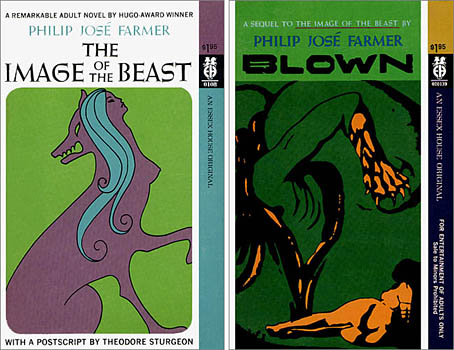
Original Essex House editions, 1968 & 1969. Artist/designer unknown although the cover of Blown is based on Geopoliticus Child Watching the Birth of the New Man by Salvador Dalí.

Image of the Beast (1968), its sequel, Blown (1969), and A Feast Unknown (1969) were all written for sf-porn publisher Essex House, an opportunity which unleashed Farmer’s already fertile imagination. These took a while to be reprinted but are now considered among his best works; they’re certainly favourites of mine and I love the simple graphics of the original covers, such a change from the usual airbrushed sf fare. I produced a cover illustration for the Creation Books edition of Image/Blown in 2001 which, while okay, I now feel could have been better. A Feast Unknown is Farmer’s most gloriously excessive novel, and still surprises when read today. Illustrator Patrick Woodroffe, who painted the cover for the first UK printing, thought the book “dangerous” and complained in his Mythopoeikon collection that there was little he could safely illustrate. The story has a thinly-disguised Tarzan (Lord Grandrith) and Doc Savage (Doc Caliban) set against each other by a group of mysterious immortals. The pair discover that violence gives them erections and killing provokes an orgasm, the cue for a couple of hundred pages of eye-popping, ball-busting mayhem. It’s ironic that during the Seventies when general readers were looking for racy thrills in books by Harold Robbins or Jackie Collins, the real hardcore stuff was over on the science fiction shelves with Farmer’s work, Ballard’s Crash, Samuel Delany’s Equinox, aka The Tides of Lust, Charles Platt’s The Gas, and others.

Farmer wrote two equally crazy sequels to Feast in 1970, Lord of the Trees and The Mad Goblin but unfortunately stripped out the excesses of the former book. I’ve always been disappointed by this and continue to hope that one day the original versions of the sequels will see print. Science fiction may have calmed down a bit (or grown conservative again) since the Seventies but Farmer’s work still exerts an influence. His unveiling of the weird psychosis at the heart of pulp fiction certainly affected the approach I took with the Lord Horror series Reverbstorm, created with David Britton in the 1990s, a series I’ve referred to more than once as a psychopathology of heroic fantasy.

The covers above all come from the official PJF website which also includes my Image/Blown cover design. (And where they also spell my name wrong.)

Previously on { feuilleton }
Men with snakes
The book covers archive

Men with snakes

laocoon.jpg

Laocoön and His Sons attributed to Agesander, Athenodoros
and Polydorus of Rhodes (c. 160–20 BCE).

No jokes about snakes in a frame, please. Bram Dijkstra’s Idols of Perversity: Fantasies of Feminine Evil in Fin de Siècle Culture (1986) is a wide-ranging study of the “iconography of misogyny” in 19th century painting. Dijkstra examines the numerous ways that women were depicted in late Victorian and Symbolist art, with one chapter, “Connoisseurs and Bestiality and Serpentine Delights”, being devoted to representations of women with animals, especially snakes. The story of Eve and the Serpent prompts many of these latter images, of course, while scenes with other creatures seem intended to demonstrate the Victorian attitude that woman was closer to the brute beasts than man and could often be found conspiring with them to bring down her masculine masters. Continue reading “Men with snakes”

Judex, from Feuillade to Franju

judex1.jpg

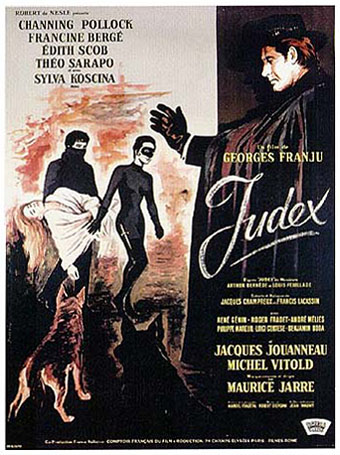
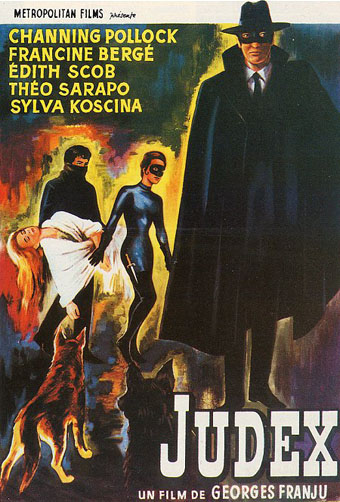
Monsieur Wiley in yesterday’s comments reminded me of George Franju’s seldom seen Judex, a 1963 film based on the Feuillade serials of the same name. Louis Feuillade (1873–1925), as you really ought to know by now, was the director of the original Fantômas serials (1913–14) and also Les Vampires (1915–16), obvious forerunners of Diabolik with all their black-clad nocturnal prowling. Feuillade’s criminals were clebrated by the Surrealists, Blaise Cendrars, Jean Cocteau and others but the director received stern reviews from less liberal critics for apparently promoting immorality:

“That a man of talent, an artist, as the director of most of the great films which have been the success and glory of Gaumont, starts again to deal with this unhealthy genre (the crime film), obsolete and condemned by all people of taste, remains for me a real problem.”

Hence the arrival in 1917 of Judex (The Judge), possibly the first costumed avenger in cinema, with his broad-brimmed hat and cloak, secret lair and network of helpful circus performers. Fictional immorality is less of a concern these days which perhaps explains why Fantômas and Les Vampires were resurrected on DVD first while Judex only appeared recently. I must admit that it’s Feuillade’s criminals which have always interested me for the most part, even if (as with many silent films) the romance of the concept is often more attractive than the actual work. (There are exceptions, of course; the Lon Cheney Phantom of the Opera is far better than the book.) Feuillade and his writer, Arthur Bernède, produced a series of spin-off novels while the films were being made (you thought novelizations were a recent thing?) and this page has some nice reproductions of the covers.

judex4.jpg

Judex turned up again in 1934, in a film directed by Maurice Champreux before Franju gave his own twist to the character. Franju is most famous for his exceptional horror film, Les Yeux sans Visage (1960) which still packs a punch today; I saw it at a cinema several years ago and one notorious scene drew gasps from an unprepared audience. Nearly everything else of his, Judex included, appears to be out of circulation. Franju began his career as a maker of documentary shorts whose approach to the medium was inspired by the juxtapositions of the Surrealists. In the celebrated Le Sang des bêtes (1949), he contrasted scenes of day-to-day life in Paris with film of animals being killed in the city’s slaughterhouses. This attitude was carried over into his dramas—Les Yeux manages to be lyrical as well as horrifying—and was impressive enough for Jean Cocteau to declare he’d happily entrust his work to Franju. This perhaps explains why Franju’s work has been so overlooked since his death in 1987, both he and Cocteau were mavericks who don’t easily fit the usual narrative of French cinema history.

judex3.jpg

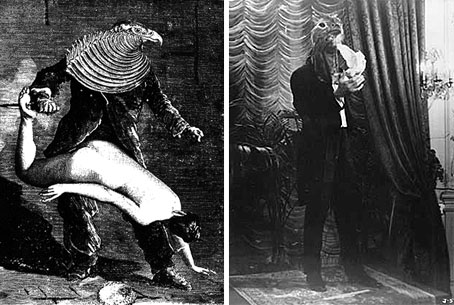
left: Une Semaine de Bonté (1934) by Max Ernst; right Channing Pollock as Judex.

Franju’s Judex was portrayed by an American stage magician, Channing Pollock, whose act with doves was put to use in the film. There’s a great scene of a masked ball (the only part of the film I’ve yet seen) with all the characters wearing bird masks that looks like a page from Max Ernst’s collage novel, Une Semaine de Bonté, brought to life. Senses of Cinema compares the remake with the original:

Franju sought in particular to recapture Feuillade’s sense of documentary and his playfulness. He reproduced with as much exactitude as possible the costumes and settings which Feuillade filmed in scrupulous detail. Feuillade’s street-scapes are now an invaluable documentary record, but Franju also paid particular attention to reproducing the elaborate interior designs and furnishings of the day, resulting in settings of quite extraordinary detail and clutter. Franju also sought, despite the playfulness, to avoid any camp satire of these elements by over-emphasis or any special attention being paid to them.

In the title role, Franju pulled off his most brilliant coup by casting the master prestidigitator of his day, near godlike in his handsomeness, Channing Pollock. Pollock’s skills as a magician were employed to produce a dazzling array of apparent magical occurrences involving, most particularly, disappearing doves, a plot device that Feuillade uses to enable the regular rescue of the heroine and others by Judex. Franju’s Judex is a far livelier, less sombre, more inventive and more mysterious character than that of Feuillade.

judex2.jpg

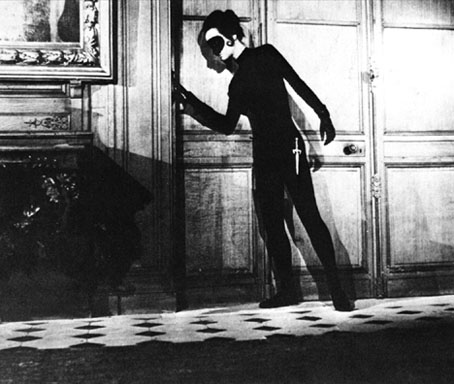
Francine Bergé as the villainous Diana Monti in Franju’s Judex (1963).

Edith Scob (the faceless girl in Les Yeux) played Jacqueline, the imperilled heroine, while Francine Bergé incarnates yet another cat-suited Feuilladesque villain. The cat-suits returned, along with the masks, in a further Feuillade homage, Nuits Rouges (1974), a feature film cobbled together from a French TV series. This page has stills from all of these and this site concerning French pulp characters (from which much of the information above was swiped) goes into more detail about the creation of Judex. There you can also read about other fascinating personages such as Belphegor, Phantom of the Louvre (another creation of Arthur Bernède), Ferocias and the Mysterious Doctor Cornelius.

And so to the inevitable question: how long do we have to wait for a Judex DVD?

See also:
Fantastic, Mysterious, and Adventurous Victoriana by Jess Nevins
Les Vampires at the Internet Archive

Previously on { feuilleton }
Danger Diabolik
Boys Own Books
Alla Nazimova’s Salomé
Meshes of the Afternoon by Maya Deren
Fantômas
La Villa Santo Sospir by Jean Cocteau

Danger Diabolik

diabolik.jpg

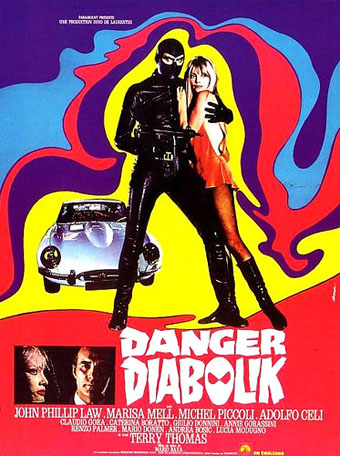
More pulp madness as Mario Bava’s 1968 crime caper finally appears on DVD in the UK this week; a camp confection from an already very camp decade, although it pales beside the lurid excesses of Barbarella which was released in the same year. Both films were based on popular European comic strips, and both are connected by the presence of John Phillip Law, the sexiest (male) screen angel in Barbarella, and the star of Danger Diabolik. Barbarella’s adventures on page and screen managed to be equally frivolous whereas master thief Diabolik in the original fumetti (which is still running) was rather more serious, at least in serial adventure terms. Bava forgoes any attempt to treat his subject with a straight face, opting instead for the knowing action-comedy style that was popular during the Sixties, whether in post-Bond fare such as Our Man Flint or superior TV series like The Avengers.

diabolik1.jpg

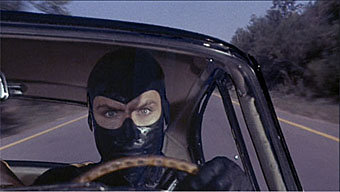
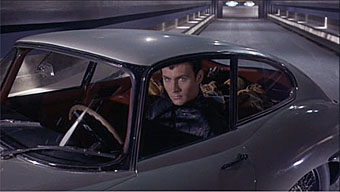
Diabolik stands apart from his contemporaries, and from other campy comic spin-offs such as Adam West’s Batman, by being an anti-hero in a field over-stuffed with costumed vigilantes and sexist super-spies. Most characters of this type are descendants of deathless arch-criminal Fantômas, and Diabolik can perhaps be seen as a trendy updating of the Fantômas type, with his black leather bondage outfit and ultra-cool E-type Jaguar, probably the only car ever made in Britain that would impress style-conscious Italians. The comic strip was created in 1962 by two sisters, Angela and Luciana Giussani, a feat one imagines would be impossible in the male-dominated world of American comics at that time.

diabolik2.jpg

The fumetti Diabolik shuns firearms in favour of knife-throwing expertise, something that Bava ignores by giving him a mundane machine-gun. Bava had directed a very silly James Bond spoof, Doctor Goldfoot and the Girl Bombs, two years earlier, and always had a great eye for aesthetics even when lacking an adequate budget. His horror films frequently outdid Hammer for Gothic atmosphere, and his strange science fiction/horror, Planet of the Vampires (1965), features a cast similarly sheathed in shiny black spacesuits. The clouds of coloured fog those astronauts encounter reappear as the coloured smoke Diabolik uses to evade his pursuers, while his underground super-pad is one of the more spectacular villainous residences, like something Norman Foster might design for Dr. No. It certainly makes the Batcave look shabby, although, as with all these underground complexes, you can’t help wondering who the hell built them and how they managed to escape detection while doing so. The plot of the film, such as it is, is some forgettable nonsense concerning Diabolik’s cat-and-mouse game with his chief adversary, Inspector Ginko. Michel Piccoli plays the inspector, and it’s surprising seeing the splendid Terry-Thomas as a government official who Diabolik embarrasses with “exhilarating gas” at a press conference. The film is embellished with a tremendously groovy score by Ennio Morricone.

diabolik3.jpg

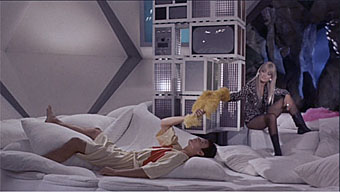
One of my favourite comic strip heroes when I was a kid was Billy the Cat in the Beano, the adventures of a super-agile boy in a black leather catsuit (no eyebrow-raising, please). I always had a fondness for these kind of characters, and I’m sure I would have loved Danger Diabolik for the cat burglary and the Sixties’ zaniness had I seen it on TV. My only gripe now is I can’t quite believe that Diabolik is all that interested in his female companion, Eva, despite the scene where they have sex on a revolving bed covered in dollar bills. If he’d rescued Alain Delon’s taciturn assassin from death at the end of Le Samouraï he could find Eva a nice young man in Monte Carlo, after which Jef Costello (as Delon is named in Melville’s film) could whack the pesky Inspector Ginko, and the pair could live together in subterranean peace, at least until the next heist. We can but dream.

A tip of the hat to Mark Pilkington for alerting me to this one. Bava’s Diabolikal influence lives on via Roman Coppola’s 2001 homage to Sixties’ camp, CQ, and the Beastie Boys’ video for Body Movin’.

Previously on { feuilleton }
Fantômas
The persistence of memory

Octopulps

octopoidal.jpg

Pulps and octopuses! Octopuses and pulps! Not sure how this has evaded my attention until now but better late than never, especially when the contents are this er, pulpy. Francesca Myman, self-proclaimed Mistress of the Tentacled Oblivion (there’s a title to conjure with), has accumulated a stunning collection of octopoidal pulp madness. More goggle-eyed cephalopods than you can wave a blunt harpoon at. Hunks and babes alike, all must submit to the suckered demands of the tentacled menace!

Previously on { feuilleton }
Zeppelin vs. Pterodactyls
Coming soon: Sea Monsters and Cannibals!
Druillet meets Hodgson
It’s a pulp, pulp, pulp world
Davy Jones