Weekend links 371

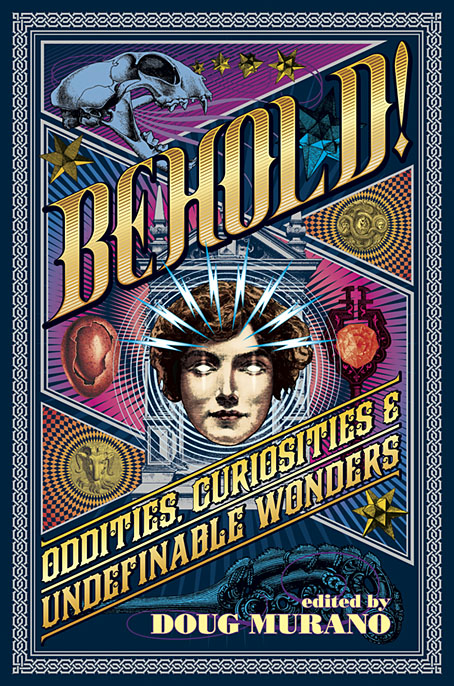
behold.jpg

• My cover design for the Doug Murano-edited story collection, BEHOLD! Oddities, Curiosities and Undefinable Wonders, appeared here last December but a repost is in order since the book has been published this week by Crystal Lake. Back in December I didn’t have a list of the featured authors but I do now: Clive Barker, Neil Gaiman, Ramsey Campbell, Lisa Morton, Brian Kirk, Hal Bodner, Stephanie M. Wytovich, John Langan, Erinn L. Kemper, John FD Taff, Patrick Freivald, Lucy A. Snyder, Brian Hodge, Kristi DeMeester, Christopher Coake, Sarah Read and Richard Thomas. The foreword is by Josh Malerman, and the interior illustrations are by Luke Spooner.

• “How do you memorialize an artist who refused to remain identical to himself? How do you remember one of the great philosopher-artists of memory?” Ben Lerner on the elusive Chris Marker.

Diabolical Fantasia: The Art of Der Orchideengarten, 1919. A welcome reprinting of art from the German magazine of weird fiction compiled by Thomas Negovan. (Previously)

• Coming in September: Conny Plank: The Potential of Noise, a documentary by Reto Caduff and Stephan Plank about the great record producer.

The Roman Roads of Britain mapped by Sasha Trubetskoy in the style of Harry Beck’s London Tube Map.

• At Dennis Cooper’s: Spotlight on…Julia Kristeva Powers of Horror: An Essay on Abjection (1980).

Ian Shank on the trove of erotic Roman art that scandalized Europe’s royals.

• At Haute Macabre: Biblio-alchemy: The Liquid Library of Annalù Boeretto.

• What makes a French film noir? Andrew Male has some suggestions.

David Shariatmadari on how 1967 changed gay life in Britain.

• Mix of the week: Gated Canal Community Radio.

• A Gallery of Moods by Mlle Ghoul.

Loe And Behold (1970) by Sir Lord Baltimore | Behold The Drover Summons (1983) by Popol Vuh | Beholding The Throne Of Might (2014) by The Soft Pink Truth

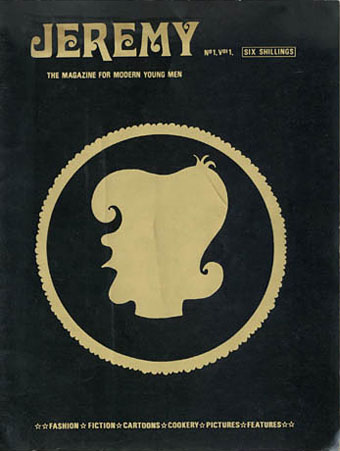
Jeremy, The Magazine for Modern Young Men, 1969

Jeremy-vol1-no1.jpg

Jeremy, vol. 1, no. 1.

To note the 50th anniversary this month of the (partial) decriminalisation of homosexual acts in England and Wales I thought I’d write something about Jeremy magazine, a short-lived publication launched in the UK in 1969. The magazine is notable not for the quality of its contents, which seem slight considering the high cover price of six shillings, but for being the first British magazine aimed at an audience of gay men that wasn’t either porn, a dating mag or a political tract. I had planned to write something about Jeremy at least two years ago when the blog was still a daily thing but detailed information about the magazine’s history is hard to find. This is frustrating but not too surprising. The anniversary of the change in the law has prompted a number of exhibitions and events devoted to Britain’s gay history but little of that history ever seems to travel beyond academic circles unless a notable life story—Quentin Crisp or Alan Turing, say—is involved. As with so many aspects of British culture, the conversation is dominated by America: the main campaigning organisation in the UK, Stonewall, is named after an American riot; the LGBT initialism is an American invention, as is the rainbow flag (the latter, as I’ve said before, being fine as a flag but—with its multiple colours—hopeless as a symbol). More Britons will know the name Harvey Milk than they do Edward Carpenter (1844–1929) or Allan Horsfall (1927–2012) even though Carpenter and Horsfall devoted years of their lives campaigning for gay men to be treated equally under the law in the Britain. Horsfall’s Campaign for Homosexual Equality pioneered the push for gay rights in Britain, the first official meeting taking place in Manchester in 1964. The Sexual Offences Act of 1967 seemed in later years like a poor compromise but when the alternative being offered was celibacy or the risk of a prison sentence it was a start. (Scotland, however, had to wait until 1980 for the same change in the law while in Northern Ireland sex between men was illegal until 1982.) Two years after decriminalisation, not only was Jeremy being launched but OZ magazine devoted a portion of its 23rd issue (September, 1969) to gay material. Jeremy advertised its early issues in OZ and IT (see below).
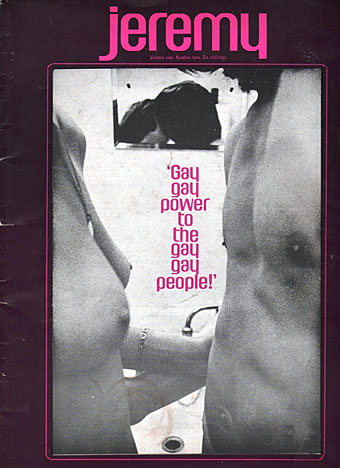
Jeremy-vol1-no2.jpg

Jeremy, vol. 1, no. 2.

Jeremy‘s status as the first gay magazine in Britain might be more acknowledged if its origins weren’t so obscure. The magazine is mentioned in books such as British Queer History (edited by Brian Lewis) and The Culture of Queers by Richard Dyer but never in any detail. Dyer refers to the title as a bisexual magazine which it may have appeared to be from the covers but this is contradicted by the ads. Peter Burton, editor of the later issues, claimed that everyone involved knew that gay men were the primary audience. Using bisexuality as a kind of fig leaf was less a case of cold feet than a means by which the magazine might be smuggled under the radar of those who would otherwise object to its existence. Britain may have been slightly ahead of the US in its tolerance of gay men but the lack of a written constitution meant that publishers, especially those regarded as subversive or disreputable, needed to tread carefully in the 1960s and 70s as OZ and Nasty Tales discovered.
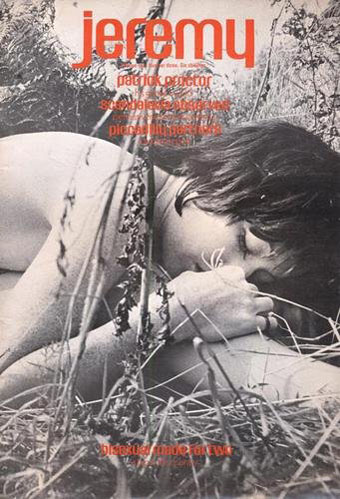
Jeremy-vol1-no3.jpg

Jeremy, vol. 1, no. 3.

The precarious legal position means that Jeremy‘s visuals are relatively innocuous, with sporadic nudity but nothing that might be regarded as pornography. The magazine’s features were also relatively innocuous although the novelty of publishing anything overtly gay meant that a piece about entertaining at home would carry a frisson that would be absent in other magazines. Later issues included encounters with minor celebrities including an early interview with David Bowie which has at least preserved the magazine’s name in Bowie histories. Bowie had the opportunity to be open about his sexuality but wisely waited until his profile had risen and he could make a declaration to a larger audience.
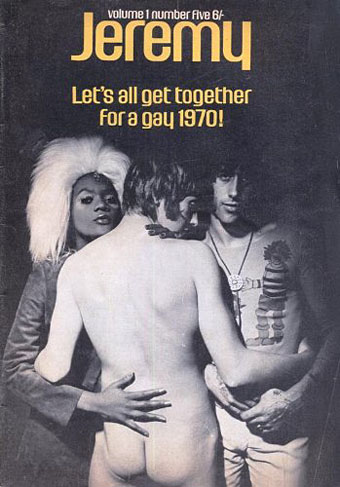
Jeremy-vol1-no5.jpg

Jeremy, vol. 1, no. 5.

A few more covers and some interior pages follow. As usual, if anyone has further information to contribute then please leave a comment. My thanks to Rex for sending the information about Peter Burton’s editorship of the magazine.

Continue reading “Jeremy, The Magazine for Modern Young Men, 1969”

Weekend links 365

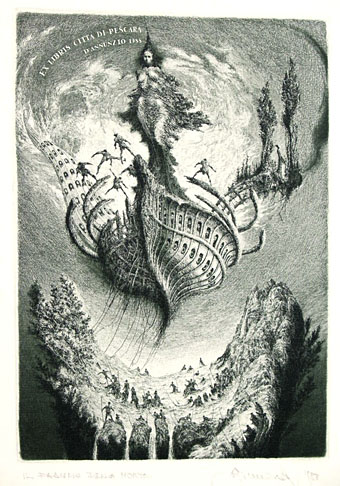
brunovsky.jpg

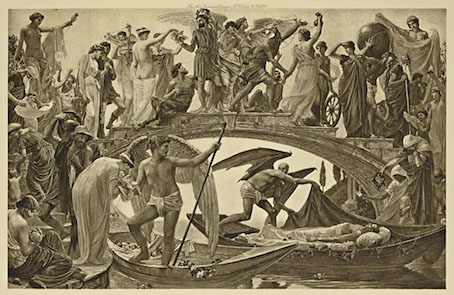
Il Fascino Della Morte (1988) by Albin Brunovsky.

• One of the forthcoming books featuring my cover art is Behold! Oddities, Curiosities, & Undefinable Wonders, a story collection due to be published next month by Crystal Lake Publishing. Bleeding Cool talked to editor Doug Murano about the collection and its contributors.

Six episodes of Tom Keating on Painters, a TV series from 1983 presented by Britain’s most well-known art forger. In six further episodes Keating examines the work of the Impressionists and Post-Impressionists.

• Opening at the Guggenheim, NYC, at the end of this month: Mystical Symbolism: The Salon de la Rose+Croix in Paris, 1892–1897.

The most potent form of gatekeeping is religion. When certain beliefs are deemed sacred, they are put beyond questioning. To challenge such beliefs is to commit blasphemy. The accusation of cultural appropriation is a secular version of the charge of blasphemy. It’s the insistence that certain beliefs and images are so important to particular cultures that they may not appropriated by others.

In Defence of Cultural Appropriation by Kenan Malik

• Mixes of the week: FACT Mix 605 by Anthony Parasole, and Secret Thirteen Mix 224 by Fanny Kaplan.

• Artist Tom Phillips at 80: “I’m still reading books. Nothing changes and everything changes.”

Negative Chambers is a new album by Yair Elazar Glotman and Mats Erlandsson.

• “Pornhub is the Kinsey Report of our time,” says Maureen O’Connor.

• “Postmodernism is dead. What comes next?” asks Alison Gibbons.

Cat Street View

Mystic Eyes (1965) by Them | Mystical Dream (1965) by The Roland Kirk Quartet | Mystic Green (1985) by Rain Parade

The Work of Walter Crane

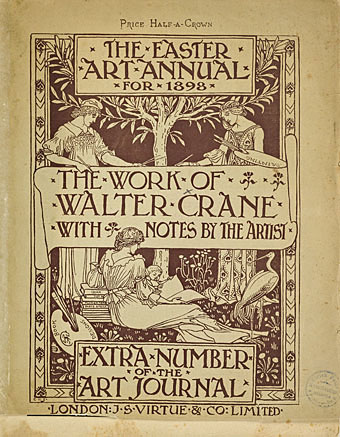
crane01.jpg

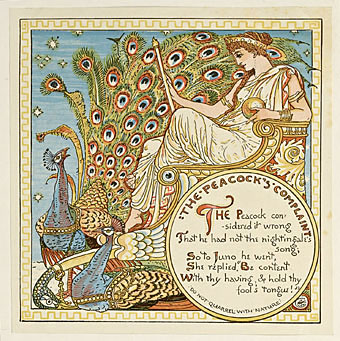
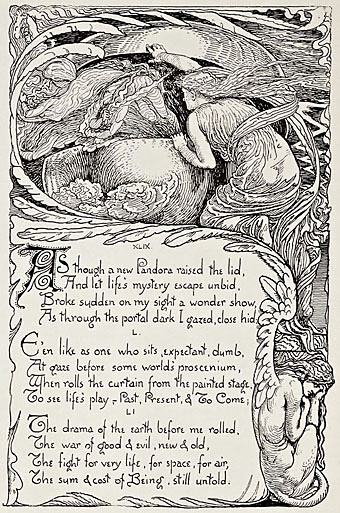
Not the first time Walter Crane has been featured here but this slim volume (62 pages) is a useful overview of the artist’s work which covers all aspects of his career: fine art, book illustration, political design (Crane was a lifelong Socialist), textiles for William Morris, and interior design. There’s more Walter Crane at Wikimedia Commons.

crane02.jpg

crane03.jpg

crane04.jpg

Continue reading “The Work of Walter Crane”

Weekend links 362

yoshi47.jpg

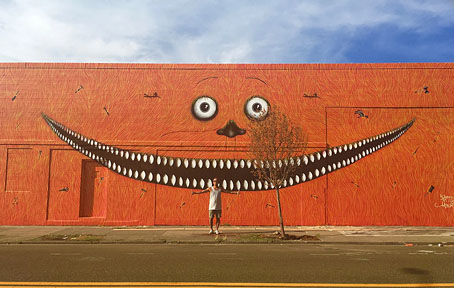
A mural for Forest For The Trees, 2016, by Yoshi47.

• “Who’s the real cunt?” Andrew O’Hagan on the Daily Mail‘s hypocrisies, Little England bigotries and omni-outrage in a review of Mail Men: The Unauthorised Story of the ‘Daily Mail’, the Paper that Divided and Conquered Britain by Adrian Addison.

Deutschlandspiegel 198/1971: a short film at the German Federal Archive which includes footage of Popol Vuh (still in their electronic phase) six minutes in.

• A meeting of remarkable minds: a live radio discussion between Annea Lockwood and Pauline Oliveros from December 1972.

The House In The Woods (aka Martin Jenkins of Pye Corner Audio) at Rare Air, Seattle, 14th May 2017.

• “Peaceful but not to be messed with.” Tony Naylor on how the bee came to symbolise Manchester.

• Mixes of the week: FACT Mix 602 by Deathprod, and Secret Thirteen Mix 222 by Yuji Kondo.

Emptyset and Mouse On Mars’s Jan St Werner on space, time and the evolution of sound.

• At Indiegogo, a funding call for Subotnick: Portrait of an Electronic Music Pioneer.

Shannon Taggart’s Camera Fantastica: an interview by Peter Bebergal.

Study finds mushrooms are the safest recreational drug.

Mary Anne Hobbs‘ favourite albums.

Bumble Bee Bolero (1957) by Harry Breuer | Bee Stings (1998) by Coil | The Bees Made Honey In The Lion’s Skull (2008) by Earth