Weekend links: 2012 edition

life1912.jpg

The Hand of Fate, Life magazine, October, 1912. Artist unknown.

In Search of Barney Bubbles: the great graphic designer is profiled on BBC Radio 4, Monday, 2nd January. And speaking of album cover designers, Cool Hunting talked to Storm Thorgerson about his work.

• FACT mix 310 is a hugely eclectic two-parter from Moon Wiring Club. Grab it while it’s still available. And there’s also Solstmas 2011/2: The Final Countdown, a mix by El Minko Misterioso.

• One of the music events of the new year will be the release of Captain Beefheart’s Bat Chain Puller album. Pre-order it here.

In 1972, at the age of thirty-one, [Fred] Halsted released L.A. Plays Itself, a film which drew upon Kenneth Anger’s surrealist eroto-expressionism, and went way beyond Anger’s sublimated homoeroticism to explicitly portray gay male S/M sex. In 1969, when Halsted first decided to make a sexually explicit film, he decided to create a part for himself, and then be that part.

Halsted Plays Himself by William E. Jones reviewed at Lambda Literary

• Lunar Rover: An interview with Steve Moore and extract from Somnium.

Battersea Power Station, a graveyard of architectural schemes.

Editors might admire a fine book, but are overridden by marketing and accounting departments who now have the final say. I know of a novel that wasn’t accepted by one publisher after the manuscript was first submitted to W.H. Smith, who said that it wouldn’t sell enough.

Jenny Diski on the state of fiction publishing in the UK

• EU copyright on James Joyce‘s works ended at midnight.

Dressed to Kill: Dispelling the Myths of Men in Drag.

The Geology of the Mountains of Madness

Mandala of the Day

Chomeography

The Floppy Boot Stomp (1978 mix) by Captain Beefheart and the Magic Band.

Let England Shake

pjh00.jpg

Design by Michelle Henning, drawings by PJ Harvey.

An album that’s been a continual visitor to the Coulthart CD player over the past few months, Let England Shake was consciously composed like George Crumb’s Black Angels “in time of war”, referencing not only wars present but those long past. Coiled around the bellicose theme is a portrait of a nation whose patriotism is built on sand. England did shake this year, and the unavoidable correlation of PJ Harvey‘s words with the events of the summer makes her album stand in relation to 2011 the way The Specials’ Ghost Town did to 1981.

In addition to the CD, Let England Shake also comes as a DVD of a dozen short films by photographer Seamus Murphy, one film for each song. Harvey and Murphy have very generously put the full set on YouTube in HD. Follow the links below.

pjh01.jpg

Let England Shake

pjh02.jpg

The Last Living Rose

pjh03.jpg

The Glorious Land

Continue reading “Let England Shake”

Colour photography, 1908

colour01.jpg

Portrait of Jessie M. King by J. Craig Annan (autochrome).

I don’t recall having seen a photo of artist Jessie M. King prior to this so it’s an additional surprise to find one in colour. All these examples are from Colour Photography: and other recent developments of the art of the camera (1908), one of the many books edited by Charles Holme from features in The Studio magazine. Needless to say, not all the entries are colour but a number of the monochrome plates have their own qualities, such as that painterly effect which so many early photographers were eager to cultivate. Anyone familiar with Gertrude Käsebier’s very painterly The Crystal Gazer, famous for its appearance on the cover of a Cocteau Twins sleeve, may like to know that two more portraits by Ms Käsebier are included in Holme’s selection. For a look at more recent attempts to match the effects of painting with the camera, see this piece by Rick Poynor about the remarkable work of Saul Leiter.

colour02.jpg

A Tangle After a Storm by Walter Bennington.

colour03.jpg

A Late Winter Sun by Dr. H. Bachmann (gum print).

Continue reading “Colour photography, 1908”

Weekend links 88

zarnowerowna.jpg

Typographic Composition (1924) by Teresa Zarnowerówna from a post about Polish graphic design at 50 Watts.

• “Direct action is a matter of acting as if you were already free… […] …the link between military and money systems remains the dirty secret of capitalism.” A lengthy and essential interview with “anarchist anthropologist” David Graeber, author of Debt: The First 5000 Years.

• “…it was after being told by an art director that he preferred her images of women to men that Toyin [Ibidapo] began to shoot boys in an attempt to prove him wrong. Something that Cult of Boys does perfectly.”

The pornographic imagination is deeply intertwined with the pain and horror of life. Some of that comes from our basic biological reality, which is unpleasant enough, and much of it comes from our social structures. Biological life has been completely degraded and continues to become more and more degraded in novel and more horrific ways, so it is inevitable that our horrible social structures – our schools, prisons, families, slaughterhouses and farms – become sites for the pornographic imagination.

Stephen Beachy discusses his novel, boneyard.

• “To my right is a wall bracket that, on closer inspection, turns out to be a human face made of porcelain fruits. The anteater rests on top of the television.” Jonathan Jones meets Jan Švankmajer.

Anselm Kiefer‘s new exhibtion at White Cube, London, takes its name and some inspiration from Fulcanelli’s alchemical exegesis, Le Mystère des Cathédrales (1926).

• Today (Sunday, 11th December) on Resonance FM at 8.00pm GMT, Alex Fitch talks to Alan Moore about HP Lovecraft and related matters.

Nick Hydra is putting all 112 issues of occult encyclopaedia Man, Myth & Magic online.

• Ira Cohen ‘s 1968 film The Invasion of Thunderbolt Pagoda is available again on DVD.

• Colleen Corradi Brannigan’s paintings of Italo Calvino’s Invisible Cities.

• “Margate’s a bloody toilet!” Can you handle The Reprisalizer?

• Bibliothèque Gay on Cocteau’s Le livre blanc (in French).

• Josie & the Pussycats in A Clockwork Orange.

Lovely Book Covers

Words With The Shaman (1985) by David Sylvian w/ Jon Hassell, Steve Jansen & Holger Czukay – I: Ancient Evening | II: Incantation | III: Awakening (Songs From The Treetops).

The Flatiron Building

flatiron1.jpg

The Flatiron Building, Detroit Publishing Company (1903).

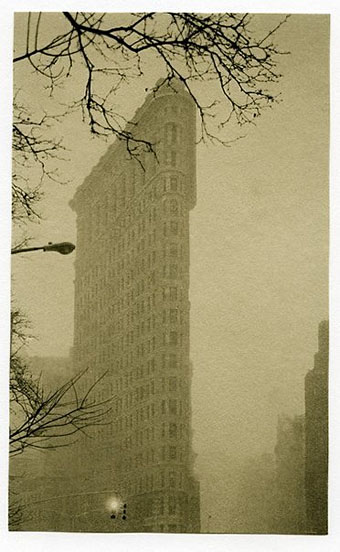
Beautiful Century posted this view of New York’s Flatiron Building at the weekend which had me looking for a larger copy. Happily this is one of the many high-resolution photos at the Shorpy Historical Archive where it’s possible to scrutinise a wealth of detail. Old photos like this are, as Michael Moorcock once said about old postcards, a form of time travel, especially when they’re as good as those in the Shorpy collection. The Flatiron was a popular subject for photographers—famously so in Edward Steichen’s 1904 nocturne—and Shorpy has many more examples such as the street-level view below. Both these photos show a common feature of pictures taken before the age of the motor car: people standing in the middle of the road. The Flatiron also has an oblique connection with Julian Biggs’ film via the mysterious origins of the phrase “23 skidoo“.

flatiron2.jpg

The Flatiron Building, Detroit Publishing Company (c. 1905).

Reinhart Wolf photographed many of New York’s skyscrapers in the late 1970s, the Flatiron included. I have a book of those photos and noticed in his Flatiron view that one of the circular decorations on the foremost angle of the building near the top is now missing (compare his view with the Shorpy photos). Every time I look at the Flatiron now I think of that missing chunk of masonry. Was it removed or did it fall? If the latter, when did this happen and what damage did it cause?

Previously on { feuilleton }
Edward Steichen