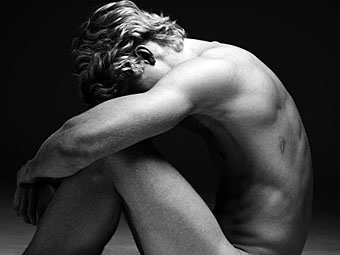
Fencing fashion again

afanador1.jpg

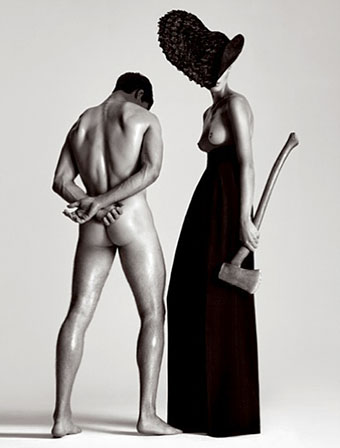
A brace of elegant fencers posing for an Elle Italia spread by photographer Ruven Afanador whose Torero series was highlighted here in April. Afanador’s recent work is worth a look for the set showing a model posing in an antiquated schoolroom among bones and stuffed animals. Via Homotography.

afanador2.jpg

Elsewhere on { feuilleton }
The men with swords archive

Previously on { feuilleton }
Torero

Villa d’Este

deste1.jpg

Detail of the Water Organ (1902).

Samples from a set of pictures at LUNA Commons of the wonderful water gardens at the Villa d’Este, Tivoli, Italy. Among the 164 items in the collection are plans, engravings, and photographs old and new. I’m partial to the older photos, most of which seem to be photogravure reproductions whose temporal distance and technical shortcomings only add to the mystique of the place.

deste2.jpg

Alley of the hundred fountains (1997).

Previously on { feuilleton }
Gertrude Käsebier’s crystal gazer
The Door in the Wall
Paris II: The River Fountain

Bondage Machine

vogue.jpg

Photography by Steven Klein, styling by Nicola Formichetti.

Not a Tom Waits album, Bondage Machine is the title of a feature in Vogue Hommes Japan which plays with bondage and fetish imagery to striking effect. What’s not to love about a huge skeletal necklace and leather underwear? Fetish gear is the aesthetic dimension of erotica and it’s always nice to see new manifestations of the form even when, as in this case, it’s largely about fashion designers flirting with the edge of acceptability.

Via the essential Homotography.

Previously on { feuilleton }
Bad Boy

Battersea Power Station

battersea.jpg

A photograph of the control room of Battersea Power Station, London, by Michael Collins, one of a series which will shortly be on display at the Royal Institute of British Architects.

The images show Battersea Power Station as what Collins describes as a “twentieth century ruined castle” – a building that was built to last, with a high quality structure and interior, including Art Deco walls and ceilings.

Giles Gilbert Scott’s enormous temple of heavy industry continues to sit decaying on the banks of the Thames while property developers come and go. The latest of these, Real Estate Opportunities, has fallen into debt which means proposals to develop the site are once again on hold. A part of me likes the idea of the building sitting there unused and purposeless year after year, like some vast Steampunk Stonehenge; Giles Gilbert Scott’s other Thames-side power station, Bankside, was successfully transformed as Tate Modern, but we know from various proposals that the fate of Battersea, whether as theme park or shopping centre, is likely to be a lot less edifying.

quark1.jpg

It took redevelopment to transform Bankside from temple of industry to temple of culture but Battersea’s unmistakable presence has a powerful cultural history of its own. Everyone knows the Hipgnosis sleeve design for Pink Floyd’s Animals (1977); less familiar is the photos of the control room which Hipgnosis used for Hawkwind’s Quark, Strangeness and Charm the same year. I tend to prefer the back cover of this sleeve to the front; that octagonal readout device is more interesting than the rather unconvincing sparks and exchanges of energy. And speaking of energy, my former employers are still active, unlike the rancorous Floyd.

quark2.jpg

There’s a page here listing other uses of the power station, including its many film appearances which date back to the 1930s. That list mentions the control room’s use as a background for the “Find the Fish” sequence in Monty Python’s The Meaning of Life (1983) but they omit an earlier Monty Python appearance when you briefly see the building in operation during And Now for Something Completely Different (1971). It was closed down a few years later. So here it is, then, belching fumes over west London on a profoundly gloomy winter afternoon.

battersea2.jpg

Elsewhere on { feuilleton }
The album covers archive

Previously on { feuilleton }
The Sonic Assassins
The Bradbury Building: Looking Backward from the Future

David Trautimas

trautimas.jpg

The Fishing Complex (2008).

Canadian artist David Trautimas re-purposes household and other objects into fantasy buildings by exaggerating their scale then montaging them into landscapes. This example is from his Habitat Machines series; there’s also an Industrial Parkland series. Many of the former group are pleasantly convincing, and their weathered appearance adds to the impression of having discovered the works of a lost Modernist architect. Some of these are like digital equivalents of paintings by Arnau Alemy.

Via Things Magazine.

Previously on { feuilleton }
The art of Arnau Alemany