Weekend links 137

jacobsen.jpg

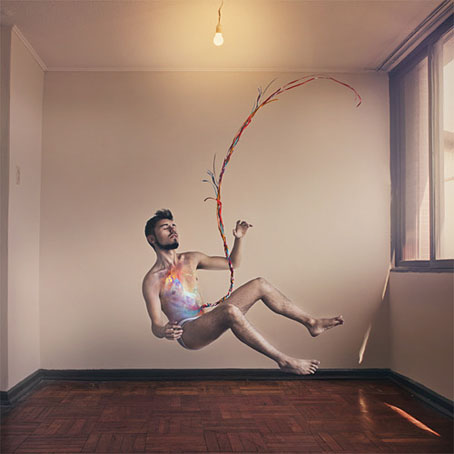
Self-portrait by Jon Jacobsen from his Home series.

Steven Arnold: Cabinet of Curiosities is “a retrospective exhibition of this groundbreaking yet under-recognized queer artist at the ONE Archives Gallery & Museum in West Hollywood. The exhibition celebrates Arnold’s radical imagination, presenting many of his tableaux vivant photographs alongside never before exhibited drawings, sketchbooks, paintings and original poster art. In conjunction with the exhibition, ONE will screen Arnold’s four films, including Luminous Procuress (1970), which featured The Cockettes and was lauded by Salvador Dalí.” The exhibition runs to  January 12, 2013.

• “The boundary-pushing techno/sound design duo Emptyset will transform London’s cavernous industrial space Ambika P3 into an immersive sound installation for one night only—and here’s how they’re going to do it”.

• “At one time he was a well-known figure in Montparnasse, where he had a reputation as a master of the occult sciences.” Aleister Crowley is interviewed about his expulsion from France in 1929.

Our normal waking consciousness, rational consciousness as we call it, is but one special type of consciousness, whilst all about it, parted from it by the filmiest of screens, there lie potential forms of consciousness entirely different. We may go through life without suspecting their existence; but apply the requisite stimulus, and at a touch they are there in all their completeness… No account of the universe in its totality can be final which leaves these other forms of consciousness quite disregarded… [T]hey forbid our premature closing of accounts with reality.

William James (1842–1910) quoted in What Should We Do With Our Visions of Heaven—and Hell? by John Horgan at Scientific American.

Screws is an album of piano music by Nils Frahm that’s currently available as a free download (inc. aiffs).

• At Pinterest: Art Visonnaire. Related: Ain’t We Got Fun: The magical surrealism of Jen Ray.

Rowan Somerville “challenges the purpose and legitimacy” of the Bad Sex Awards.

Jimmy’s End: the website for the film by Alan Moore & Mitch Jenkins.

Douglas Rushkoff in conversation with Genesis Breyer P-Orridge.

• Linda Rodriguez McRobbie explores The History of Boredom.

• Recreating the sounds of the BBC Radiophonic Workshop.

Alchemical Emblems, Occult Diagrams, and Memory Arts.

Rocaille: A Blog about Decadence, Kitsch and Godliness.

• A new video for Goddess Eyes II by Julia Holter.

• The complete audio recordings of Jean Cocteau.

The Rumpus interview with Russ Kick.

Forgotten Bookmarks

• RIP Spain Rodriguez

Astradyne (1980) by Ultravox (produced by Conny Plank) | Biomutanten (1981) by Les Vampyrettes (Conny Plank & Holger Czukay) | Never Gonna Cry Again (1981) by Eurythmics (feat. Holger Czukay, produced by Conny Plank).
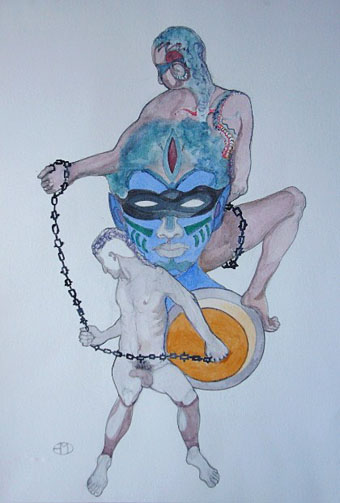
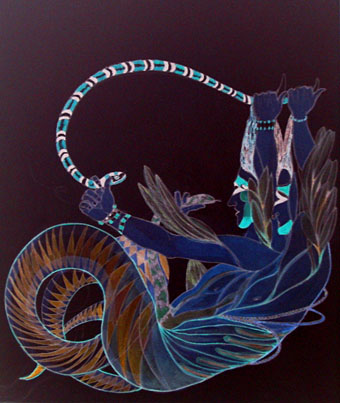
Zimbu Xolotl Time

wb1.jpg

Or The Wild Boys revisited. These are two of Emma Doeve’s Wild Boys paintings from the Academy 23 book which was published in October by WhollyBooks to coincide with the recent London event remembering and celebrating The Final Academy, a William Burroughs-themed series of events held in London and Manchester in 1982. I’ve mentioned before that the book contains an edited version of my post about the event at Manchester’s Haçienda club. The book is now sold out but I expect some copies will find their way into the secondhand market eventually. Had Emma’s pictures been around a year ago I would have included them in my post about The Wild Boys and the various music and art inspired by Burroughs’s novel. They’re also a reminder that I ought to finish my own Wild Boys portfolio which has languished this year while I’ve been engaged with other things, not least finishing the Reverbstorm book. Something for the future, then. As for Zimbu Xolotl Time, Phil Hine can explain.

wb2.jpg

Elsewhere on { feuilleton }
The William Burroughs archive

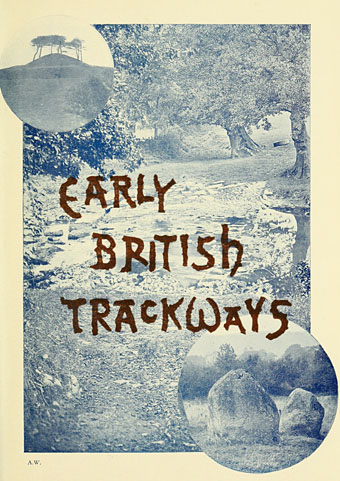
Early British Trackways

watkins01.jpg

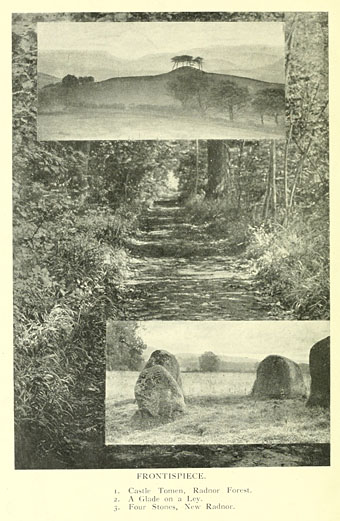
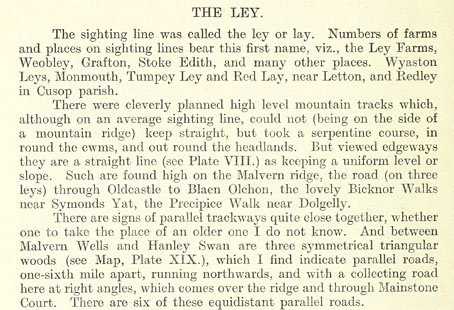
Continuing the Earth mysteries/megaliths theme, Early British Trackways: Moats, Mounds, Camps, and Sites (1922) by Alfred Watkins (1855–1935) was the first book in which the ley lines theory was proposed. Watkins was an amateur archaeologist (more a kind of early psychogeographer), photographer and writer who theorised that ancient Britons had marked the land with pathways connected by a variety of natural and man-made features: hills, mounds, trees, ponds, hillside notches and (of course) standing stones. Watkins coined the term “ley” after noticing that many of the lines connecting these features ran through villages or areas of land whose names ended in “-ley”, “-lay” or similar. The thesis was developed more fully in The Old Straight Track (1925), a book which became the ur-text for subsequent ley hunters. I’ve never seen any of Watkins’ books so it was interesting finding this short volume at the Internet Archive, not least because several of the photos appear in Mysterious Britain (1972) by Janet & Colin Bord, a classic guide to Britain’s sacred sites and folk rituals.

watkins02.jpg

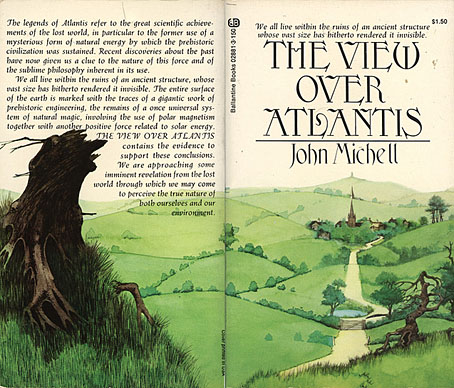
Watkins never regarded ley lines as having any mystic significance, he thought they were probably old trade routes. Archaeologists have never agreed with his suppositions, however, and Watkins himself might have disapproved of the conjectures added to his theories by John Michell in The View Over Atlantis (1969) which wedded ley line theory to feng shui to create the whole “lines of energy” idea. Whatever one thinks of Michell’s theories, that book and subsequent volumes put ley lines firmly into popular culture, and without them we wouldn’t have the references in Children of the Stones, Steve Hillage’s Green (1978) (pretty much a Michell-inspired concept album), Nigel Kneale’s Quatermass (1979) and so on. But this slim book is where it all begins.

tvoa.jpg

Illustration by Roger Dean (1972).

watkins03.jpg

Continue reading “Early British Trackways”

A Journey to Avebury by Derek Jarman

jarman2.jpg

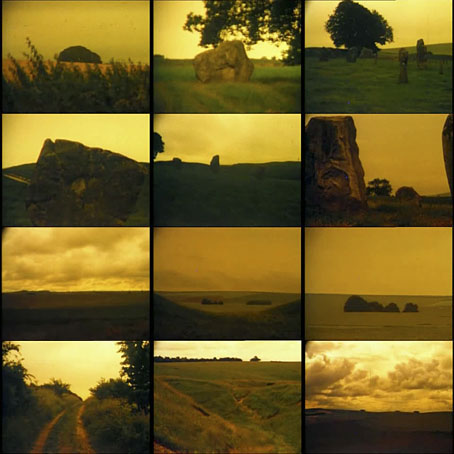
Among the Doublevision video releases I was writing about earlier this month there’s a notable omission from those which have been reissued on DVD: Derek Jarman’s In the Shadow of the Sun was the seventh release on the label, the 1980 version of a film which was compiled in 1974 using footage from his earlier Super-8 shorts, one of which was A Journey to Avebury (1971). Several of the short films have appeared as extras on recent DVDs but the gorgeously oneiric In the Shadow of the Sun remains stubbornly unavailable.

jarman1.jpg

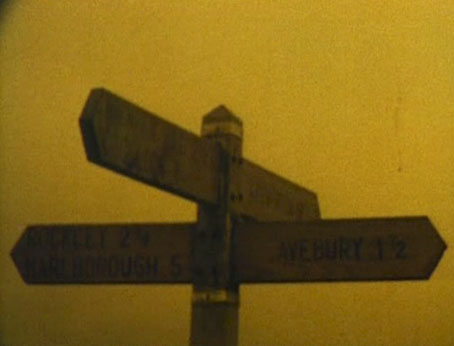
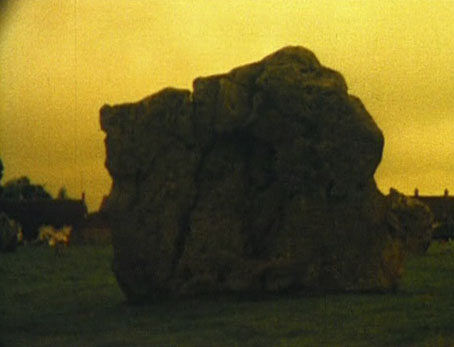
A Journey to Avebury lasts for ten minutes, and in its original state was nothing more than silent, static shots of fields, pathways (putative ley lines, perhaps), silhouetted trees, and finally the Avebury stones. I still find it one of the most fascinating of his short films. The yellow filter gives all the shots an oppressive, sulphurous cast which turns the otherwise bucolic landscape into a place of imminent (or even post-) apocalypse. I’m reminded of the yellow skies in Charles Platt’s erotic nightmare The Gas (1970), or some of the outdoor shots in Penda’s Fen (1974) which are equally suffused with menace.

jarman3.jpg

The copy of A Journey to Avebury that’s currently on YouTube is a recent version with an uncredited electronic score. I still don’t know who did the music; it doesn’t sound like Coil. Cyclobe? (It’s Coil.) The YouTube version can be found in far better quality on the Second Sight DVD of Jarman’s The Last of England.

cots6.jpg

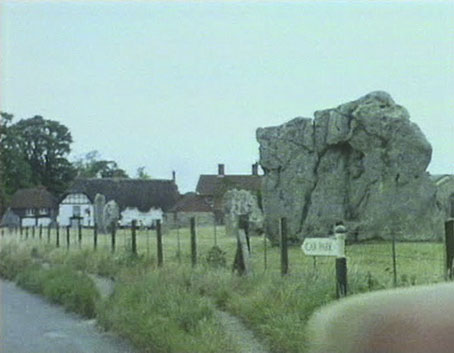
And just to show how everything here is connected to everything else, that brooding megalith above (known locally as “The Devil’s Seat”) can be seen in at least one shot in Children of the Stones. No surprise there but the shot also reveals the place where Jarman and co. would have been standing five years earlier.

Previously on { feuilleton }
Children of the Stones
Avebury panoramas
Derek Jarman’s music videos
Derek Jarman’s Neutron
Mister Jarman, Mister Moore and Doctor Dee
The Tempest illustrated
Penda’s Fen by David Rudkin
In the Shadow of the Sun by Derek Jarman
Derek Jarman at the Serpentine
The Angelic Conversation
The life and work of Derek Jarman

Children of the Stones

cots1.jpg

“Pretty phantasmagorical!” says precocious teenager Matthew when he and his father drive into the fictional village of Milbury in the opening scene of Children of the Stones. Matthew’s father is a scientist whose work requires a three-month stay in a village built in the centre of a series of ancient ramparts and stone circles. Once settled, they find many of the villagers to be blandly cheerful, while Matthew discovers that his maths skills at the local school pale beside younger children who can solve complex equations with ease. Omnipresent characters in the village are Hendrick, a retired astronomer who owns the local manor house and acts as village squire; Margaret, a newly-arrived archaeologist who knows the history of the stones; and Dai, a vagrant poacher who lives outside the circle, and who seems eager to remain free of the Stepford-like happiness afflicting his neighbours.

cots2.jpg

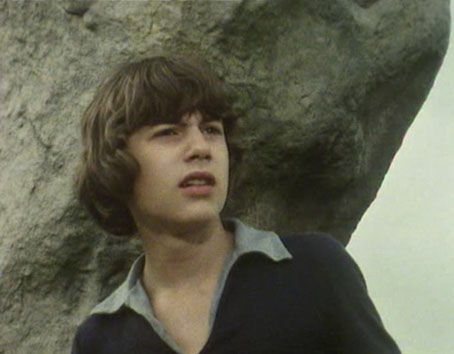
Matthew (Peter Demin).

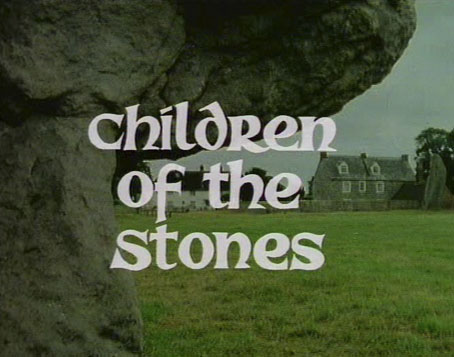
Matthew’s “phantasmagorical” epithet is directed at the neolithic mound outside the village but could easily apply to the whole of this seven-part serial which I watched again recently. HTV produced Children of the Stones which was first broadcast in early 1977. A mystery serial for children involving pagan history, folk rituals and an undercurrent of science fiction wasn’t such a surprising thing in the 1970s, this being a decade when a popular interest in the occult and the paranormal was more prevalent than at any time before or since. Children’s television reflected adult trends which is why we got to see an adaptation of Alan Garner’s The Owl Service, the occult adventure series Ace of Wands (with its hero named “Tarot”), The Tomorrow People (which occasionally strayed from science fiction to science fantasy) and others (see an earlier post, Occultism for kids). Children of the Stones was the most complex of all of these, a well-crafted drama with similarities to Nigel Kneale’s TV plays, The Wicker Man and The Prisoner. With a slight change of emphasis it would have worked just as well as a serial for adults. The best children’s serials of the period were usually adaptations of novels; Children of the Stones was an original work for television, written by Jeremy Burnham & Trevor Ray, and directed by Peter Graham Scott.

cots4.jpg

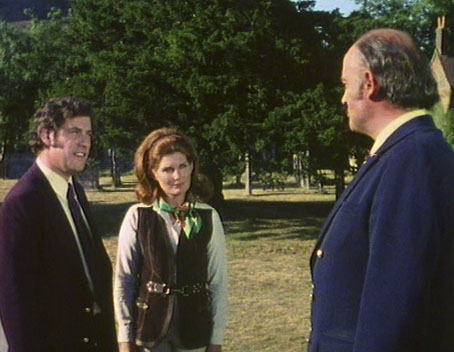
Adam (Gareth Thomas), Margaret (Veronica Strong) and Hendrick (Iain Cuthbertson).

Continue reading “Children of the Stones”