Salon de la Rose + Croix

salonrc01.jpg

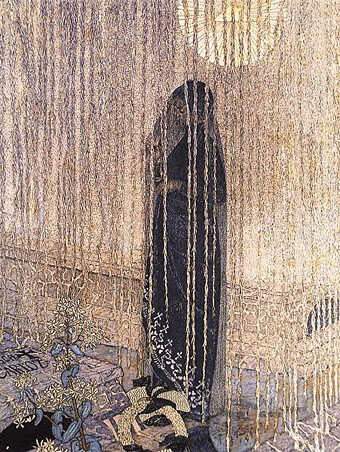
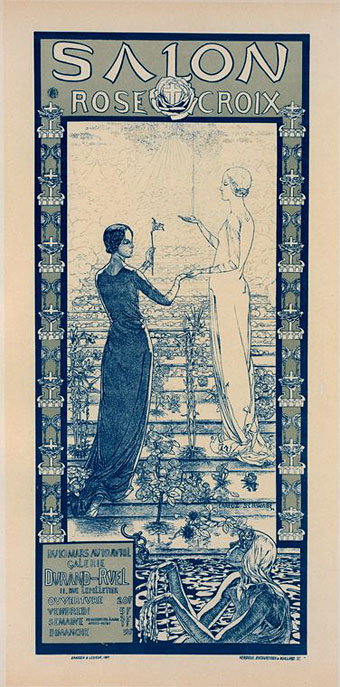
Carlos Schwabe’s poster from 1892 for the first of Joséphin Péladan’s art and music Salons de la Rose + Croix. The “Sâr” Peladan’s imposition on the artistic life of Paris in the 1890s may have the smack of a vanity project but he caused enough of a stir to give Rosicrucianism an unlikely fashionabilty for a while. The roster of contributing artists is also impressive, almost a who’s who of Symbolist art. There were six salons in all, the last being in 1897. The poster for the fifth salon by Armand Point & Léonard Sarluis shows Perseus holding the decapitated head of Émile Zola. The evangelist of literary realism was one of Symbolism’s arch-enemies but that didn’t prevent Carlos Schwabe from producing illustrations for Le Rêve.

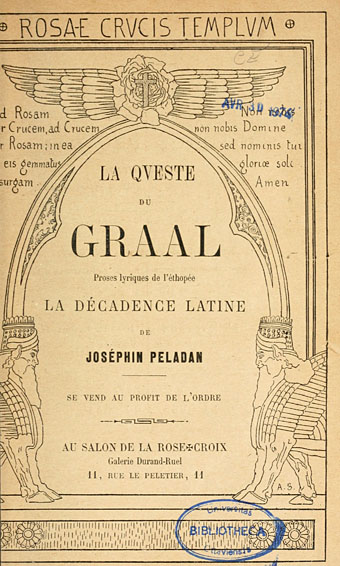
The pages below are from Peladan’s many books, La Queste du Graal: Proses Lyriques de l’Éthopée; La Décadence Latine (1892). The illustrations aren’t the best reproductions, and they aren’t the greatest artworks either, but they give a sense of what Peladan wanted to see embellishing his own brand of artistic mysticism. Gallica has a Salon de la Rose + Croix catalogue (also from 1892) but like many of the documents archived there the quality leaves a lot to be desired.
salonrc02.jpg

Continue reading “Salon de la Rose + Croix”

The art of Carlos Schwabe, 1866–1926

schwabe01.jpg

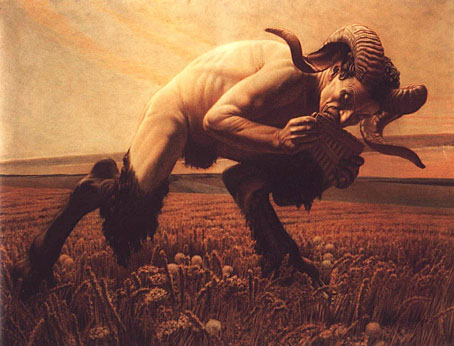
Le Faune (1923).

Yesterday’s Pan prompted me to repost Carlos Schwabe’s wonderful painting of a faun, one of my favourite faun/satyr depictions, and easily one of the best in the entire Symbolist corpus. Other satyr aficionados of the period such as Arnold Böcklin and Franz Stuck had an unfortunate knack for making their goat gods look rather foolish.

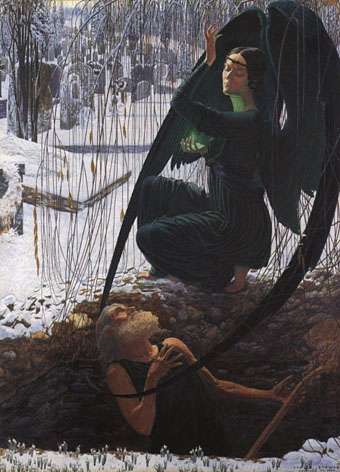
Schwabe was a German artist, and one of the more mystical of the Symbolists, with a fondness for winged figures and a preoccupation with death. The mystical end of the Symbolist spectrum is the one I enjoy the most so I often point to Schwabe or Jean Delville as exemplars of this type of art. Both Schwabe and Delville were connected briefly by Joséphin Péladan’s very mystical Salon de la Rose + Croix although Delville later gravitated to Theosophy. Schwabe produced illustrations for an edition of Baudelaire’s Les Fleurs du Mal, and would have featured in the Baudelaire posts last week if some of those drawings hadn’t appeared here already. The title page was a new find, however, so it’s included below.

schwabe09.jpg

Jour de morts (1890).

schwabe04.jpg

La mort du fossoyeur (1895).

Continue reading “The art of Carlos Schwabe, 1866–1926”

Athanasius Kircher’s Pan

kircher1.jpg

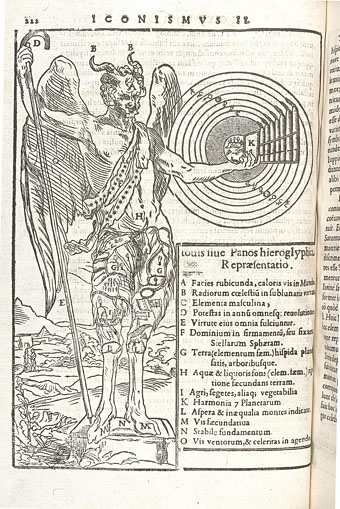
More from the Kircher archives at the University of Heidelberg. As before, it’s good to see illustrations familiar from countless reprintings in books in their place of origin. The volume in question is Obeliscus Pamphilius: hoc est, Interpretatio noua & Hucusque Intentata Obelisci Hieroglyphici (1650), one of Kircher’s attempts at deciphering the hieroglyphics on Egyptian obelisks. I’m still not sure how the Great God Pan fits into these speculations even as a diagrammatic figure, unless in this case it’s Pan as a representative of Nature as a whole.

Whatever the explanation, the Pan picture often turns up in occult anthologies although you’re as likely to see the copy from Manly P. Hall’s The Secret Teachings of All Ages (1928) as the original. Hall’s rendering is useful for the translation of the Latin although he also says it may represent the god Jupiter (?) and he censors the not-very-obtrusive penis, a rather fatuous bit of prudery for a book that’s supposedly concerned with universal truths.

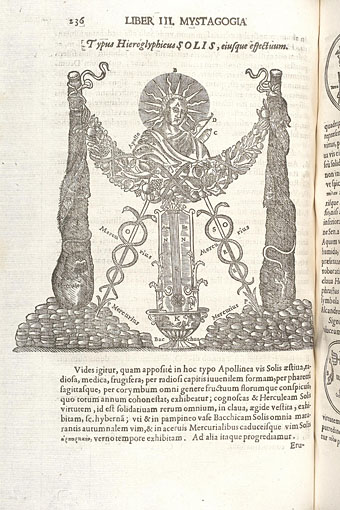
A few more plates follow, one of which features a serpent I swiped several years ago for a Cradle of Filth T-shirt design.

kircher2.jpg

Continue reading “Athanasius Kircher’s Pan”

Weekend links 224

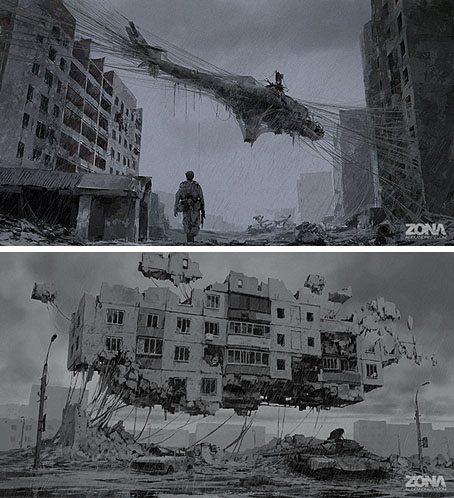
zona.jpg

Zona: concept art by Alex Andreyev for a planned TV series based on Roadside Picnic by Arkady & Boris Strugatsky.

The Black Sessions are a long-running series of concerts by international artists recorded for radio station France Inter. UK group Broadcast were recorded by the station in May, 2000. While copies of the shows can be often be hard to find, files of the Broadcast concert may be downloaded here. A fantastic performance, especially the white-hot psychedelic freakout at the end.

• Further investigations from the radio age: Invention for Radio No. 1: The Dreams (43 mins, 1964): “an attempt to re-create in five movements some sensations of dreaming—running away, falling, landscape, underwater and colour”. Voices recorded by Barry Bermange with Radiophonic manipulation by Delia Derbyshire.

• “…in his first description of Cthulhu he gives you a list of four things that Cthulhu isn’t quite like.” Nick Talbot talks to Alan Moore about HP Lovecraft. Related: one of my depictions of Azathoth appears in this list of “gods who have forsaken you”.

• Tracking the locations of JG Ballard’s Super-Cannes: an investigation by Rick Poynor. Related: houseboats, architecture and eco-disaster; Justin Sullivan photographs California’s extreme drought.

• “As her writing career existed outside the realm of respectable ‘high-lit’ fiction, she cast herself as an outsider icon.” Chris Kraus on I’m Very Into You, a collection of Kathy Acker’s emails.

• Cover design inspiring fiction: Susan Coll on how a photo of a Bauhaus chair on the cover of her new novel, The Stager, made her alter her text at the last minute.

• “People were either taken by it or felt it was the Antichrist.” MetaFilter on Clair Noto’s unmade science-fiction film, The Tourist.

The Norwood Variations is a new album by Drew Mulholland (Mount Vernon Arts Lab et al).

• Thought Maybe has a collection of the television essays made by Adam Curtis.

• From 1974: How To Make Magic, a children’s handbook of the occult.

• Mix of the week: Secret Thirteen Mix 126 by Mira Calix.

One Minute Blasts Rising To Three And Then Diminishing (2000) by Mount Vernon Arts Lab | Dashwood’s Reverie (2001) by Mount Vernon Arts Lab | Warner’s Reverie (2002) by Mount Vernon Astral Temple

Weekend links 223

paez.jpg

Step Up (2014) by Angelica Paez.

• Lots of attention this week for Kevin Martin whose latest album as The Bug, Angels And Devils, is out now on Ninja Tune. The previous Bug release, London Zoo (2008), was a fierce collection that stood apart from the Grime pack not only for its guest vocalists but also for being informed by Martin’s broad range of influences: industrial and extreme electronics, heavyweight dub, metal and avant-garde jazz. Martin was interviewed by The Quietus and FACT who also asked other musicians to choose their favourite Martin recordings. Elsewhere, The Wire has Swarm, a track not included on the album.

Related: Martin’s four superb compilation albums for Virgin Records have been deleted for years but are worth seeking out: Ambient 4: Isolationism, Macro Dub Infection Volume One & Volume Two, and Jazz Satellites Volume 1: Electrification (Virgin cancelled volume 2). From the NME, 1995: Kevin Martin’s Ten Commandments For All Time.

• “…it never becomes quite clear why two grown men would want to write to each other in the guise of a horse and a cat.” Henry Giardina reviews The Animals: Love Letters Between Christopher Isherwood and Don Bachardy, edited by Katherine Bucknell.

Shufflepoems: A Deck of Poetry by Lydia Swartz. “100 cards, four suits, one stanza per card. Shuffle for a new adventure every time.” The project needs a last-minute push to gain Kickstarter funding so if this sounds interesting go, go, go!

The Haxan Cloak’s favourite heavy metal albums. Metallica’s Master Of Puppets still gets my vote. More from The Quietus: David Stubbs on the Werner Herzog soundtracks of Popol Vuh.

• At Strange Flowers: Waking the witch, a remembrance of occult artist Rosaleen Norton and other characters from Sydney’s Kings Cross area, with news of a planned Norton documentary.

• A nine-note motif has for decades signalled “Asian” in popular music. Kat Chow looks at the history of a musical stereotype.

Joseph Conrad’s Heart of Darkness is the subject for entrants in the Folio Society’s latest illustration competition.

• Irradiating the Object: Rhys Williams talks to writer M. John Harrison.

Does the Sea Serpent Really Look Like an Art Nouveau Oar-fish?

Schrödinger’s cat caught on quantum film.

70s sci-fi art: a Tumblr.

Demodex Invasion (1995) by Techno Animal | Piranha feat. Toastie Taylor (2001) by Techno Animal | Poison Dart feat. Warrior Queen (2008) by The Bug