A theme for maniacs

bach.jpg

The theme in question.

When did the first few bars of Bach’s Toccata and Fugue in D Minor BWV 565 become a signifier of an unhinged personality, and thereby a horror cliché? The question was raised by my film viewing in the run-up to Halloween following a return visit to The Black Cat, Edgar G. Ulmer’s Universal oddity. Ulmer’s film is the best of a trio of Universal horrors packaged by Eureka in a double-disc set, part of the company’s ongoing programme to reissue obscure films starring Boris Karloff and Bela Lugosi. The three films in the set—Murders in the Rue Morgue (1932), The Black Cat (1934) and The Raven (1935)—all star Lugosi, with Karloff co-starring in The Black Cat and The Raven. The Bach piece was impossible to ignore after watching all three films together. In The Black Cat we see a villainous Karloff regaling a potential victim with a performance of Toccata and Fugue on his home organ. Bela Lugosi does the same in The Raven, where he portrays an equally villainous but much more demented doctor obsessed with the writings of Edgar Allan Poe. The Universal horror films have been the source of many cinematic clichés of which this is a further example, even if the use of Toccata and Fugue to signify villainy or madness predates The Black Cat.

Wikipedia’s incomplete list of the composition’s cinematic appearances states that Toccata and Fugue was already a theatrical cliché by the early 1930s but offers no evidence for the claim. It’s likely there were silent films using the piece for their scores when so much silent orchestration borrows from pre-existing classical music. But silent films, today as in the past, can be scored in many different ways, the score isn’t always permanently attached to the film. The one silent film that you might expect to use the Bach piece, the 1925 version of The Phantom of the Opera, has a fine score by Carl Davis in its restored form, but no Toccata and Fugue. A brief history of the cinematic life of the piece would go something like this…
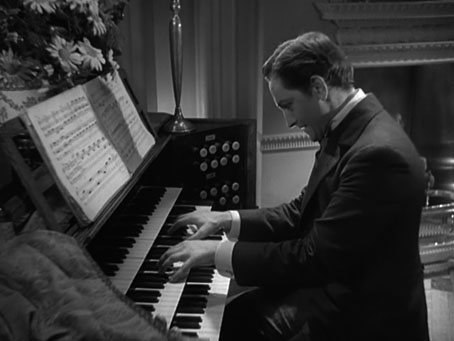
jekyll.jpg

Dr Jekyll and Mr Hyde (1931)
Rouben Mamoulian’s excellent adaptation opens with a view through the eyes of Dr Jekyll (Frederic March) playing another Bach piece on the organ; prior to this the film’s titles had been scored with an orchestral arrangement of Toccata and Fugue. An hour later the composition returns when Jekyll plays an extract from the fugue section, an ominous sign despite his joy at his impending marriage.
blackcat.jpg

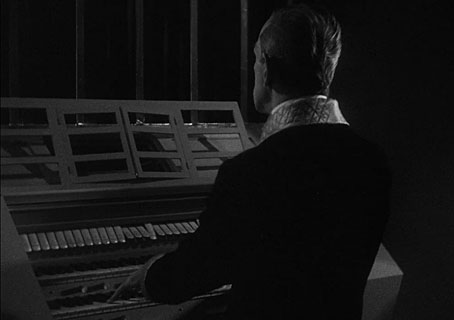
The Black Cat (1934)
Despite the title, this one has nothing at all to do with Edgar Allan Poe. Instead of another spurious adaptation we get Boris Karloff as Hjalmar Poelzig, cinema’s only Satanist architect. The character is a bizarre amalgam of Aleister Crowley and Hans Poelzig, a German architect who designed the sets for Paul Wegener’s third and best Golem film.
raven.jpg

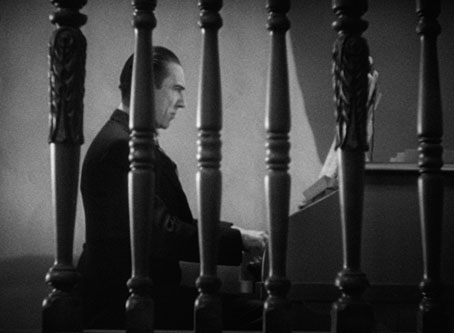
The Raven (1935)
This one does at least contain a number of Poe references. Lugosi is a brilliant doctor who also happens to be a homicidal maniac, his Poe obsession having led him to fill the secret rooms in his house with torture devices.
canterbury.jpg

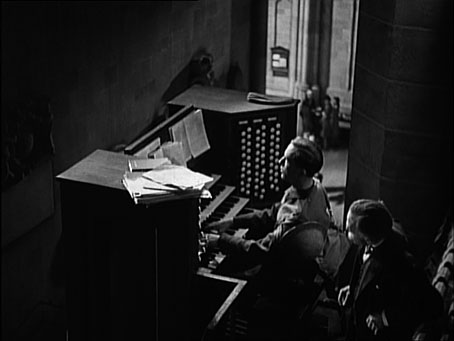
A Canterbury Tale (1944)
Not a horror film but included here because Powell & Pressburger’s war-time drama is about the last time you find the Bach piece being used in an unironic manner, intended to evoke religious awe rather than madness or doom. Prior to this the piece had also been used to soundtrack an abstract animation by Mary Ellen Bute, Synchromy No. 4: Escape (1938), two years before Disney did something very similar in Fantasia. In A Canterbury Tale Dennis Price is a conscripted cinema organist finally arrived at Canterbury Cathedral prior to being shipped to the front. Before he leaves, the cathedral organist allows him to play the music for the departure service which in turn allows us to hear Bach’s piece illustrating views of genuine Gothic grandeur.
sunset.jpg

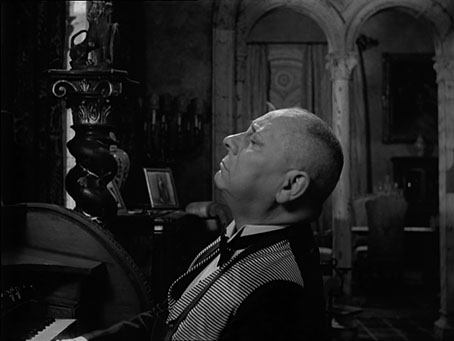
Sunset Boulevard (1950)
Its fitting that the self-conscious use of Toccata and Fugue begins with a supremely self-conscious film. Billy Wilder’s masterpiece isn’t a horror film either but it is a full-blown Gothic drama, being narrated by a dead man whose first encounter with the mentally fragile Norma Desmond sees him being mistaken for an undertaker. The Bach piece is played by Desmond’s butler, Max, a washed-up film director portrayed by a genuine (and genuinely great) washed-up film director, Erich von Stroheim. Max may not be a maniac but his employer (and ex-wife) is certainly unhinged, while Stroheim himself was notorious in his directing days for his megalomania, overspending lavishly and refusing to compromise with the studios over the editing of his films. (The first cut of his mutilated epic, Greed, ran over nine hours.) Since the 1925 Phantom of the Opera was mentioned earlier, it’s worth noting that Norma Desmond’s boat-shaped bed is the same prop that appears in the silent Phantom’s underground lair.
Continue reading “A theme for maniacs”

Twinkle, twinkle little stars

turner1.jpg

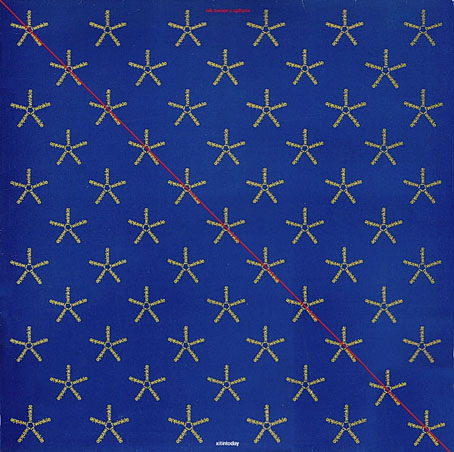
Xitintoday (1978) by Nik Turner’s Sphynx.

It’s been a long time since I’ve had a reason to write about Barney Bubbles but I’ve finally worked out why one of his more mysterious album covers looks the way it does.

When Nik Turner was unceremoniously kicked out of Hawkwind in 1976 he headed to Cairo to consider his next move. While there he recorded an hour or two of flute improvisations inside the sarcophagus in the King’s Chamber of the Great Pyramid of Cheops. The resulting tapes provided the basis for his first solo album, Xitintoday, which was released in 1978 on the Charisma label, and credited to Nik Turner’s Sphynx. Steve Hillage produced the album, helping to craft the meandering solos into a suite of songs based on passages from The Egyptian Book of the Dead. Xitintoday is one of the more unusual concept albums from a decade filled with such things. I’ve always liked it, in many ways it’s closer to Hillage’s oeuvre than Turner’s, as well as being very different to anything else in the Hawk-sphere.

turner2.jpg

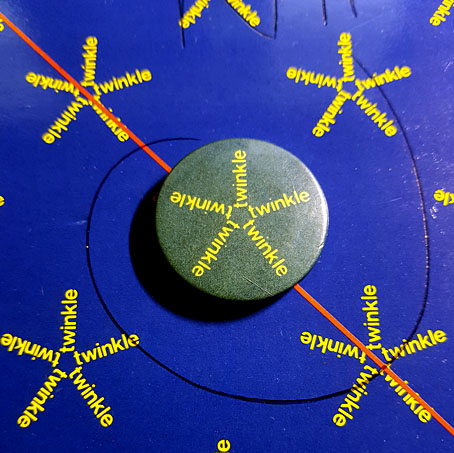
A faded promo badge. The ballpoint scrawl is Mr Turner’s autograph.

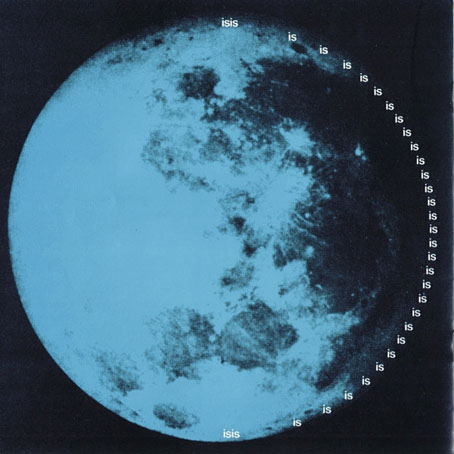
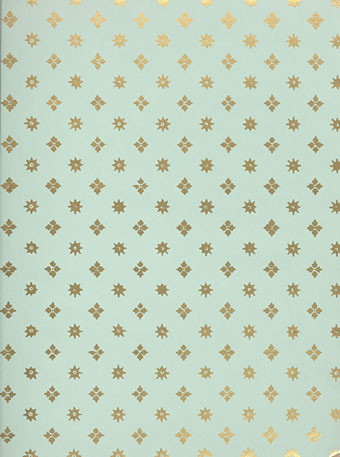
Barney Bubbles’ design for the album is also very different to anything else in the Hawk-sphere, an example of what might be called his High Modernist period, when the hippy motifs and decorative pastiches of his earlier work were replaced with bold, flat colours and playful graphic designs. Xitintoday was released with a square booklet containing lyrics, notes about the mythological theme, and a series of pictures which combine diagrams and Ancient Egyptian reliefs with calligram-like wordplay. The back cover of the album exemplifies the latter, with the word “Day” spelled out in much smaller words reading “Night”; inside the booklet there’s a page for Isis the Moon Goddess where the words “Isis is is is is…” form a curve around a photograph of the Moon. The cover design continues the cosmic theme with a field of star shapes in which each star is created by the word “Twinkle”. The star field makes sense in the context of the booklet but I’ve wondered for a long time why Barney Bubbles thought it was a suitable cover design rather than simply being another booklet page.

turner3.jpg

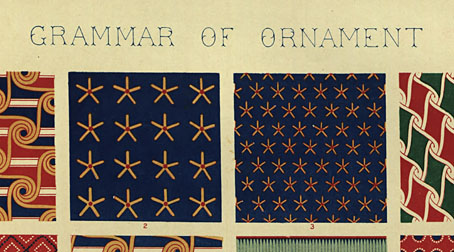
The solution arrived last week when work-related research had me looking through old design books for examples of Ancient Egyptian ornamentation. One of these, The Grammar of Ornament (1856) by Owen Jones, contains several pages of full-colour plates filled with Egyptian pattern samples.

egypt1.jpg

And on one of those pages there are these two squares which made me think immediately of the Xitintoday cover. This might seem tenuous when the cover design doesn’t feature any red dots but Barney Bubbles was an avid Egyptophile, avid enough to name his son after one of the Egyptian gods. A quick search revealed many more examples of this pattern which are closer matches for the cover design.

egypt2.jpg

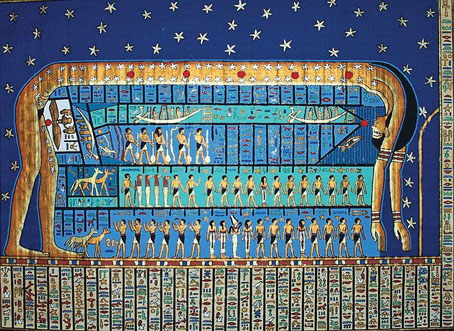
It turns out that the yellow star on a blue background was a common way of representing the night sky in Egyptian art, you’ll find the same stars in wall paintings and on the ceilings inside royal tombs.

egypt3.jpg

For years I’ve regarded the Xitintoday cover as being uncharacteristically random and abstract, surprisingly so when Bubbles designs from the same period are all so smart and well-considered. This discovery puts the Sphynx album in the same category, a design which avoids many more obvious solutions for a combination of the very old and the very new. Another feature of Barney Bubbles design is a kind of “Aha!” moment, when your appreciation of the design catches up with the thinking behind it. The appreciation this time has taken an outrageously long time to arrive but I’m pleased to have got there in the end.

Previously on { feuilleton }
• Led Zeppelin IV: Jimmy Page versus Little Bo-Peep
• The Grammar of Ornament revisited
• On the pyramid

Weekend links 646

wallpaper.jpg

It’s that lethal book again. A sample of wallpaper impregnated with arsenic, one of many such pages in Shadows from the Walls of Death: Facts and Inferences Prefacing a Book of Specimens of Arsenical Wall Papers (1874) by RC Kedzie.

• “I like to spend time in the now because there I can create something new but in the past I cannot.” Damo Suzuki, former vocalist in Can, on creativity and his resilience in the face of long-term illness. Related: a trailer for Energy: A Documentary about Damo Suzuki.

• “I enjoy Carnival of Souls, but it is a dark form of enjoyment, with high stakes, because the enjoyment is predicated on me being able to shake myself free of the film after it is over, and that can be a struggle.” Colin Fleming on fear as entertainment.

• “Some people like fantasy epics or Regency romance or Sudoku or science-fiction world-building or the gentle challenge of cozy mysteries; I like the undead.” Sadie Stein on encounters with ghosts.

• “You’re now standing on the blocks of the Great Pyramid at Giza. For the first time ever you can explore the entire pyramid interior.” The Giza Project.

• “What do we think about when we watch films set in vanished decades that many of us experienced at first hand?” asks Anne Billson.

• At Bandcamp: Touch celebrates forty years of not being a record label.

• “Why scientists are sending radio signals to the Moon and Jupiter.”

• At DJ Food’s: Retinal Circus gig posters 1966–68.

• Steven Heller’s font of the month is Feneon.

• The Pyramid Spell (1978) by Nik Turner | I Am Damo Suzuki (1985) by The Fall | Carnival Of Souls Goes To Rio (2001) by Pram

Weekend links 645

macgeorge.jpg

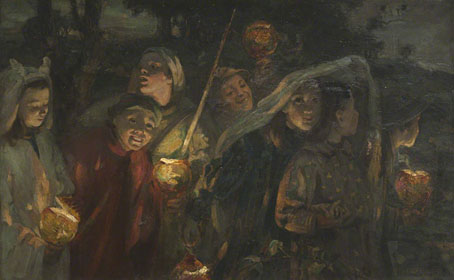
Halloween (no date) by William Stewart MacGeorge.

• Couldn’t Care Less: Cormac McCarthy in a 75-minute conversation (!) with David Krakauer at the Santa Fe Institute, filmed in 2017 and recently posted to YouTube. Not a literary discussion, this one is all about science, philosophy, mathematics, architecture and the operations of the unconscious mind. McCarthy’s essay about the origins of language, The Kekulé Problem, may be read here.

• At Wormwoodiana: Douglas A. Anderson finds a 1932 reprint of an HP Lovecraft story, The Music of Erich Zann, in London newspaper The Evening Standard. The story had appeared a few months prior to this in a Gollancz book, Modern Tales of Horror which reprinted a US collection edited by Dashiell Hammett. The newspaper printing includes an illustration by Philip Mendoza.

• New Hollywood Vs Mutant Cinema: The flipside of US cinema, 1960s–80s. Joe Banks talks to Kelly Roberts, Michael Grasso and Richard McKenna about their new book, We Are the Mutants: The Battle for Hollywood from Rosemary’s Baby to Lethal Weapon.

• At Bandcamp: Rich Aucoin explains the army of synths on his new quadruple album. The battalion includes the bespoke modular setup known as T.O.N.T.O., a rig that few people get to play with.

• New/old music: Malebox, an EP of Patrick Cowley rarities coming soon from Dark Entries.

• Mix of the week: Samhain Séance 11: endleofon by The Ephemeral Man.

• The surreal photographs of Ralph Eugene Meatyard.

• “NASA team begins study of UFOs”.

• Ghost Rider (1969) by Musical Doctors | Ghost Rider (1970) by The Crystalites | Ghost Rider (1977) by Suicide

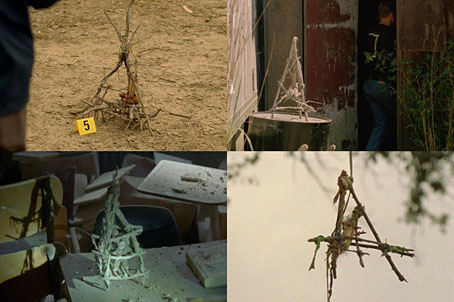
Sticks

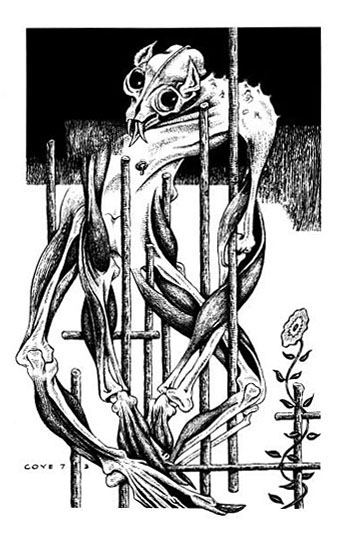
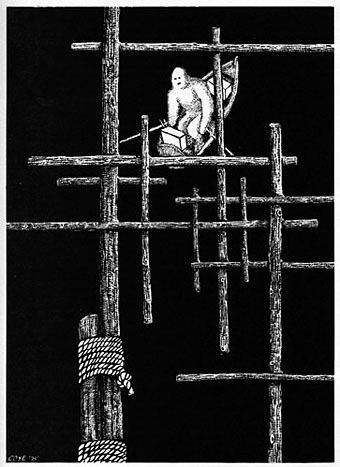
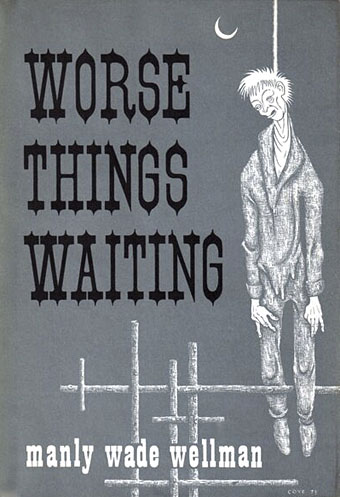
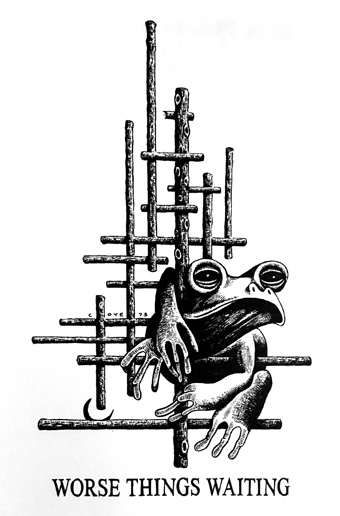
1: Illustrations by Lee Brown Coye

coye1.jpg

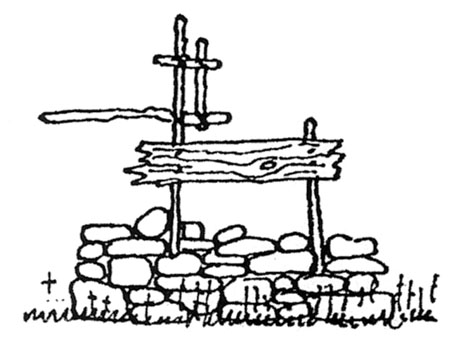
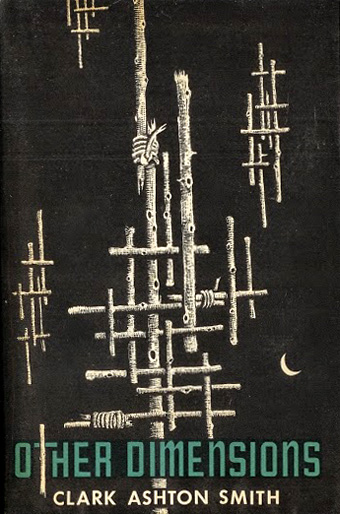
One recurring feature in Coye’s work is the motif of wooden sticks, often in latticework-like patterns. This was inspired by a 1938 discovery in an abandoned farmhouse.

Coye had returned to the North Pitcher, New York, area where he spent much of his childhood. While wandering deep in the woods, Coye discovered an abandoned farmhouse. Boards and pieces of wood which had been set perpendicular to one another surrounded the site. Neither inside nor out could Coye find an explanation for the presence of these crossed sticks. In the years following, Coye remained interested in the significance of his discovery.

When Coye returned to the site in 1963, there was nothing left of the building or the sticks (the area had suffered severe flooding), and he never found out why the sticks were there or who it was that had arranged them in such a manner. Because of the strangeness of the entire experience, these forms never left Coye, and they appear in many of his paintings and illustrations. [Via]

coye4.jpg

coye2.jpg

coye3.jpg

coye6.jpg

coye5.jpg


2: A short story by Karl Edward Wagner

whispers.jpg

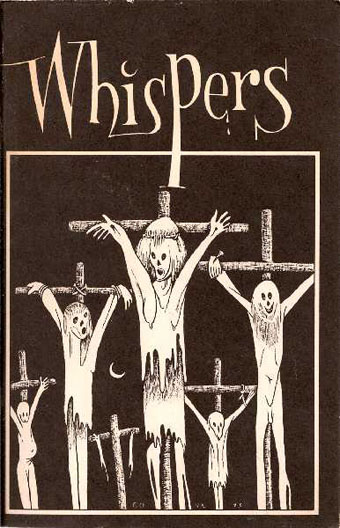
Whispers #3, March 1974. Cover art by Lee Brown Coye.

The story [Sticks] is really Lee Brown Coye’s and is about Lee Brown Coye, as the Afterword [in Whispers #3] explains. Coye had described the events upon which Sticks was based to me, and when Stuart David Schiff decided to bring out a special Lee Brown Coye issue of Whispers, I stole time from my final few months of medical school to write a story inspired by Coye’s experiences. Sticks is shot through with in-jokes and references which the serious fantasy/horror fan will recognize. I wrote the story as a favour and tribute to Lee, and I never expected it to be read by anyone beyond the thousand or so fans who read Whispers. To my surprise, Sticks became one of my best known and best liked stories. It won the British Fantasy Award and was a runner-up in the World Fantasy Award for best short fiction. The story has been anthologized numerous times and translated into several languages. It was broadcast on National Public Radio on Hallowe’en 1982 and was to have been produced for the short lived television series, Darkroom. Not bad for an in-joke. [Via]


3: Season one of True Detective

truedetective.jpg


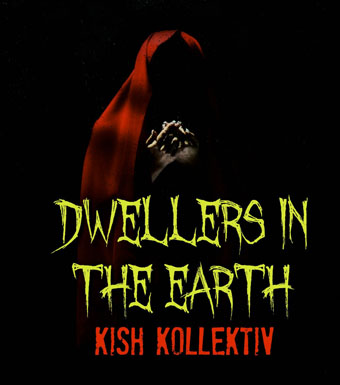
4: An invented soundtrack album by Kish Kollectiv

dwellers.jpg

Produced for UK television in 1982 by ATV, the undeservedly obscure Dwellers in the Earth is a loose adaptation of the late Karl Edward Wagner’s short story Sticks (itself an inspiration for The Blair Witch Project). The film—thought lost for many years until a somewhat degraded can of film reel turned up in a private collection in Hong Kong in 2009—has been routinely described as one of the scariest made-for-television horror movies of all time. It was directed by the late Freddie Francis and starred Robert Powell and Jenny Agutter with Michael Ironside, Ian McCulloch and Linda Hayden in supporting roles.

With the kind permission of the composer’s widow, Nadezhda Mastandrea, Kish Kollektiv has painstakingly recreated Staszek Korolenko’s long lost soundtrack score for the mysterious film. The UK-based Kollektiv gratefully acknowledges Mr. Korolenko’s huge influence on its own work. The Anglo-Belarusian composer died at the age of only 43, while the master recordings of many of his scores were later destroyed when the cellar of his family home flooded in 1989. [Via]

Previously on { feuilleton }
• Owls and flowers
• In the Key of Yellow