
Infinite reflections

fireflies.jpg

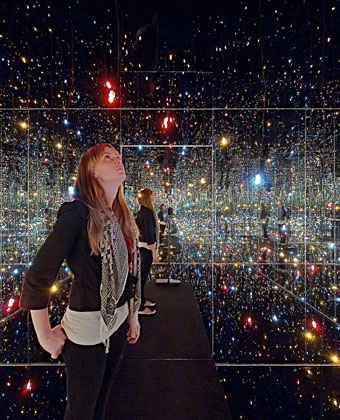
Fireflies on the Water by Yayoi Kusama (2002).

One of my favourite contemporary artworks, Fireflies on the Water by Yayoi Kusama, receives a new showing at Sydney’s Museum of Contemporary Art. Her mirrored room features 150 lights and a pool of water and while most photos show an impressive work, none of them can match this fantastic 360º panorama by Australian photographer Peter Murphy. Kusama isn’t the only artist to use mirrors this way but mirror rooms and reflective surfaces have become as much a recurrent feature of her work as her trademark spots.

Fireflies on the Water is being shown as part of the Yayoi Kusama: Mirrored Years exhibition and can be seen until June 8th, 2009. (Via Nevertheless.)
samaras.jpg

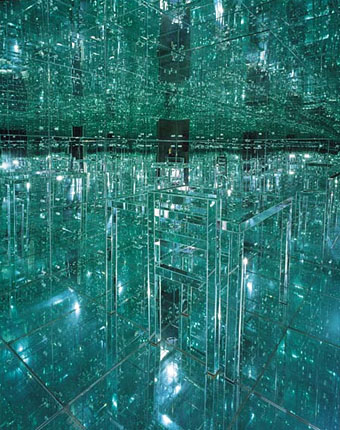
Mirrored Room by Lucas Samaras (1966).

I’ve often wondered how far back the invention of the fully-mirrored room can be traced. Halls of mirrors are historically common but the mirrors tend to be on the walls only. American artist Lucas Samaras produced his Mirrored Room (with mirrored chair and table) in 1966, something which fascinated me when I first encountered it in art books.
frippandeno.jpg

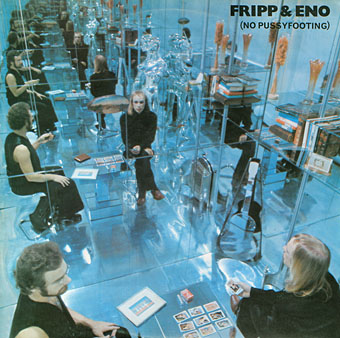
It evidently fascinated ex-art student Brian Eno who I’m sure must have borrowed the idea for the cover of his collaboration with Robert Fripp, (No Pussyfooting), in 1973. I’ve always assumed this was a room in Eno’s home at the time but never seen that confirmed. Anyone know whether this is the case?

Elsewhere on { feuilleton }
• The panoramas archive

Previously on { feuilleton }
• The art of Josiah McElheny
• Yayoi Kusama
• The art of Yayoi Kusama
• Exposure by Robert Fripp
Sleeve craft

randf.jpg

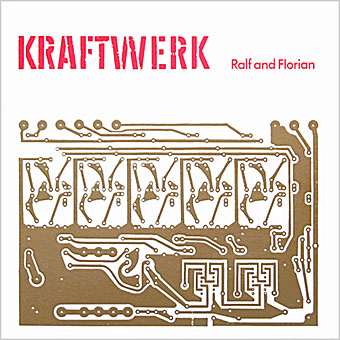
Another authorless design: Vertigo #6360 616 (1973).

Things we did (or didn’t) learn about album cover design this week.

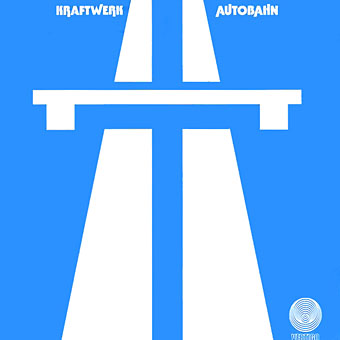
• The jury is still out as to whether Barney Bubbles designed the covers for the UK releases of Kraftwerk’s third and fourth albums, Ralf and Florian and Autobahn. BB experts Rebecca & Mike did clarify a few points with Kraftwerk designer and collaborator Emil Schult, however. This matter requires further research if only to satisfy my own curiosity.

• The Guardian finally caught up with the CD Cover Meme which was discussed here last year. “Labels spend fortunes on what you lot have managed in minutes” says the paper. By the same rationale anyone who keeps a blog is, de facto, a journalist because all that either involve is writing down a few words. Clever.

• Taking the DIY theme one stage further, Figment is a site where you can invent your own band and promote them via imaginary album sales on the site. You can also create your own cover art, of course, and Figment have asked me to judge an album cover contest with the very real and worthwhile first prize of the latest edition of Photoshop and a copy of Paul Gorman’s excellent Barney Bubbles monograph, Reasons To Be Cheerful. The contest is running now until April 3rd, 2009, if you’re interested.

Update: Cover versions: How Hipgnosis created some of the most memorable images of the Seventies. The Independent on the new Hipgnosis book.

Elsewhere on { feuilleton }
• The album covers archive

Who designed Vertigo #6360 620?

autobahn1.jpg

Autobahn by Kraftwerk; Vertigo #6360 620.

Colin Buttimer was in touch last week to let me know he’d copied my Barney Bubbles post (with my permission) to his excellent new site, Hard Format, which is devoted to the art of music design. In the intro to that piece he repeats something he’d mentioned to me earlier, namely his belief that Barney Bubbles designed the UK release of Kraftwerk’s Autobahn album in 1974. I thought this unlikely at first but the more I’ve been thinking about it the more possible it seems. So here’s a quick run through the evidence in the hope that someone out there may have more information to either confirm or deny the theory.

Continue reading “Who designed Vertigo #6360 620?”