Weekend links 36

high_society.jpg

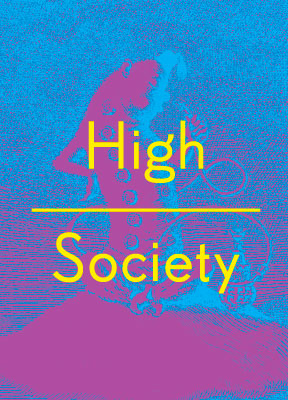
Mervyn Peake’s Caterpillar from Alice’s Adventures in Wonderland finds itself used to promote High Society, an exhibition at the Wellcome Collection devoted to the long history of human drug-taking. There’s more about the exhibition here and also an accompanying book by Mike Jay from Thames & Hudson. Related: The Most Dangerous Drug:

A group of British drug experts gathered by the Independent Scientific Committee on Drugs (ISCD) rated alcohol higher than most or all of the other drugs for health damage, mortality, impairment of mental functioning, accidental injury, economic cost, loss of relationships, and negative impact on community.

• Unless the magazine Man, Myth & Magic was advertised on TV in 1970 (and I suspect it would have been) Austin Osman Spare’s work has never been seen on British television, certainly not in any detail or with a credit to the artist. This week the BBC finally paid him some attention with a brief spot on The Culture Show as a result of the Fallen Visionary exhibition which is still running (until November 14) in London. Alan Moore, Fulgur‘s Robert Ansell and others attempt to summarise Spare’s career in seven minutes.
fujita.jpg

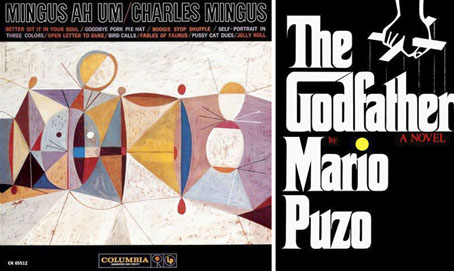
Neil Fujita designs: Mingus Ah Um (1959) and The Godfather (1969).

• RIP graphic designer Neil Fujita. Related:

“By taking the “G” and extending it to the “D,” I created a house for “God.” The way the word was designed was part of the logo and so was the type design. So when Paramount Pictures does a film version or Random House, which bought out the book from Putnam, does another Godfather book, I still get a design credit. In fact, before the first Godfather film opened in New York I saw a huge billboard going up in Times Square with my design on it. I actually got them to stop work on it until we were able to come to an agreement.” Waxing Chromatic: An Interview with S. Neil Fujita

French SF illustration. Related: Where did science fiction come from? A primer on the pulps, a feature by Jess Nevins with some of the craziest covers you’ll see this month.

• Gay-bashers in 1970s San Francisco had to beware the wrath of the Lavender Panthers.

• More Marian Bantjes as she discusses her work in an audio interview.

Music from Saharan cellphones.

Origami Beauty Shots.

Krautrock.com

Better Git It In Your Soul (1959) by Charles Mingus.

Illustrating Poe #1: Aubrey Beardsley

beardsley_poe1.jpg

The Black Cat.

Halloween approaches, as if you needed reminding. In honour of that event it’s Poe Week here at {feuilleton}, and we’ll be skating through some favourite depictions of stories and poems by the Boston genius.

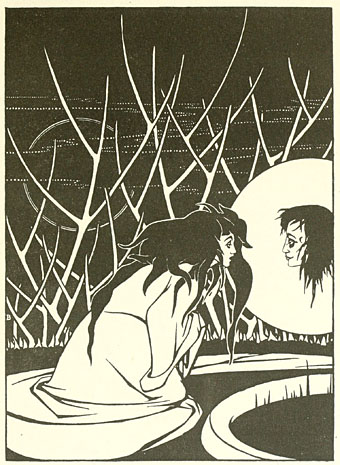
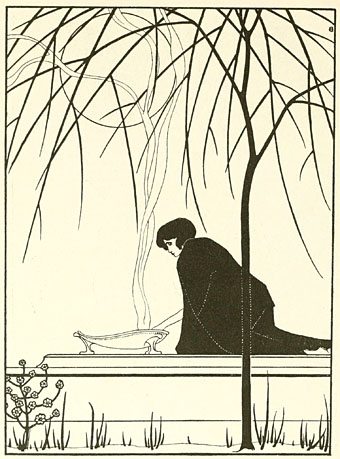
Aubrey Beardsley’s four Poe illustrations were commissioned by Herbert S. Stone and Company, Chicago, in 1894 as embellishment for a multi-volume collection of the author’s works. The Black Cat is justifiably the most reproduced of these. The other drawings are fine in themselves but not very successful illustrations of Poe’s tales. Aubrey wasn’t really suited to this kind of horror atmosphere; looking at his ear-ringed orangutan and the spotless furnishings surrounding it you’d never guess the scene of murderous simian frenzy which lies at the heart of the story.

beardsley_poe2.jpg

The Murders in the Rue Morgue.

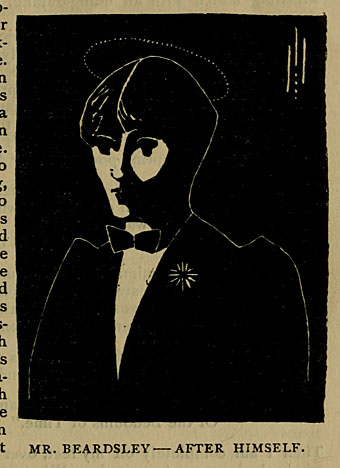
Herbert Stone’s company had begun publishing The Chap-Book in the same year, a witty American equivalent of British periodicals like The Yellow Book, and Beardsley’s work was featured in the early issues. Looking through some of these at the Internet Archive I was surprised to see the following illustration in a short appraisal of Beardsley’s art. If this is by the artist, as the credit implies, it’s a drawing I haven’t seen in any books of his work. If anyone can confirm this is a genuine Aubrey then please leave a comment. The other Poe illustrations follow.

beardsley_portrait.jpg

From The Chap-Book, May 15th, 1894.
Continue reading “Illustrating Poe #1: Aubrey Beardsley”

Weekend links 35

cr.jpg

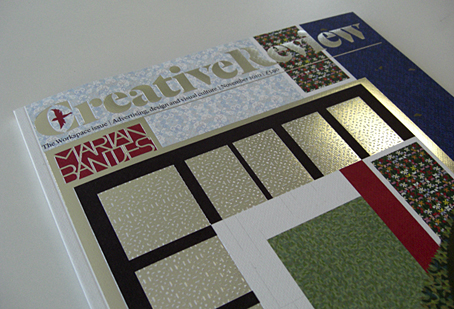
Marian Bantjes designs the cover of the latest Creative Review and there’s a feature about her work inside.

• “…the question: ‘was Shakespeare gay?’ strikes me as so daft as to be barely worth answering. Of course he was. Arguably he was bisexual, of sorts, but his heart was never on his straight side.” Don Paterson throws the cat among the pigeons in an examination of the Shakespeare’s sonnets. Related (sort of): Shakespeare and Company: The bookshop that thinks it’s a hotel. Also related: Jeanette Winterson revisits Shakespeare and Company.

100 orbs of light float in the Schuylkill River. Also in Philadelphia: Animators Amok in a Curiosity Cabinet: the Brothers Quay are making a film in the Mütter Museum. Can’t wait to see it.

• More Alan Moore: Fossil Angels, a lengthy essay about magic and the occult, was written in 2002 but hasn’t been given a public airing until now.

Alberto Manguel is always worth reading:

As Borges was well aware even then, the history of literature is the history of this paradox. On the one hand, the deeply rooted intuition writers have that the world exists, in Mallarmé’s much-abused phrase, to result in a beautiful book (or, as Borges would have it, even a mediocre book), and, on the other hand, to know that the muse governing the enterprise is, as Mallarmé called her, the Muse of Impotence (or, to use a freer translation, the Muse of Impossibility). Mallarmé added later that all who have ever written anything, even those we call geniuses, have attempted this ultimate Book, the Book with a capital B. And all have failed.

• Here Comes Everybody: Wake In Progress is a self-described “foolhardy attempt to illustrate Finnegans Wake”. Easier to illustrate than make a film of the book, I’d have thought, and Mary Ellen Bute already attempted the latter.

hoffmeister.jpg

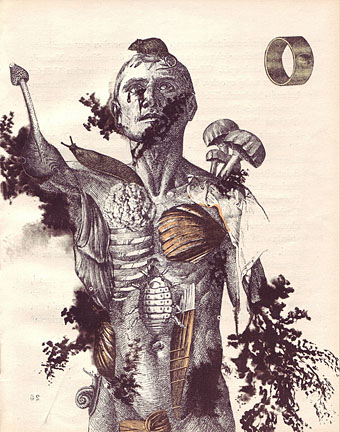
Psychic Explosion: Adolf Hoffmeister’s illustrations for a 1967 edition of Lautréamont’s Poesies at A Journey Round My Skull.

Craig Colorusso’s Sun Boxes can be seen at Turner Falls, Massachusetts, during November.

Clive Hicks-Jenkins has a book and retrospective exhibition of his art due next year.

• A sneak peek into The Steampunk Bible to which I’m a contributor. And also here.

• “Human or other; depends who comes”: the Ballardian films of Paul Williams.

Transmission (1979) by Joy Division; Transmission (1995) by Low; Monkey (2010) by Robert Plant.

The art of Marcus Behmer, 1879–1958

behmer05.jpg

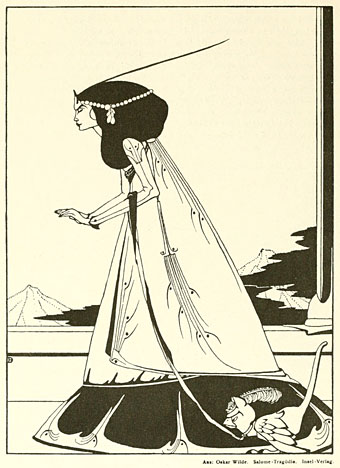
Salomé: Der Wunsch.

Back in March I wrote something about Alex Koch’s art periodical, Deutsche Kunst und Dekoration, a guide to German arts, crafts and architecture founded in Darmstadt in 1897. The Internet Archive has a nearly complete run of these and I’ve recently been working my way through their scans, a process which takes a while as there’s more than 10,000 pages to be looked at. When I find the time I’ll be posting some of the finds from this wonderful publication, the early issues of which are devoted to the best examples of the Art Nouveau style in Germany and elsewhere.

behmer06.jpg

Salomé: Die Erfüllung.

For now, however, I can’t resist posting these pictures from volume 18 (April–Spetember 1906) which form part of a feature about German illustrator Marcus Behmer. I’ve only seen one or two of Behmer’s drawings before and they didn’t really show him at his best. What’s immediately apparent is the great debt his work owed at this point to Aubrey Beardsley, right down to the treatment of foliage and a deliberately grotesque approach to character. It’s also good to find another treatment of the Salomé theme in black-and-white, and the pictures here are credited as being based on Wilde’s play.

behmer07.jpg

Salomé: Das Opfer.

Wikipedia has a page about the artist but it’s all in German, unfortunately, so a crude translation has to suffice. As with Beardsley, the grotesquerie extended to the sexual sphere and it would be nice to know more about the byways of Behmer’s career if only to see where his curious erotic drawings pieces come from. Wikipedia notes that “Behmer was already since 1903 member in the first homosexual organization of the world in Berlin” so I assume that means he was part of Adolf Brand’s circle, and may have contributed to Brand’s publication Der Eigene. A few examples of the erotic work can be found here and here. Further examples from Deutsche Kunst und Dekoration follow.
Continue reading “The art of Marcus Behmer, 1879–1958”

Pavomania

peacock1.jpg

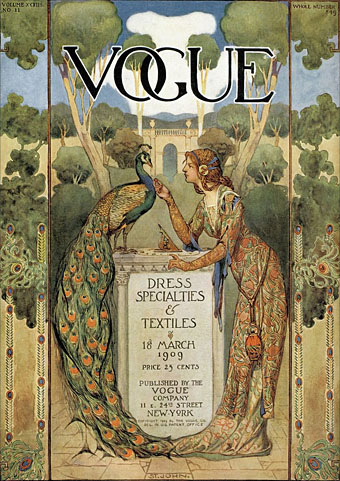
Colour me Mr Popular as I’m interviewed once again, the venue on this occasion being Coilhouse which is a fine place to be featured. My thanks to S. Elizabeth for the indulgence. In the course of our discussion I mentioned The Peacock Obsession, and by coincidence these pages have been receiving links recently from Peacock’s Garden, a site devoted to that ubiquitous fowl. These two pieces can be found there with the Vogue cover being a new one to me. The artist is the great J. Allen St John, better known for his Edgar Rice Burroughs illustrations and distinctive title designs; Golden Age Comic Book Stories has many examples of his work.

peacock2.jpg

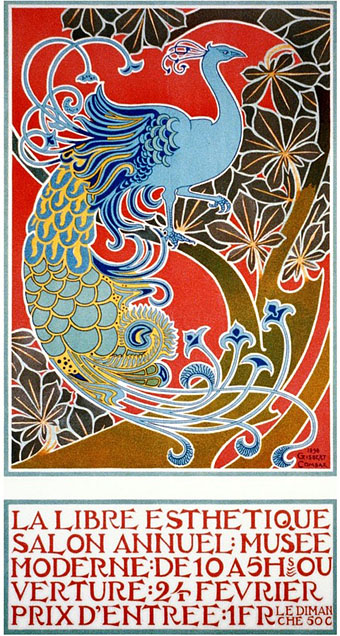
This splendid Art Nouveau poster is by Gisbert Combaz (1869–1941) and those who’ve seen my Dodgem Logic cover may recognise the peacock whose outline I rather shamelessly swiped. Combaz’s poster turns up regularly in Art Nouveau histories but his other work is less visible which is a shame, he has a very bold graphic style and I’d love to see more. Lastly, I’ve linked to this before but it’s worth mentioning again, Seasons of the Peacock at Animalarium which also has Combaz’s poster.

Previously on { feuilleton }
The Art Nouveau dance goes on forever
Dodgem Logic #4