Tentacles #3: Dwellers in the Mirage

dwellers01.jpg

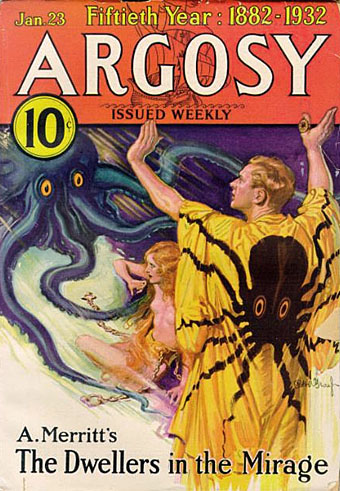
Illustration by Robert A. Graef (1932).

If the predatory octopuses of the Sargasso Sea are too mundane for you, how about an extra-dimensional Kraken named Khalk’ru which has to be placated with human sacrifice? This creature is the prime menace in A. Merritt’s Dwellers in the Mirage (1932), a novel I’m afraid I haven’t read despite its quite evident tentacular delirium. The story is a Lost Race adventure with the unlikely setting of a warm valley in Alaska where the usual heroic outsider encounters the diabolical Kraken worshippers. Merritt’s work is out of copyright in Australia so the text of the book can be found at the Australian Project Gutenberg. There you’ll discover that chapter four is entitled Tentacle of Khalk’ru.

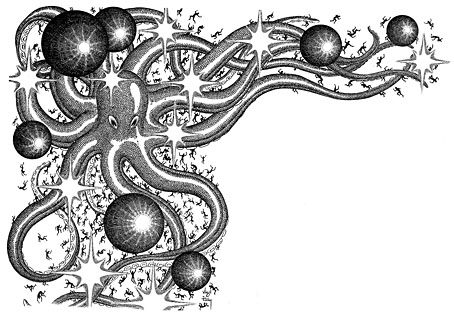
A handful of covers and illustrations follow.

dwellers06.jpg

Virgil Finlay (1941).

Continue reading “Tentacles #3: Dwellers in the Mirage”

The Garden of Adompha

adompha1.jpg

…the growths of that garden were such as no terrestrial sun could have fostered, and Dwerulas said that their seed was of like origin with the globe. There were pale, bifurcated trunks that strained upwards as if to disroot themselves from the ground, unfolding immense leaves like the dark and ribbed wings of dragons. There were amaranthine blossoms, broad as salvers, supported by arm-thick stems that trembled continually.

And there were many other weird plants, diverse as the seven hells, and having no common characteristics other than the scions which Dwerulas had grafted upon them here and there through his unnatural and necromantic art.

These scions were the various parts and members of human beings. Consummately, and with never failing success, the magician had joined them to the half-vegetable, half-animate stocks on which they lived and grew thereafter, drawing an ichor-like sap. Thus were preserved the carefully chosen souvenirs of a multitude of persons who had inspired Dwerulas and the king with distaste or ennui. On palmy boles, beneath feathery-tufted foliage, the heads of eunuchs hung in bunches, like enormous black drupes. A bare, leafless creeper was flowered with the ears of delinquent guardsmen. Misshapen cacti were fruited with the breasts of women, or foliated with their hair. Entire limbs or torsos had been united with monstrous trees. Some of the huge salver-like blossoms bore palpitating hearts, and certain smaller blooms were centered with eyes that still opened and closed amid their lashes. And there were other graftings, too obscene or repellent for narration.

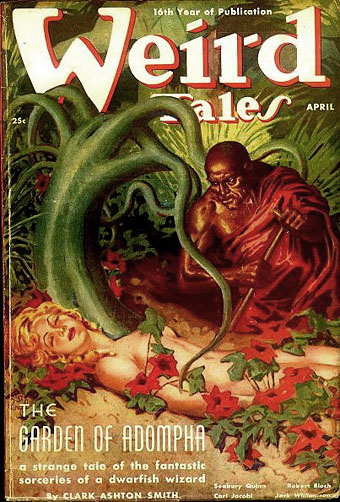
Thus Clark Ashton Smith in The Garden of Adompha, one of the stories in the author’s Zothique cycle which was first published in Weird Tales in April, 1938. Zothique was Smith’s contribution to the Dying Earth subgenre, sixteen stories set on the last continent in the final days of the Earth, and a home to no end of sorcery and cruelty. I’ve always enjoyed this subgenre, especially in the hands of Jack Vance whose later Dying Earth stories show the influence of Zothique, so these are some of my favourites among Smith’s prodigious output. The Garden of Adompha is a particularly grotesque piece, concerning the sequestered garden of the title to which King Adompha has undesirables removed. Once there his wizard, Dwerulas, drugs the victims and grafts parts of their bodies to the garden’s hothouse plants. Virgil Finlay’s cover painting downplays the horror somewhat, and Dwerulas’s supine prey, Thuloneah, looks like a very typical American girl, but then for a story that reads like a pulp equivalent of Octave Mirbeau it’s surprising it made the cover at all.

adompha2.jpg

Re-reading some of Smith’s stories over the past week, The Garden of Adompha among them, there’s been the additional pleasure of searching for illustrations from their original publication. I knew that Virgil Finlay had painted this cover, one of the few cover features Smith received from Weird Tales, but Alistair Durie’s Weird Tales (1979) collection only has a monochrome reproduction. The always reliable Golden Age Comic Book Stories not only has a copy of Finlay’s original painting but also the interior illustration which looks like a litho drawing rather than the artist’s more usual scratchboard. The most recent book collection featuring the story was The Collected Fantasies Of Clark Ashton Smith Volume 5: The Last Hieroglyph (2010) from Night Shade Books. (I would have linked to the publisher’s page but their site seems to be broken.)

Update: Golden Age Comic Book Stories changed its name then vanished altogether. The picture links here have been updated.

adompha3.jpg

Previously on { feuilleton }
Vathek illustrated
The Vengeance of Nitocris
The House of Orchids by George Sterling
Haschisch Hallucinations by HE Gowers
Odes and Sonnets by Clark Ashton Smith
The King in Yellow
Clark Ashton Smith book covers

Raymond Bertrand’s science fiction covers

bertrand01.jpg

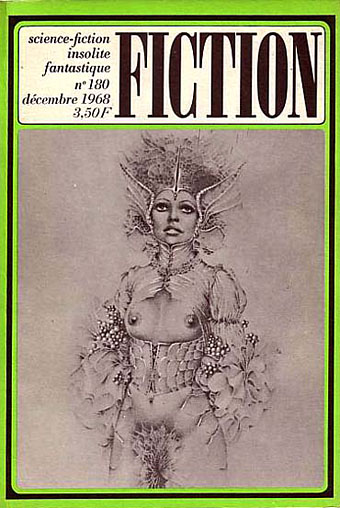
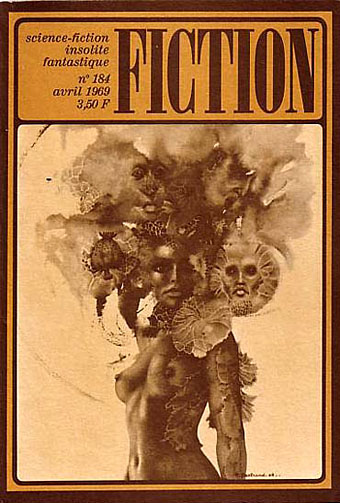
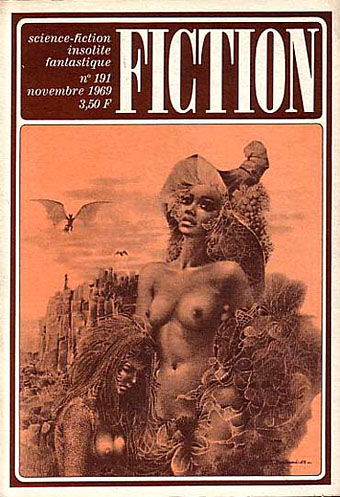
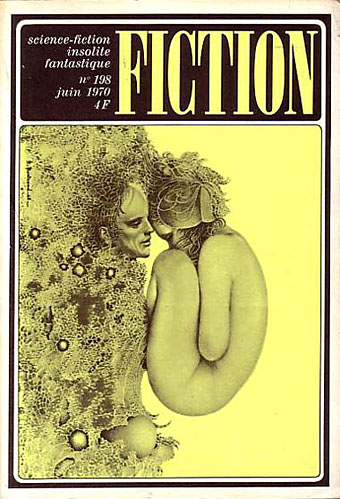
Work by the elusive French artist Raymond Bertrand has appeared here before although the art continues to be more visible (if obscure) than the man himself. Bertrand’s most famous drawings are the naked women that appeared on the cover of issue 28 of Oz magazine, the notorious School Kids Issue, but I don’t think he was credited for the usage and his name is never mentioned when the magazine is discussed. Looking for information about the Chute Libre books at French SF site Noosfere led me to an entry for Bertrand’s work. The list doesn’t include any of the book collections of his drawings but does have these magazine covers which feature some pieces I hadn’t seen before.

bertrand02.jpg

Fiction was the leading French SF magazine, and sported a fascinating range of cover art especially from the mid-60s on. Artists at that time included Philippe Druillet and Philippe Caza, both of whom would become big names in the comics world a few years later. Galaxie was the French edition of American magazine Galaxy, and featured unique material among its translations of Anglophone works. Being French, there’s a greater amount of flesh on display than you’d find on magazine covers in the US and UK; some of this is as salacious as anything else from the period although at least one of the artists drawing naked females was a woman, Sophie Busson. Naked females emerging from—or being absorbed by—strange vegetation, polyps or aquatic organisms were Bertrand’s métier so that’s mostly what one finds here. Few of the covers seem to relate to the magazine’s contents, the artists appear to have been free to draw what they liked; in the case of Druillet that means his usual Lovecraftian architecture. An exception is issue 198 of Fiction which has an article about Bertrand’s work by Jacques Chambon: Raymond Bertrand ou de l’amour de l’art à l’art de l’amour. I’m hoping now that someone might be good enough to translate that piece for us lazy Anglophones.

And speaking of former Oz artists, Renaud Leon left a message recently with news that YouTube now has a channel featuring many examples of Jim Leon’s remarkable paintings.

bertrand03.jpg

bertrand04.jpg

Continue reading “Raymond Bertrand’s science fiction covers”

Wildeana 7

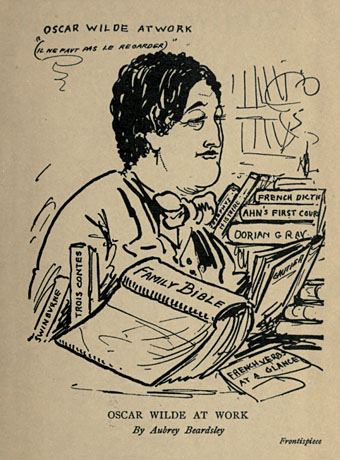
wilde1.jpg

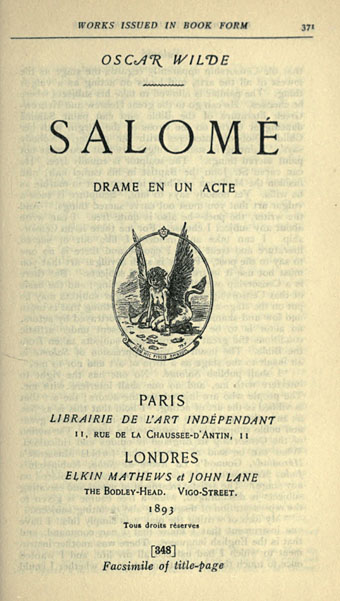
Continuing an occasional series. The drawing above is frequently credited to Aubrey Beardsley in books about Oscar Wilde but receives an “anonymous” attribution in books of Beardsley’s work. The copy here, and the pages below, are from Bibliography of Oscar Wilde (1914) by Stuart Mason.

Last November it was announced that Wilde’s lipstick-blotched tomb in Père Lachaise cemetery is to be cleaned (again) then shielded from the persistent kissers and graffiti writers by a glass screen. Flickr has a collection of photos showing the earlier condition of the tomb and its embellishments.

wilde2.jpg

• Maria Bustillos in The Vexed Posthumous Life of Oscar Wilde chronicles the story of the blue plaque on Wilde’s former home in Tite Street, London.

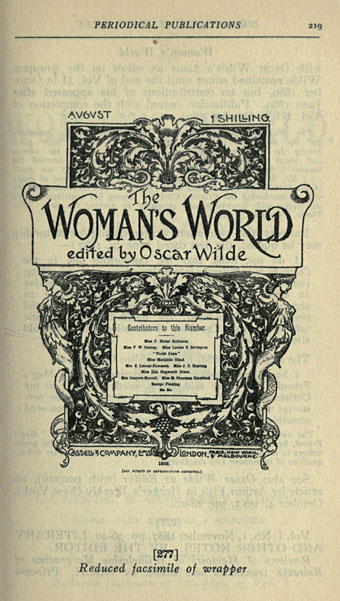
• “A hundred and twenty five years ago, Oscar Wilde edited a fashion magazine, his first and only office job. We have yet to learn from the experience.” Wilde in the Office by Kaya Genç.

wilde3.jpg

Elsewhere on { feuilleton }
The Oscar Wilde archive

Weekend links 121

lambshead.jpg

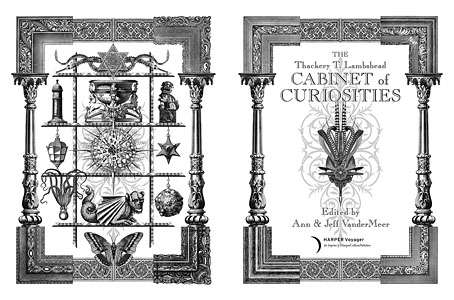
Title spread for The Thackery T. Lambshead Cabinet of Curiosities (2011) edited by Ann & Jeff VanderMeer.

I was surprised this week to find myself nominated as Best Artist in the World Fantasy Awards. The results will be announced at the World Fantasy Convention in November. Among the books nominated for Best Anthology is the Thackery T. Lambshead Cabinet of Curiosities for which I provided title page designs and some illustrations. Editors Ann & Jeff are well-represented (and ought to win for their landmark The Weird anthology), and I’m pleased to see Mark Valentine receive a nod for his excellent Wormwood magazine. Mark and Roger Dobson published my first Lovecraft adaptation, The Haunter of the Dark, in a large-format edition under their Caermaen imprint in 1988.

I remember having a conversation with my father about it. I told him what I’d really have liked to find, in my exhaustive search of the canon, was a gay superhero. You know: fucking dudes, saving the world. Never mind the fact that superheroes, with their notoriously contour-hugging apparel, are usually assumed gay by default. I wanted something that had existed, something from history. My father considered my criteria.

“I think what you want is Gore Vidal.”

Henry Giardina on Gore Vidal’s Bully Republic at the Paris Review.

• Appreciations and memorials for the late Gore Vidal continue to surface: “He was punk rock with a traditional, smooth exterior. But there was nothing traditional about him, not really. He defied singular category,” says Aaron Tilford at Lambda Literary. “Jokes course through Vidal’s entropy-heavy commentaries like a warm, reviving current. They, more than the barbs to which they form a counterpoint, are what make his essays a continuing pleasure to read,” says “J.C.” at the TLS.

• “Winterson’s opposition to strict realism is less an artistic critique than a cultural one. She uses the term ‘realism’ to describe an entrenched way of viewing the world, which it is the writer’s duty to challenge.” Hannah Tennant-Moore on Jeanette Winterson at n+1.

The Ghosts of Bush by Robin The Fog: “A final hauntological perambulation around the hidden corners of Bush House, Aldwych, London, June 2012”.

• “For everything that is not shown, the filmmaker counts on the power of imagination of his viewers.” Lebbeus Woods on Chris Marker and La Jetée.

Joseph Burnett on “Rainbow Ambiguity: Defying conservatism in mainstream LGBT culture”.

• Leigh Brackett book and magazine covers at Golden Age Comic Book Stories.

BLDGBLOG visited the Whitechapel Bell Foundry in London.

Stilled Life: A collection of photography by Thom Ayres.

• Underground subversion: Stickers on the Central Line.

Andrei Codrescu on five favourite Fantastical Tales.

Vangelis performs an analogue synth freakout for Spanish TV in 1982 | Oro Opus Alter, a track from the forthcoming album by Ufomammut | New World, a track from the forthcoming album by The Irrepressibles. Can’t wait.