Peculiar Shocks

bodyshocks02.jpg

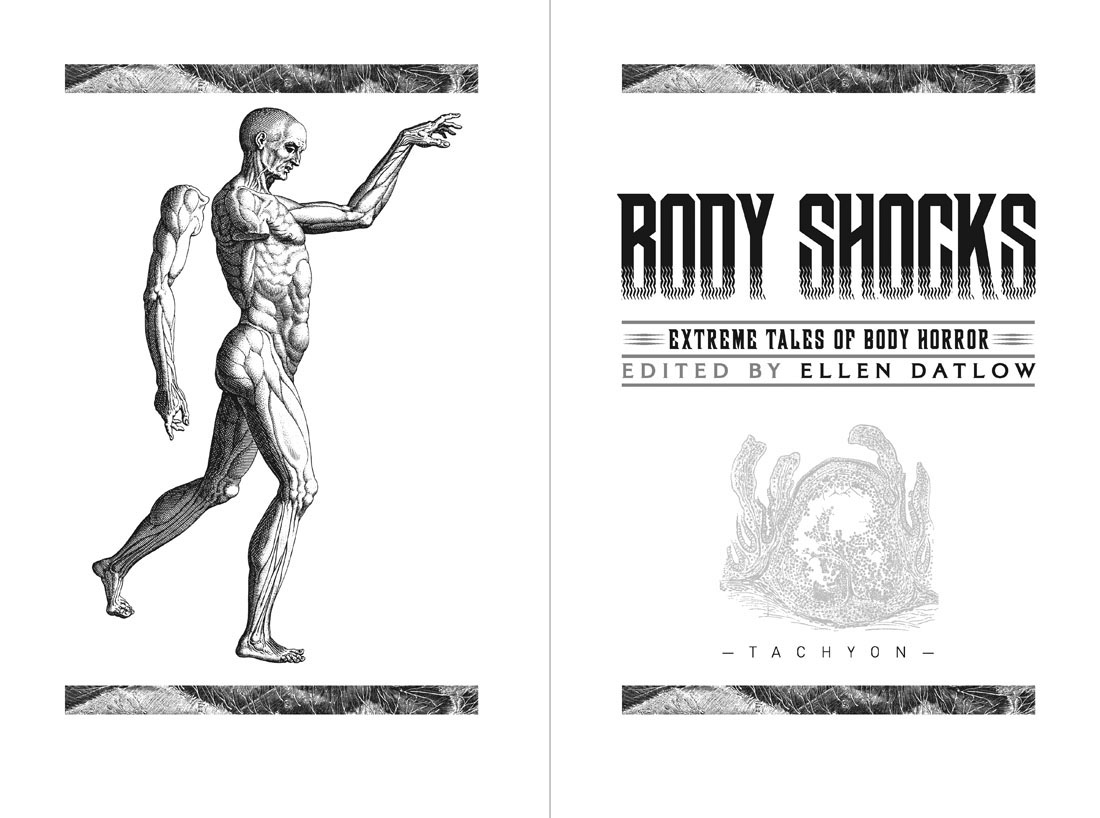
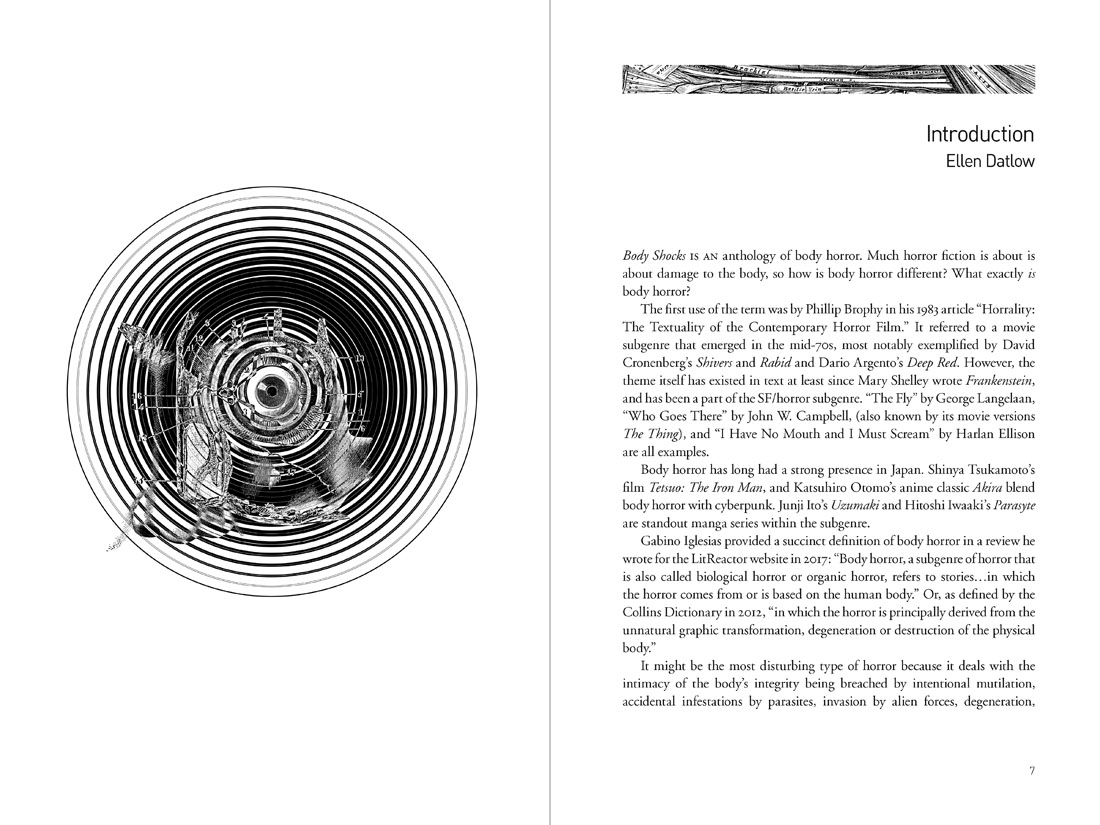
My cover design for Body Shocks, the body-horror story collection edited by Ellen Datlow, appeared here back in March. Now that the book is out from Tachyon I can show some of the interior design. In the earlier post I mentioned cover drafts that featured anatomical illustrations, none of which worked as well as the eyeball collage that became the final cover. The rejected pieces were better suited to the interior which combines engraved illustrations with the kind of sans-serif typography you might find on modern medical labels.
bodyshocks03.jpg

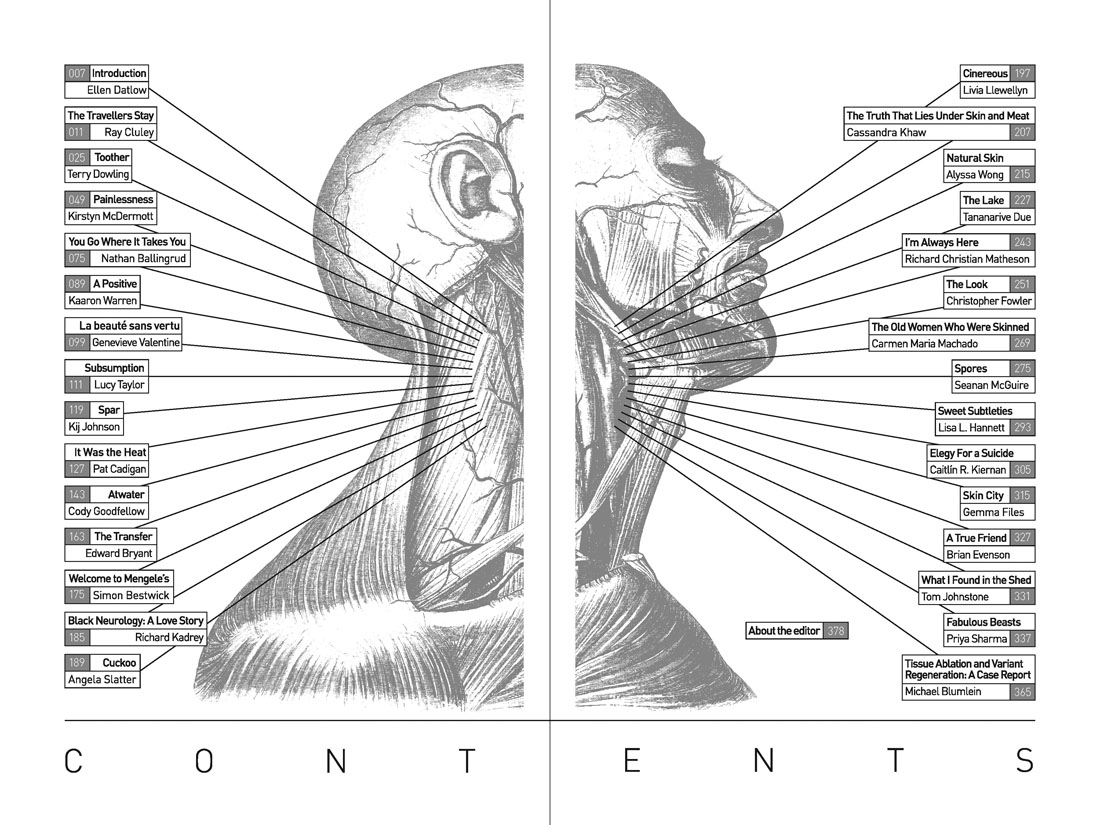
The diagram of veins that fills out the contents spread looks like an illustration from a 19th-century edition of Gray’s Anatomy but it’s actually an illustration from a book about massage whose title I don’t seem to have made a note of. Gray’s is a thorough volume, being a complete guide to the human body, but the illustrations aren’t as large or as detailed as those you can find elsewhere. The header bands used to indicate the beginning of each story are from Gray’s, however, while many of the stories end with full-page plates from The Anatomy of Humane Bodies by William Cowper. These are mostly engravings of autopsies which I processed by inverting the images then overlaying them with parallel lines. You can still tell the pictures are medical illustrations but they’re not as obtrusive as they would be if they’d been left untreated.
bodyshocks04.jpg

Continue reading “Peculiar Shocks”

Mask of the Red Death, 1969

masque.jpg

More animation, and more Edgar Allan Poe, although the story is reduced to a minimal trace in this 1969 short from the Zagreb animation studios. I’ve no idea whether the title is a misreading (or mistranslation) of Poe’s or a deliberate play on the masks used in the masque but I’ve gone with the most common labelling. Directors Branko Ranitovic and Pavao Stalter use a paint technique to sketch the stages of a tale that continues to resonate today. Watch it here.

Previously on { feuilleton }
The Pendulum, the Pit and Hope
The Tell-Tale Heart from UPA

The Hangman by Paul Julian and Les Goldman

hangman1.jpg

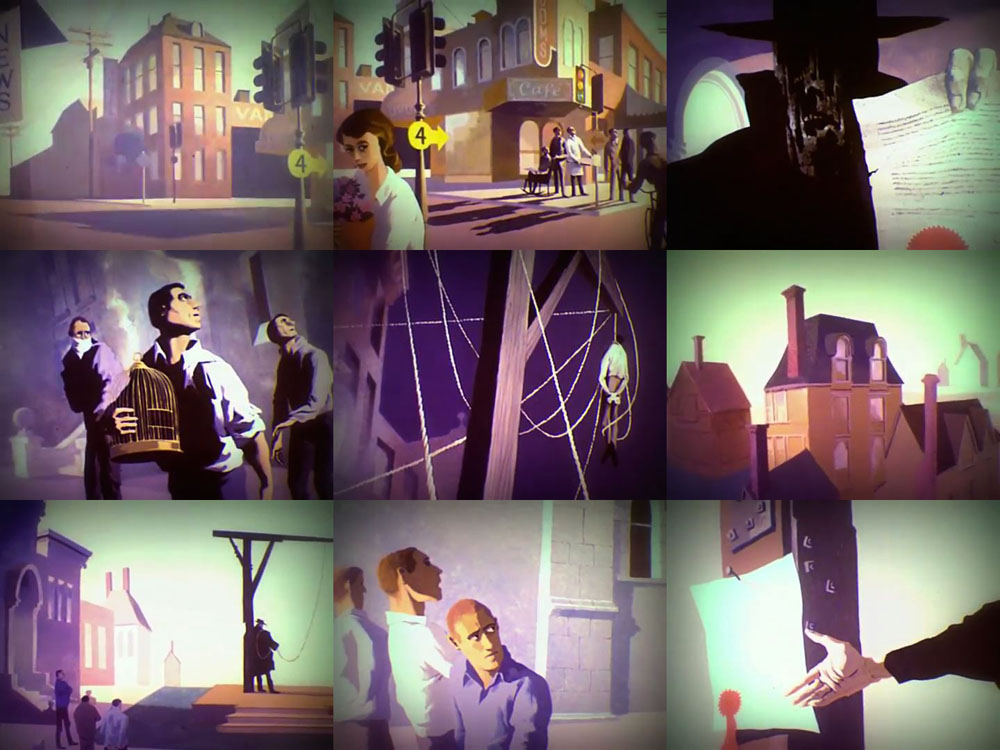
After mentioning Paul Julian in the previous post I went looking for examples of his work. The production design and background paintings that Julian created for the animated adaptation of The Tell-Tale Heart (1953) are perennially celebrated, especially around Halloween, but director Ted Parmelee tends to receive all the credit. The Tell-Tale Heart was a production for UPA but Julian had a long career in animation, especially for Warner Bros., and his voice (if not his name) are universally familiar from the sounds the Road Runner makes in the Wile. E Coyote cartoons. Until this week if I’d thought about this at all I would have assumed that the “hmeep-hmeep” sound (as Julian described it) was created by Mel Blanc, not one of the cartoon’s background artists.

hangman2.jpg

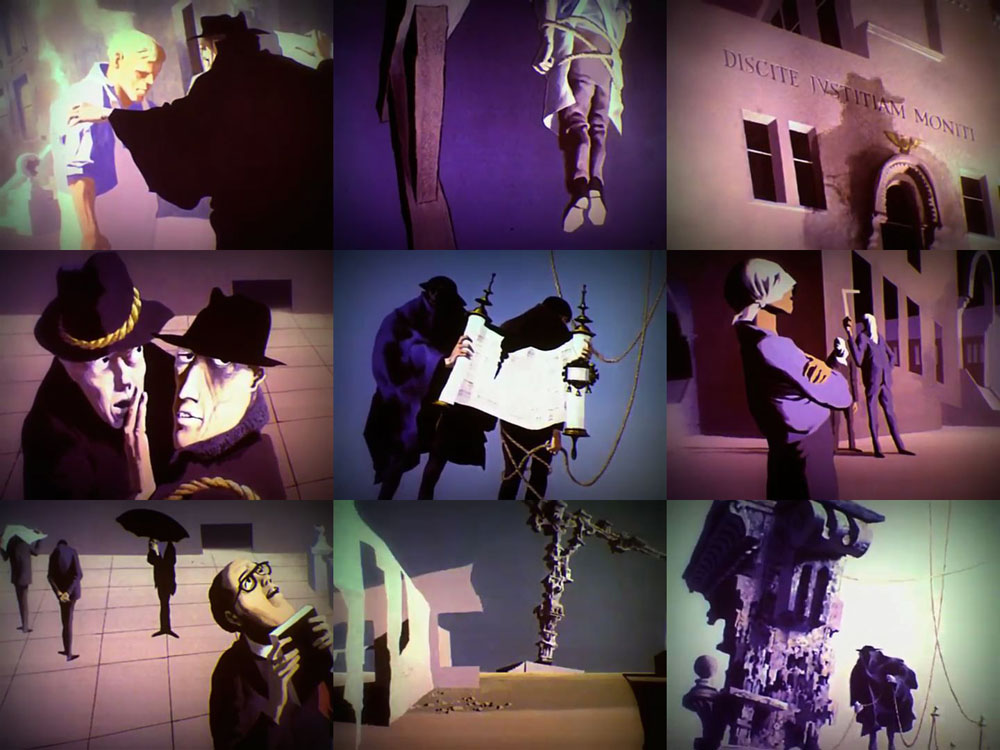
The Hangman (1964) is an 11-minute animation that, like The Tell-Tale Heart, is a long way from Looney Tunes and Merrie Melodies. Herschel Bernardi reads a poem by Maurice Ogden that describes a hangman who arrives in a small town and begins executing the citizens one after the other. No-one is spared, even those who support the actions of the hangman when his first victims are Jewish, Black, an unspecified “alien” and a man who openly questions the executions. The poem was written during the McCarthy era but is the kind of moral fable whose sentiments can be applied to any time, even if the design makes the context a specifically American one. Paul Julian painted the backgrounds and co-directed with Les Goldman, while Julian’s wife, Margaret, provided the minimal animation. The jazzy score—which doesn’t really suit the theme—was the work of Serge Hovey. Julian’s townscapes start out as Edward Hopper-like scenes of tall houses, old storefronts and wide roads striped with sunset shadows. In the second half of the film a Surrealist quality takes over. The gallows pole slowly consumes the town as well as its people, dismantling the buildings in order to grow into a towering edifice. The characterisations and the scene transitions make it plain how much of The Tell-Tale Heart was Julian’s work, while the film as a whole reminds me of one of Ray Bradbury’s morality tales. Watch it here.

Previously on { feuilleton }
The Tell-Tale Heart from UPA

T-shirts by Skull Print

skullprint-dotu.jpg

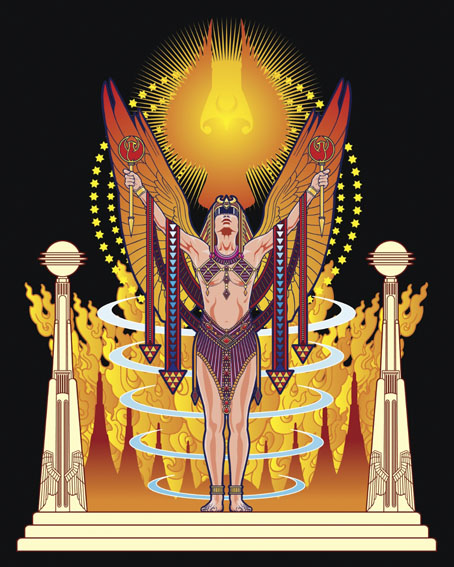
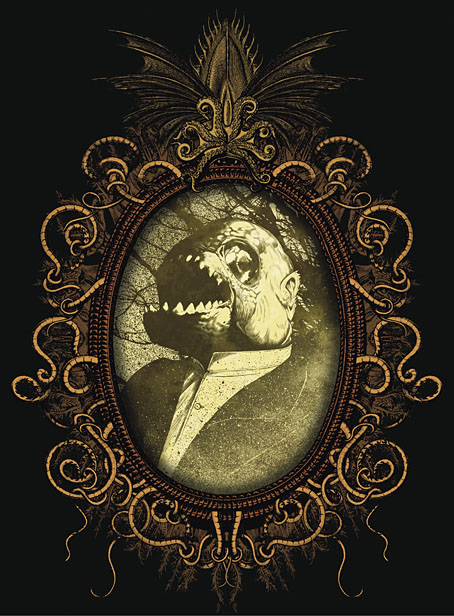
I’m very pleased to announce that I’ve partnered with T-shirt printers Skull Print to make shirts available featuring my artwork. See this standalone page for details. Skull Print are a small business based in the UK who specialise in music-related merchandise. Joe Banks pointed me in their direction when he was wondering if I’d considered doing a shirt design based on the cover of his Hawkwind book, Days of the Underground. To thank Joe for this, the first shirt is an adaptation of his cover design, which is followed by a very old piece of cover art for the Zones album by Hawkwind. Skull Print cater to a substantial Hawkwind fanbase so it makes sense to make this one available. And since we’re now in the horror month, I’ve added a couple of recent Lovecraft-related designs which have been tailored specially for this purpose.

skullprint-monsters.jpg

A design based on my cover for Lovecraft’s Monsters, an excellent story collection edited by Ellen Datlow.

I should emphasise that these aren’t the only shirt designs available. Skull Print operate on a print-on-demand basis so in theory any artwork of mine may be printed as a shirt if someone makes a request for one. (With a couple of exceptions; a few designs are subject to copyright restrictions.) The advantage that Skull Print have over other services such as CafePress is that I don’t have to spend time uploading the artwork to a website then creating a special sales page for it. Anyone who wants a shirt can now send me a request for one then I send the artwork to Skull Press and they’ll take care of everything else.

joyce.jpg

I’ll be setting up a few more designs with PayPal buttons when I have a spare moment. Some designs have been surprisingly persistent sellers at CafePress, such as my ideogrammatic portrait of James Joyce which is often ordered in the run-up to Bloomsday. A few years ago a shirt bearing this design was ordered by one “M. Atwood” of Halifax, Nova Scotia. I’ve been hoping ever since that the M. Atwood who everyone knows as a writer might turn up somewhere dressed in this item. If anyone sees a photo like this then please let me know!

Previously on { feuilleton }
Hawkwind: Days of the Underground
The Chronicle of the Cursed Sleeve
Rock shirts
Void City

Weekend links 584

crowley.jpg

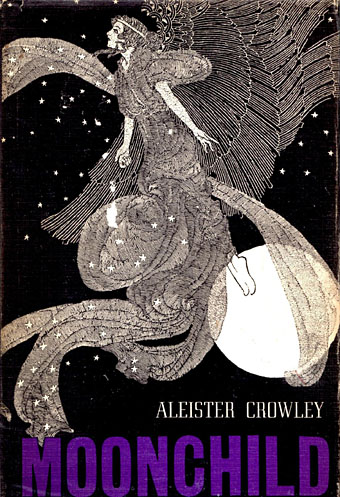
Cover for the 1970 US edition of Moonchild by Aleister Crowley. No artist credited (unless you know better…). Update: The artist is Dugald Stewart Walker, and the drawing is from a 1914 edition of Hans Christian Andersen’s fairy tales. Thanks to Mr TjZ!

• “…a very mid-Seventies cauldron of Cold War technology, ESP, sociology, black magic and white magic, experimental science and standing stones, secret radar and satanic rituals, whirring aerials and wild moors: a seething potion of Wyndham and Wheatley.” Mark Valentine on The Twelve Maidens, a novel by Stewart Farrar.

• “The line in the song ‘feed your head’ is both about reading and psychedelics. I was talking about feeding your head by paying attention: read some books, pay attention.” Grace Slick explains why those three little words have been attached to these pages since 2006.

Freddie deBoer reposted his “Planet of Cops” polemic, a piece I linked to when it first appeared in 2017, and which used to come to mind all the time before I absented myself from the poisonous sump of negativity that we call social media.

• RIP Charlie Watts. The Rolling Stones’ last moment of psychedelic strangeness is Child Of The Moon, a promo film by Michael Lindsay-Hogg featuring an uncredited Eileen Atkins and Sylvia Coleridge.

• Old music: A live performance by John Coltrane and ensemble of A Love Supreme from Seattle in 1965 that’s somehow managed to remain unreleased until now.

• A short film about Suzanne Cianni which sees her creating electronic sounds and music for the Xenon pinball machine in the early 1980s.

• “I’ll be in another world”: A rediscovered interview with Jorge Luis Borges.

Steven Heller explains why Magnat is his font of the month.

Clive Hicks-Jenkins on the allure of toy theatre.

• New music: Vexed by The Bug ft. Moor Mother.

• At Dennis Cooper’s: Nikola Tesla Festschrift.

Moon Child (1964) by The Ventures | Moonchild (1969) by King Crimson | Moonchild (1992) by Shakespears Sister