A feast of Poe

martini1.jpg

King Pest by Alberto Martini.

My thanks to the estimable Mr Shea for bringing to my attention this website devoted to the many illustrated editions of Edgar Allan Poe. Quite a few of the older illustrations have been featured here in the past but most of the later ones are new to me. The site is comprehensive enough to include my own illustrated edition from 2017, a book whose shortcomings I often find myself apologising for. (I was very pressured for time with that commission, and would welcome an opportunity to redo some of the pictures.)

martini2.jpg

A Descent into the Maelström by Alberto Martini.

I could draw attention to the later editions but I’ll single out the work of Alberto Martini (1876–1954), an Italian artist whose work I find especially attractive for the way it provides a bridge between Decadence and Surrealism. His Poe illustrations appear now and then in books or articles about horror fiction but you seldom see all of them together.

martini3.jpg

The Murders in the Rue Morgue by Alberto Martini.

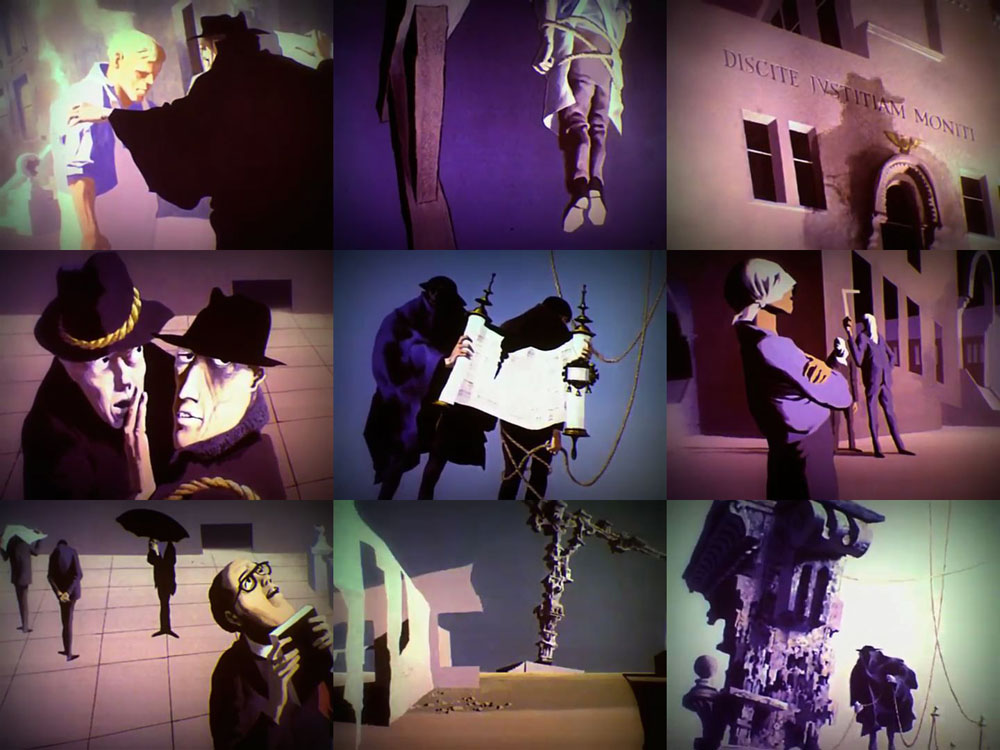
Meanwhile, Ted Parmelee’s short but very effective animated adaptation of The Tell-Tale Heart (1953) turned up recently at the Internet Archive in a copy that’s the best I’ve seen to date. Watch it here.

tell-tale.jpg

Elsewhere on { feuilleton }
The illustrators archive

Previously on { feuilleton }
Robert Lawson’s House of Usher
Edmund Dulac’s illustrated Poe
The Fall of the House of Usher, 1928
The Purloined Eidolon
Martin van Maële’s illustrated Poe
Mask of the Red Death, 1969
Narraciones extraordinarias by Edgar Allan Poe
Fritz Eichenberg’s illustrated Poe
The Pendulum, the Pit and Hope
Hugo Steiner-Prag’s illustrated Poe
Burt Shonberg’s Poe paintings
Illustrating Poe #5: Among the others
Illustrating Poe #4: Wilfried Sätty
Illustrating Poe #3: Harry Clarke>
Illustrating Poe #2: William Heath Robinson
Illustrating Poe #1: Aubrey Beardsley
Poe at 200
The Tell-Tale Heart from UPA
William Heath Robinson’s illustrated Poe
The Hangman by Paul Julian and Les Goldman

hangman1.jpg

After mentioning Paul Julian in the previous post I went looking for examples of his work. The production design and background paintings that Julian created for the animated adaptation of The Tell-Tale Heart (1953) are perennially celebrated, especially around Halloween, but director Ted Parmelee tends to receive all the credit. The Tell-Tale Heart was a production for UPA but Julian had a long career in animation, especially for Warner Bros., and his voice (if not his name) are universally familiar from the sounds the Road Runner makes in the Wile. E Coyote cartoons. Until this week if I’d thought about this at all I would have assumed that the “hmeep-hmeep” sound (as Julian described it) was created by Mel Blanc, not one of the cartoon’s background artists.

hangman2.jpg

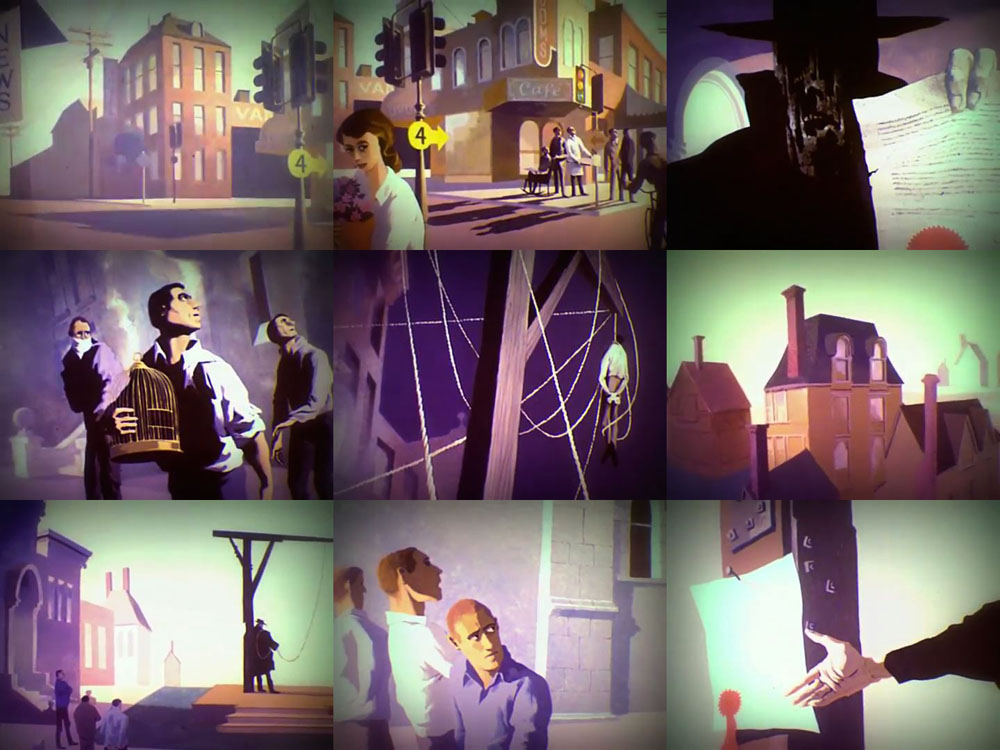
The Hangman (1964) is an 11-minute animation that, like The Tell-Tale Heart, is a long way from Looney Tunes and Merrie Melodies. Herschel Bernardi reads a poem by Maurice Ogden that describes a hangman who arrives in a small town and begins executing the citizens one after the other. No-one is spared, even those who support the actions of the hangman when his first victims are Jewish, Black, an unspecified “alien” and a man who openly questions the executions. The poem was written during the McCarthy era but is the kind of moral fable whose sentiments can be applied to any time, even if the design makes the context a specifically American one. Paul Julian painted the backgrounds and co-directed with Les Goldman, while Julian’s wife, Margaret, provided the minimal animation. The jazzy score—which doesn’t really suit the theme—was the work of Serge Hovey. Julian’s townscapes start out as Edward Hopper-like scenes of tall houses, old storefronts and wide roads striped with sunset shadows. In the second half of the film a Surrealist quality takes over. The gallows pole slowly consumes the town as well as its people, dismantling the buildings in order to grow into a towering edifice. The characterisations and the scene transitions make it plain how much of The Tell-Tale Heart was Julian’s work, while the film as a whole reminds me of one of Ray Bradbury’s morality tales. Watch it here.

Previously on { feuilleton }
The Tell-Tale Heart from UPA