Weekend links 217

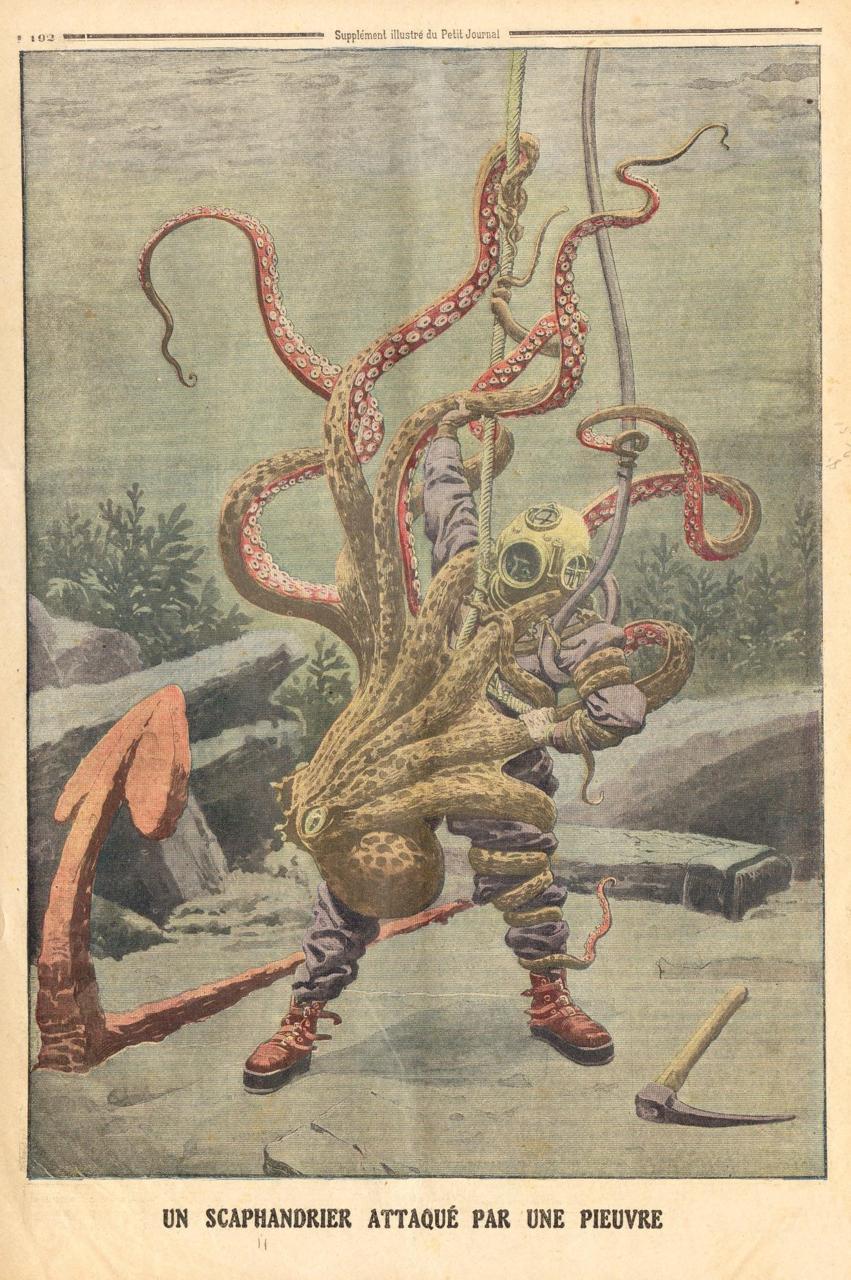
scaphandrier.jpg

Le Petit Journal, June 16, 1912. Via Beautiful Century.

Occult art by Nicomi Nix Turner, Daniel Martin Diaz, Amy Earles and William Crisafi. Related: Illustrations by Ernest M. Jessop for The Witches Frolic by Thomas Ingoldsby.

• “Our definition of ‘Industrial’ then was a very broad one, it’s definitely not so much now.” Chris Carter & Cosi Fanni Tutti on 20 Jazz Funk Greats by Throbbing Gristle.

• At Dangerous Minds: the Amok Assault Video (1988), an hour of the bizarre, the extreme and the outré which will probably get yanked from YouTube before too long.

I’ve always thought the exchange of words for money is no more and no less problematic than any other kind of prostitution—and it’s important that we prostitutes control a certain amount of our production (and reproduction, for that matter). If I’m writing a book and I’m warned, “Oh, this is unsaleable, you need to make it shorter,” or, “It has to be this, or that,” I’m proud to say I don’t pay attention.

Though this is becoming more difficult. As large publishers turn into monopolies, and the MBAs who are running them—maybe editors used to run them before—are steadily tightening the screws, they feel more and more that they get to call the shots.

Writers can do anything, says William T. Vollmann

• Mixes of the week: Over two hours of Coil and other artists sequenced by Surgeon, and Secret Thirteen Mix 122 by DJ Skirt.

Alan Moore calls for a boycott of the “wretched” new Hercules film on behalf of his friend Steve Moore.

Joe Orton‘s first play, Fred and Madge, will receive its world premier in September.
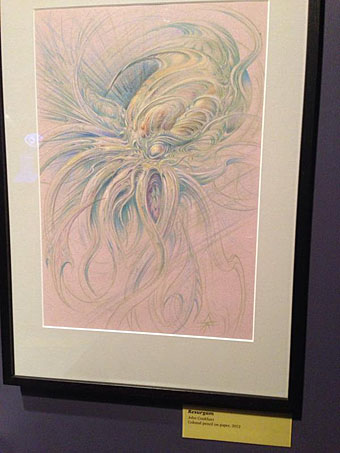
tentacles.jpg

Ned Raggett found the drawing of mine that’s part of the Tentacles exhibition currently showing at the Monterey Aquarium, California. Thanks, Ned! There’s a sepia-toned version of the drawing in my Cthulhu calendar.

• “Weird is a wayward word,” says Erik Davis in an exploration of weirdness old and new.

• More details about the forthcoming Scott Walker + Sunn O))) collaboration.

• A trailer for a reissue of Robert Wiene’s The Cabinet of Dr. Caligari (1920).

A history of sex toys in pictures.

Books on Book Covers

Octopus’s Garden (1969) by The Beatles | The River (1970) by Octopus | Octopus (1970) by Syd Barrett
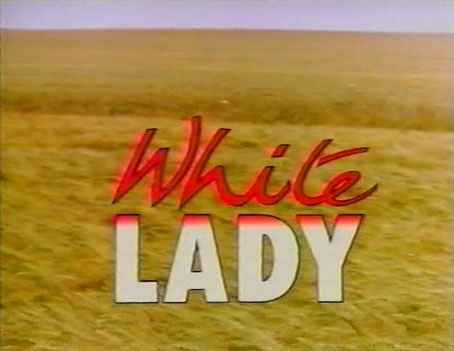
White Lady by David Rudkin

whitelady1.jpg

Amy: Dad? What’s a parable.

Gil: Parable? A sort of story, with something in it…strange. To help you remember it. And think. About something important.

I first heard about David Rudkin’s White Lady (1987) from Grant Morrison during a conversation about Penda’s Fen, Morrison having been a Rudkin-head as far back as the original screening of that TV film in 1974. This was at a time when you couldn’t call up details of somebody’s entire career in a couple of seconds, so all I knew of Rudkin’s television work aside from Penda’s Fen was Artemis 81 (1981) and his adaptation of The Ash Tree (1975) by MR James, one of the BBC’s Christmas ghost stories.

vampyr.jpg

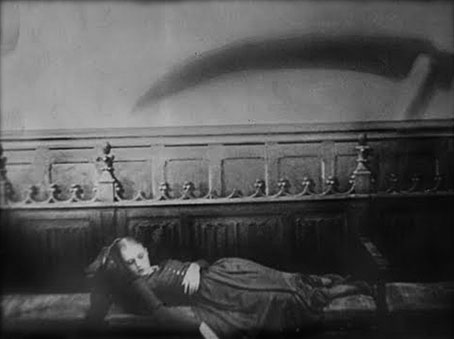
Vampyr (1932).

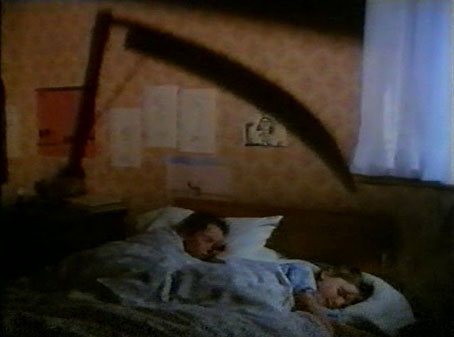
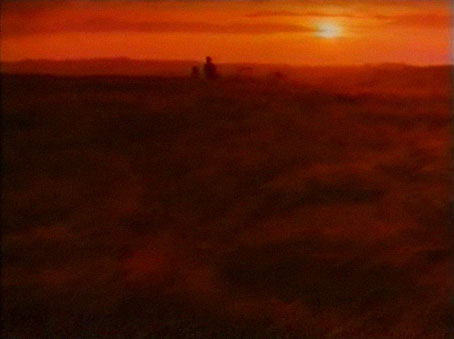
All of those films feature sinister, possibly supernatural events taking place in the English countryside, and this theme is continued in White Lady, a 45-minute drama which Rudkin wrote and also directed. In dramatic terms the film is a minimal piece concerning a divorced father trying to set himself up as a farmer while also taking care of two young daughters. In the fields surrounding the farm pesticides are being used, although we see little direct evidence of this. More overt are the disturbing interjections and animated graphics which show photographs and X-rays of laboratory animals suffering from pesticide exposure. Rudkin’s dialogue tells us at the outset that this is a parable, hence the deadly effects of the pesticide being embodied by the White Lady of the title, a spectral figure who carries a scythe.

whitelady2.jpg

The first time I saw this I thought the scythe was a heavy-handed device, despite its obvious farming connections; watched again I realise that Rudkin would have been alluding (if only for himself) to the scythe-bearing ferryman in Carl Dreyer’s Vampyr (1932), a film Rudkin subjected to very close scrutiny in 2005 for the BFI’s Film Classics series. In his book Rudkin notes a shot in which a sleeping figure is menaced by the shadow of a scythe on a wall; that shot is recapitulated in White Lady.

whitelady3.jpg

It’s unfair to compare this to the eerie, intellectual masterpiece that is Penda’s Fen, but White Lady is still worth a look for anyone interested in Rudkin’s dramas, especially with it being his sole directing credit. If the dire warnings of genetic mutation haven’t come to pass there’s relevance in our present concern about the effects of nicotinoids on bee and bird populations. The White Lady still has plenty of work to do.

White Lady: part one | part two

Previously on { feuilleton }
The Horror Fields
Robin Redbreast by John Bowen
Red Shift by Alan Garner
Children of the Stones
Penda’s Fen by David Rudkin
David Rudkin on Carl Dreyer’s Vampyr

The Nest, a film by David Cronenberg

cronenberg.jpg

This isn’t exactly news when it’s been posted on numerous sites over the past few days, but for the benefit of those who haven’t yet seen it, The Nest is a short film by David Cronenberg made for the exhibition of the director’s work that’s currently running at the EYE Film Institute in Amsterdam. Nine minutes, a single shot and no overt horror but it’s still an insidious piece. It’s only on YouTube for as long as the exhibition is in progress so watch it while you can.

Previously on { feuilleton }
Long Live the New Flesh: The Films of David Cronenberg

Weekend links 215

calibair.jpg

Julian House artwork for Other Voices, a new singles series on the Ghost Box label. Other Voices 01 is a collaboration between Sean O’Hagan of the High Llamas and Jon Brooks of The Advisory Circle.

Last week I linked to a copy Zadie Smith’s new introduction for Crash by JG Ballard. That piece could only be read in full by NYRB subscribers but this week the Guardian has the full text:

I was in college when the Daily Mail went to war with [David Cronenberg’s] movie, and found myself unpleasantly aligned with the censors, my own faux-feminism existing in a Venn diagram with their righteous indignation. We were both wrong: Crash is not about humiliating the disabled or debasing women, and in fact the Mail‘s campaign is a chilling lesson in how a superficial manipulation of liberal identity politics can be used to silence a genuinely protesting voice, one that is trying to speak for us all.

Related: Thomas Jones in 2008 reviewing Miracles of Life:

Despite all the bodily fluids spurted and smeared onto wrecked dashboards, the problem isn’t that it’s too pornographic but that it isn’t pornographic enough: the novel is too conscious of the deeper meaning of the sex and violence for the sex and violence to work as elements in themselves.

The fetishisation of Ballard’s novel (and Ballard’s fetishes) show no signs of abating: B-Movie (Ballardian Video Neuronica), is a short film by John Foxx, Karborn and Jonathan Barnbrook.

• Last Thursday I was watching a live performance by Pye Corner Audio and Not Waving, so it’s good to find this mix by the pair surfacing in the same week. Kudos to the latter for choosing something by Chrome. More mixes: FACT mix 468 by Throwing Snow, and Secret Thirteen mix 120 by Drøp.

• Ellen Datlow’s horror anthology, Lovecraft’s Monsters, continues to gather plaudits. Among recent reviews there’s Matt Barone at Complex who included the book in his Year’s Best Genre Fiction Books (So Far) list, and also praised my illustrations.

In recent years, many of the people on book covers have been women without faces. So prevalent is this visual cliché that the publishing industry has cycled through at least two well-documented iterations. The first, the Headless Woman, features some poor thing cut off above the neck, like the swimsuit-clad beachgoer on Alice Munro’s story collection “The View from Castle Rock.” The website Goodreads’s Headless Women page has 416 entries. Last year, the Headless Woman was supplanted by the Sexy Back, in which a woman is shown from behind, often gazing out over a vista.

Eugenia Williamson on the packaging of books for a female readership.

• The latest Taschen volume from Dian Hanson, editor of (among other titles) The Big Penis Book, is My Buddy. World War II Laid Bare, featuring photos from the archives of Michael Stokes. World of Wonder has pages from the interior.

I Have Walked This Body by Jenny Hval and Susanna is a track from a forthcoming album inspired by Maya Deren and Alexander Hammid’s Meshes of the Afternoon. It sounds fantastic so I’m looking forward to hearing more.

• If you have a spare half-million dollars, and don’t mind the possibility of possession by murderous supernatural entities, the Palmer house from Twin Peaks is for sale.

• Read an extract from Season of the Witch: How the Occult Saved Rock and Roll by Peter Bebergal.

The Stars and Their Courses: over six hours of the Nevada night sky in 4k definition.

Lee Siegel on the fraught friendship of TS Eliot and Groucho Marx.

Harmony Korine talked to Kenneth Anger for Interview Magazine.

New Scientist: How magic mushrooms induce a dream-like state.

• 3D-print your own Marcel Duchamp chess set.

Scott O)))

Crash (1980) by Tuxedomoon | Burning Car (1980) by John Foxx | A Crash At Every Speed (1994) by Disco Inferno | Burning Car (Dubterror Remix, 2008) by John Foxx

Maska: Stanisław Lem and the Brothers Quay

maska1.jpg

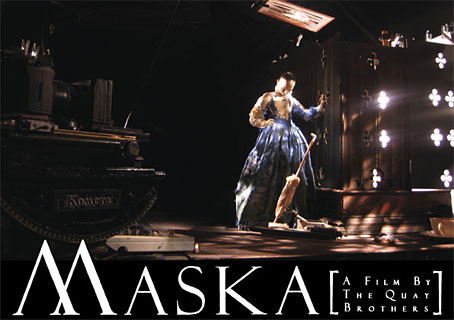
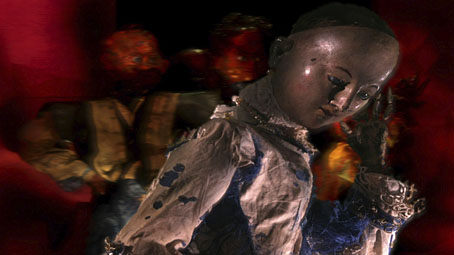
Did I mention the Brothers Quay? This is a mesmerising piece, and another short film to add to the growing number of Quay works yet to be collected on DVD. Maska (2010) is a 23-minute digital animation based on Stanisław Lem’s short story, The Mask (1976), which the producers have recently made available on YouTube. It was perhaps inevitable that if the Quays were going to venture into science fiction they’d use an Eastern European source. Lem’s story concerns a sophisticated technological society which is nonetheless still a monarchy. The narrator is an artificial woman who the aristocracy have created for a special mission; her human exterior conceals a robot interior, but this is no Maria from Metropolis. Midway through the story the robot breaks free of its human shell and is revealed to be a mantis-like creature.

maska2.jpg

The Quays’ corpus has tended to avoid genres of any kind so it’s fascinating seeing how they wrangle both sf and horror into a mise-en-scène which is remote from their decaying European scenarios but which, in its details, is completely familiar: puppet characters, flickering light, shifting focus, everything immersed in shadow. Maska also departs from form by having a spoken narration which offers some rudiments of explanation. The habitual atmosphere of unease is still present, however, and pushed to outright horror in places, assisted by extracts from Penderecki’s nerve-jangling De Natura Sonoris No. 1.

maska3.jpg

As with Piotr Kamler’s Chronopolis, this is a good reminder of how science fiction can be presented in a less obvious manner by animation, offering a view into a world that doesn’t have to be explained down to the last detail. Some of the best written SF, and some comic-strip SF (usually the Continental titles), delivers a strangeness that’s completely absent from most filmed science fiction. Vast budgets demand simple-minded narratives with mass appeal so it’s left to animation and low-budget films to venture into areas that would be off-limits elsewhere. Maska is an impressive film, one of the best Quay shorts I’ve seen for some time. Watch it here.

Elsewhere on { feuilleton }
The Quay Brothers archive