Three stages of Icarus

icarus1.jpg

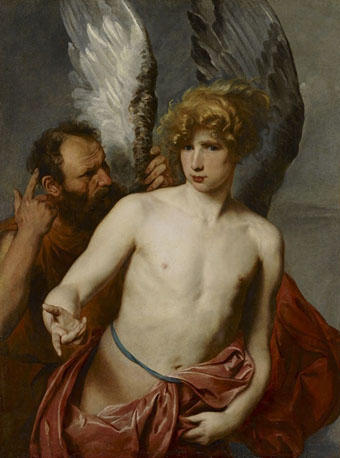
Daedalus and Icarus (1615–1625) by Anthony van Dyck.

The story of the doomed youth as seen via the few Icarus works at the Google Art Project. Brueghel’s famous painting is absent, unfortunately, so I won’t quote the equally famous lines by Auden either. Van Dyck gives us a golden-haired twink that Auden might approve of although I seem to recall the poet preferred rougher trade. No indication as to how those wings are supposed to function when they don’t seem to be attached to anything. The father points ominously skyward while the boy already knows where he’s headed.

icarus2.jpg

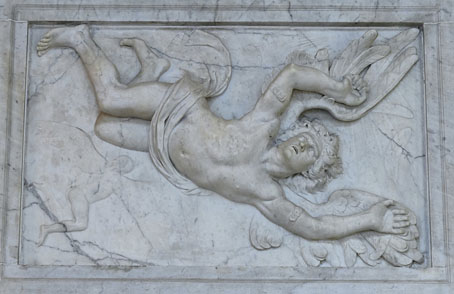
Icarus (1655) by Artus Quellinus.

Artus Quellinus was a Flemish sculptor whose work is a deliberate harking back to Classical antecedents.

icarus3.jpg

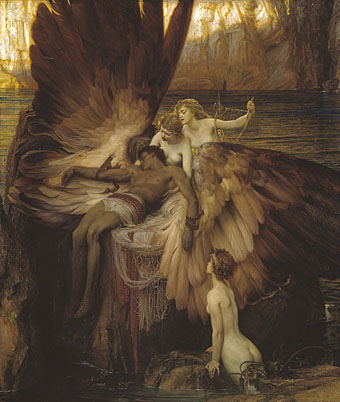
The Lament for Icarus (1898) by Herbert Draper.

Herbert Draper has been dismissed for years as a late-Victorian kitsch-monger, far too academic to be worthy of consideration. Since I often feel an affection for anything that upsets art critics I rather like his brand of fin-de-siècle soft porn. Many artists of the period at least varied their output often enough to avoid accusations of unseemly interests. Not so Draper, whose oeuvre runs the gamut of wet mythological females: naiads, sirens, kelpies, mermaids, etc. Even with dead Icarus as a subject he has to throw in a naiad or three. Van Dyck’s twink has transmuted here into a muscular hunk; he’d need to be strong to wield those colossal wings. Interesting to see from the study below that the figure was developed considerably from the original model. The study is also a better piece of draughtsmanship than the painting where the right arm seems wrong somehow, and the legs appear to be melting down the rock on which he’s beached. Barry Windsor Smith produced a variation on the theme in the 1980s that may have been inspired by the Draper, something he called Self-Portrait with Wings.

icarus4.jpg

Study for Icarus (1898) by Herbert Draper.

Previously on { feuilleton }
The end of Orpheus

The art of Michael Leonard

leonard1.jpg

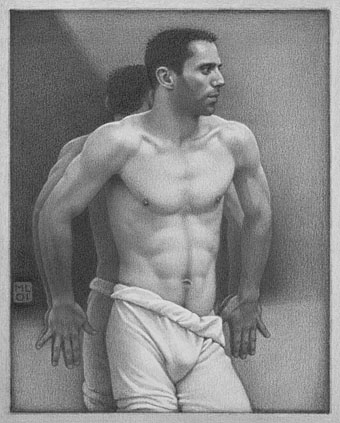
Against the Glass.

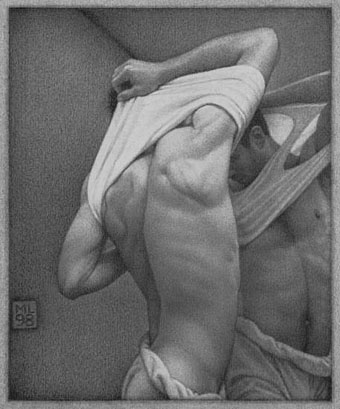
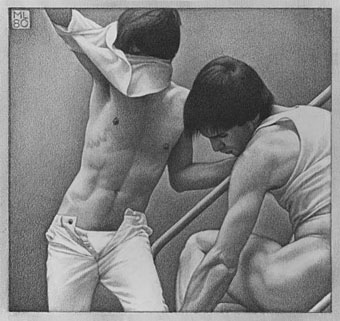
British artist Michael Leonard received a passing mention here some time ago for his work as an illustrator in the 1970s. Since that time he’s concentrated on establishing himself as a portraitist of considerable repute, with a painting of the Queen and Spark the Corgi hanging in the National Portrait Gallery. These fantastic pencil drawings show a more homoerotic side of his work, part of a large series of nude (or near-nude) studies in which beautiful men (and also a number of women) are perfectly rendered. I’ve always liked pure pencil drawing, the challenges of doing it to this standard are considerable, as are the pleasures of seeing such a successful application of the simplest of media. The compositions work really well, tight and often cropped to concentrate the attention. Leonard applies a similar approach in his paintings, some of which replicate or echo the pencil works. I prefer the pencils but then I have a predilection for monochome art. You can judge his paintings for yourself here.

leonard2.jpg

Twisting Torsos.

leonard3.jpg

On the Steps.

Elsewhere on { feuilleton }
The gay artists archive

Patrick Procktor, Art and Life

procktor.jpg

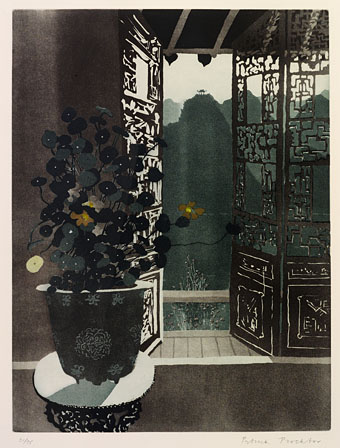
Nasturtiums, Wusih (1980) by Patrick Procktor.

Ian Massey was in touch last week to alert me to Patrick Procktor, Art and Life, an exhibition of Patrick Procktor’s art he’s curated at the Huddersfield Art Gallery in Yorkshire:

Patrick Procktor was part of a bohemian circle in 1960s and 1970s London that also included his great friends the artist David Hockney and the fashion designer Ossie Clark.

The focus of this exhibition is on the artist’s paintings on canvas and works on paper, and includes portraits of quintessential Sixties figures including Derek Jarman and Jimi Hendrix, alongside topographical pictures painted in countries such as India, Italy, Egypt and China.

I really like that nasturtiums print. For those who can’t get to Huddersfield there’s Ian’s monograph of the artist, also entitled Patrick Procktor, Art and Life, which was published by Unicorn Press in 2010. The exhibition runs to 10th November, 2012.

procktor2.jpg

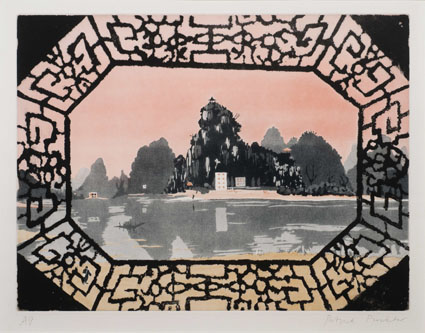
Da Miou Mountains, Kweilin, aquatint (1980).

Update: Ian says although the nasturtiums are on the gallery website they aren’t in the show because the print was sold just beforehand. He’s sent this print from the same series. The exhibition was reviewed by Charles Darwent in The Independent on Sunday.

Previously on { feuilleton }
Gervase and Patrick

Weekend links 124

despont.jpg

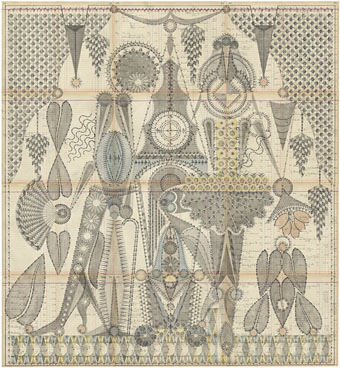
Couple with Clock Tower (2011) by Louise Despont.

Assuming such a thing doesn’t already exist, there’s a micro-thesis to be written about the associations between the musicians of Germany’s Krautrock/Kosmische music scene in the early 1970s and the directors of the New German Cinema. I’d not seen this clip before which shows the mighty Amon Düül II jamming briefly in Fassbinder’s The Niklashausen Journey, a bizarre agitprop TV movie made in 1970. More familiar is the low-budget short that Wim Wenders helped photograph a year earlier showing the Düül performing Phallus Dei. Wenders later commissioned Can to provide music for the final scene of Alice in the Cities. And this is before you get to Werner Herzog’s lengthy relationship with Popol Vuh which includes this memorable moment. Any others out there that I’ve missed?

Album sleeves in their original locations. And speaking of album sleeves, photo prints of some very famous cover designs by Storm Thorgerson will be on display at the Public Works Gallery, Chicago, throughout September and October.

Crazy for kittehs: the quest to find the purring heart of cat videos: Gideon Lewis-Kraus goes where few journalists dare to tread. Also at Wired, the same writer explores the Cat Cafés of Tokyo.

The City of Rotted Names, a “shamelessly Joycian cubist fantasy” by Hal Duncan, available to read in a variety of formats on a pay-as-thou-wilt basis until Monday only.

• Jailhouse rockers: How The Prisoner inspired artists from The Beatles to Richard Hawley.

How To Survive A Plague, a documentary about HIV/AIDS activism in the US.

• Deborah Harry: hippy girl in 1968, punk in 1976, and Giger-woman in 1981.

Alan Garner answers readers’ questions about his new novel, Boneland.

• For steampunk aficionados: ‘COG’nitive Dreams by Dana Mattocks.

• David Bowie, Iggy Pop, Madonna & Asparagus: Kraftwerk in 1976.

• New music videos: Goddess Eyes I by Julia Holter | Sulphurdew by Ufomammut | Warm Leatherette by Laibach.

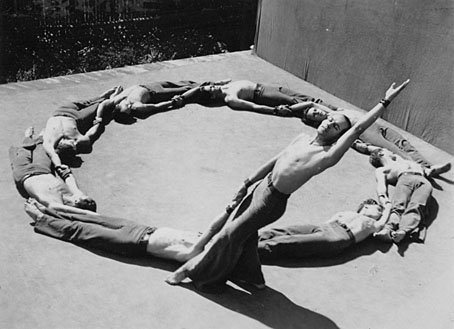
Ted Shawn and His Men Dancers

shawn07.jpg

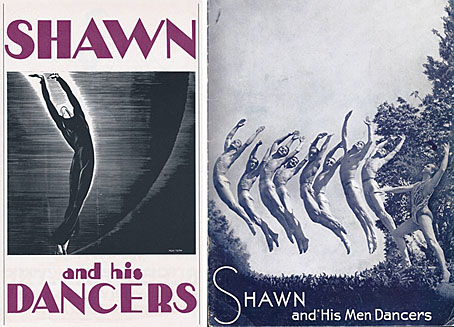
Poster on the left designed by Major Felten (1931).

In 1914, [Ruth] St Denis married a twenty-two-year-old gay man, the ambitious and sexually charismatic Ted Shawn (1891–1972), who became her dance partner. Shawn appeared at any opportunity in the scantiest of costumes. In 1915, they founded the Denishawn Dance School in Los Angeles, which became a significant artistic center from which many creative dancers emerged, most notably Martha Graham.

Burton Mumaw (b. 1912), a student of Shawn’s, first danced with the Denishawn company in 1931. Mumaw and Shawn soon became lovers and life companions. Shawn separated from St. Denis in 1933 and formed his Company of Male Dancers. Mumaw and Shawn were the leading soloists of the new company. (more)

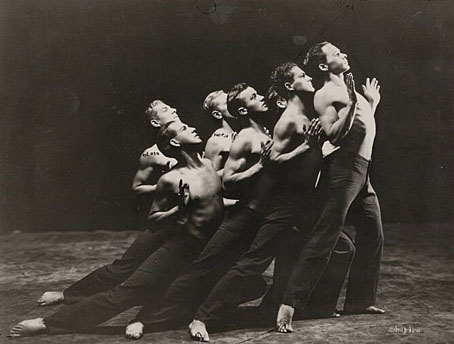
I can’t vouch for the accuracy of GLBTQ’s claims about Ted Shawn’s sexuality before he married Ruth St Denis, but it’s impossible to see his all-male dance troupe as anything other than homoerotic, especially when they had a tendency to perform in the nude (see below). Shawn’s intention was to move the associations of male dance away from the perceived effeminacies of ballet towards something more assertive and muscular. Shawn and Ruth St Denis had gone to great lengths to import into American dance various exotic elements from Asia and the ancient world, a process they called “Oriental dance”. This was no doubt the kind of Orientalism which is repudiated today for its appropriations but in the 1910s and 20s these developments were significant moves away from the staid traditions of 19th-century ballet. Shawn continued this evolution with a robust choreography based on ethnic war dances and other masculine fare. This kind of all-male dance is now very common—and remains homoerotic, of course, often intentionally so—but in the 1930s the idea was a radical one.

YouTube has a short film of Shawn and company in action in 1935. At the Internet Archive there are the two volumes of Ted Shawn’s Ruth St. Denis, Pioneer & Prophet: Being a History of Her Cycle of Oriental Dances (1920).

shawn08.jpg

shawn09.jpg

Continue reading “Ted Shawn and His Men Dancers”