The Ticket That Exploded: An Ongoing Opera

ticket1.jpg

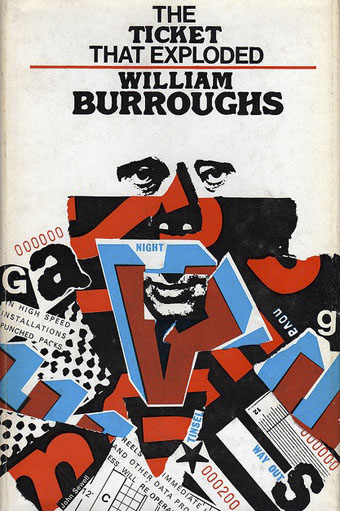
The book that made my head explode when I was 16. Calder & Boyars edition, 1968; design by John Sewell.

Years ago the idea of an opera based on The Ticket That Exploded would have been a wry joke: a novel brimming with text that’s fragmented even by Burroughs’ standards, as well as the usual preoccupations with spurting cocks, alien sex, parasitic invasion and erotic asphyxia. That said, if you can swallow the content (so to speak) a libretto is no doubt easy to create from all those sentence fragments, and there’s no worry about anyone complaining that you’ve missed some crucial part of the story. James Ilgenfritz’s The Ticket That Exploded: An Ongoing Opera attempts just this in an extract which can be seen on YouTube:

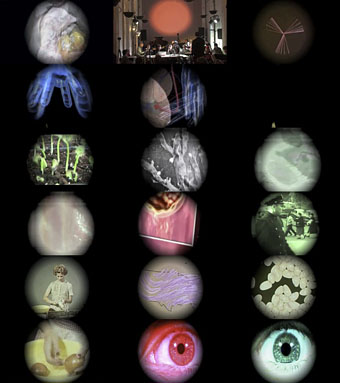
Premiered at Issue Project Room while I was Artist in Resident in 2011, and based on William S. Burroughs’ 1962 novel of the same name, The Ticket That Exploded takes all its text directly from the novel. I wrote the libretto and composed the music, which was then exquisitely interpreted by some of the greatest musicians in the New York area. Jason Ponce collected a massive array of bizarre visual materials and innovative digital processing programs to perform the visual component of this work live onstage at the premiere.

There’s more from Jason Ponce at Vimeo. A DVD of the complete work is planned in 2014. Via Supervert.
ticket2.jpg

Elsewhere on { feuilleton }
The William Burroughs archive

Weekend links 147

kalynovych.jpg

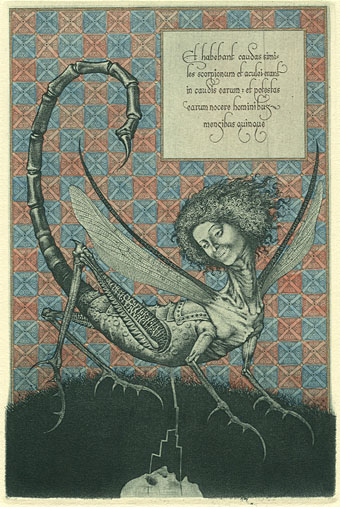
Bestia Apocalypsi (2000) by Konstantin Kalynovych.

A funding page for Better Things: The Life and Choices of Jeffrey Catherine Jones, Maria Paz Cabardo’s documentary film about the late comic artist and illustrator.

• Phantasmaphile’s Pam Grossman has declared 2013 to be the Year of the Witch.

• At WFMU: The Space Ghost Coast To Coast Sonny Sharrock Tribute Episode.

I think that mass culture is idiotic. I always have. Even things that are the sort of trendy new whatevers, it’s always about money and sex and nothing else.

Laurie Anderson on music for dogs and Obama.

• It’s that…thing…again. Clive Hicks-Jenkins on his new Mari Lwyd designs.

• Rick Poynor’s Dictionary of Surrealism and the Graphic Image.

• “Why do gay porn stars kill themselves?” asks Conner Habib.

scarfolk.jpg

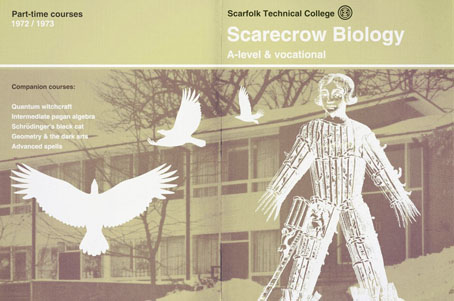
If you’re staycationing in Scarfolk this year you’ll be pleased to hear the town now has 20% less rabies. Above: The 1972–73 prospectus for scarecrow and wicker man biology at Scarfolk Technical College. Related: A Day At The Seaside. I guessed the source even without the cryptic comments. Can you?

Laurie Spiegel designed a T-shirt for The Wire magazine.

Julia Holter covers Chiamami Adesso by Paolo Conte.

Strange Attractor has two new Austin Spare prints.

Forgotten Women Designers and Illustrators.

• RIP Alan Sharp, a sharp screenwriter.

• “Can You Pass the Acid Test?

Sonny and Linda Sharrock live at WKCR 03/21/74 | Many Mansions (1991) by Sonny Sharrock | Ghost Planet National Anthem (1993) by Sonny Sharrock

The recurrent pose 50

vleugels.jpg

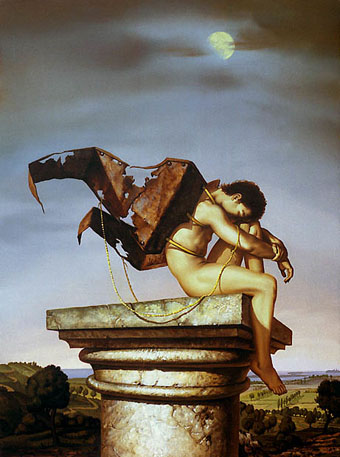
Belator (2013) by Christiane Vleugels.

With this series about the Flandrin pose being the oldest on the blog—the initial post was Feb 16, 2006—the whole thing has gradually evolved from a diverting observation to the unearthing of a trend that runs deeper and further than I expected.

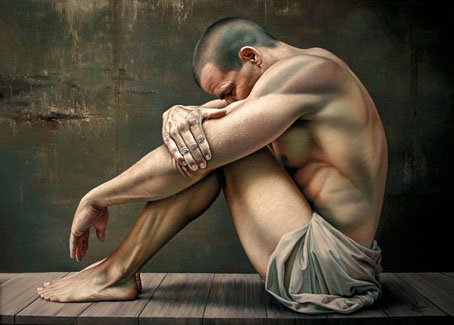
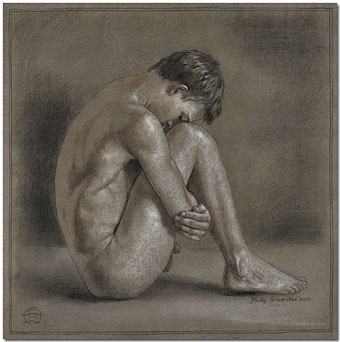
Christiane Vleugels is a Belgian artist with a hyperrealist style. Siegfried Zademack has a painting style closer to Salvador Dalí, here putting Flandrin’s Classical figure onto the pillar of Saint Simeon Stylites. One of Philip Gladstone’s paintings was the subject of an earlier post, and some of his other drawings might be considered Flandrinesque. They show that you don’t have to render every last hair and shadow in order to make an impression.

zademack.jpg

Saint Simon on the Pillar (after Flandrin) (1988) by Siegfried Zademack.

gladstone.jpg

Untitled (seated male nude in the Flandrin pose) (2011) by Philip Gladstone.

Elsewhere on { feuilleton }
The recurrent pose archive

The art of Seiji Inagaki

inagaki1.jpg

Night Hand (1997).

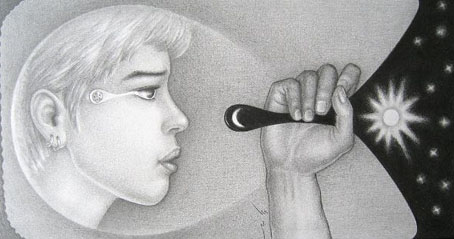
Many web searchers have arrived here recently looking for gay artists from Japan so here’s another. Seiji Inagaki was born in 1942, and describes himself as bisexual if you want to get all self-identifying about it. A lot of his drawings are the usual stuff of cute boys posing or having sex but there’s also some stranger work like the picture below of a boy being fellated by one of those weird Japanese ghosts you find in more traditional art. Despite having been active for many years there isn’t much of his work online even if you search using Kanji characters. The Japanese Gay Art site has a number of his drawings for sale.

Continue reading “The art of Seiji Inagaki”

Wildeana 9

dine.jpg

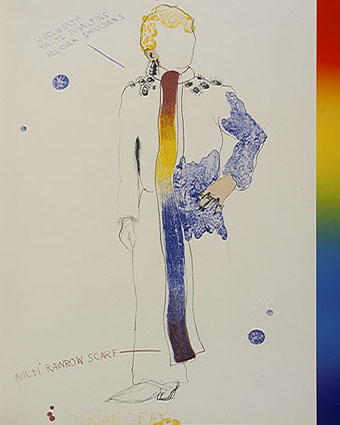
Dorian Gray (1968) by Jim Dine; one of a series of prints for an illustrated edition. Rainbows didn’t become a gay symbol until Gilbert Baker’s flag design ten years later.

Continuing an occasional series.

• “…the Public is a very curious thing; it is sometimes perverse, and even obstinate, and it has evidently made up its mind to like the plays of Mr. Oscar Wilde.” Callum at Front Free Endpaper found a sceptical review of The Importance of Being Earnest in The Sketch for 20th February, 1895.

• “Wilde’s vision of Socialism, which at that date was probably shared by many people less articulate than himself, is Utopian and anarchistic.” George Orwell, writing in 1948, looks back at Wilde’s The Soul of Man Under Socialism.

Oscar Wilde between Paris and Brighton: Research at the excellent Charles Ricketts & Charles Shannon blog following Wilde’s travels in the early months of 1891.

Wilde Ride by Anthony Paletta: “Oscar Wilde spent a year in the US and met the likes of Walt Whitman and Henry James.”

• There’s plenty of Wildeana at Pinterest.

Elsewhere on { feuilleton }
The Oscar Wilde archive