The Prophecy

prophecy1.jpg

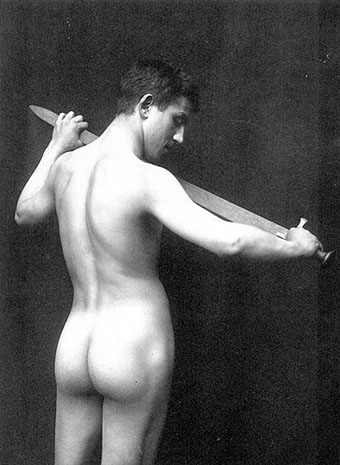
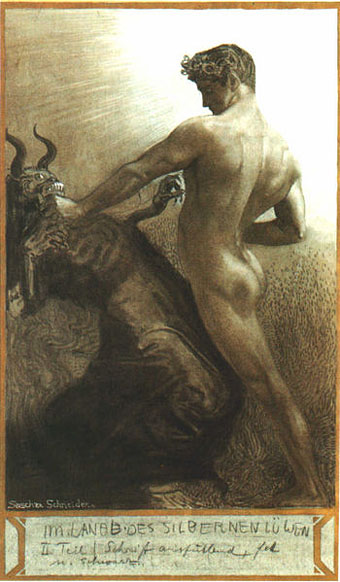
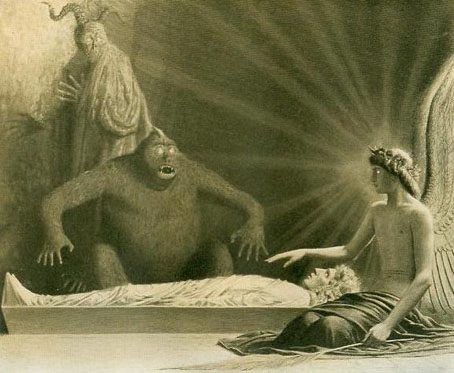
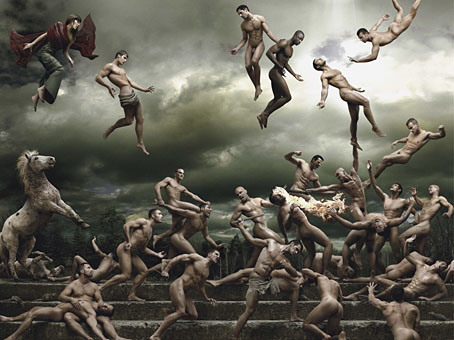
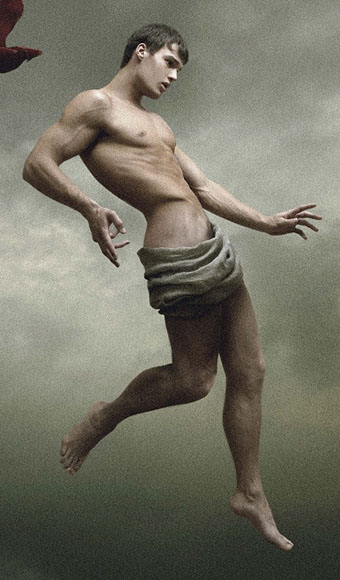
The Prophecy is a Michelangelo-esque collaboration between BeautifulMag and digital artist Aymeric Giraudel which you can download at high resolution here and here. (If you want a single picture you’ll have to stitch them together yourself.) Among the models for this are Les Farfadais whose work was mentioned here last June.
prophecy2.jpg

Elsewhere on { feuilleton }
The gay artists archive

Beardsley’s Salomé

salome1.jpg

So the first book purchase of the year turns out to be the original Dover edition of Beardsley and Wilde’s Salomé. This appeared in 1967, a year after the major V&A exhibition which introduced Beardsley’s work to a new generation and commenced the Beardsley craze that lasted into the Seventies. Not that I’m in desperate need of these drawings, having most of them several times already in different Beardsley books, but this volume is worth having since the reproductions are large size, very sharp and they took enough care to ensure that the uncensored versions of the drawings were used. The book also includes the complete text of Wilde’s play and Robert Ross’s Note on Salomé from 1930 which I don’t have elsewhere.

salome2.jpg

Beardsley’s work was subject to many censorship actions during his career but the Salomé book caused the most trouble (his later erotic works were private editions so don’t really count). The original title page shown here had the semi-erect penis of the winged boy and the pendulous genitals of the herma removed while one drawing, The Toilette of Salomé, was deemed too much and had to be redrawn entirely. That picture did contain a masturbating page boy so it’s perhaps not so surprising. There was such a lot to offend Victorian sensibilities in Beardsley’s work at this time, whether overt or surreptitious, that it’s remarkable the book was printed at all. His art was so radically different from anything else being done in 1894 that many people had difficulty accepting these pictures as illustrations at all, regardless of the content. As a result they missed salacious details that would have finished the career of a lesser artist. Wilde’s play was equally scandalous and could only be performed in France, having been banished from the London stage. As Robert Ross says in his Note:

Wilde used to say that Salomé was a mirror in which everyone could see himself. The artist, art; the dull, dullness; the vulgar, vulgarity.

salome3.jpg

The sense of shock extended back to Beardley’s original Salomé drawing (also included in the Dover volume) which appeared in the first number of The Studio in 1893, some of the readers of that magazine finding the detail of the spilled blood nourishing a phallic lily a grotesque detail too far. The Studio drawing was reworked and simplified as The Climax for Salomé. You can see the complete set of illustrations here. Neither that collection nor the Dover book include a picture of the original cover, however, whose splendid gold-on-green peacock feathers look a lot more impressive than Beardley’s rough design. So here it is.

salome4.jpg

Download the 1906 US edition of Salomé free at the Internet Archive

Elsewhere on { feuilleton }
The book covers archive
The illustrators archive
The Salomé archive

Hadrian and Greek love

hadrian.jpg

Hadrian: Empire and Conflict is an exhibition based around the life of the Roman emperor which opens at the British Museum on 24 July and runs until 26 October, 2008.

This special exhibition will explore the life, love and legacy of Rome’s most enigmatic emperor, Hadrian (reigned AD 117–138).

Ruling an empire that comprised much of Europe, northern Africa and the Middle East, Hadrian was a capable and, at times, ruthless military leader. He realigned borders and quashed revolt, stabilising a territory critically overstretched by his predecessor, Trajan.

Hadrian had a great passion for architecture and Greek culture. His extensive building programme included the Pantheon in Rome, his villa in Tivoli and the city of Antinopolis, which he founded and named after his male lover Antinous.

This unprecedented exhibition will provide fresh insight into the sharp contradictions of Hadrian’s character and challenges faced during his reign.

Objects from 31 museums worldwide and finds from recent excavations will be shown together for the first time to reassess his legacy, which remains strikingly relevant today.

The Henry Moore Institute had an exhibition devoted to Hadrian’s lover Antinous last year. This week The Independent was looking at their relationship in light of the exhibition announcement, probably the most celebrated gay relationship in the ancient world.

Several of the artefacts (in the exhibition) relate to his male consort, Antinous, who accompanied him on his travels around the empire. These items include a poem written on papyrus, featuring the two men hunting together, and new finds that include memorials to the dead lover at Hadrian’s villa in Tivoli.

Although it was not uncommon for his predecessors to have taken gay lovers alongside a female spouse, Hadrian was unique in making his love “official” in a way that no other emperor had before him.

piranesi_tivoli.jpg

Ruined Gallery of the Villa Adriana at Tivoli.

I managed to see Hadrian’s villa at Tivoli when I visited Rome, a very well-preserved estate. One of my favourite places in the city, partly as a result of Piranesi’s drawings of the place, was the Castel Sant’Angelo which was built on the site of Hadrian’s Mausoleum. Piranesi also produced some renderings of the villa, including this splendid view of the ruined statue gallery.

barberini.jpg

And while we’re on the subject of antique sexuality, the provocative Greek sculpture known as the Barberini Faun appears in cropped form on the cover of a new book about homophilia in Ancient Greece, The Greeks and Greek Love by James Davidson. Davidson’s book looks like a fascinating work if this Guardian article on the subject is anything to go by, and a welcome tonic in the light of Frank Miller’s recent fabulations in 300.

Elsewhere on { feuilleton }
The gay artists archive
The etching and engraving archive

Previously on { feuilleton }
The Cult of Antinous

Dirty Dalí

dali.jpg

The paranoiac-critical gaze: Dirty Dalí.

I finally managed to see this fascinating documentary this week. Since my TV broke down some time ago I refused to waste money buying another, partly for the reason that films such as this are increasingly rare and most of them have been shunted to minority channel BBC 4 which I can’t receive. Thanks to BitTorrent you can still find the worthwhile stuff, of course, but this often requires patience.

dali_hermaphrodite.jpg

The Wines of Gala and of God (1977).

Dirty Dalí: A Private View was a reminiscence by art critic Brian Sewell about his encounters with Dalí and wife Gala at their home in Port Lligat in the late 60s and early 70s. What’s interesting about it is the first-hand light it throws on Dalí’s complicated sexuality, a subject which has been the source of speculation in biographies (notably Ian Gibson’s The Shameful Life of Salvador Dalí) but which is confused by the artist’s simultaneous revealing of his obsessions in his art and the veiling of his interests in public statements, not least the frequent declarations of impotence. Sewell confirms that Dalí was interested in both men and women although purely as a voyeur, and relates how his first encounter with the artist led to his having to lie naked in the armpit of a giant Christ sculpture in Dalí’s garden, masturbating while Dalí took photographs. Sewell also examines Dalí’s affair with Federico García Lorca, the closest the artist came to a gay romance, and his subsequent relationship with Gala, which became one where the pair used the artist’s celebrity to attract delectable people of both sexes, like a pair of art world super-swingers. According to Sewell, Dalí’s physical ideal was the hermaphrodite which would possibly explain his attraction to (alleged) transsexual Amanda Lear during this time.

masturbator.jpg

The Great Masturbator (1929).

As a piece of television the film struggles to fill out its running time by resorting to animating photographs, a persistent hazard for documentaries that lack the relevant raw material. All the footage of Dalí is lifted from previous documentary films including a large chunk of Russell Harty’s Aquarius interview, Hello Dali! (that camp double-entendre now seems very apt), from 1973. The overall effect of Sewell’s narrative is to add to Dalí’s already considerable feet of clay but that’s the inevitable outcome of nearly any biography; real lives are always messy. Sewell nonetheless ends by reaffirming Dalí’s principal importance as one of the great painters of the 20th century and, in an interesting side note, declares him to be the last great painter of a religious work with his Christ of St John of the Cross. A great religious artist and also one who produced hundreds of pornographic drawings, some of which are seen in the film. In art, as in the life, the contradictions are everywhere.

Dirty Dalí at Grey Lodge
Homage to Catalonia: Robert Hughes on Dalí

Previously on { feuilleton }
Impressions de la Haute Mongolie revisited
Dalí and Film
Ballard on Dalí
Fantastic art from Pan Books
Penguin Surrealism
The Surrealist Revolution
The persistence of DNA
Salvador Dalí’s apocalyptic happening
The music of Igor Wakhévitch
Dalí Atomicus
Las Pozas and Edward James
Impressions de la Haute Mongolie