(Pynchonian? Pynchonesque? Pynchon-heads can no doubt supply the most common descriptor but for now Pynchonian will do.)
Is it possible to identify a Pynchonian strand in cinema? This question came to mind while I was reading the end of Gravity’s Rainbow, and probably a little before then during a scene that takes place in the Neubabelsberg studio in Berlin. The Pynchon reading binge is still ongoing here—after finishing the Rocket book I went straight on to Vineland, and I’m currently immersed in Mason and Dixon—so I’ve been watching films that complement some of the preoccupations in the Pynchon oeuvre, at least up to and including Vineland. This is a small and no doubt contentious list but I’m open to further suggestions. Inherent Vice is excluded, I’ve been thinking more of films that are reminiscent of Pynchon without being derived from his work.
Elements that increase the Pynchon factor would include: a serio-comic quality (essential, this, otherwise you’d have to include a huge number of thrillers); detective work; paranoia; songs; and a conspiracy of some sort, or the suspicion of the same: a mysterious cabal–the “They” of Gravity’s Rainbow—who may or may not be manipulating the course of events.
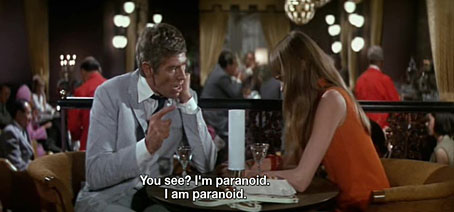
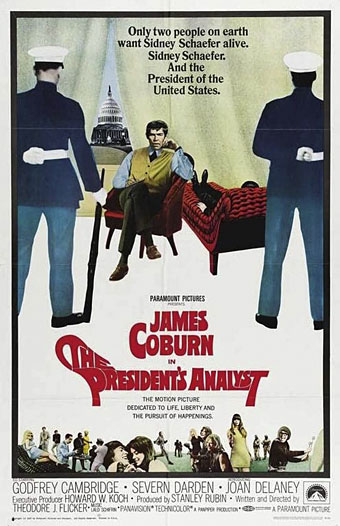
The President’s Analyst (1967)
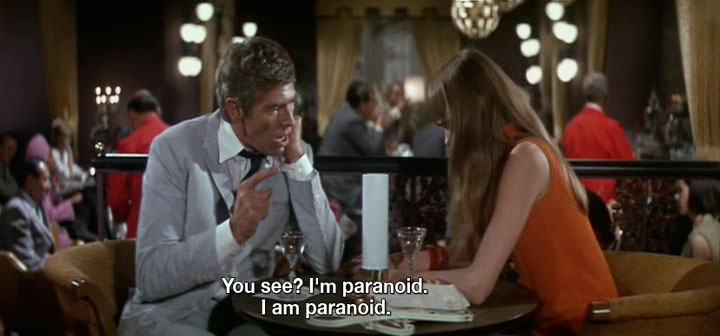
I’d be very surprised if Pynchon didn’t like this one. James Coburn as the titular analyst, Dr Sidney Schaefer, has little time to enjoy his new job in Washington DC before half the security services in the world are trying to kidnap him to discover what he’s learned about the President’s neuroses. This in turn leads the FBI FBR to attempt to kill Schaefer in order to protect national security. Pynchonian moments include a bout of total paranoia in a restaurant, Canadian spies disguised as a British pop group (“The ‘Pudlians”), and a visit to the home of a “typical American family” where the father has a house full of guns, the mother is a karate expert, and the son uses his “Junior Spy Kit” to monitor phone conversations. Later on, an entire nightclub gets spiked with LSD. This is also the only film in which someone evades abduction to a foreign country by the cunning use of psychoanalysis.
Is it serio-comic? Yes.
Is there detection? In the background: the CIA CEA and KGB agents have to work together in order to outwit the FBI FBR and discover who the ultimate villains might be.
Is there paranoia? You only get more paranoia in one of the serious conspiracy dramas of the 1970s like The Conversation or The Parallax View. (The latter includes the same actor who plays the All American Dad, William Daniels.)
Any songs? Yes. Coburn hides out for a while with the real-life psychedelic group Clear Light, and helps with their performance in the acid-spiked nightclub.
“They”? There are multiple “Theys” in this one.
Pynchon factor: 5. Maybe a 6 for the LSD.
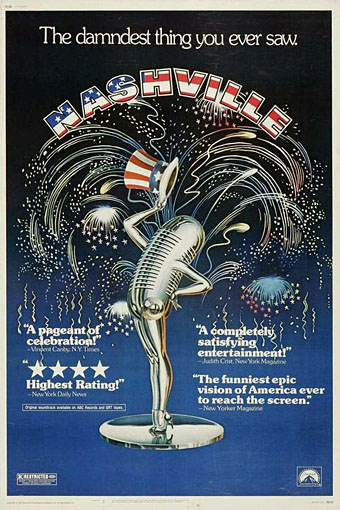
Nashville (1975)
This one is a stretch but Robert Altman is the director I think of as closest to Pynchon’s sensibility even if individual works are light on the Pynchon factor. His films are often rambling, quirky and satirical—especially when he goes the ensemble route—but never too comic to avoid a sudden lurch into the dark. The Long Goodbye might seem a more likely choice, given the way it points to subsequent Chandler variations like The Big Lebowski (see below) and Inherent Vice, but it’s still Chandler’s story. Nashville is pure Altman, the best of his ensemble entries and my choice for his best film of all, a portrait of America in the mid-1970s where someone can be loved by millions yet still be a target for assassination. It’s worth noting that the director of Inherent Vice, Paul Thomas Anderson, was the insurance standby when Altman was directing his final film, The Prairie Home Companion.
Is it serio-comic? Yes.
Is there detection? No.
Is there paranoia? No, although as a portrait of the USA in the 1970s it can’t avoid a lurking sense of unease.
Any songs? Lots of songs.
“They”? No.
Pynchon factor: 2
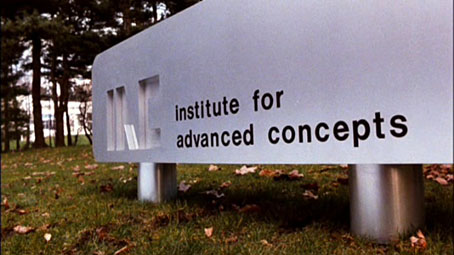
Simon (1980)
The debut feature from Marshall Brickman, Simon is an overlooked oddity with a great performance by Alan Arkin as a college professor, Simon Mendelssohn, who gets tricked by the Institute for Advanced Concepts into believing he’s an extraterrestrial. Parts of this play like a comic version of Altered States, which coincidentally was released the same year. Both films feature reckless quests for academic glory, flotation tank experiments (Simon includes a reference to Dr John Lilly), and regressions to earlier stages of evolution. Pynchonian moments include a church commune who worship the television, a gas that reduces intelligence, and a self-aware computer called “Mother” whose human interface is a giant phone receiver.
Is it serio-comic? Yes.
Is there detection? No.
Is there paranoia? A little.
Any songs? No.
“They”? The IAC are a small but powerful “They”, with carte blanche to foist their whims on an unsuspecting nation.
Pynchon factor: 2.5
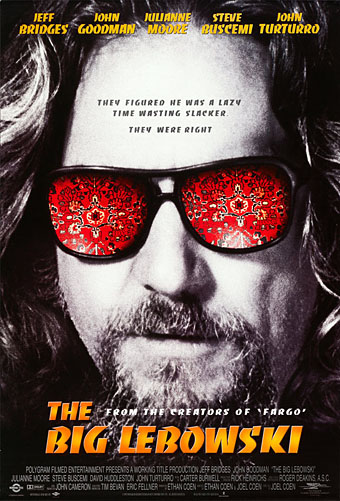
The Big Lebowski (1998)
When the book trailer for Inherent Vice appeared in 2009 (with narration by the author himself…or was it? etc), a common reaction was “This sounds just like The Big Lebowski“. If The President’s Analyst is the closest Hollywood gets to The Crying of Lot 49 then The Big Lebowski may be the closest to Vineland‘s story of the youth of the hippy era coping with life in a world that’s passed them by.
Is it serio-comic? Yes.
Is there detection? Yes.
Is there paranoia? A little. Most of the time The Dude is more concerned with trying to keep up with his continual changes of fortune.
Any songs? Lots of songs on the soundtrack, plus the Busby Berkeley-style dream sequence.
“They”? Yes.
Pynchon factor: 4.5
I Heart Huckabees (2004)
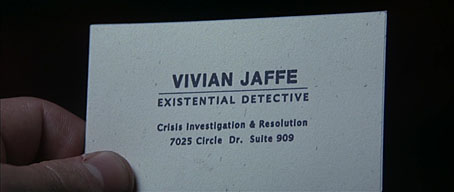
David O’Russell’s mélange of existential philosophy, environmentalism and coincidence is like Wes Anderson with a more political edge, and the kind of quirky comedy there was still space for in the Hollywood of the late 1990s/early 2000s. Jason Schwartzman is Albert Markovski, a poetry-writing environmental activist with a coincidence problem who turns to existential detectives, Vivian Jaffe (Lily Tomlin) and husband Bernard Jaffe (Dustin Hoffman), for a solution. “Everything is connected”, Bernard insists, so it’s no surprise that the presence of Lily Tomlin returns us to Nashville, while the pair require a little of Sidney Schaefer’s psychoanalysis to get to the bottom of Albert’s problems. Meanwhile, the Jaffes’ former pupil, Caterine Vauban (Isabelle Huppert), is lurking in the wings, tempting Albert with the attractions of sex and nihilist philosophy (shades of The Big Lebowski).
Is it serio-comic? Yes.
Is there detection? Yes.
Is there paranoia? A little. Albert is increasingly worried about losing control of his protest group.
Any songs? Shania Twain puts in an appearance but she doesn’t sing.
“They”? The Huckabees Corporation is a small-scale “They”, manipulating the environmentalists for their own ends.
Pynchon factor: 3.5
Under the Silver Lake (2018)
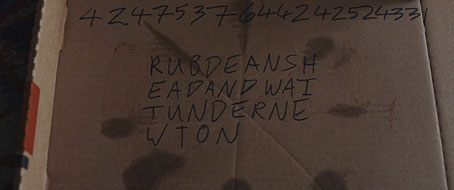
David Robert Mitchell’s surprising follow-up to the excellent It Follows is self-consciously Lynchian, and quite possibly self-consciously Pynchonian too. A long and rambling tale of burgeoning paranoia in the hip Los Angeles enclave of Silver Lake where slacker Sam (Andrew Garfield) discovers a web of interconnected mysteries after trying to find out why his attractive female neighbour has disappeared. It’s sinister, funny and bizarre, with mysterious deaths, hidden codes, treasure maps, chess games, pop music, Californian cults and more. Mitchell wisely avoids explaining too much which means the film now has a cult following determined to dredge its alleged secrets.
Is it serio-comic? Yes.
Is there detection? Yes.
Is there paranoia? Yes.
Any songs? Lots of songs, also a mysterious Songwriter character and an indie band, Jesus and the Brides of Dracula.
“They”? Multiple “Theys”.
Pynchon factor: 5
Lodge 49 (2018–2019)
Several people recommended this TV series (thanks!) so here it is. And while Jim Gavin’s creation may not be a feature film it’s very definitely Pynchonian. See this post for details.
Is it serio-comic? Yes.
Is there detection? Yes.
Is there paranoia? A little. Dud and Ernie have a paranoid episode involving a drone.
Any songs? Yes, from the characters themselves and also from Broadcast and others on the soundtrack.
“They”? Once again, there are multiple “Theys”.
Pynchon factor: 49
Honourable mentions: WD Richter’s The Adventures of Buckaroo Banzai Across the 8th Dimension (1984) makes it to the Pynchon Zone via its appropriation of “Yoyodyne”, the name of the defence contractor from V. and The Crying of Lot 49. Despite this, and much as I like Buckaroo Banzai, I don’t think it’s Pynchonian enough for this list, although the writers at the defunct Pynchon site, Spermatikos Logos, might disagree. This archived page makes a case for the film, and also mentions a possible reciprocation from the author which I missed when I was reading Vineland.
Likewise, Richard Linklater’s debut, Slacker (1990), also came to mind. It has the requisite large cast of idlers and eccentrics (including a couple of conspiracy obsessives), plus a meandering yet connected structure, but it doesn’t otherwise seem Pynchonian enough.
Anything else I’ve missed?
Update 1: Added Lodge 49.
Update 2: Further recommendations at Letterboxd.
Update 3: Finally added Under the Silver Lake.
Previously on { feuilleton }
• Going beyond the zero
• Pynchon and Varo
• Thomas Pynchon – A Journey into the Mind of [P.]

.jpg)