Recovering Bond

new_bonds.jpg

Penguin is really coming up with the goods these days, living up to their reputation as a house with high standards of cover design, unlike Picador and the shabby way they treated Cormac McCarthy recently.

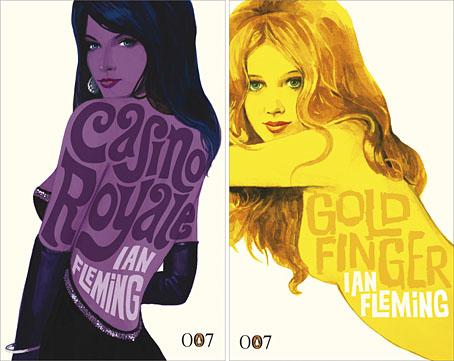
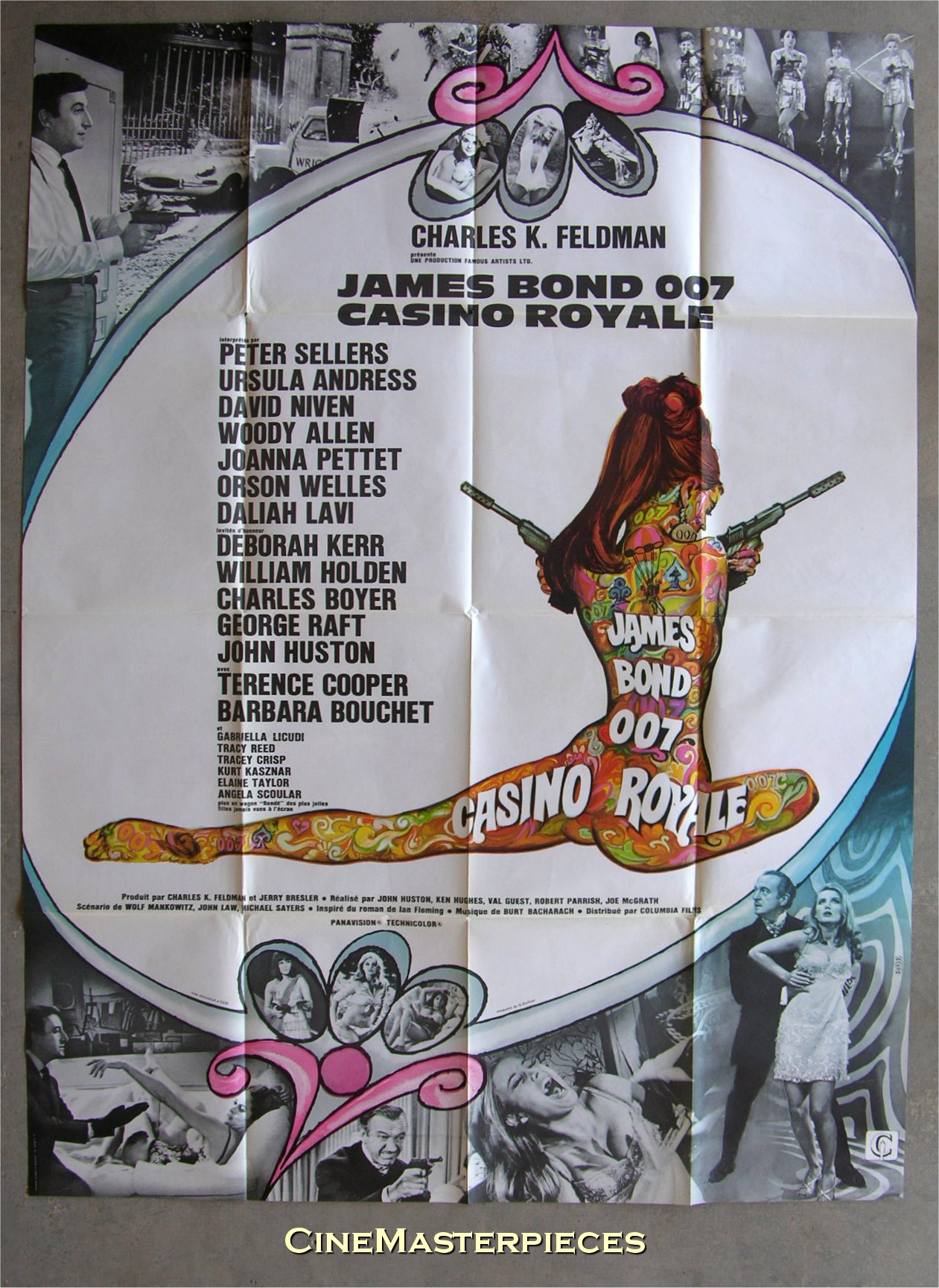
Ian Fleming’s Bond novels are the latest to receive a makeover with some fabulous art from illustrator Michael Gillette. 2008 is Fleming’s centenary so the books have been republished as demi-format hardbacks with these new designs adorning the jackets. Each cover features a different girl matched to the theme of the book (yes, I know they’re women but in Bond’s world women are always girls unless they’re Miss Moneypenny); each cover also features groovy period type which alludes to the hand-drawn elaborations of the Sixties and Seventies. The effect is reminiscent of the poster art for the 1967 film of Casino Royale (below) which used a naked girl as the focal point; all Bond posters before and after this place oo7 himself centre stage. Penguin even dare to push the level of pastiche by making On Her Majesty’s Secret Service look rather like an old romance novel, not such a surprising decision since this is the book where Bond gets married.
casino.jpg

My favourite Bond covers remain the old Pan paperbacks from 1963 but that’s just me; these look great. There’s been a persistent moan recently from authors and publishers worrying about file sharing as they foresee the publishing world going the same way as the music business. The solution is obvious: you can’t stop texts being copied and distributed but you can make the books themselves desirable objects so make them worth buying and owning. Penguin has numbered the spines of the new Bond books as they did with their recent Sherlock Holmes reprints, a smart appeal to book collectors as well as a tip to read them in the order they were written. “Smart” is the key word here; Picador take note.

Update: The Pan covers mentioned above were designed by Raymond Hawkey. Bond site MI6.co.uk has some details about the designer.

Elsewhere on { feuilleton }
The book covers archive

Previously on { feuilleton }
Repackaging Cormac
The World’s Greatest Detective
James Bond postage stamps
Boys Own Books

Norman McLaren

mclaren1.jpg

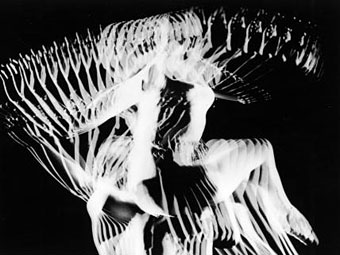
Pas de Deux (1968).

News of a theatre piece celebrating the creativity of Norman McLaren, the pioneering Scots (and gay) animator and film-maker, had me searching YouTube again for his work. His short film Neighbours (1952) is very well-known, oft-cited and imitated for its pixillated character movement. No surprise to see it there, then, along with other works such as Boogie Doodle (1941), Fiddle Dee Dee (1947), A Phantasy (1952), Blinkety Blank (1955) and several others.

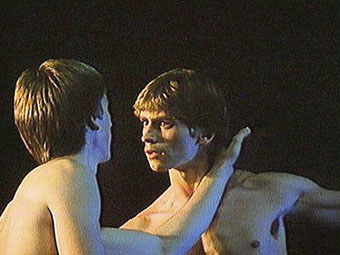
Less well-known is a favourite film of mine which hadn’t been YouTubed last time I looked but which is now there in two parts, Pas de Deux (1968). This is a black and white film of a simple ballet performance transformed by its presentation to yield something that could only exist on film. Careful lighting, an atmospheric score, judicious use of slow motion and the stunning application of optical printing to multiply and mirror the figures makes one of the best ballet films I’ve ever seen; it was also one of McLaren’s personal favourites among his many films. He used slow motion again for two more dance works, Ballet Adagio (1972) and Narcissus (1983), one of his final films which impresses for its overt homoerotics but is less striking than its predecessor. The only version of the latter on YouTube is this scratch version with the visuals set to more recent music.

mclaren2.jpg

Narcissus (1983).

The best way to see McLaren’s incredible films is at a decent resolution, of course, and the National Film Board of Canada have made them available on a seven-DVD box set.

mclaren3.jpg

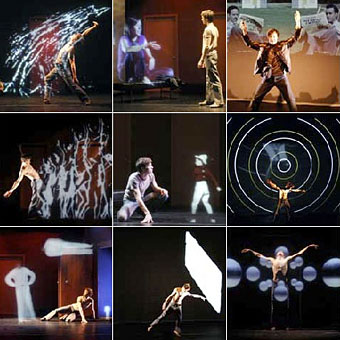
The theatre work mentioned above is Norman by Michel Lemieux and Victor Pilon which is at Macrobert, Stirling, from 17–19 April, 2008 then the Theatre Royal, Brighton from 6–10 May, 2008.

In an improbable act of theatrical alchemy, dancer/choreographer Peter Trosztmer literally inhabits McLaren’s cinematic universe. He dances, weaves, converses and interacts with the animator’s pulsing images and leaping figures, set loose in a riotous ballet of line, light and movement.

Previously on { feuilleton }
Reflections of Narcissus

The skull beneath the skin

skull1.jpg

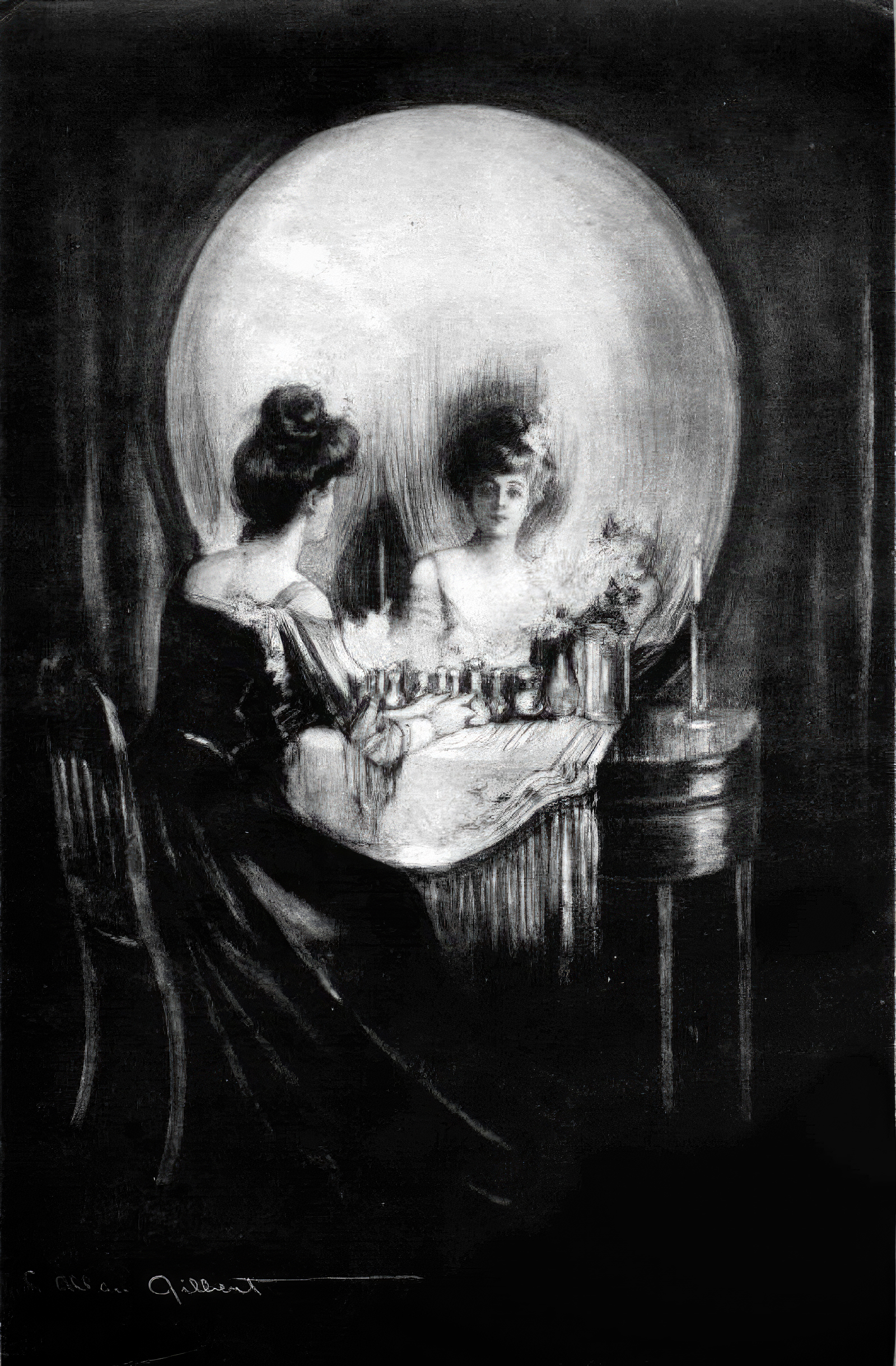
All Is Vanity by Charles Allan Gilbert (1892).

The subliminal skull is another of those perennial motifs that recur in art from time to time, and one which has become especially prevalent since the late 19th century. There seem to be a number of reasons for this, the most obvious being that if you’re going to show how clever you are by hiding one image inside another you may as well make the hidden thing something that everyone recognises. A secondary reason would seem to be the waning power of the vanitas theme. As painting became more pictorially sophisticated it wasn’t enough to simply show a skull and expect people to accept this with a stern moral as the principal content. Hence the development of death as a non-skeletal character in Symbolism and the reduction of skulls in pictures to a kind of playful game.

Holbein’s anamorphic skull in The Ambassadors is probably the grandfather of all the later versions but the more recent popularity of the hidden motif can be traced back to Charles Allan Gilbert whose 1892 picture, All is Vanity, drawn when he was just 18, was sold to Life Publishing in 1902, and subsequently spread all over the world in postcard form. Despite giving birth to a host of imitators, Gilbert’s picture is the one that still inspires artists and photographers up to the present day.

Continue reading “The skull beneath the skin”

Paradise Now available now

paradise.jpg

Arthur Magazine‘s second essential DVD release is now available.

“Life, revolution and theater are three words for the same thing: an unconditional NO to the present society.” Julian Beck (Living Theatre)

“Paradise Now … more relevant now because we’re closer to now than we ever have been.” Hanon Reznikov (Living Theatre)

Arthur Magazine proudly presents PARADISE NOW: The Living Theatre in Amerika DVD — a fulminating art-meets-life installation brought to you in collaboration with The Living Theatre, The Ira Cohen Akashic Project and Saturnalia Media Rites of the Dreamweapon featuring rare, never-before-distributed films and a bacchanal of revolutionary multimedia documents from The Living Theatre’s historic and influential ’68–’69 American tour.

LIMITED EDITION OF 1,000 – AVAILABLE NOW NOW NOW NOW

Click here for full details, order info and YouTube preview

Previously on { feuilleton }
Paradise Now: The Living Theatre in Amerika DVD
William Burroughs by Ira Cohen, 1967
The Invasion of Thunderbolt Pagoda