Weekend links 416

hassell.jpg

Cover art and design by Arien Vallzadeh, Dan Kuehn, Mati Klarwein & Taska Cleveland.

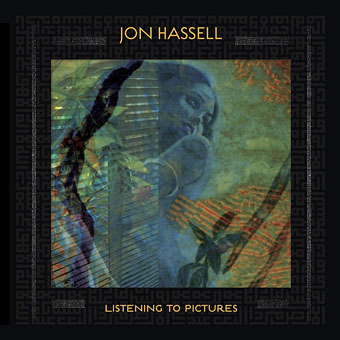
• At Bandcamp: “Jon Hassell collages the past on his absorbing new record”. The new album, Listening to Pictures (Pentimento Volume One), was released last week, and it joins the rest of Hassell’s catalogue in sounding unlike any of his other albums while still being recognisably the work of the same artist. Musical collage is a familiar technique today but was much less common thirty years ago; it’s almost a constant in Hassell’s work, however, going back to Possible Musics (1980), with its tape-looped rhythms and layered recordings, to the later Magic Realism (1983), an album which was in the vanguard of digital sampling, and which still sounds like nothing else.

• “We’re supposedly in the middle of a vinyl revival, streaming services are hoovering up all the coin, and everyone seems to have a cassette column. But, argues James Toth, it’s the humble compact disc that we should be celebrating.” No argument here, I’ve long favoured CDs over vinyl even before the current fad for overpriced antique (or not-so-antique) discs and equally overpriced new pressings.

• “Reading [Robert] Aickman’s strange stories is to glimpse a reality you would prefer to forget,” says John Gray. Among the other writers mentioned in Gray’s piece is the excellent (and under-recognised) Walter de la Mare; Wormwoodiana’s Mark Valentine reviews a previously unseen de la Mare story.

• At The Wire: Greetings Music Lover: The premiere of Steve Urquhart’s new audio documentary exploring the life and work of BBC Radio Lancashire broadcaster and Wire contributor Steve Barker.

• Out in November: k-punk: The Collected and Unpublished Writings of Mark Fisher (2004–2016).

• “European cinema embraces the vagina—what’s taken Hollywood so long?” asks Anne Billson.

Strange Stars: David Bowie, Pop Music, and the Decade Sci-Fi Exploded by Jason Heller.

• “Avoid all systems”: Ex-Can vocalist Damo Suzuki is interviewed at Dangerous Minds.

• “A new room in the Great Pyramid”: lost 1963 John Coltrane album discovered.

• Mixes of the week: FACT mix 656 by Mor Elian, and 6 by The Ephemeral Man.

• An introduction by Erik Davis to The Night Land by William Hope Hodgson.

Pyramid Of The Sun (1960) by Les Baxter | The Giant Pyramid Sitting At The Bottom Of The Sea Of Bermuda And The Ancient People (1979) by Isao Tomita | The Obsidian Pyramid (2005) by Eric Zann
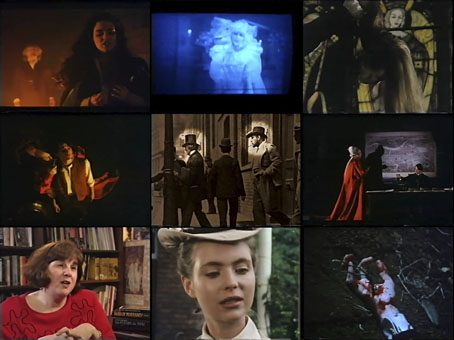
The South Bank Show: Dracula

sbs1.jpg

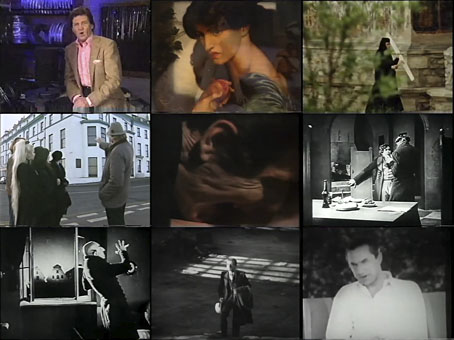
While illustrating Dracula earlier this year I was listening to Wojciech Kilar’s soundtrack to Francis Coppola’s Dracula to sustain the vampiric mood. I also watched Coppola’s film again, it’s an adaptation I enjoy a great deal despite its flaws. (This post detailed some of the plus points.) The South Bank Show‘s programme devoted to Dracula on page and screen was broadcast in early 1993, timed for the opening of Coppola’s film in the UK. I watched this when it was first shown, and remembered it being a good one but neglected to go searching for it back in January. I also remembered it being more about Coppola’s film than it is, although there’s still enough to make it a substantial promo piece.

sbs2.jpg

The territory here may be familiar but the evolution of Stoker’s novel is contextualised by some expert commentators—Leonard Wolf, Elaine Showalter (with a copy of Bram Dijkstra’s Idols of Perversity at her side) and Christopher Frayling—while discussion of the film adaptations includes Christopher Lee, Francis Coppola, James V. Hart (the screenwriter of Coppola’s film), Gary Oldman, Winona Ryder and others. Among the film clips there are several scenes from Count Dracula, Gerald Savory’s 1977 adaptation for the BBC. This is surprising since The South Bank Show was screened by the BBC’s rival, ITV. But Savory’s Count Dracula is still the most faithful screen adaptation that I’ve seen (and possibly the most faithful to date) so it’s a worthwhile choice, and one whose naturalism makes a sober contrast to Coppola’s Sturm und Drang.

Previously on { feuilleton }
Illustrating Dracula
Illustrating Frankenstein
Dracula and I by Christopher Lee
The Dracula Annual
Nightmare: The Birth of Horror
Albin Grau’s Nosferatu
Count Dracula
Symbolist cinema

Weekend links 415

varo.jpg

The Creation of the Birds (1957) by Remedios Varo.

• “I think my music is very modern and very old. Together.” Sandy Robertson interviewed Popol Vuh’s Florian Fricke for Sounds in 1981. The Fricke-directed Sei Still Wisse ICH BIN referred to in the feature may be viewed here. Further Vuh-ing: Popol Vuh on Beat Club, 1971; a news clip of the group from the same year; a filmed improvisation from around the same time (Florian still had his Moog); and the group miming to recorded music from a year or two later.

• More Rammellzee (see last week): Gothic Futurism, a video collage based on Rammellzee’s treatise of the same name. Probably the only place you’ll ever see Rammellzee, the late Glenn Branca and art historian Kenneth Clark thrown together.

• After releasing 5 albums, Disjointed Oddities And Other Such Things is the first EP of “odd strange electronics, psych, Radiophonics, drone and quirky folk” by Keith Seatman.

Alina Cohen on Remedios Varo, a Spanish Surrealist painter whose work has been receiving increased attention in recent years but whose life remains under-examined.

• More German music: “I grew up in total ruins”—Irmin Schmidt of Can on LSD, mourning and musical adventures.

• Mixes of the week: FACT mix 655 by Matthewdavid, and The Monday Is Okay mix by JQ.

Olivia Laing, Sarah Wood and Philip Hoare discuss Modern Nature by Derek Jarman.

National Geographic has digitized its collection of 6,000+ vintage maps.

• At Bandcamp: The Transcendental Sound of Moroccan Gnawa Music.

Joe Fletcher on the nightmarish dream logic of Bruno Schulz.

Levi Stahl on the mind of Donald E. Westlake.

Affenstunde (1970) by Popol Vuh | Toy Planet (1981) by Irmin Schmidt & Bruno Spoerri | Adithaim (2005) by The Cracow Klezmer Band

Weekend links 414

polackova-vyletalova.jpg

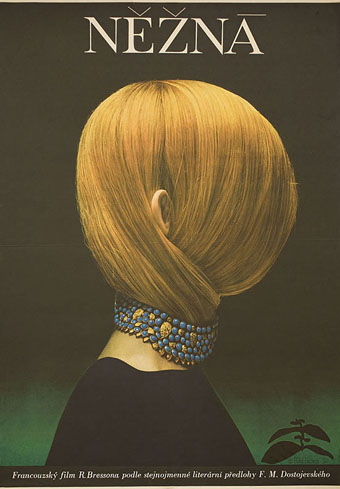
Czech poster for Robert Bresson’s Une Femme Douce (1969) by Olga Polácková-Vyletalová. There’s more about Polácková-Vyletalová’s striking poster designs (and this one in particular) at Mubi. See also the Polácková-Vyletalová collection at Terry Posters.

• “I heard that in Japan the tendency is to hammer down the nails that stick out. I think that Haruomi Hosono is a nail that sticks out. And has maintained that.” Van Dyke Parks on Haruomi Hosono, best known in the West for being one third of Yellow Magic Orchestra but a prolific artist in his own right. Hosono’s early solo albums are being reissued by Light In The Attic later this year.

Hua Hsu on The Spectacular Personal Mythology of Rammellzee. “Rammellzee will always feel like part of the underground,” says Geeta Dayal in a review of the Rammellzee exhibition currently showing in New York.

• Mixes of the week: Hassell’s Children, a Fourth World mix by Ban Ban Ton Ton, The Island of Bright Tombs by SeraphicManta, and a Radio Belbury mix by The Advisory Circle.

• More Robert Aickman: The Fully-Conducted Tour, a complete short story. Related: Matthew Cheney reviews the new Aickman collection, Compulsory Games.

• Another Kickstarter bid, this time for a reprint of Art Nouveau designs and illustrations by Carl Otto Czeschka.

Oliver Burkeman reviews How to Change Your Mind: The New Science of Psychedelics by Michael Pollan.

Art/design/architecture magazines online at the International Advertising & Design Database.

• Tonedeaf in our nose: Gerri Kimber on the musicality of James Joyce’s writing.

• More William Hope Hodgson: Greydogtales examines Hodgson’s poetry.

• The Art of Elsewhere: Jed Perl on the world of Edward Gorey.

• At Dennis Cooper’s: Records.

Beat Bop (1983) by Rammellzee vs. K-Rob | Equation (1989) by Material ft. Rammellzee | No Guts No Galaxy (1999) by Ramm Ell Zee & phonosycographDISK

Aubrey Beardsley and His World

beardsley.jpg

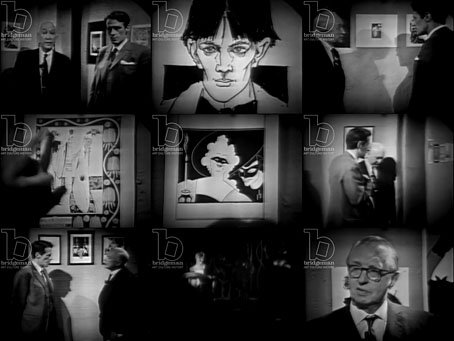
This US TV programme isn’t the greatest quality, and it’s blighted throughout with a large watermark, but it’s a revelatory piece both for Aubrey Beardsley enthusiasts and Oscar Wilde aficionados. Camera Three was a CBS arts show which presented Aubrey Beardsley and His World on 12th March, 1967, as a preview for the Beardsley exhibition which had just opened in New York. This was the same landmark exhibition that made such a splash the year before at the V&A in London, and V&A curator Brian Reade appears in the programme to discuss Beardsley’s importance with host James Macandrew. It’s good to see Reade again (he was also in a later BBC documentary) since his Beardsley monograph is a great favourite of mine; as is typical of the period, he looks and sounds very upper class but his scholarship is always authoritative.

Ordinarily this would be enough to satisfy me, even though the programme only runs for 27 minutes and doesn’t tell me anything about Aubrey that I didn’t know already. The great revelation comes near the end with the appearance of Vyvyan Holland, the younger son of Oscar Wilde. Holland not only admired Beardsley’s work but actually met him in 1895 shortly before the artist’s untimely death. Holland was 9 years old at the time, and was taken to visit Aubrey by his mother; he was 81 in 1967, and died himself later that year so we’re very fortunate that he was captured on tape at all. The programme also includes a short extract from Alla Nazimova’s 1923 film of Salomé, with costumes and decor all based on Beardsley’s drawings. Watch it here.

Elsewhere on { feuilleton }
The Aubrey Beardsley archive