Weekend links 498

mead.jpg

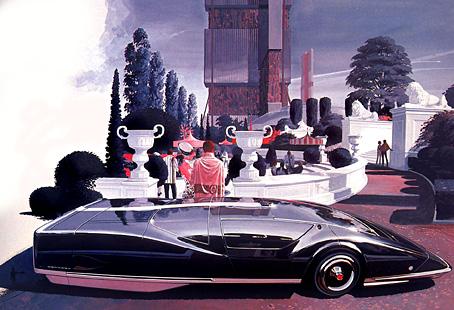
The Sentinel 280, a car design by Syd Mead from 1964.

• “Boris Dolgov did not exist. The man who bore that name may have existed, but there never was a man in the United States with that name until 1956, too late for Weird Tales.” Teller of Weird Tales on the mysterious identity of a magazine artist.

• Saying goodbye to 2019 also meant saying farewell to Vaughan Oliver, Neil Innes and Syd Mead. Related: Vaughan Oliver at Discogs; I’m The Urban Spaceman; a look back at Syd Mead’s vehicle designs.

Lanre Bakare on how ambient music became cool. (Again. This begs the question of when it became uncool, especially when a ten-year-old Brian Eno piece about “the death of uncool” is being quoted.)

Westerners interpreted the peyote experience very differently from the practitioners of the peyote religion, where the focus was “ritual, song and prayer, and to dissect one’s private sensations was to miss the point”. Writers such as Havelock Ellis, who published an essay on his peyote experiences in the Lancet in 1897 (it’s likely that he also administered the substance to his friends W.B. Yeats and Arthur Symons), instead tended to focus on its visual effects. Ellis described “the brilliance, delicacy and variety of the colours” and “their lovely and various textures”. Peyote reached Europe in tandem with the X-ray, cinema and electric lights, Jay notes, and “nothing delighted the eye of the mescal eater so much as the new electrical sublime”.

Emily Witt reviewing Mescaline: A Global History of the First Psychedelic by Mike Jay

Peter Bradshaw takes on the thankless task of ranking Federico Fellini’s feature films.

Geoff Manaugh on when Russia and America coöperated to avert a Y2K apocalypse.

• “Music is an ideal medium for interstellar communication,” says Daniel Oberhaus.

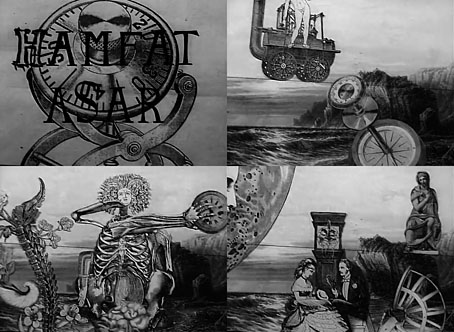
Keith Allison on Karel Zeman, a creator of remarkable cinematic fantasies.

•  Japanese Designer New Year’s Cards of 2020.

• At Dennis Cooper’s: Vera Chytilová Day.

2020 in public domain.

Sentinel (1992) by Mike Oldfield | Sentinels (2001) by Cyclobe | Sentinel (2004) by Transglobal Underground

Weekend links 496

kemeny.jpg

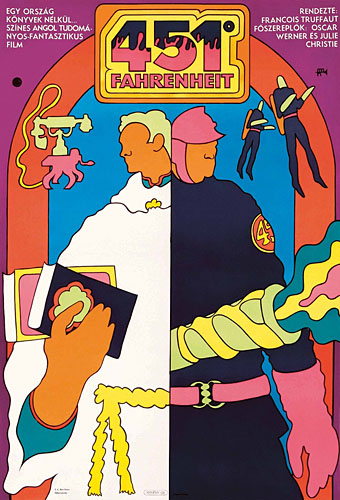
Fahrenheit 451 (1966) poster by György Kemény.

• “The novel is constantly assailed by people wanting to conscript it to their own ends. (Other art forms are not similarly burdened; someone yelling ‘What about global warming?’ between numbers at a Keith Jarrett concert would be recognized to have made a category error.)” Jonathan Clarke on the demands that literature should nurture empathy.

• The first three features by Alejandro Jodorowsky—Fando y Lis (1968), El Topo (1970) and The Holy Mountain (1973)—return to Britain’s cinema screens in January (well…two of them return; I’m not sure that Fando y Lis has ever been shown in cinemas over here). All three films will be given overdue blu-ray releases by Arrow in March.

• “What distinguishes Oulipo from other language games, is that its methods have to be capable of producing valid literary results.” Tony White reviews The Penguin Book of Oulipo: Queneau, Perec, Calvino and the Adventure of Form, edited by Philip Terry.

But from a present-day perspective, it is also remarkable the extent to which cafés, busy conduits for knowledge and sentiment, resembled later digitally connected systems. The larger establishments offered not just a huge selection of newspapers, domestic and foreign, but also reference material—maps, dictionaries, encyclopaedias, language lexicons, address books—for writers struggling with their research, or merely trying to settle an argument. The combination of hard facts and caffeinated opinion firing through the steamy analogue ether constituted a local area network of extraordinary reach. In the pre-digital era, the Viennese café offered the greatest possible concentration of current knowledge—for the price of a mélange.

From the Strange Flowers guide to Vienna, part 2

• “People like Edmund Wilson and Isaiah Berlin, they have to love Zhivago to prove that good writing can come out of Soviet Russia. They ignore that it is really a bad book.” Jennifer Wilson on Vladimir Nabokov’s fighting spirit.

• Master animator Richard Williams died in August so here again is the exceptional adaptation of A Christmas Carol made by his studio in 1971.

• Hearing a person: Annea Lockwood remembers her partner, composer Ruth Anderson, whose death was announced last week.

• The London Review of Books has relaunched its website. The paywall is currently down until mid-January so dig in.

Live In Paris by Pharoah Sanders, a previously unreleased ORTF concert recording from 1975.

• Unrising sun: Amos Chapple’s photographs of the polar nights of Murmansk.

Mary McNamara on the rescuing of 200 historic Hollywood backdrops.

• Mix of the week: XLR8R Podcast 623 by Aida.

• At Dennis Cooper’s: Sandy Dennis Day.

The Desert Is A Circle (1970) by Shades Of Joy | The Desert Is A Circle (1971) by Paul Horn | Holy Mountain (1994) by Axiom Ambient

There Lived Kozyavin

khrzhanovsky1.jpg

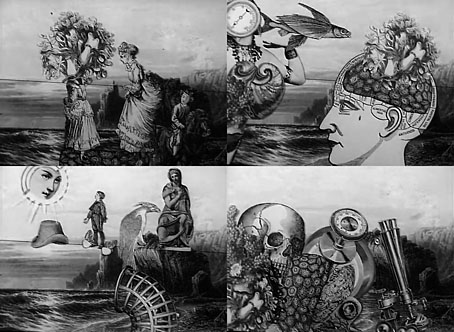
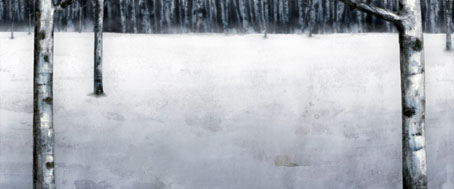
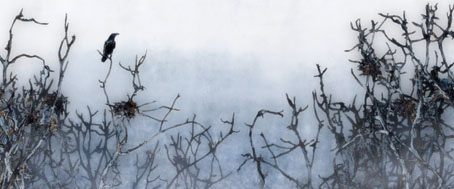
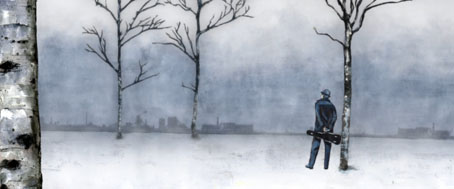
The aesthetics of Surrealism are largely absent in the art of Soviet Russia but they can be found in some of the early animated films of Andrei Khrzhanovsky. One of these, The Glass Harmonica (1968), shows the influence of Magritte and De Chirico, among others, and is also distinguished by being the only animation to be officially banned by the Soviet authorities. The film is rather confused but its message about the liberating power of art and music was clear enough to pose an ideological threat.

More straightforward is There Lived Kozyavin (1966), a shorter film with a jazzy score about a bureaucrat mindlessly following his supervisor’s order to an extreme degree. As with The Glass Harmonica, the film borrows the limitless plains and unusual landscapes of Surrealism for its setting. The message may be the same as those posters exhorting Soviet citizens to be better workers but it does so in a more entertaining manner.

khrzhanovsky2.jpg

Weekend links 493

gaycomix.jpg

Art by Rand Holmes for Gay Comix No. 1, September 1980.

• In the universe next door, Los Angeles in November, 2019 looks like the drawings in the Blade Runner Sketchbook (1982). The book has been out of print for many years but available online for a while, although seldom in a downloadable form. A recent upload at the Internet Archive remedies this. In addition to the familiar Syd Mead designs for flying cars and street furniture there are some Moebius-like doodles by Ridley Scott, and Mead’s design for Tyrell’s cryogenic crypt, a detail that would have formed part of an unfilmed sub-plot.

• RIP Howard Cruse, comic artist and pioneering editor of the first few issues of Gay Comix in the 1980s. Cruse produced work outside the gay sphere (I first encountered his strips in Heavy Metal) but the stories that he and other artists created for Gay Comix (later Gay Comics) were some of the first by lesbians and gay men chronicling their own lives, as opposed to porn fantasies or the more recent trend of bolting a token sexuality to a superhero. John Seven talked to Cruse about his career in 2007.

• “On the eve of the First World War Stefan George had started recruiting his own twink army…” Well, if you really must have an army… Strange Flowers presents part one of a guide to the city of Vienna.

In Wild Air, 2016–2018: all 72 of Heath Killen’s requests for a list of six interesting things from artists, writers, scientists, ecologists, musicians, historians and others. My answers are at number 55.

• “Satan is a friend of mine”: Sander Bink on a forgotten occult novel, Goetia (1893) by Frits Lapidoth.

• Picturing a voice: Rob Mullender-Ross on Margaret Watts-Hughes and the Eidophone.

• “They broke the rules”: Killian Fox on the film posters of the French New Wave.

• At Dennis Cooper’s: Jan Švankmajer Day.

Ogi No Mato (1976) by Ensemble Nipponia | Rêve (1979) by Vangelis | Blade Runner Esper “Retirement” Edition, Part III (1982)