Zemania

zeman01.jpg

Invention for Destruction (1958).

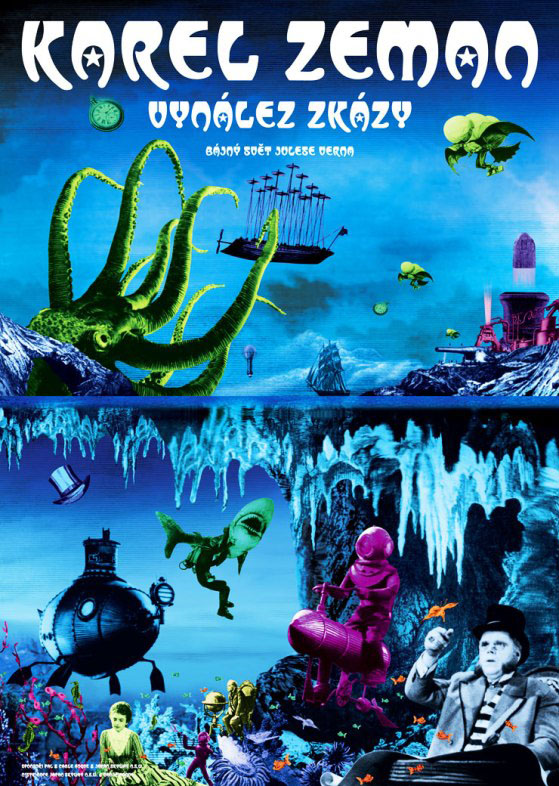
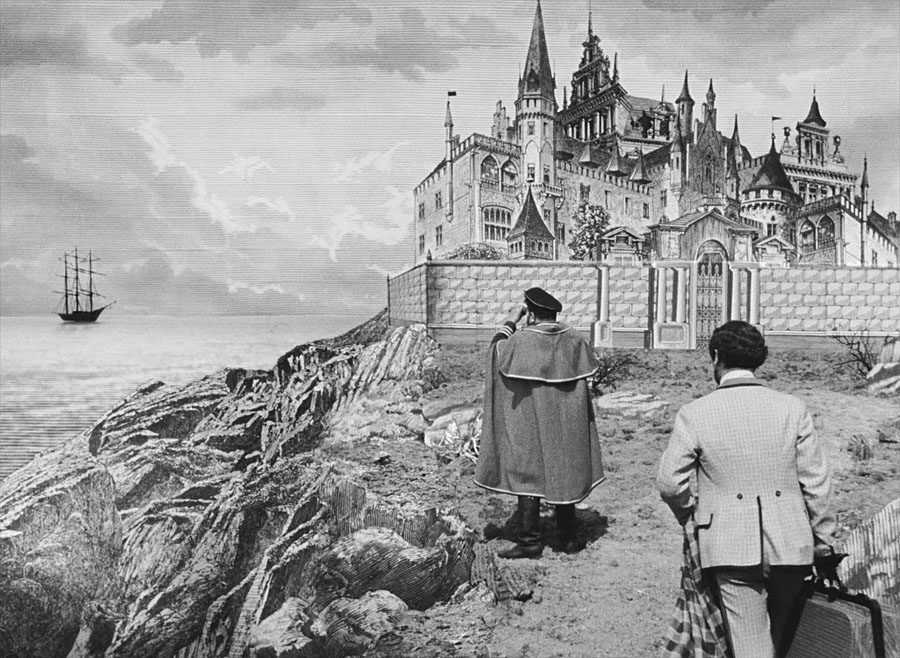
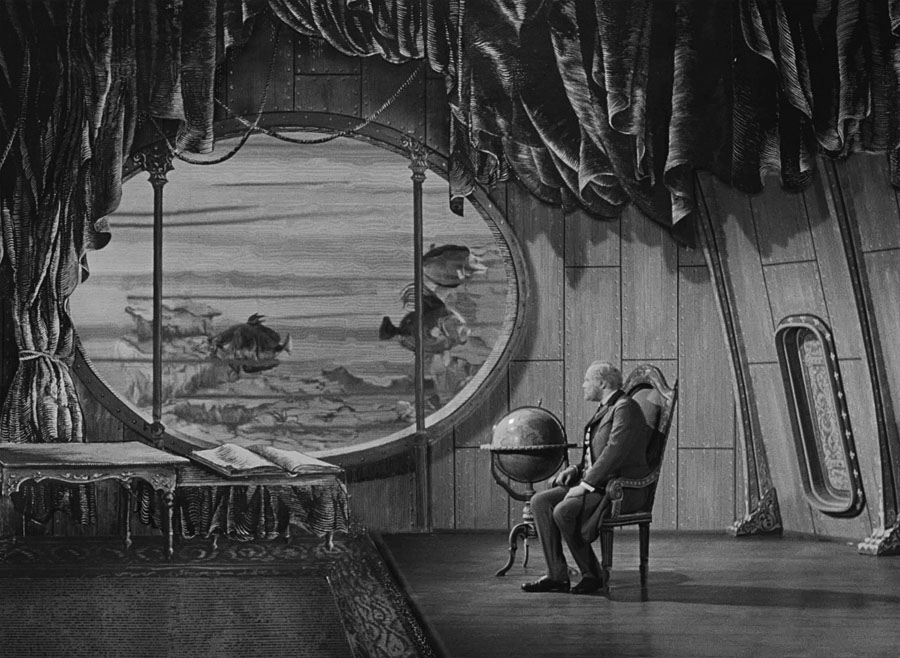
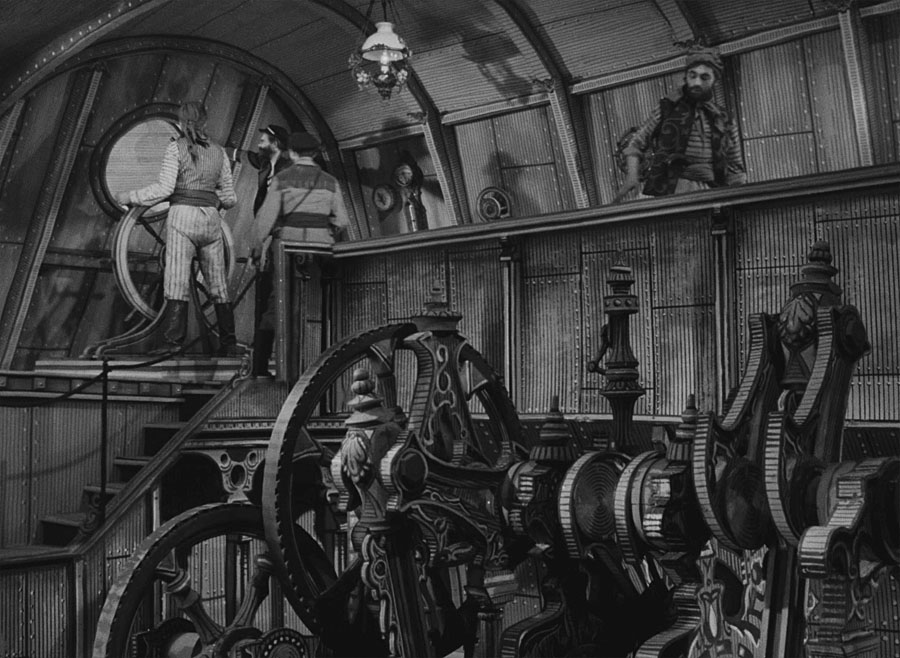
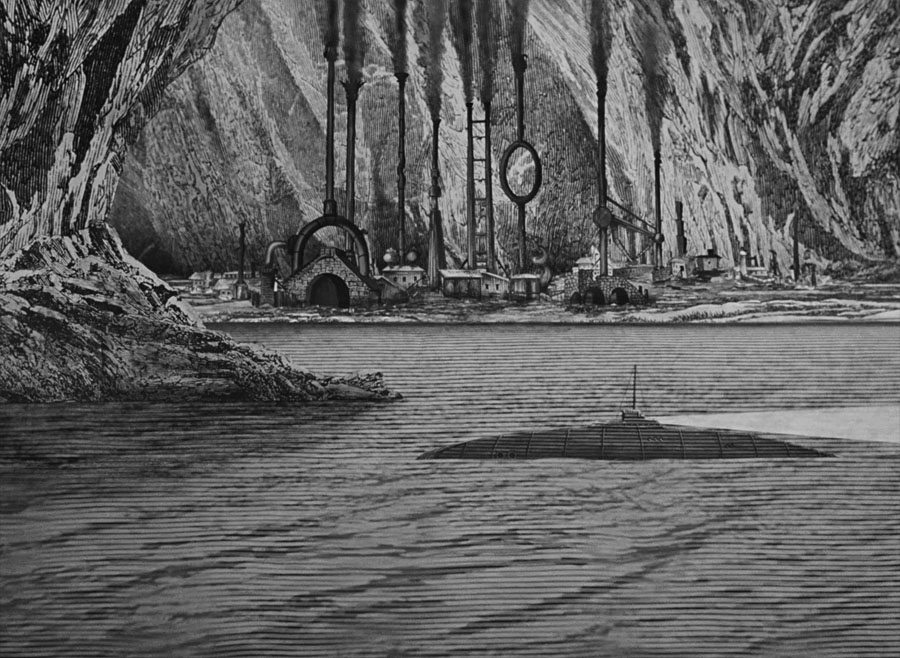
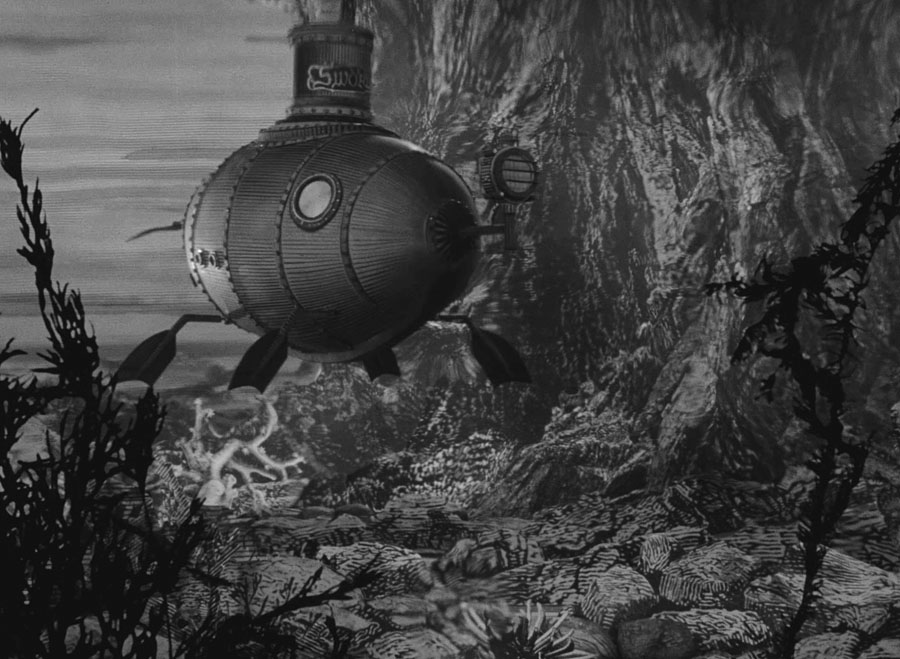
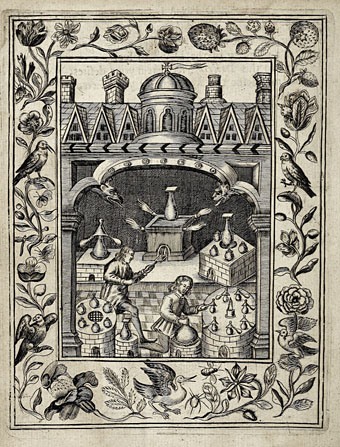
In addition to Jean Kerchbron’s Golem my weekend viewing involved a fresh immersion in the semi-animated fantasies of Karel Zeman, one of which, Invention for Destruction, I’d not seen for many years. It hadn’t occurred to me before how closely Zeman’s technique on these films matches some of my own recent illustration when it applies original drawn elements to settings constructed from old engravings. For Zeman, combining actors with animated models and pictorial backgrounds was an economical way of bringing to life the worlds of Jules Verne, Rudolf Erich Raspe and others while retaining the feel of the original book illustrations. These films are also closer to the Max Ernst school of engraved collage than they may at first seem. The mansion at the beginning of Invention for Destruction could easily have been an illustration of a single building but Zeman offers a hybrid construction with unrealistically conflicting perspectives; later on we see a desert cavalry of camels on roller skates. It’s no surprise that Jan Švankmajer admires Zeman’s films. And having recently watched all the Švankmajers it’s good to know there are several Zeman features still to see.

zeman02.jpg

zeman03.jpg

zeman04.jpg

zeman05.jpg

zeman06.jpg

Continue reading “Zemania”

Weekend links 524

heisler.jpg

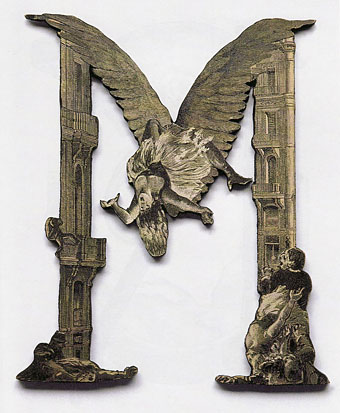
Letter M from Abeceda (1942) by Jindrich Heisler.

• At the BFI: Matthew Thrift chooses 10 essential Ray Harryhausen films. “This is, I can assure the reader, the one and only time that I have eaten the actors. Hitchcock would have approved,” says Harryhausen about eating the crabs whose shells were used for Mysterious Island. Meanwhile, Alfred Hitchcock himself explains the attraction and challenges of directing thrillers.

“Although largely confined to the page, Haeusser’s violent fantasies were even less restrained, his writings littered with deranged, bloodthirsty, scatological scenarios.” Strange Flowers on Ludwig Christian Haeusser and the “Inflation Saints” of Weimar Germany.

• Death, Pestilence, Emptiness: Putting covers on Albert Camus’s The Plague; Dylan Mulvaney on the different design approaches to a classic novel.

• A trailer (more of a teaser) for Last and First Men, a film adaptation of Olaf Stapledon’s novel by the late Jóhann Jóhannsson.

• At Dennis Cooper’s: Spotlight on…James Purdy: The Complete Short Stories of James Purdy.

Al Jaffee at 99: Gary Groth and Jaffee talk comics and humour.

Steven Heller on Command Records’ design distinction.

Czech Surrealism at Flickr.

Sisters with Transistors.

Solitude by Hakobune.

Mysterious Semblance At The Strand Of Nightmares (1974) by Tangerine Dream | Mysterious Traveller (Dust Devils Mix) (1994) by System 7 | The Mysterious Vanishing of Electra (2018) by Anna von Hausswolff

Švankmajer’s cats

dtc1.jpg

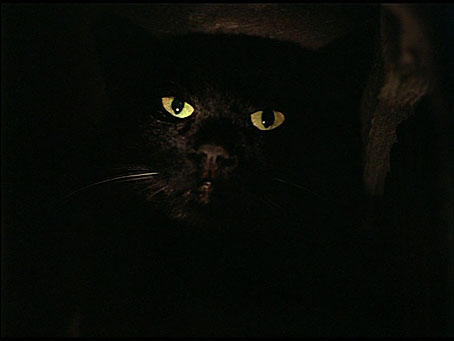
Down to the Cellar.

“Black cats are our unconscious,” says Jan Švankmajer in an interview with Sarah Metcalf for Phosphor, the journal of the Leeds Surrealist Group. I’ve spent the past few weeks working my way through Švankmajer’s cinematic oeuvre where black cats were very much in evidence, although for a director who describes himself as a “militant Surrealist” there are fewer than you might imagine.

jabberwocky.jpg

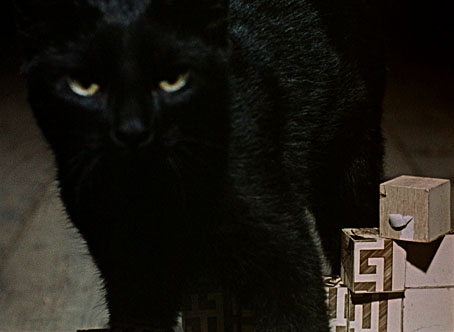
Jabberwocky.

The first feline appearance is in Jabberwocky (1973), a difficult film for animal-lovers when almost all the cat’s appearances seem to have involved throwing the unwilling animal into a wall of building blocks. Each “leap” that the cat makes through the wall interrupts the progress of an animated line being drawn through a maze; when the line finally escapes the maze, childhood is over. Our final view of the cat is of it struggling to escape the confines of a small cage: the unconscious tamed by adulthood.

dtc2.jpg

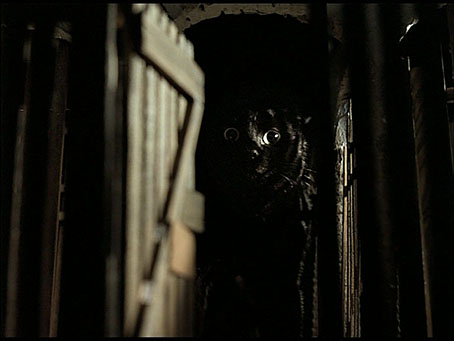
Down to the Cellar.

The black cat in Down to the Cellar is not only the most prominent feline in all of Švankmajer’s films, it’s also carries the most symbolic weight in a drama replete with Freudian anxiety. The cat guards the entrance to the subterranean dark where its growth in size corresponds to the mounting fears of a small girl sent by a parent to collect potatoes.

faust.jpg

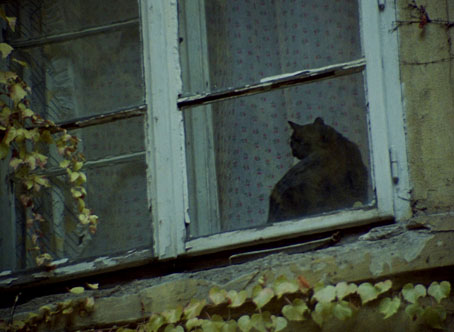
Faust.

The cat seen at the beginning of Faust (1994) appears very briefly but nothing is accidental in Švankmajer’s cinema. Two separate shots show the cat in the window watching Faust on his way to meet Mephistopheles. As with Down to the Cellar, the cat oversees the threshold to another world, in this case the doorway to a labyrinthine building filled with malevolent puppets and the temptations they offer. The cat may also be the traditional symbol of ill fortune. Faust at this point in the story still has the option to turn back but he goes on to meet his fate. (I think there may also be another cat later in the film but I was too lazy to go searching for it. Sorry.)

little-otik.jpg

Little Otik.

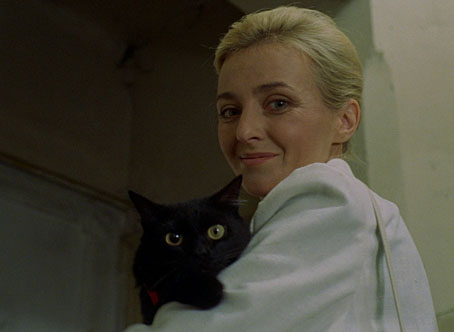
The cat that appears in the early scenes of Little Otik (2000) is a child substitute for a childless couple, its status reinforced by the scene of Bozena holding the animal like a baby. The arrival of the monstrous Otik usurps the cat’s position as the family favourite. Consequences ensue.

Švankmajer’s later features are catless. Insects (2018) is more concerned with arthropods and their human equivalents, while Surviving Life (2010) spends so much time inside the unconscious of its protagonist it doesn’t require a symbol. Lunacy (2005), on the other hand, is a combination of a story by Edgar Allan Poe—The System of Doctor Tarr and Professor Fether—and the philosophical views of the Marquis de Sade. Švankmajer had already adapted two of Poe’s stories prior to this but The Black Cat wasn’t among them. Given the cruelties in Poe’s story and many of Svankmajer’s films, Lunacy in particular, this may be just as well.

Previously on { feuilleton }
Jan Švankmajer: The Animator of Prague
Lynch dogs
Jan Švankmajer, Director
Don Juan, a film by Jan Švankmajer
The Pendulum, the Pit and Hope
Two sides of Liška

Scarabus, a film by Gérald Frydman

scarabus1.jpg

Another tip from Philip Strick’s Science Fiction Movies (1976) (previously) that’s also another short animated film I hadn’t seen before. Gérald Frydman is a Belgian director, and Scarabus (1971) was his debut film. As with a number of the selections in Strick’s book, Scarabus tends more towards Surrealism than science fiction, although this always depends how broadly you define SF: identical men in black clothes populate a crumbling urban environment where much of the architecture is inside out and upside down, and unidentified yellow blobs clutter the place. Airships drift overhead while the men interact with each other, sometimes in a violent manner. The meaning may be elusive but it’s all very well done, and the film was later chosen to accompany the French theatrical screenings of Alain Resnais’s Providence. That’s what I call a good night out.

scarabus2.jpg

Previously on { feuilleton }
Labirynt by Jan Lenica

Jiří Barta: Labyrinth of Darkness

barta1.jpg

A new purchase. It’s excessive and wasteful to order DVDs from South Korea but when this is the only available option you have no choice. Jiří Barta: Labyrinth of Darkness is a Korean clone of a deleted disc that was originally released in the US by Kino, and which I’d managed to miss when it was still easy to find. The collection gathers all of the Czech animator’s short films from 1978–89 plus his 53-minute masterwork, The Pied Piper (1986), a film whose Expressionist puppets and decor steal the familiar folk tale away from picture-book cuteness and return it to its darker roots. The subtitle “Labyrinth of Darkness” suggests that all the films tend towards horror which isn’t really the case, although anyone disturbed by animated shop mannequins may be unnerved by Club of the Discarded (1989). Barta’s films can be dark but they’re also wry or quirky: The Design (1981) is a wordless fable about the imposition of social uniformity by contemporary architecture, while The Extinct World of Gloves (1982) cleverly uses anthropomorphism to pastiche a range of cinematic genres. Barta is still active today but most of his recent films have been advertising commissions and a child-friendly feature, Toys in the Attic, the marketplace being resistant to animation that’s too strange or personal. I still hope we might one day see his feature-length film of The Golem but there’s been no news about this since a preview was released in 2002:

“Everyone is expecting a fairytale about that legend. Our interpretation is a little bit different, because we start from another point of view, which is Gustav Meyrink’s Golem…It is much more interesting, but I think that this is the reason why we have not moved forward, why the whole project has stopped, why some producers have disappeared, appeared and disappeared again.” (via)

barta2.jpg

The unavailability of the Kino disc of Barta’s films is part of a worrying trend for those of us who like to own physical copies of scarce films. Many DVDs released ten or more years ago are now deleted and—in the case of my precious Piotr Kamler collection—impossible to find, while the films they contain are of such minority interest there’s little hope of seeing them on blu-ray any time soon. In the hierarchy of cinematic value, feature-length dramas always receive the most attention while documentaries, shorts, animations and experimental films are subject to the greatest neglect. Yes, “everything is now on YouTube” (except when it isn’t), but invariably compromised by low resolution, a lack of subtitles, or blighted by TV watermarks. And everything on YouTube is only there for as long as the uploader maintains their channel or until someone files a copyright complaint; previous posts here are filled with links to videos that are now deleted, so the Koreans are doing everyone a service by keeping Barta’s films in circulation. The same goes for the great René Laloux whose science-fiction features, Time Masters (1982) and Gandahar (1987), are currently available with English subs only from South Korea. The quality of this Jiří Barta disc leaves much to be desired but it’s still better than YouTube.

Previously on { feuilleton }
Jiří Barta’s Pied Piper
Gloves
More Golems
Barta’s Golem