Weekend links 517

magritte.jpg

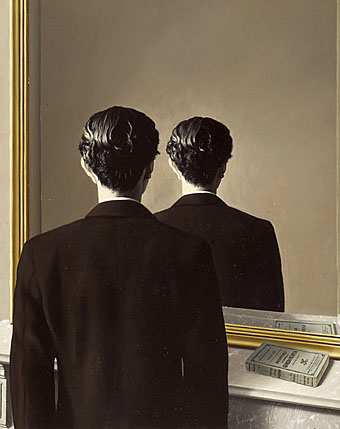
Edward James by René Magritte; La Reproduction Interdite (1937).

• “James was filmed in the late 1970s, striding round Las Pozas in a sweater and a tattered dressing-gown, surmounted by parrots (The Secret Life of Edward James can be seen on YouTube). When asked what motivated him, he replied: ‘Pure megalomania!’ He was having his second childhood, he said, though he wasn’t sure the first had ever ended.” Mike Jay on lifelong Surrealist, Edward James (1907–1984), and the concrete fantasia he built in the Mexican jungle.

• “I found the roots of electronic music in a cupboard!” Musician Paul Purgas (one half of Emptyset) on the discovery of early electronic music from India’s National Institute Of Design. Related: Purgas talks about his discovery with Patrick Clarke.

• RIP Phil May. Here’s The Pretty Things in their guise as psych band “Electric Banana” for an appearance in What’s Good for the Goose (1969). A decent moment in an otherwise terrible film.

• Music is a memory machine: David Toop explores how the transmission of music between disparate cultures can be a tool against populism and prejudice.

• Kraftwerk’s remarkable journey, and where it took us: Bob Boilen and Geeta Dayal discuss the tanzmusik of Düsseldorf.

• At Dangerous Minds: Acid Drag & Sexual Anarchy: Fifty years ago The Cockettes turned drag upside down.

Hua Hsu on the secret lives of fungi: “They shape the world—and offer lessons for how to live in it”.

• The great writer who never wrote: Emma Garman on the flamboyant Stephen Tennant.

• Cult 1998 PlayStation game LSD: Dream Emulator is finally playable in English.

Jim Jupp of Ghost Box records talks about the Intermission compilation album.

Jonathan Moodie on psychoactive cinema and sacred animation.

Alex Barrett on where to begin with Akira Kurosawa.

• At Dennis Cooper’s: Skeletons.

Skeleton Makes Good (1982) by Captain Beefheart & The Magic Band | Red Skeletons (1996) by Coil | Kids Will Be Skeletons (2003) by Mogwai
Weekend links 502

wilson.jpg

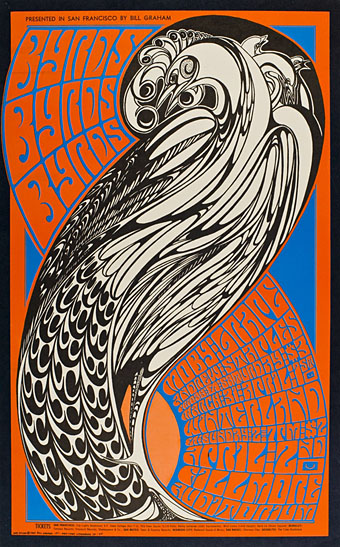
The Byrds (1967) by Wes Wilson.

• RIP Wes Wilson, one of the first of the San Francisco psychedelic poster artists of the 1960s, and also one of the more visible thanks to the popularity of his compressed type designs, some of which were derived from a style developed by Alfred Roller for the Vienna Secession circa 1900. When Playboy magazine wanted a cover that reflected the psychedelic art trend in late 1967 it was Wilson they called. Related: Wes Wilson’s posters at Wolfgang’s.

• “In the ’70s, New Age music offered listeners, trapped in the urban rat-race, audio capsules of pastoral peace to transform their homes into havens. Today the Internet and social media form a kind of post-geographic urban space, an immaterial city of information whose hustle ‘n bustle is even more wearing and deleterious to our equilibrium.” 2010–19: Back To The Garden: The Return Of Ambient And New Age by Simon Reynolds.

• “This pointed-finger symbol goes by many names: mutton fist, printer’s fist, bishop’s fist, pointer, hand director, indicule, or most unimaginatively as ‘a hand’. Scholarly consensus has pretty much settled on the word ‘manicule’, from the Latin maniculum, meaning ‘little hand’.” John Boardley on the typographic history of the pointing hand.

Tales Of Purple Sally (1973) by Alex. All instruments by Alex Wiska apart from bass by Holger Czukay, and drums by Jaki Liebzeit. The latter pair also produced the album. Related: Jah Wobble talking to Duncan Seaman about working with Czukay and Liebeziet.

• “On Jan 25, 2020, tired of negative film lists on Twitter, I asked people for ‘obscure [or] underseen films you adore and think more people should know about.’ This was the result.”

Flash Of The Spirit by Jon Hassell & Farafina “hails from a time when the possibilities of music seemed less well-defined, and borders felt more open,” says Geeta Dayal.

The Art Of Computer Designing: A Black and White Approach (1993) by Osamu Sato. There’s more of Sato’s print work at the Internet Archive.

• At the Morgan Library: Jean-Jacques Lequeu: Visionary Architect. Drawings from the Bibliothèque nationale de France.

• New from Strange Attractor: Inferno: The Trash Project: Volume One by Ken Hollings.

• At Dennis Cooper’s: Storm de Hirsch Day.

Celeste by Roger Eno & Brian Eno.

Ben Watt‘s favourite music.

The Inferno (1968) by The Inferno | Inferno (1990) by Jah Wobble’s Invaders Of The Heart | Inferno (1993) by Miranda Sex Garden

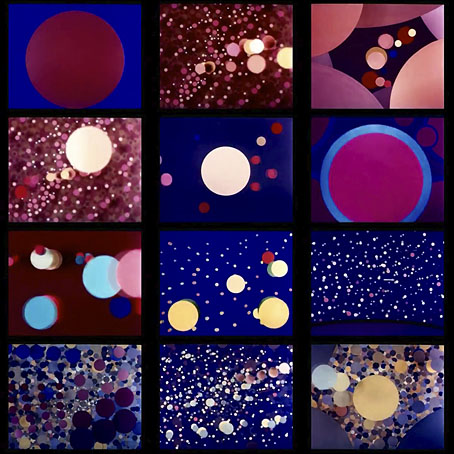
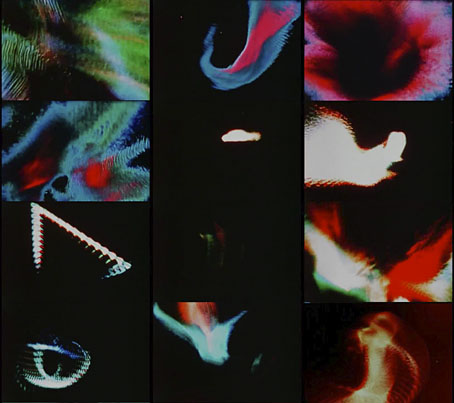
Heavy-Light, a film by Adam K. Beckett

beckett.jpg

In the early 1990s the UK’s Channel 4 still operated as an avant-garde television channel, broadcasting films, dramas and documentaries that the other channels would be unlikely to show. Late nights were often filled out with resolutely uncommercial fare, as was the case when Abstract Cinema was shown in 1993, a 50-minute documentary by Keith Griffiths that traced the history of abstract cinematic experimentation from the animations of Oskar Fischinger to the growing field of computer graphics. The documentary was followed by an additional 25 minutes of abstract shorts, one of which, Heavy-Light (1973) by Adam K. Beckett, is a particular favourite.

Most of Beckett’s films are free-form doodles, hand-drawn and dreamlike in their endlessly shifting and often erotic metamorphoses. Heavy-Light is different for being the product of some optical process that sends billowing waves of vivid colour blooming out of darkness. The effect is very similar to Jordan Belson’s films where the realisation is equally mysterious and the result equally (that word again) psychedelic; a bonus in Beckett’s film is the excellent score by Barry Schrader. Beckett died young at the age of 29 so there isn’t much of his work to see although a few of the animated films are also on YouTube at the moment (see here, here, here and here). They may not remain there for long so watch them while you can.

Elsewhere on { feuilleton }
The abstract cinema archive

An Optical Poem by Oskar Fischinger

fischinger.jpg

Oskar Fischinger’s only successful collaboration with a Hollywood studio was this 7-minute animation made for MGM in 1937. As with some of Fischinger’s earlier films, a piece of classical music is illustrated with dancing shapes of cut-out paper. The music in this instance is Liszt’s Second Hungarian Rhapsody, and this short was one of the films that brought Fischinger’s to Walt Disney’s attention when the Disney studio was planning a similarly abstract sequence for Fantasia. Fischinger worked on the Toccata and Fugue opening but his early efforts for Disney were dismissed as “too dinky” by the man responsible for a ubiquitous anthropomorphic mouse.

Elsewhere on { feuilleton }
The abstract cinema archive

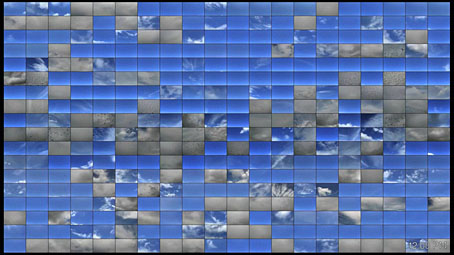
A History of the Sky, a film by Ken Murphy

sky.jpg

This is a year-long time-lapse study of the sky. A camera installed on the roof of the Exploratorium museum in San Francisco captured an image of the sky every 10 seconds. From these images, I created a mosaic of time-lapse movies, each showing a single day. The days are arranged in chronological order. My intent was to reveal the patterns of light and weather over the course of a year.

I once filled out a three-hour VHS tape with a single shot of drifting clouds using my old video camera. I was thinking at the time of Brian Eno’s studies of the skies over Manhattan but the roofs of South Manchester can’t compete with those of New York City. Ken Murphy’s film is a slowly evolving mosaic that also serves to remind us northerners how quickly the night comes to California.

Previously on { feuilleton }
Mistaken Memories Of Mediaeval Manhattan