Weekend links 236

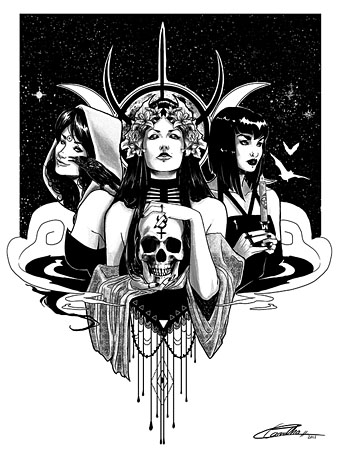
carvalho.jpg

The Three Witches (2014) by Lorena Carvalho.

Immersion, a new album by Grey Frequency, “…is a recording of the broken signals, wraiths in the ether from lost futures and utopias which were once promised…”. Box Of Secrets (1999) is an album of electronica by Ian Boddy that’s a free download until the end of December.

• “Hothouse flowers, Egyptian statuary, jewels, Nubian servants, crystal balls, cocaine, opium and champagne were just some of the things she spent her money on…” Lucy Davies explores the riotous world of Marchesa Luisa Casati.

• “London is a network of complete nexuses, coincidences, overlaps, references…” Stephanie Boland talks to Iain Sinclair about his new book 70×70: Unlicensed Preaching: A Life Unpacked in 70 Films.

My Women’s Studies professors would say: “You don’t know how hard we fought for you.” And yet, when they told me my sexuality was not correct, I felt embarrassed. I knew I had longings that didn’t line up with the politics, but I refused to repress them, particularly in my writing. I fought to unravel a political correctness that was censoring desire.

Screenwriter Erin Cressida Wilson on sex, cinema and secrets

Cthulhu, Fiction and Real Magic, a lecture by Ian ‘Cat’ Vincent at Treadwell’s, London, on December 3rd. For those who can’t attend, Erik Davis has just posted his essay about Lovecraft and contemporary occultism.

• “John Gielgud was obsessed with trousers, loved corduroy and leather. And so he wrote a film set in a menswear shop.” Gielgud’s unfilmed screenplay for gay porn director Peter de Rome may now be filmed.

• “The stories are even more fantastic and full of marvels than those in the Arabian Nights.” Robert Irwin on the newly-translated Tales of the Marvellous.

• Mixes of the week: The Advisory Circle present Winter From Out Here; Fall by The Ephemeral Man; Secret Thirteen Mix 136 by Cosmin TRG.

Danny Cooke‘s drone views of Pripyat, Chernobyl. Related: Into the Zone: Gasworks Park (Seattle, WA) by Christina Scholz.

• Watch Dragnet’s 1967 LSD episode. More psychedelics: “Magic mushrooms change brain connections“.

• Earth Magic: Peter Bebergal on photography of witches at play and at ritual.

• Düsseldorf 1970: The crucible of Krautrock by those who were there.

• It’s Alright Ma, It’s Only Witchcraft (1968) by Fairport Convention | Witch’s Will (1973) by Wilburn Burchette | Witches’ Multiplication Table (1982) by Holger Czukay
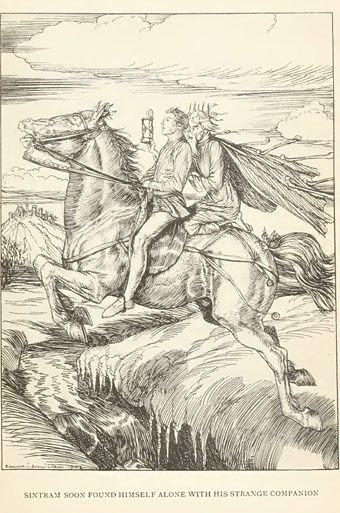
Edmund J. Sullivan’s Sintram and His Companions

sintram01.jpg

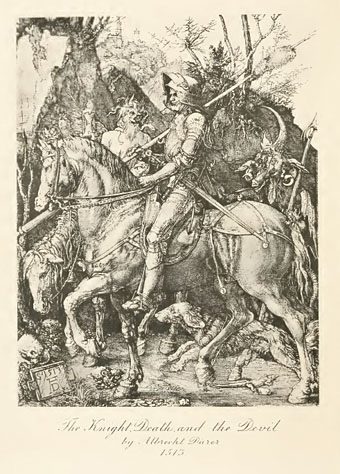
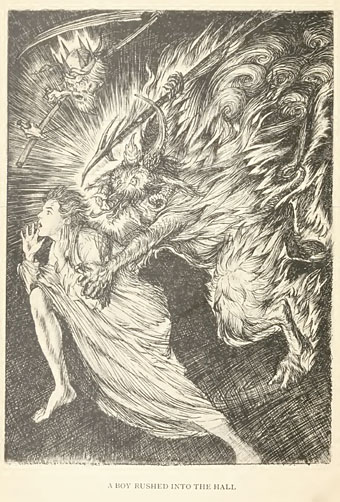
More Sullivan, the illustrations this time being for a 1908 edition of Sintram and His Companions by Friedrich de la Motte Fouqué. This is one of Fouqué’s lesser known works, a tale of a Norwegian knight which the author based on the famous etching by Albrecht Dürer, The Knight, Death and the Devil (1513). The etching is shown as a frontispiece which Sullivan then has to follow, not an enviable task for any artist. If the subsequent drawings can’t match Dürer’s meticulous rendering they nonetheless base their characters on Dürer’s figures, the dog included. This kind of repurposing is commonplace today but it was very uncommon in 1908, and offhand I can’t think of an earlier example. It’s also worth noting the discussion in the comments for yesterday’s post about the influence of Edmund J. Sullivan on the young Austin Osman Spare. Sullivan and Spare knew each other, and Phil Baker’s Spare biography mentions Sullivan’s work being an influence, but I’d not given the matter much attention until this week. The influence is easy to see when you view their drawings together.

To return to Dürer, the sight of his etching always makes me think of a later piece of fiction, A Dog in Dürer’s Etching “The Knight, Death and the Devil” (1966) by Marco Denevi. A short tour-de-force that may be read in full here.

sintram02.jpg

sintram03.jpg

Continue reading “Edmund J. Sullivan’s Sintram and His Companions”

Albert Weisgerber’s Grimm Fairy Tales

weisgerber01.jpg

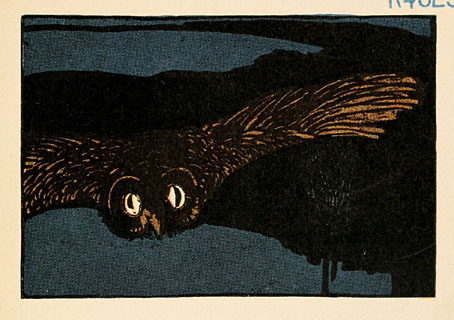
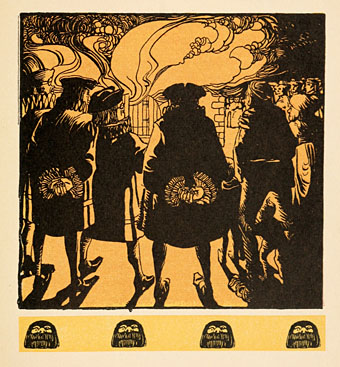
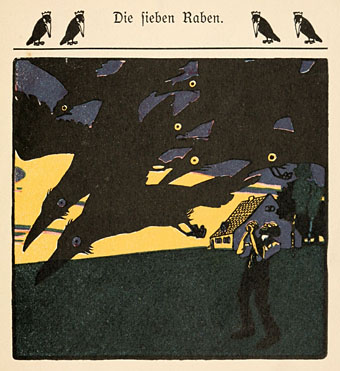
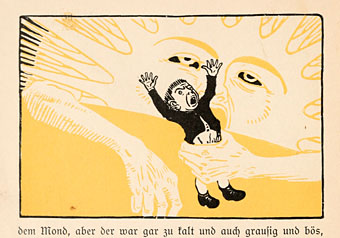
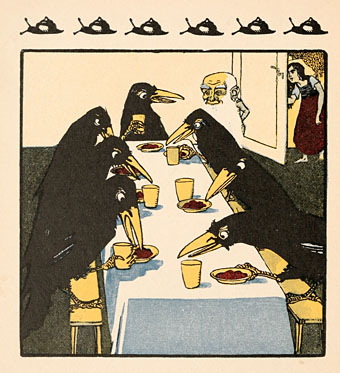
Following yesterday’s artwork by Andrea Dezsö, some illustrations from a German edition of Grimm’s Fairy Tales from around 1900. Albert Weisgerber (1878–1915) was more of a fine artist than a jobbing illustrator—Alfred Kubin was a friend—but some of his drawings appeared in Jugend magazine as well as this book. The heavy shading and blocks of colour are reminiscent of the Beggarstaffs, while the illustration choices don’t avoid the darker moments of the tales, as with the picture of Gretel pushing the witch into the oven. 50 Watts has some of Weisgerber’s other drawings. Browse the book here or download it here.

weisgerber02.jpg

weisgerber03.jpg

weisgerber04.jpg

weisgerber05.jpg

Continue reading “Albert Weisgerber’s Grimm Fairy Tales”

Weekend links 232

hackett.jpg

Forget Me Not (no date) by Caitlin Hackett.

• Halloween brings out the articles about weird fiction: “No one would now write of [HP Lovecraft] as the critic Edmund Wilson did, in the New Yorker in 1945: ‘The only real horror in most of these fictions is the horror of bad taste and bad art.’ The true horror was in fact that of judging Lovecraft by the standards of a defunct literary culture,” says John Gray. At The Atlantic there’s Jeff VanderMeer on the uncanny power of weird fiction, while Matt Seidel at The Millions explores the mysteries and attractions of Robert Aickman’s “strange stories”.

The Witching Hour is a video essay by Pam Grossman “examining the many different faces of witches in film”. Pam’s video opens with a scene from Suspiria; over at FACT, Goblin’s Claudio Simonetti talks about the creation of Suspiria‘s peerless soundtrack.

• David Rudkin and Alan Clarke’s uncanny television film, Penda’s Fen, is given a 40th anniversary screening later this month at the Horse Hospital, London. For those who can’t attend (and those who haven’t already read it) there’s my post from 2010.

Nabokov sees each day’s weather as a palette: “The weather this morning was soso: dullish, but warm, a boiled milk sky, with skin – but if you pushed it aside with a teaspoon, the sun was really nice, so I wore my white trousers”. He listens carefully to the sound of the rain, which his letters brilliantly orchestrate. He provides fantastic descriptions of puddles, some of which contain shifts in perspective reminiscent of the nearly cinematic transitions found in the novel he would write shortly afterwards, King, Queen, Knave:

“I looked out of the window and saw: a red-haired housepainter caught a mouse in his wheelbarrow and killed it with the stroke of a brush, then he tossed it in a puddle. The puddle reflected the dark-blue sky, quick black upsilons (reflections of swallows flying high) and the knees of a squatting child, who was attentively studying the little grey round corpse.”

Eric Naiman on Vladimir Nabokov’s Letters to Véra

• Occult rock: Peter Bebergal talks to Expanding Minds about his new book, Season of the Witch: How the Occult Saved Rock and Roll. There’s an hour-long film of Black Sabbath saving rock and roll in Paris, 1970, here.

• Mixes of the week: Burning The Existence, “a three-hour sonic exploration of the outer fringes of Goth”, and a horror soundtrack mix by Death Waltz.

• “‘Capital loathes the old,’ [Gareth] Evans said, ‘for anchoring us in the reality of the lived.'” Iain Sinclair on London’s lost cinemas.

Desirina Boskovich, co-editor of the Steampunk Users Manual, offers “7 Reasons Why Steampunk Is Totally ‘Now'”.

• Penguin has new collage covers by Julian House for The Cut-Up Trilogy by William Burroughs.

Hear a homemade synthesizer turn weather into music.

• Grotesque doodles by William Makepeace Thackeray.

full fathom five is Thom’s new blog.

Weird Dream (1976) by Harmonia 76 | Weird Caravan (1980) by Klaus Schulze | Weird Gear (1991) by Ultramarine

Shapeshifters

arvin.jpg

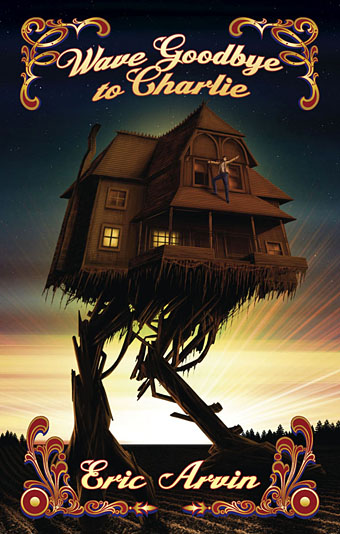
Time for another work update. These are three covers for fantasy novels from LGB imprints due for release in the next week or so. The brief for Eric Arvin’s cover was walking house plus some kind of fairground (or carnival) decoration. I found a nice trove of fairground art at Sheffield University but the picture was working so well I didn’t want to clutter it with extraneous detail. Wave Goodbye to Charlie is published by Wilde City Press.

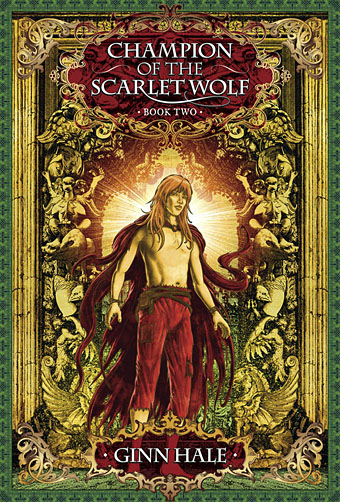
hale1.jpg

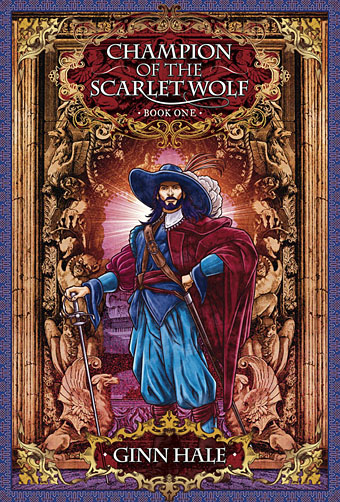
And speaking of extraneous detail… Ginn Hale’s books continue a series featuring swashbuckling, shapeshifting characters, witches and the like. (There’s also a witch in Eric Arvin’s novel but she drives a Buick.) I spent a great deal of time collaging bits of gargoyles and statuary from A. Raguenet’s six-volume Materials and Documents of Architecture and Sculpture (1915) into two elaborate arch designs…then covered them over. This is a bad habit but at least everything ended up in the finished artwork. My other bad habit is spending ages creating something only to place it into the composition and find it doesn’t work at all… Ginn Hale’s novels are published by Blind Eye Books.

hale2.jpg