Weekend links 697

munnings.jpg

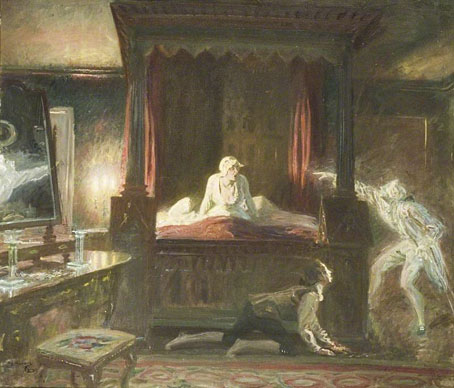
The Haunted Room, Painted at a Farmhouse on Exmoor (1952) by Alfred James Munnings.

• “In Scotland, children made terrifying jack-o’-lantern turnips and piled cabbage stalks around doors and windows, baiting fairies to bring them new siblings.” It’s that time of year again. Public Domain Review looks at The Book of Hallowe’en (1919) by Ruth Edna Kelley.

• At Wormwoodiana: Mark Valentine on the centenary of Visible and Invisible, EF Benson’s collection of horror stories.

• At Dennis Cooper’s: DC’s ostensibly favourite haunted attractions of Halloween season 2023 (international edition).

Mostly it was down to the environments of their sound. The aerial acrobatics of Fraser’s voice. The architecture of sound that came from Guthrie’s effects-treated guitars; not just the often-cited often-derided ‘cathedrals of sound’ but all manner of sunken ballrooms, tunnels, factories, attics, foundries, observatories, caverns. If any category was required, Cocteau Twins could have been placed within Symbolism, a hallucinatory death-rattle of romanticism in the industrial age, when all that had been discarded returned in dreams and decadence, orgiastic excess, disembodied spectral heads and ornate altars, lonely demons and alluring succubi, jewels and masks and apparitions, all the minutiae of things that the steam engine and the printing press had yet to fully exorcise.

Darran Anderson on the Cocteau Twins’ Head Over Heels at 40. His digs at the music press are a welcome riposte to the nostalgia that often attends discussion of the weekly snark-machine that was the NME, Sounds et al in the 1980s

• Follow the footsteps of the Beast in a guide to Aleister Crowley’s British haunts, with text by Gary Lachman and design by Michelle Merlin. Also at Herb Lester: Occult Paris: City of Night.

• At Print Magazine: Charlotte Beach talks to illustrator and author Edward Carey about his spooky drawings.

• “Silent movies are full of friendly ghosts.” Kathleen Rooney on Caspar, Colleen [Moore] and the Beyond.

• New music: Mizuniwa by Yui Onodera.

Spooksville (1963) by The Nu-Trends | Spooks (1981) by Tom-Tom Club | Spooky Rhodes (1997) by Laika

Weekend links 696

hornel.jpg

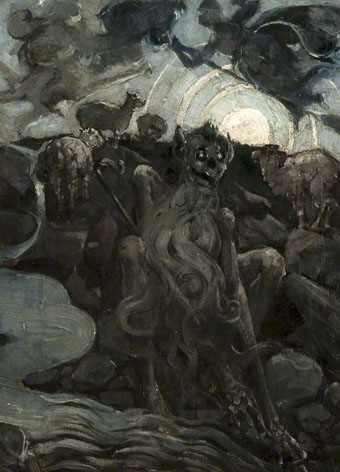
The Brownie of Blednoch (1889) by Edward Atkinson Hornel.

• “None of the theatrics of most films are available in Bresson, because in some ways Bresson’s characters, along with Dreyer’s and Cassavetes’s are the most inscrutable in motion pictures—maybe since their creators are the best believers in suggestion.” Greg Gerke explores the later films of Robert Bresson.

Iizuna Fair is a short animated film by Sumito Sakakibara that will be viewable at Vimeo for the next few months.

• Occult scholar Mitch Horowitz returns to the Aquarium Drunkard podcast for a wide-ranging discussion.

Marty [Scorsese] went to the Edinburgh Film Festival in 1974 to collect an award for Alice Doesn’t Live Here Anymore. They asked him who he wanted to present it to him, and he said Michael Powell. They had no idea who he was. No one did, but I found an American doing publicity for Kubrick’s 2001 who knew where he was. He introduced Michael to Marty at a lunch where Marty bombarded Michael with questions about how he did this and how he did that. Michael writes in his autobiography that the blood started to run in his veins again, it had been so long that he and Emeric had been living in oblivion.

Marty brought Michael to America, where we had already started working on Raging Bull. Marty had been educating me about Powell and Pressburger’s films, sending me home with VHSs. I had fallen in love with them, and then he said that Michael Powell was coming for dinner one night and asked if I would like to meet him. That’s how we met and eventually became involved, all thanks to Marty.

Thelma Schoonmaker remembering her husband, Michael Powell, and discussing the ongoing restoration of his films. Good to hear that plans are afoot to resurrect Gone to Earth

Whole Earth Index is a near-complete archive of the Whole Earth Catalog and its related publications.

• At the Daily Heller: David Byrd, the East Coast’s psychedelic poster man.

• See the winners of the Nikon 2023 Photomicrography Competition.

• New music: Golden Feelings by Better Weather.

Mikrostruktury (1963) by Wlodzimierz Kotonski | La Chasse Aux Microbes (1977) by Michael Bundt | Microscopic (1995) by Gas

Quicksilver

quicksilver1.jpg

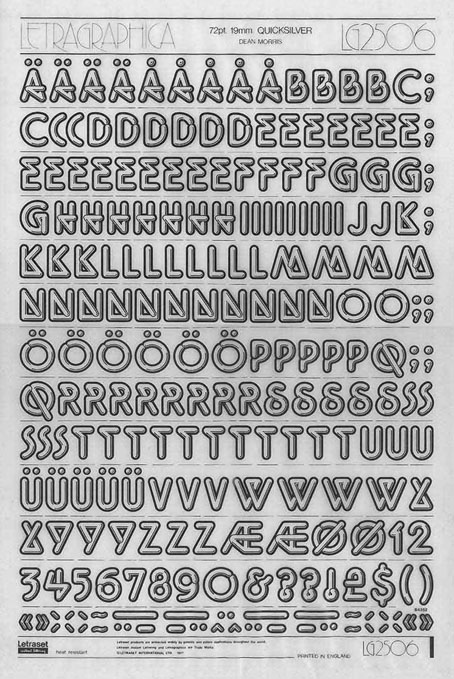
Letraset rub-down sheet, 1977.

Work-related research this past week had me looking for old Letraset fonts like Quicksilver here, one of the foundry’s many quirky type designs from the 1970s whose novelty inspired brief flushes of popularity before they were replaced by trendier designs. Quicksilver, which first appeared in 1976, has been lodged in my memory since I first saw it in a Letraset catalogue that was one of only two books lurking in a cupboard in the art room at school. (The other was a much-thumbed copy of The World of MC Escher.) The catalogue fascinated me because it revealed that these unusual typefaces could be identified by name: Data 70, Block Up, Pluto, Shatter, etc. I already knew that typefaces had names, of course, thanks to the occasional notes you’d find in paperbacks telling you that the book was set in 11pt Plantin or similar; but in the days before computers made everyone a lot more familiar with typography the typesetting business was a remote and mysterious world. Information about new type designs wasn’t easy to find unless you had access to the latest design magazines or a well-stocked library. The further realisation, that typefaces were designed by individuals who also had names, came later.
quicksilver3.jpg

Quicksilver was designed by Dean Morris who was only 16 at the time he sent off his design to Letraset:

The name Quicksilver was my second choice, however. Letraset Englishly felt that my first choice, ‘Polished Sausage’, would be ‘rather unpopular in foreign markets’. I designed it as a 16-year-old kid at John Glenn High School in Bay City, Michigan (born in Mercy Hospital 3 months after Madonna), and sent Letraset a xerox of a tight marker sketch of 3″ letters letterspaced with the heavy outlines slightly overlapping as I originally intended. I drew only a skinny S without an alternate, and submitted no punctuation. I knew nothing about submitting typeface artwork and I assumed there’d be, you know, discussion.

But Letraset wanted it, and they must have wanted it REAL FAST (fifties nostalgia and disco were WHITE HOT then, remember), because they sent a letter and contract soon after, and they did the finished art themselves at 5″ high (they can’t have known my age, maybe they had no confidence in my technical skills), starting with the E as did I in the design stage. And what a gorgeous rendering job they did in the pre-Mac days of ruling pens, straight-edges, and compasses (they shunned rapidographs!) — and they hand retouched the curves where they met the straight lines! Letraset sent a 5″ sample E for approval, but I’m sure they had already drawn all the characters. They followed my sketch very closely, designed the punctuation, and suggested an alternate but weird wide S, which I approved, figuring there was probably no other decent way to design it. I don’t know if the thematically wrong heavy-overlap-line on the P came from me or them. (more)

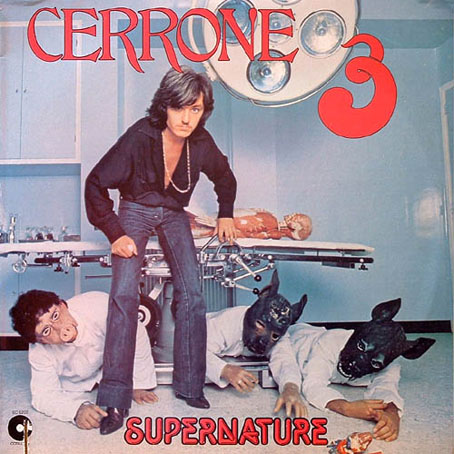
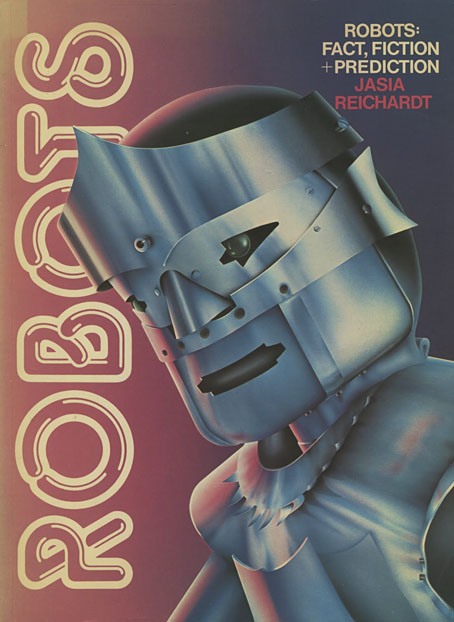
Morris has a collection of Flickr albums which show how popular the design was in the late 70s and early 80s, especially on record sleeves. It’s probably going a little too far to describe this as “the disco font” but it was certainly popular with the disco crowd. The robot book below is one of the few book covers. I expected there to be many others but Morris’s design might have been regarded as too eccentric for use in the publishing world where readabilty is more of an issue.
quicksilver5.jpg

Cerrone 3 (Supernature) (1977) by Cerrone. Silly cover art but Supernature is a great song.
quicksilver2.jpg

Robots (1978).

quicksilver4.jpg

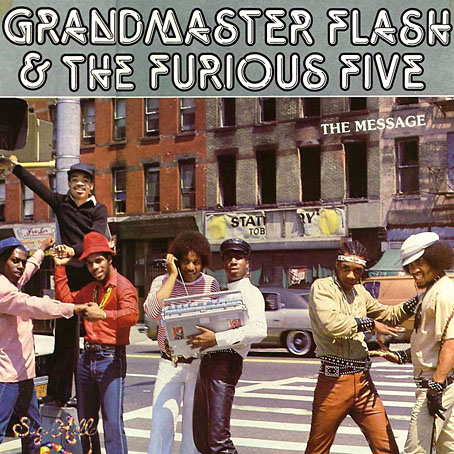
The Message (1982) by Grandmaster Flash And The Furious Five.

Quicksilver also proved distinctive enough but not too weird (like Block Up, for example) to stay around and find further uses years later, often ironically as tends to happen to type designs that become associated with a particular period or idiom. The font’s bold outline is an unusual feature, one that gives it an advantage over similar designs like Letraset’s later Chromium One which doesn’t read so well at a distance. And I like the shape of the letters, the result of Morris’s determination to shape everything with a single shiny bar.

quicksilver6.jpg

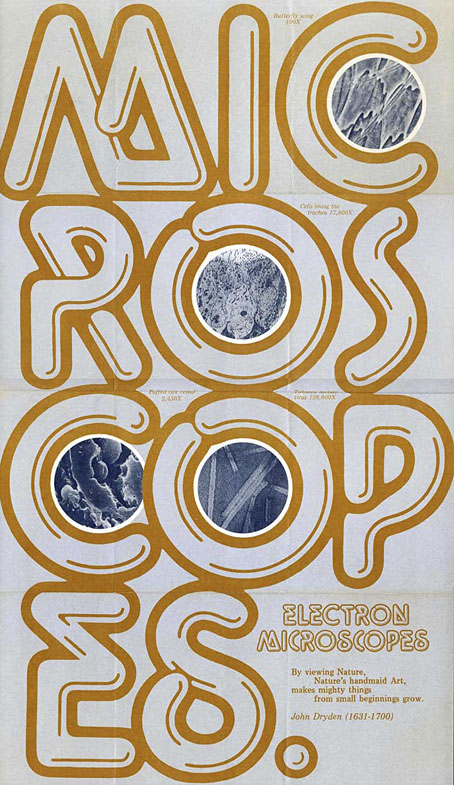
One thing that Quicksilver does share with a handful of its contemporaries from that old Letraset catalogue is a lack of an official digital version. The sample above has been created with Neon Lights, a copy afflicted with poor spacing and inconsistent character sizes. It works if you need something in a hurry but Morris’s design deserves better treatment. As to my use of the font that prompted the Letraset search, this is subject to the usual embargoes so you’ll have to wait a while before seeing the results.

Previously on { feuilleton }
Typefaces of the occult revival
Weekend links 694

sutton.jpg

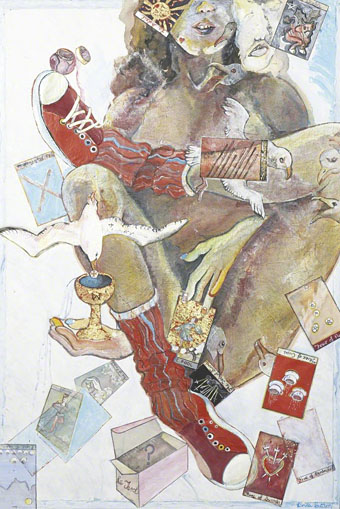
Reading the Tarot at Southend-on-Sea (c.1968) by Linda Sutton.

• “Starship Africa, released in 1980, was a densely textured audio collage emulating the sensation of intergalactic space travel, though it freaked out some in the scene. According to [Adrian] Sherwood, DJ David Rodigan told him: ‘What do you think you’re doing to reggae music?'” David Katz on the return of Creation Rebel.

• Coming soon from Strange Attractor: Subcontinental Synthesis, a history of India’s first electronic music studio, edited by Emptyset’s Paul Purgas. There’s also a related compilation album, The NID Tapes: Electronic Music from India 1969–1972.

• New music: The Lamentations Of Jeremiah by Vince Clarke, and Tidescape by Roger Eno.

But even when it’s a signal, even when it’s a microbe, we’ll likely never know if it’s aliens. Not just because of the vast distances involved or because of the wild possibilities presented by chemistry and biology, but because science seldom works that way. Discoveries almost never arrive as we think they will, as lightning bolt eurekas. They are slow, gradual, communal. Alien life may not be something we ever ‘find’, but instead inch towards, ever closer, like a curve approaching its asymptote. For all our desire to know who’s out there, that may have to be enough.

Jaime Green on the scientific method and the search for extraterrestrial life

• At Public Domain Review: Charles H. Bennett’s Shadows (ca. 1856).

• Steven Heller’s font of the month is JAF Herb.

Make a Spawn of Cthulhu mask.

Theon Cross’s favourite music.

Herb (1980) by Sly And The Revolutionaries With Jah Thomas | Pause In Herbs (1995) by Ken Ishii | Herb Is Burnin’ (2010) by Method Of Defiance

Okinami letterforms

okinami4.jpg

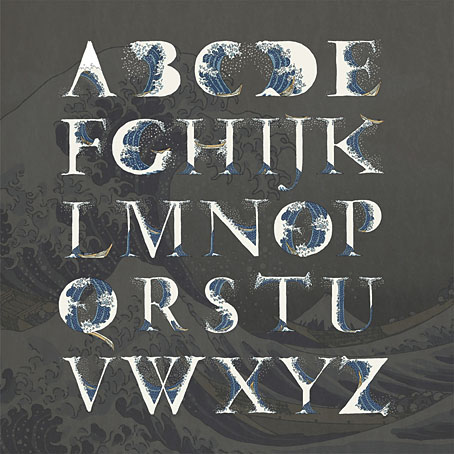
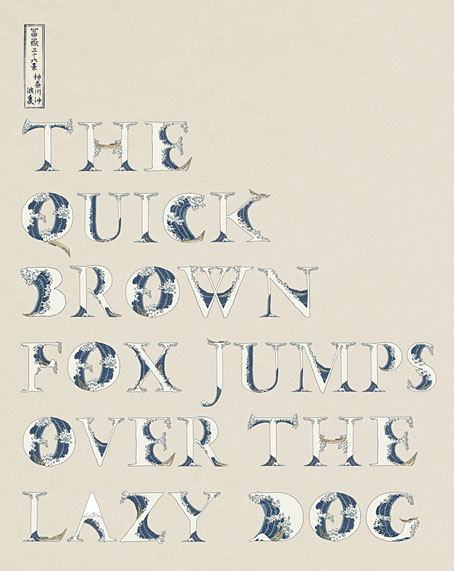
A couple of years ago I posted an incomplete collection of record covers based on Hokusai’s prints, many of which included his most famous work, The Great Wave off Kanagawa. In our age of mechanical reproduction Hokusai’s wave has become as much an emblem for Japan itself as any of the official national symbols, reproduced endlessly in a variety of media while being subject to the usual 21st-century derivations and pastiches. This is a common fate for well-known artworks but Hokusai’s wave is one of the few that are flexible enough to be mutated into a seres of letterforms (you can’t really call this a font) like the ones we have here, a design created by Indonesian designer Aditya Tri which grafts portions of the print onto Garamond serifs. The name of the design, Okinami, is the Japanese word for an offshore wave.

okinami1.jpg

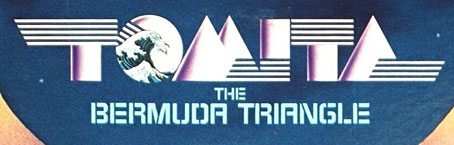
Okinami is an unusual design but this isn’t the first time that Hokusai’s wave has been combined with letterforms. When Tomita’s “Musical Fantasy of Science Fiction”, The Bermuda Triangle, was released in the West it was given new cover art, with a gatefold illustration by Don Punchatz and a title design that added the Great Wave to the modified Sinaloa typeface which by this time had become Tomita’s signature font.

tomita.jpg

Design by Joseph J. Stelmach.

Are there other examples out there? I wouldn’t be surprised. Meanwhile, Hokusai’s print will be even more visible next year when it appears on the back of the new 1000 Yen banknote. A good argument for the retaining of physical currency, and further evidence that Japan gets all the best things.

okinami2.jpg

Previously on { feuilleton }
Hokusai record covers
Waves and clouds
Tomita album covers