Ghost clocks

ghost1.jpg

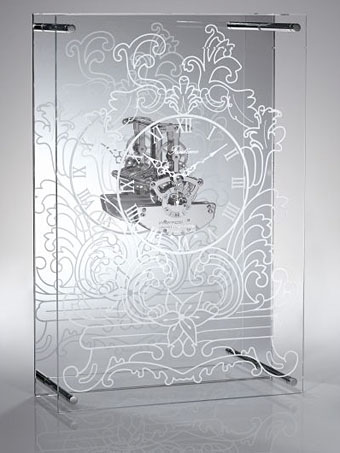
Ghost Clock by Yee Ling Wan (2005).

We’ve had skeleton clocks and mystery clocks this week, ghost clocks would seem the next logical step. There don’t seem to be many devices which fit the label unfortunately but this pair are interesting enough. Yee Ling Wan’s clock is relatively cheap (around £70) compared to yesterday’s antiques and can be purchased from a number of online outlets.

ghost2.jpg

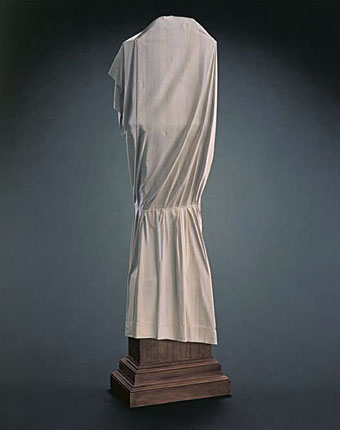
Ghost Clock by Wendell Castle (1985).

Wendell Castle’s Ghost Clock isn’t a timepiece at all but is a solid block of mahogany carved and laminated to give a trompe l’oeil impression of a sheeted grandfather clock. The wrapped object and the confounding of expectations reminds me of Magritte who may have been an inspiration. Ce n’est pas une horloge, perhaps.

Previously on { feuilleton }
• Mystery clocks
• Skeleton clocks
• The Midsummer Chronophage
• The Corpus Clock

Mystery clocks

mystery1.jpg

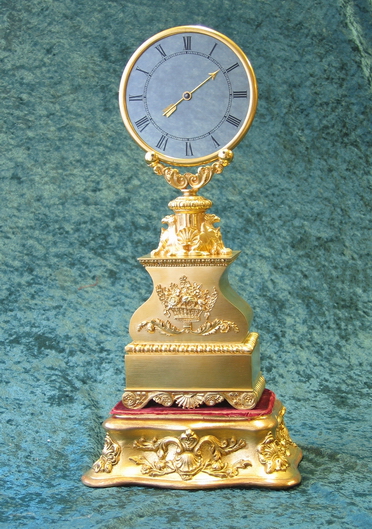
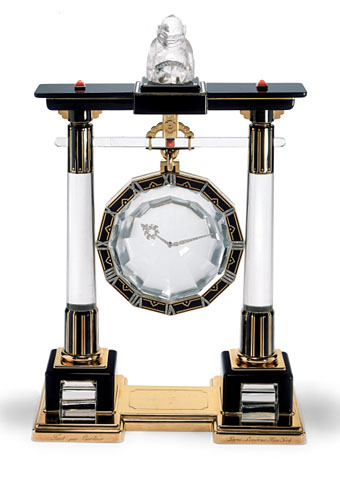
Yesterday’s post concerned skeleton clocks so I have to follow up with something about mystery clocks, those fascinating devices whose hands move without any apparent attachment to gears or clockwork. It’s the glass that moves, of course, and the trick is easily puzzled out in many of the pieces with circular faces. Rather more ingenious are square clocks like the simple and elegant Smiths Electric Mystery Clock from 1934 which used a central pane of glass moving from side to side to operate the hands. Especially impressive is this one-off piece which is entirely clear and seems to have no moving parts at all.

The clocks shown here are among the more lavish examples. The piece above is an early model from circa 1837 credited to Jean Eugène Robert-Houdin, the renowned stage magician who was also a notable inventor, clockmaker and scientist. Below is one of a series of Art Deco-styled clocks made by Cartier during the 1920s. Having the clock suspended rather than supported is an unusual touch which adds just that bit more mystery.

mystery2.jpg

Previously on { feuilleton }
• Skeleton clocks
• The Midsummer Chronophage
• The Corpus Clock

Skeleton clocks

clock1.jpg

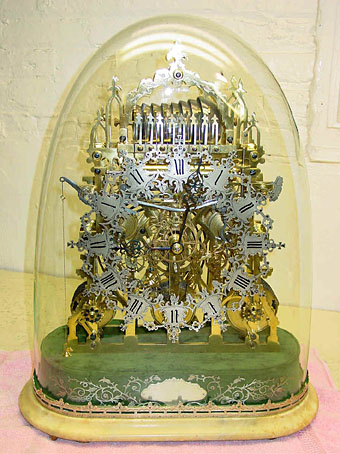
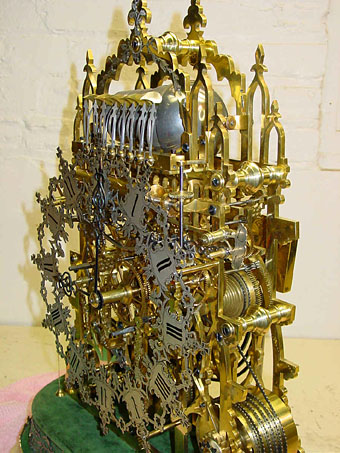
Behold the complexity of the Smith of Clerkenwell skeleton clock from 1865, one of many such intricate devices at this site devoted to the collection, restoration and construction of skeleton clocks old and new. The Clerkenwell manufacturers also made a musical version of this machine and I like this moonphase astronomical clock from 1870. Don’t mention Steampunk, these chronometers are surely Clockpunk if they’re anything.

clock2.jpg

Previously on { feuilleton }
• The Midsummer Chronophage
• The Corpus Clock

Portuguese Diseases

disease1.jpg

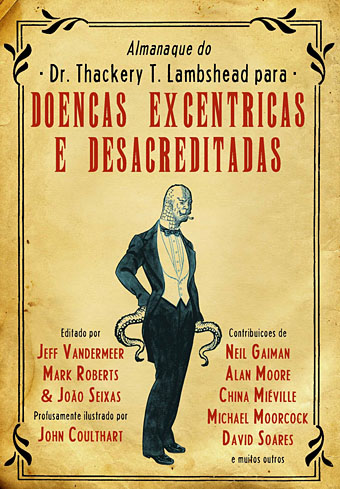
This volume appears to be in print now, the Portuguese edition of The Thackery T Lambshead Pocket Guide to Eccentric and Discredited Diseases, a unique fantasy anthology compiled in 2003 by Jeff VanderMeer and Mark Roberts. The new edition is published by Saida de Emergência and translated by Luís Rodrigues, João Seixas and Vítor Morta. I didn’t design this cover with its eccentric kerning but I did design the original edition for Night Shade, to date still one of my most elaborate and detailed book designs, too elaborate for the larger publishing houses, in fact, who either dropped or amended the deliberately diseased title spread for their paperback editions. You can see some of the original pages below. I sent the Portuguese publishers all the artwork and layouts but since I haven’t seen a printed copy of the book I don’t know how the interior looks. I don’t even know whether my name appears on the cover as it does here since other examples online show a different design. However, it’s often the case these days that cover designs get sent out prematurely for marketing purposes before things have been finalised.

disease2.jpg

Title spread.

disease3.jpg

Contents spread.

Previously on { feuilleton }
• Pasticheur’s Addiction

Weekend links 21

nagai.jpg

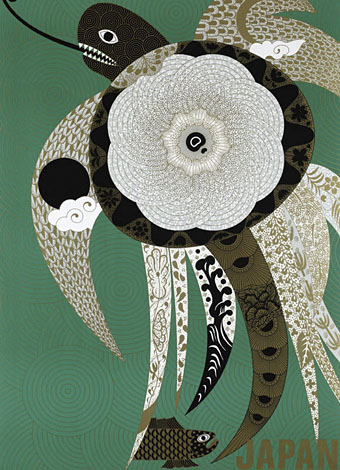
A poster by Kazumasa Nagai.

• Franco Maria Ricci creates the world’s largest maze. “The former publisher said he first confided his ambition to Jorge Luis Borges, who characteristically told him the world’s largest maze already existed and was called a desert.” Related: Mirror, Mask, Labyrinth, a review of two new collections of Borges’ poetry.

• FACT mix 164 is a dubstep collection by Pinch and a promotion for the Dark Matter compilation which I designed earlier this year.

• One of the monuments of 20th century music, Bitches Brew by Miles Davis, is released in another new (and expensive) edition next month by Sony. Nice packaging, and there’s a vinyl edition included, but these things always come across as a cyncial attempt to milk the hardcore fans one more time. And have you noticed how all vinyl releases are now described as “audiophile”? If the big record companies had shown this much dedication to quality in the 1980s when they were jobbing out sub-standard vinyl pressings their reputation might be slightly higher today.

• More Gysin: Brion Gysin, William Burroughs, and the secret life of a building on the Bowery. And Ubuweb’s page of Gysin sound works and recordings.

• Michael Moorcock: “I think I preferred my own imagination”. A two-part interview about the cover designs for Moorcock books.

• The Pansy Project: “Artist Paul Harfleet plants pansies at the site of homophobic abuse, he finds the nearest source of soil to where the incident occurred and generally without civic permission plants one unmarked pansy. The flower is then photographed in its location and posted on his website, the image is entitled after the abuse … The Pansy Project also marks locations where people have been killed as a result of homophobic attack”

• This Gaming Life: Travels in Three Cities. Jim Rossignol’s book is available as a free download.

• Lost London. Also, the Victorian Catacombs of South London.

• Dedalus Books had its Arts Council grant reinstated.

• ’Zine Lutefisk: fashion/art/escape.

• Time Will Show The Wiser (1968) by Fairport Convention | She Moves Through The Fair (1969) by Fairport Convention | She Moved Through The Fair (1994) by Jam Nation.