Mati Klarwein book covers

mati1.jpg

The World’s Desire (1972) by H. Rider Haggard & Andrew Lang. Painting: Astral Body Asleep (1968).

The use of Mati Klarwein’s paintings on album covers is well documented, the official Klarwein site has a small section devoted to some of the covers. Less well-known are these book covers which were evidently the product of a brief enthusiasm for Klarwein’s work in the Ballantine Books’ art department. As with many of the album covers, these are all pre-existing paintings which have been cropped for use as cover art.

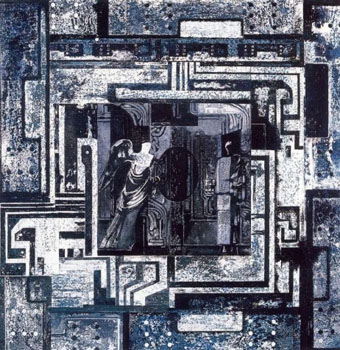
The most surprising example is the cover for The Alien Condition with its detail from Annunciation, a painting better known for its appearance on Abraxas (1970), a very successful Santana album. Given how visible that cover art would have been in 1973 you have to suspect that the painting’s use as a book cover was a deliberate bid to attract a youthful readership. All these titles are works of science fiction or fantasy; I don’t recall having seen a Klarwein cover for any non-genre titles. If anyone knows of an example then please leave a comment. (Thanks to Jay for the tip!)

mati2.jpg

With a Finger in My I (1972) by David Gerrold. Painting: Blessing (1965).

mati3.jpg

The Alien Condition (1973) edited by Stephen Goldin. Painting: Annunciation (1961).

mati4.jpg

Two Views of Wonder (1973) edited by Thomas N. Scortia & Chelsea Quinn Yarbro. Painting: Unknown.

mati5.jpg

Arrive at Easterwine: The Autobiography of a Ktistec Machine (1973) by RA Lafferty. Painting: Nativity (1961).

Elsewhere on { feuilleton }
The book covers archive

Previously on { feuilleton }
The art of Mati Klarwein, 1932–2002

Weekend links 169

anderson.jpg

Cover illustration by Gray Morrow, 1967. One of the less exploitative examples from a collection of hippy book covers.

• Ten Photographs by Alain Resnais: Mise en scène of Memory, Aesthetics of Silence by Ehsan Khoshbakht. In the comments to that post someone shows an old Penguin book with cover photos by Chris Marker. This confirms that the “C. Marker” whose name I found on the back of another Penguin book was indeed Monsieur Chat.

• There’s more (there’s always more…): Cornelius Castoriadis interviewed by Chris Marker in 1989, the complete footage of an interview edited down for Marker’s TV series L’héritage de la chouette (The Owl’s Legacy). Watch the series itself at YouTube.

• “A generation of innovators want to change the way we have sex and consume porn, but Google, Apple, and Amazon won’t let them,” says Andrea Garcia-Vargas. Related: Sam Biddle on how Tumblr is pushing porn into an internet sex ghetto.

• Mix of the week: the Chop Quietus Mix, “a jagged journey all the way from Broadcast to the uneasy thrum of Suicide, kosmische flavours from Popol Vuh and Cluster, Alexander Robotnik and many more.”

Strange Flowers looked back at The Student of Prague: “the first art film, the first horror film and the first auteur film”, and now a century old.

Clive Hicks-Jenkins talked to animator Barry Purves about the pleasures and difficulties of creating animated films for adults.

• Mazzy Star released a song, California, from their new album which arrives in September. Can’t wait.

Suzanne Ciani, “American Delia Derbyshire of the Atari Generation” explains synthesizers, 1980.

Christer Strömholm‘s photos of Parisian transgender communities in the 1950s.

What are These Giant Concrete Arrows Across the American Landscape?

• How Kiyoshi Izumi built the psych ward of the future by dropping acid.

Alan Moore: The revolution will be crowd-funded.

Fuck Yeah Mazzy Star

• Suzanne Ciani: Lixiviation | The First Wave—Birth Of Venus (1982) | The Eighth Wave (1986)

Summer

mucha.jpg

Summer (1896) by Alphonse Mucha.

With the temperature rising inexorably throughout the week—today it hit 30C—it’s been easy to identify with Alphonse Mucha’s languid spirit of summer, and the urge to drape yourself on a branch beside some water. Mucha produced many picture series on different themes, with several attempts at depicting the seasons. This is from the first series in 1896, and is the one I prefer over all the others. The 1903 version deploys all the traditional harvest iconography but also looks much too sedate and overdressed for warm weather; Summer 1896 is suitably enervated and dishevelled. She even looks as though she may be a little horny although it’s unlikely she’d want to do much about that. Her sister spirits may be seen here.

The art of Marijke Koger

koger1.jpg

Love Life (1966).

A slight return to The Fool, and specifically the work of Marijke Koger. Since The Fool was a collective it can be difficult separating out the work of individuals but all of these examples are credited as hers in Norman Hathaway & Dan Nadel’s excellent Electrical Banana (2011) book. The nature of the collective also tends to downplay the contribution of women to psychedelic art, with Koger tending to receive less individual credit than Bonnie MacLean does for her US concert posters. Koger’s Love Life design is very advanced for 1966, and could easily have been created at almost any time in the next decade. The Bob Dylan poster below is the most florid representation of Mr Zimmerman I’ve seen, an image that fits the times more than Dylan’s persona which remained resolutely untouched by acid culture.

It’s no surprise with this subject that Sweet Jane has already looked at the work of The Fool. There’s more photos and designs to be found at A Dandy in Aspic (many of them from the Electrical Banana book) while Bang The Drum All Day has some of the graphics produced for Brian Epstein’s Sunday Night at the Saville concerts.

koger3.jpg

Fashion drawing (1966).

koger4.jpg

Lucy (1966).

koger5.jpg

Love Bob Dylan (1967).

koger2.jpg

Tiger Man (1970).

Previously on { feuilleton }
The Fool album covers
Through the Wonderwall

The Fool album covers

fool.jpg

The Fool (1968).

Many people know the work of design collective The Fool even if they couldn’t tell you the name or the names of any of the individuals involved.  The accelerated career trajectory of Dutch artists Marijke Koger and Simon Posthuma took them from a hippie enclave on the isle of Ibiza in 1966, to London and work for The Beatles throughout 1967 thanks to their distinctive brand of rainbow-hued psychedelia. Marijke Koger says the name The Fool was chosen after they met Crowley-obsessed blues singer Graham Bond who introduced them to the Tarot deck. Barry Finch and Josje Leeger later joined Koger and Posthuma. For The Beatles the group created the short-lived mural for the Apple boutique in Baker Street (removed after complaints), the decoration on John Lennon’s piano, and the inner sleeve for the Sgt Pepper album. The gatefold interior of the album was going to incorporate a Fool painting but Robert Fraser apparently persuaded the band to replace this with a group photo. The Fool themselves (and their decor) appear in the Beatles-produced feature film, Wonderwall (1968).

beatles.jpg

Proposed interior for the Sgt Pepper album (1967).

Given all this sudden visibility it’s surprising they weren’t more in demand for album cover designs although they were also busy producing florid outfits for other groups. The Beatles clothes on the All You Need is Love broadcast are Fool creations. Of the album covers, the one for The Incredible String Band is probably the most well-known. This small collection reminds me I still haven’t heard Evolution by The Hollies. The work on that cover led to a collaboration with Graham Nash on an album by The Fool (and session musicians) in 1968. The collective split up in 1969 with Marijke Koger and Simon Posthuma relocating to California.

Marijke Koger-Dunham’s site
Simon Posthuma’s site

beatles2.jpg

Sgt Pepper inner sleeve.

incredible.jpg

The 5000 Spirits Or The Layers Of The Onion (1967) by The Incredible String Band.

hollies.jpg

Evolution (1967) by The Hollies. Clothes and design by The Fool, photo by Karl Ferris.

degroot.jpg

Picknick (1967) by Boudewijn De Groot.

move.jpg

Move (1968) by The Move.

Elsewhere on { feuilleton }
The album covers archive

Previously on { feuilleton }
Through the Wonderwall