Moon and Serpent Rising

masbbom1.jpg

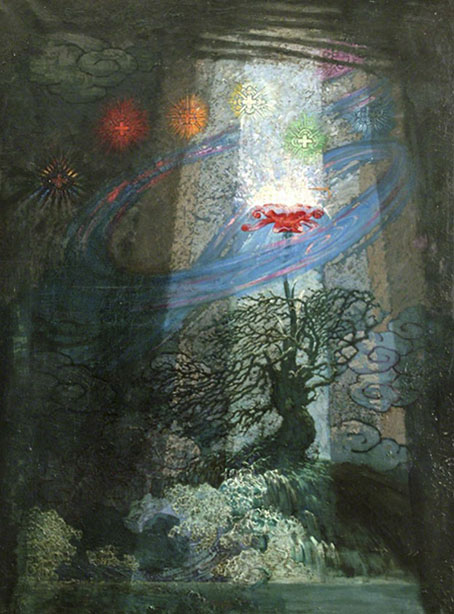
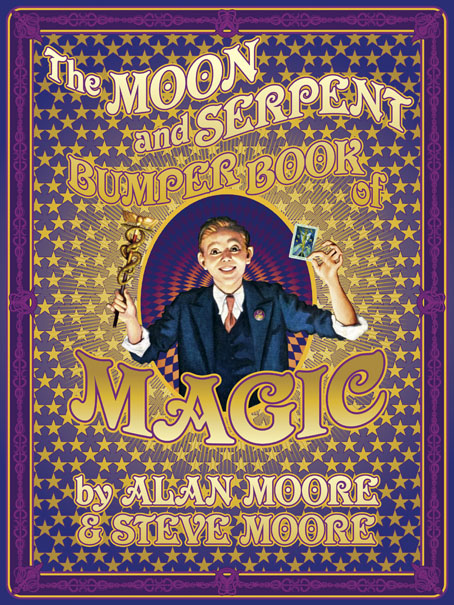
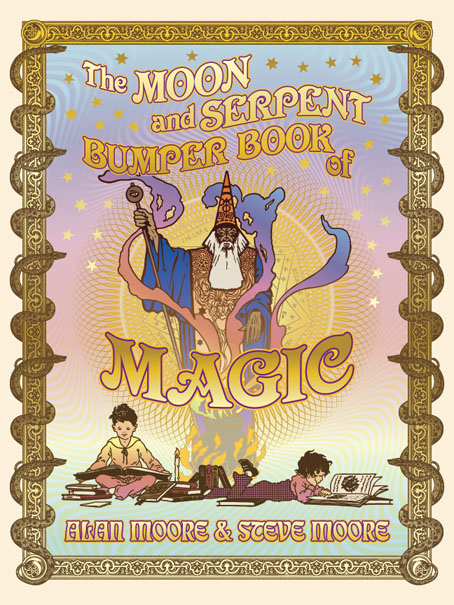
Top Shelf announced this one on Friday so I can break my silence about the book I’ve been working on since May 2021. The Moon and Serpent Bumper Book of Magic by Alan Moore and Steve Moore was first announced in February 2007. I’d created the cover design which was used for promotional purposes after which the project went into hibernation for several years. In 2014 Alan and Steve were back at work again, and were co-writing the final essay when Steve died suddenly in March of that year, whereupon the book retreated to limbo once more. Since 2007 my cover has been floating around the internet like the lid for an empty toybox, but the book really is finished at last, and will be published by Knockabout (UK) and Top Shelf (US) in October.
masbbom2.jpg

In addition to the cover design I was also slated to be working on two of the book’s internal features: The Soul, a six-part illustrated serial set in the 1920s which evolved out of the occult-detective strip that Alan and I were planning circa 1999; also a series of twenty full-page illustrations for a feature titled Magical Landscapes. When Tony at Knockabout informed me at the beginning of 2021 that the book was being revived I made the audacious suggestion to him and to Alan that I could, if need be, design the whole thing as well as illustrate my own sections. Alan readily agreed, saying he trusted me implicitly, which was good to hear; his sole brief was that the book should be “beautiful and psychedelic”. One reason for his trust is that we’d already made excursions into the Moon & Serpent zone together. I designed three of the Moon & Serpent CDs in the 2000s, and made the video that accompanied the William Blake-themed reading/performance by Alan and co. at the Purcell Room, London, in 2001. Consequently, I’ve often felt like a floating member of the Moon & Serpent cabal.
masbbom3.jpg

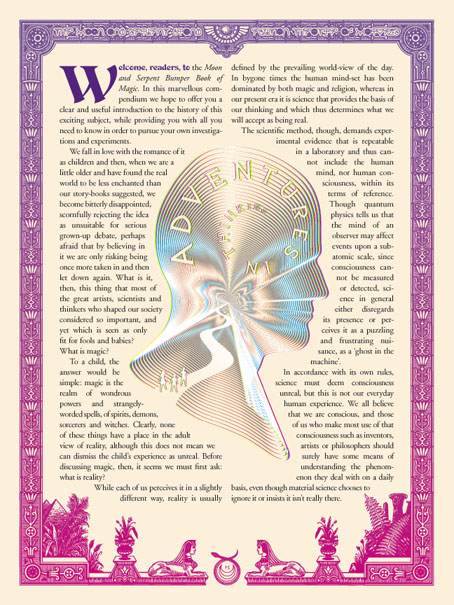
A couple of things are worth noting now that the book is about to enter the world. The first is that the contents are a little different to the press release from 2007 which announced a book of 320 pages, with 78 of those pages being brand new Tarot card designs. The authors subsequently realised that creating an entirely new Tarot deck is a huge task in itself, especially if, as was the intention, you wanted it to be as wide-ranging and authoritative as the Crowley/Harris Thoth deck. There is a chapter about the Tarot in the finished book but readers will now have to choose decks of their own. I can imagine disappointment being expressed about this, and about some of the other changes but the book as it now stands is actually bigger than the original proposal, with an additional 32 extra pages. The expansion is partly a result of my page design which put fancy borders on all of the text pages. I ended up doing a lot more work for the book than I expected, adding new pages here and there, creating a lot of extra graphics and illustrations, and breaking up the long final essay into sections which are illustrated throughout with small pictures.


Continue reading “Moon and Serpent Rising”

Arsenal: Surrealist Subversion

arsenal1.jpg

It’s the “S” word again. I said at the beginning of this month that I was looking forward to seeing where this interest led, and here we are. My recent reading has included Penelope Rosemont’s Surrealist Women (1998), a comprehensive study that I’d dipped into in the past but hadn’t gone through properly until now. In the section devoted to activities since the 1960s Rosemont mentions a magazine, Arsenal: Surrealist Subversion, which she produced with her husband, Franklin Rosemont, as part of their work with the Chicago Surrealist Group. Arsenal had more of an erratic schedule than most magazines, managing four issues that appeared in 1970, 1973, 1976 and 1989. I really didn’t expect there to be copies of such an obscure publication available anywhere but, once again, the invaluable Internet Archive has scans of the first three issues.

arsenal2.jpg

Arsenal proves to be a curious mix of the kind of material you’d expect from a Surrealist publication—poetry, essays, drawings, collages, significant quotes—together with chunks of Marxist politics and Freudian business that seem to have strayed in from another magazine. The latter material isn’t so unwarranted, being a reflection of André Breton’s original concerns, but committed Marxists of whatever stripe have never had much time for Surrealist art-creation and game-playing, while Freud himself was nonplussed by Breton’s attempts to interest him in the activities of the Parisian Surrealists. Breton casts a long shadow here; the Rosemonts had met him in Paris in the mid-60s, and many of the articles (also their combative attitudes) have a Bretonian cast.

arsenal3.jpg

Elsewhere, Arsenal breaks new ground with a Surrealist appraisal of blues musicians, music being a form that Breton and Louis Aragon had dismissed in the 1920s as “too confusing” for incorporation into the Surrealist project. The magazine also reprints a couple of comic strips, including a page of Little Nemo in Slumberland which may be the first acknowledgement from inside Surrealism of Winsor McCay’s dream-worlds as Surrealist precursors. And after posting Breton’s musings about “The Great Transparent Ones” these mysterious beings surface once again. Not only the Great Transparent Ones but also HP Lovecraft’s Great Old Ones in a piece by Franklin Rosemont about the Cthulhu Mythos. Rosemont draws attention to the obvious similarity between the names of Breton and Lovecraft’s beings, while also noting Lovecraft’s prowess as a transcriber of dreams. In doing so he complains about Lovecraft circumscribing his imagination by resorting to the story structures of the pulp magazines. Lovecraft was never a member of any avant-garde literary circle, however, unlike Clark Ashton Smith, who also receives further mention in these pages; if it wasn’t for Weird Tales we never would have heard of HP Lovecraft and there wouldn’t be a Cthulhu Mythos. This fault-picking is typical of many other pieces in the magazine, the book reviews in particular where a kind of petulant bad temper is the predominant tone. You probably can’t expect much else from a magazine that names itself after a store of weapons but the cumulative effect makes it seem that the road to the Marvellous must be paved with razor blades and broken glass. To their credit, the editors did print in the third issue some of the negative reviews they received for the previous two, including the inevitable dismissals from hardline Communists. Despite all this I’d still like to see how things developed (or came to an end) in the fourth and final issue.

• Further reading: I Could Dream In French: An Interview With Penelope Rosemont.

Elsewhere on { feuilleton }
The Surrealism archive

Previously on { feuilleton }
First Papers of Surrealism
The original Cabaret Voltaire
View: The Modern Magazine

Weekend links 698

ayrton.jpg

Contained Maze (1966) by Michael Ayrton.

• At Public Domain Review: Skeletons (1692) by Ikkyu, a Japanese monk, whose book is “a mixture of poetry and prose that comes down to us in printed editions supposedly replicating a manuscript, now lost, by the monk’s own hand. The text describes a series of visions of animated skeletons that Ikkyu had when he visited an abandoned temple. The lively illustrations testify to their maker’s sardonic sense of humour: he images skeletons dancing, drumming, drinking sake, having sex.”

• At The Daily Heller: Victor Moscoso’s Psychedelic Valedictory Exhibit. The exhibition will be at the Instituto Cervantes in New York City which has an accompanying 224-page catalogue of Moscoso’s posters and other designs.

• More Moscoso: Color (1971) and Moscoso Comix (1989), free to download at the Internet Archive. Moscoso’s underground comics experimented with the form in a manner that still looks radical today.

Drone and ambient metal is often invoked in elemental terms. There is something antediluvian and beyond about it. Pierce the earth’s crust, and there is liquid fire, ever so slowly shifting the tectonic plates we inhabit. Such music is envisaged as massive and totally beyond our control. It infuses the foundations of civilization. As Attila Csihar intones on Sunn O))) track ‘Aghartha’, named for a legendary subterranean kingdom: “Into the memories of the consciousness of ancient rocks/ Nature’s answer to eternal question”.

Stripped of the trappings of modern pop and rock, ambient metal invites a search for answers to the bigger questions. Ancient musical modes are resurfaced to get us closer to a putative godhead.

Dan Franklin on Earth 2, the deceptively-titled debut album by Earth. The album’s 30th anniversary has prompted a collection of remixes, Earth 2.23, by various artists

• At Spoon & Tamago: Download over 30 butterfly designs by Meiji-era artist Yuho Tanaka.

• New music: HYbr:ID II by Alva Noto, and The View From Vega by Benge.

The winners of the Landscape Photographer of the Year 2023.

• At Dennis Cooper’s: Guy Maddin Day (restored/expanded).

• A happy 20th birthday to Swan River Press.

Industrial Landscape (1980) by Marc Barreca | Desolate Landscape (2012) by John Zorn | Primordial Landscape (2013) by Patrick Cowley

Weekend links 693

sime.jpg

Imaginary (no date) by Sidney Sime.

• Victor Rees was in touch this week to alert me to a one-off screening of The Gourmet (previously), a cult TV drama from 1986 written by Kazuo Ishiguro and directed by Michael Whyte. The screening, which will take place at Swedenborg House, London, on 16th October, is one of a series of retrospective events based around an exhibition from 1974, Albion Island Vortex, by Brian Catling and Iain Sinclair. The film, which is connected to Sinclair’s oeuvre by its use of one of the Hawksmoor churches, will be followed by a Q&A session with Sinclair and Michael Whyte. The screening is free but places are limited so prior booking is required.

• “Alongside his thieves and vagabonds, Hotten includes religious slang, public schoolboy slang, pirate slang, equine stable slang, phrases coined by Dr. Johnson, the slang of softened oaths, workmen’s slang, stagehand slang, shopkeeper’s slang, and dozens of other argots.” Hunter Dukes on A Dictionary of Modern Slang, Cant, and Vulgar Words (1860) by John Camden Hotten.

The Night Land, William Hope Hodgson’s “Dying Earth” doorstop, is republished in an abridged version as part of MIT Press’s Radium Age series, “proto–science fiction stories from the underappreciated era between 1900 and 1935”. All the reprints come with new introductions, the one for Hodgson being by Erik Davis.

• “My partner wanted me to stop buying lava lamps. It was an expensive hobby, and we were running out of room in our apartment.” Nora Claire Miller on the lure of the lava lamp. I only own a single one but I appreciate the obsessive attraction.

• Rambalac takes his roaming camera for a walk through teamLab Planets, Tokyo, a labyrinthine exhibition featuring plenty of water (and wet feet), and a moss garden filled with large silver eggs.

• At Strange Flowers: An examination of the connections between the self-mythologising Marie Corelli and her fictional counterparts in the Mapp and Lucia novels of EF Benson.

• Coming soon from Strange Attractor: Cabarets of Death, a book about the otherworldly cabarets of Montmartre by Mel Gordon, edited by Joanna Ebenstein.

• Among the new titles at Standard Ebooks, the home of free, high-quality, public-domain texts: The Secret Glory by Arthur Machen.

10 essential Japanese reggae releases selected by Kay Suzuki.

• Mix of the week: A Fact Mix by Venus Ex Machina.

Modern Art in Mid-Century Comics.

• RIP Michael Gambon.

Planet Caravan (1970) by Black Sabbath | Planet Queen (1971) by T. Rex | Oszillator Planet Concert (1971) by Tangerine Dream

Worlds Beyond Time

worlds1.jpg

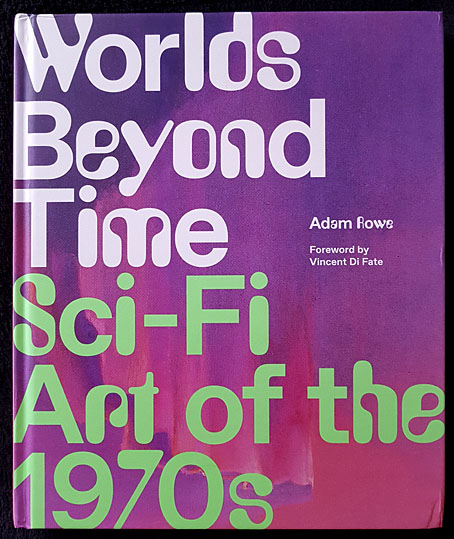
Or yesterday’s tomorrow today. Adam Rowe’s book arrived in the post this weekend, a little bumped at the corners (art books often suffer at the hands of the postal services) but very welcome all the same.

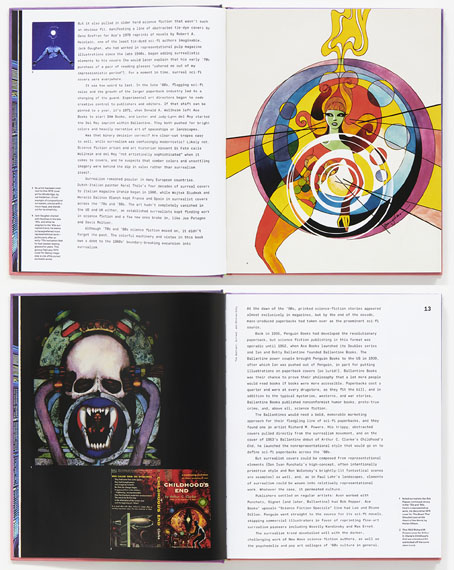
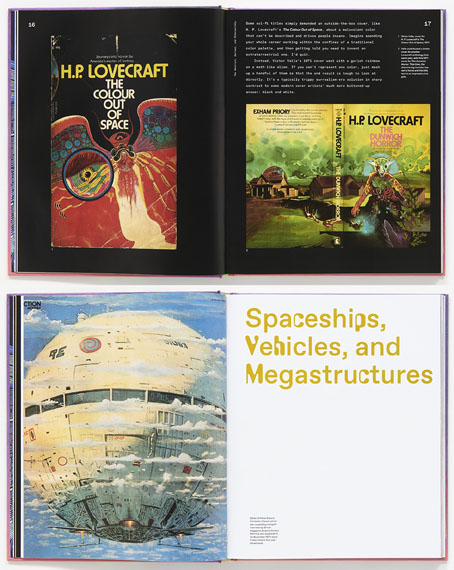
In the 1970s, mass-produced, cheaply printed science-fiction novels were thriving. The paper was rough, the titles outrageous, and the cover art astounding. Over the course of the decade, a stable of talented painters, comic-book artists, and designers produced thousands of the most eye-catching book covers to ever grace bookstore shelves (or spinner racks). Curiously, the pieces commissioned for these covers often had very little to do with the contents of the books they were selling, but by leaning heavily on psychedelic imagery, far-out landscapes, and trippy surrealism, the art was able to satisfy the same space race–fuelled appetite for the big ideas and brave new worlds that sci-fi writers were boldly pushing forward.

worlds2.jpg

In Worlds Beyond Time: Sci-Fi Art of the 1970s, Adam Rowe—who has been curating, championing, and resurrecting the best and most obscure art that 1970s sci-fi has to offer on his blog 70s Sci-Fi Art—introduces readers to the biggest names in the genre, including Chris Foss, Peter Elson, Tim White, Jack Gaughan, and Virgil Finlay, as well as their influences.

worlds3.jpg

One of my own formative influences was Visions of the Future (1976), a large-format book edited by Janet Sacks that recycled material from NEL’s Science Fiction Monthly magazine to present a guide to British SF art in the 1970s. In many ways the book was a rather poor collection—the reproductions aren’t good, not all the artists are first-rate, and a few have nothing to do with SF or “the future” at all—but it was important to me for the many artist interviews which confirmed that you could make some kind of living producing this type of art. Adam Rowe’s book is like a superior sequel to Visions of the Future, with miniature biographies for many of the artists, plus a look at the recurrent themes he’s explored on his 70s Sci-fi Art Tumblr. There’s a lot in here I hadn’t seen before. I’m grateful he’s found space for Paul Kirchner’s Dope Rider, a typically Surrealist Kirchner comic strip, and one I never got to see when it was running in the pages of High Times. Kirchner’s The Bus was a favourite, however, being a regular in the pages of Heavy Metal magazine. Kirchner has never been very science fictional either but Worlds Beyond Time is a more flexible title than Visions of the Future, one that can embrace imaginative possibilities that aren’t limited to spaceships, planets and futuristic cities.

Elsewhere on { feuilleton }
The book covers archive
The illustrators archive

Previously on { feuilleton }
Corgi SF Collector’s Library
Foss, Jodorowsky and low-flying spacecraft
Crank book covers
Do You Have The Force?
The artists of Future Life
Science Fiction Monthly
The fantastic and apocalyptic art of Bruce Pennington
Roger Dean: artist and designer