Ô Sidarta: a film about Philippe Druillet

sidarta2.jpg

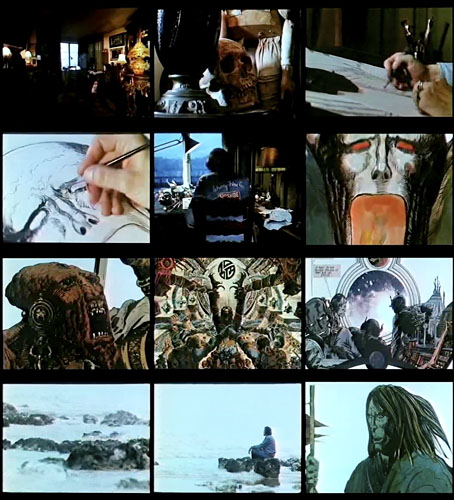
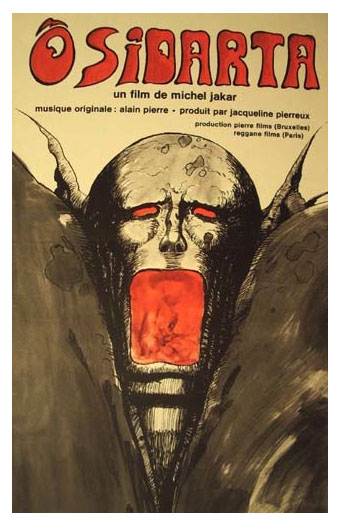
“Qualité très médiocre,” says the uploader of this 10-minute film by Michel Jakar about French comic artist Phillipe Druillet but that’s okay with me when we’re given an opportunity to see Druillet at work in 1974. (Ô Sidarta, as Druillet-heads will tell you, is the name of Lone Sloane’s spaceship.) Jakar captured the saturnine artist on 35mm (!), accompanied by a buzzing electronic score from Alain Pierre; the drawing we see Druillet creating was later used on a poster when the film was being shown around festivals. Cut into the shots of the artist at work are pages and panels from the Lone Sloane story, Délirius (1973), and a later album, Yragaël (1974). Most fascinating for me was seeing Druillet flinging the ink and paint around at speed. This makes sense given the huge volume of pages he was producing in the 1970s, all of them crawling with detail and shading, but it’s still good to have suspicions confirmed.

sidarta1.jpg

Previously on { feuilleton }
Lovecraft: Démons et Merveilles
Heavy Metal, October 1979: the Lovecraft special
Philippe Druillet album covers
Druillet’s vampires
Salammbô illustrated
Druillet meets Hodgson

Lovecraft: Démons et Merveilles

hpl-pd01.jpg

UK publisher Titan Books announced earlier this year that they’d be reprinting the first volume of Glénat’s excellent comic-strip adaptation of Michael Moorcock’s Elric novels in an English edition, a book that should be out in September. This was a surprise to me when I’ve complained for years that Titan seldom showed any interest at all in Continental comics, despite France and Belgium being over-burdened by world-class creators. I’ve been surprised again this week by the news that Titan will also be reprinting the English edition of Philippe Druillet’s The Six Journeys of Lone Sloane in March next year. Druillet’s books have been unavailable in English editions for decades so this is good news indeed, even if the attention is scandalously late.

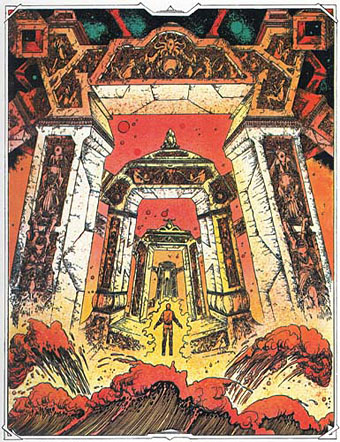
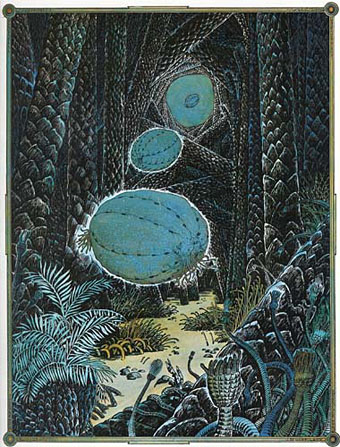
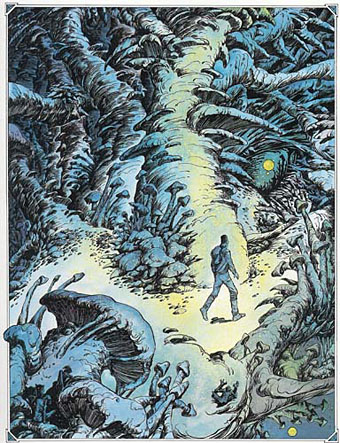
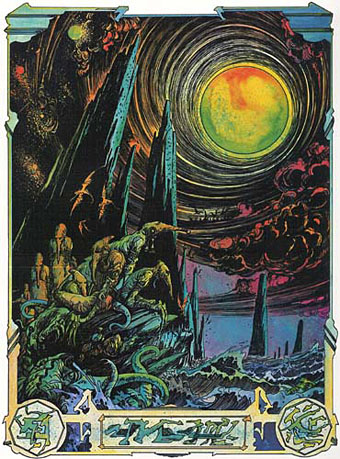
As I noted in the post about Glénat’s Elric, Druillet illustrated Moorcock’s albino anti-hero in 1973. The artist is better known for his Lovecraftian depictions, however, even when—as in the adventures of Lone Sloane—the story could easily sustain itself without all those sinister temples, fish people, Cyclopean architecture and the menace of nameless gods. The Lovecraft influence, which can be found in some of his earliest illustrations, comes to the fore in Lovecraft: Démons et Merveilles, an HP Lovecraft story collection published in an expensive limited edition by Éditions Opta/André Sauret in 1976. Druillet provided ten colour illustrations plus a design for the boards. Some of these illustrations have since been used on paperback editions of Lovecraft in France, although many of them crop the artwork. Tentacles have become a perennial cliché in Lovecraftian art (I should know, I’ve drawn enough of them) so it’s worth noting how few there are in Druillet’s drawings.

hpl-pd02.jpg

hpl-pd03.jpg

hpl-pd04.jpg

Continue reading “Lovecraft: Démons et Merveilles”

Weekend links 217

scaphandrier.jpg

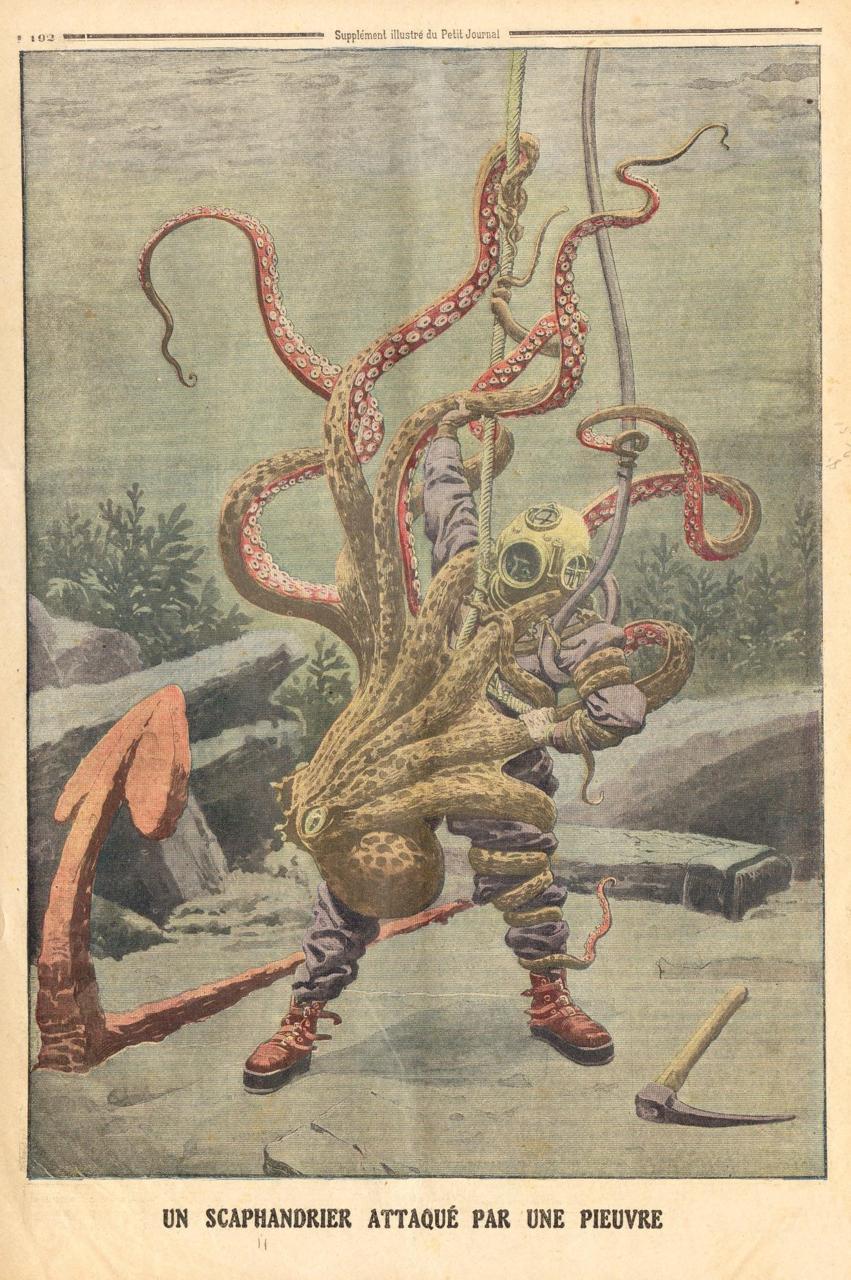
Le Petit Journal, June 16, 1912. Via Beautiful Century.

Occult art by Nicomi Nix Turner, Daniel Martin Diaz, Amy Earles and William Crisafi. Related: Illustrations by Ernest M. Jessop for The Witches Frolic by Thomas Ingoldsby.

• “Our definition of ‘Industrial’ then was a very broad one, it’s definitely not so much now.” Chris Carter & Cosi Fanni Tutti on 20 Jazz Funk Greats by Throbbing Gristle.

• At Dangerous Minds: the Amok Assault Video (1988), an hour of the bizarre, the extreme and the outré which will probably get yanked from YouTube before too long.

I’ve always thought the exchange of words for money is no more and no less problematic than any other kind of prostitution—and it’s important that we prostitutes control a certain amount of our production (and reproduction, for that matter). If I’m writing a book and I’m warned, “Oh, this is unsaleable, you need to make it shorter,” or, “It has to be this, or that,” I’m proud to say I don’t pay attention.

Though this is becoming more difficult. As large publishers turn into monopolies, and the MBAs who are running them—maybe editors used to run them before—are steadily tightening the screws, they feel more and more that they get to call the shots.

Writers can do anything, says William T. Vollmann

• Mixes of the week: Over two hours of Coil and other artists sequenced by Surgeon, and Secret Thirteen Mix 122 by DJ Skirt.

Alan Moore calls for a boycott of the “wretched” new Hercules film on behalf of his friend Steve Moore.

Joe Orton‘s first play, Fred and Madge, will receive its world premier in September.

tentacles.jpg

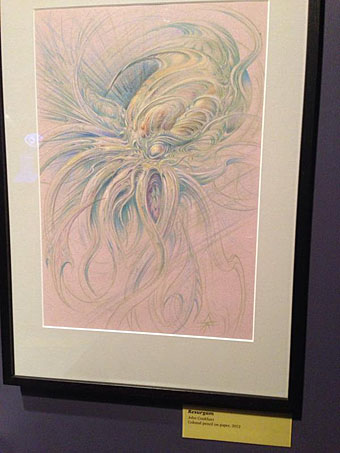
Ned Raggett found the drawing of mine that’s part of the Tentacles exhibition currently showing at the Monterey Aquarium, California. Thanks, Ned! There’s a sepia-toned version of the drawing in my Cthulhu calendar.

• “Weird is a wayward word,” says Erik Davis in an exploration of weirdness old and new.

• More details about the forthcoming Scott Walker + Sunn O))) collaboration.

• A trailer for a reissue of Robert Wiene’s The Cabinet of Dr. Caligari (1920).

A history of sex toys in pictures.

Books on Book Covers

Octopus’s Garden (1969) by The Beatles | The River (1970) by Octopus | Octopus (1970) by Syd Barrett

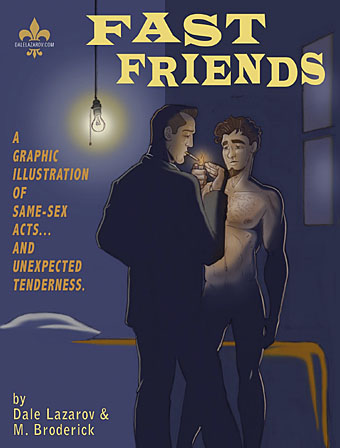
Fast Friends

lazarov1.jpg

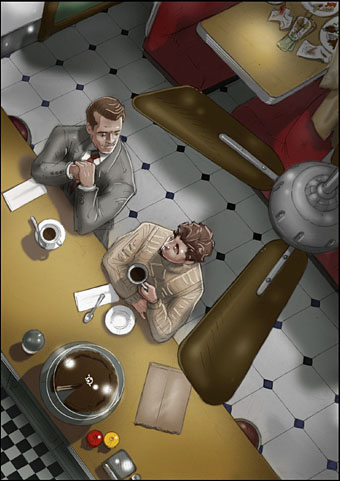
My thanks to writer Dale Lazarov for letting me see an advance copy of his new comic, Fast Friends. Despite writing about gay art often enough I don’t see many gay comics but this one had the immediate attraction of being a 62-page wordless story, wordless comics being a minor tradition that I’ve always enjoyed. When description and dialogue are removed, the artist needs to take greater care over the storytelling, even in an uncomplicated story such as this chance meeting between two spurned lovers. That’s not to say wordless comics aren’t still written at the outset: someone has to imagine the characters, create the story, describe the action, and so on. Michael Broderick is responsible for the artwork, and he proves himself adept at dealing with the technical challenges; he’s equally adept at making the erotic encounter into a stimulating, sexy read. Fast Friends is a touching story, and, in the recurring comic books that act as a commentary on the action, not unaware of the romance comic tradition.

lazarov2.jpg

Elsewhere on { feuilleton }
The gay artists archive

Weekend links 216

heathen.jpg

Why Do The Heathen Rage? (2014) by The Soft Pink Truth. Cover art by Mavado Charon.

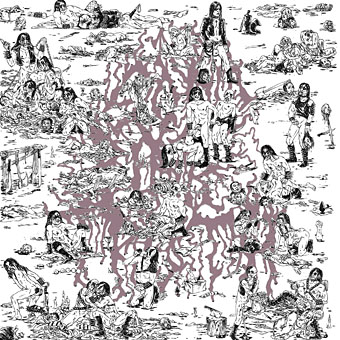
Drew Daniel’s latest release as The Soft Pink Truth is Why Do The Heathen Rage?, a witty electronic riposte to the often reactionary attitudes of black metal music and the people who create it. (The album is dedicated to Magne Andreassen, a gay man stabbed to death by the drummer from Emperor.) Dorian Lynskey talked to Daniel about queering the metal world, as did Angus Finlayson at FACT. Daniel’s project has been receiving press everywhere but you wouldn’t know it to read US/UK gay news sites where the music coverage is relentlessly narrow and insular. To date, only BUTT magazine has mentioned Why Do The Heathen Rage? but then BUTT have always stood apart from their parochial contemporaries. Never mind, here’s another fucking article about “petite pop princess” Kylie Minogue.

• “By the letter of the law, Ulysses was obscene. Obviously, gratuitously, relentlessly obscene.” Josh Cook on censorship and dangerous books. One of my own dangerous publications, the fifth issue of the Lord Horror comics series, Hard Core Horror (declared obscene in a UK court in 1995), received a very belated review at The Comics Journal. More censorship: Judy Bloom on the perennial panics in US school libraries. Lest we feel superior to American prudery, Leena McCall’s painting of a semi-naked woman caused some consternation in a London gallery last week.

• “Over and over, we’re told that nobody buys [compact discs] anymore.” Steven Hyden on the latest obituaries being written for a music format. Ten years ago the death of vinyl was being confidently predicted: “The physical presence of the popular song is gone,” Paul Morley declared. Related: The death of mp3s.

There is nothing quite like Maryanne Amacher’s third ear music. It is alarming. Some of her fellow artists never quite believed that their ears were not being damaged. Third ear music invades you, wraps inside your body, your head, your eyes — just like she says. You can’t be sure, after a while, if the sounds you hear are those created by your ears or Maryanne Amacher.

Stefany Anne Golberg on the music of Maryanne Amacher

• At Dangerous Minds: Nothing Lasts Forever (1984), Bill Murray in a “lost sci-fi comedy set in a totalitarian New York City”.

• More Joyce (there’s always more Joyce): Humument Images to Accompany James Joyce’s Ulysses by Tom Phillips.

• Another celebration of Penda’s Fen by David Rudkin, and another reminder that it’s still not available on DVD.

• Stairway to Heaven: Atlas Obscura on the Gustave Moreau Museum, an essential stop if you visit Paris.

• Mix of the week: Secret Thirteen Mix 121 by Higher Intelligence Agency.

• MetaFilter has a wealth of links to pulp magazine archives.

Yan Nascimbene’s illustrations for Italo Calvino’s stories.

• Rebecca Litchfield’s Orphans of Time and Soviet Ghosts.

• RIP Charlie Haden

Going Home (1972) by Alice Coltrane (Charlie Haden, bass) | Earth (1974) by Joe Henderson Featuring Alice Coltrane (Charlie Haden, bass) | Malkauns (1975) by Don Cherry (Charlie Haden, bass)